Inferior Olive — Function, Location & Quiz
The inferior olive is the cerebellum’s teaching input rather than its ordinary stream of movement information. Each climbing fibre produces a rare but powerful signal in a Purkinje cell when intended and actual outcomes differ.
That role distinguishes climbing fibres from high-frequency mossy-fibre input. Without olivary error signals the cerebellum can still receive a motor plan and sensory context, but its ability to update an internal model and improve the next attempt is impaired.
Test this anatomy in the White Matter Tracts Quiz: 15 Questions With Answers or explore it on the interactive 3D brain.
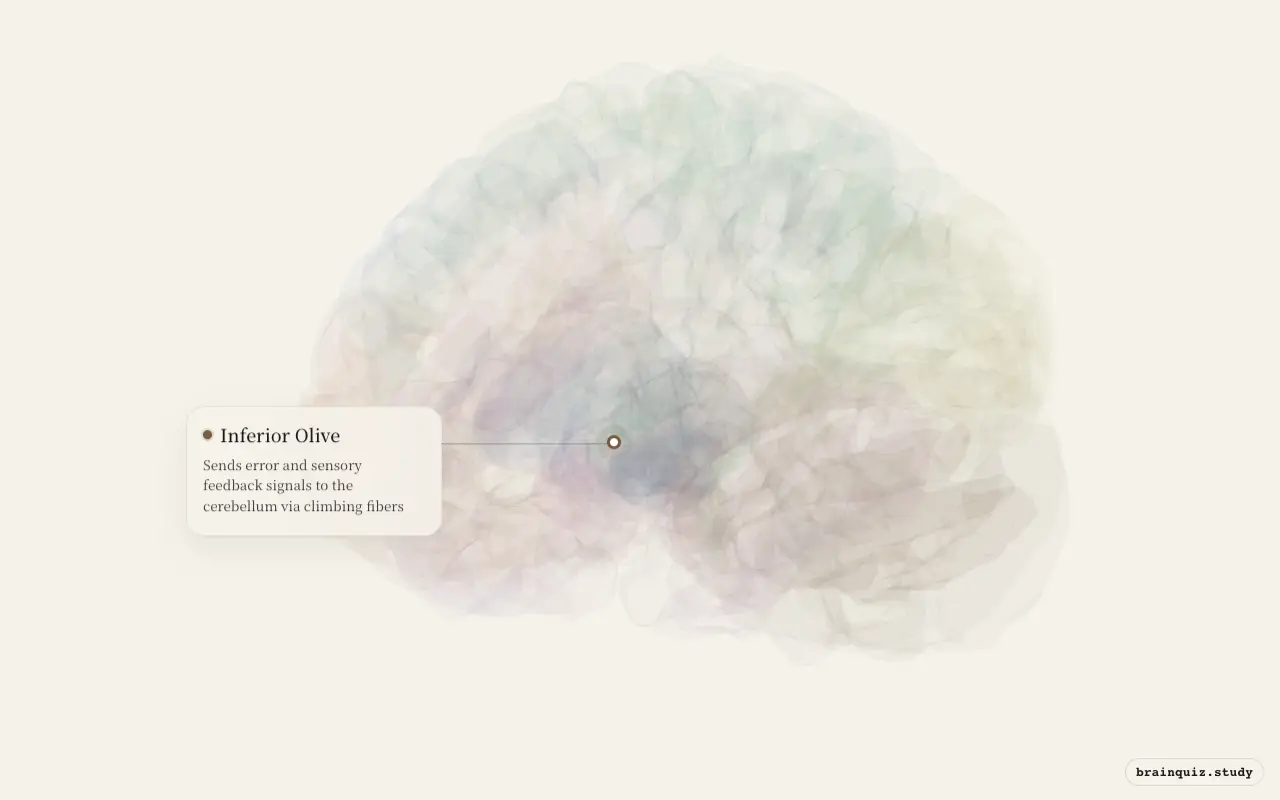
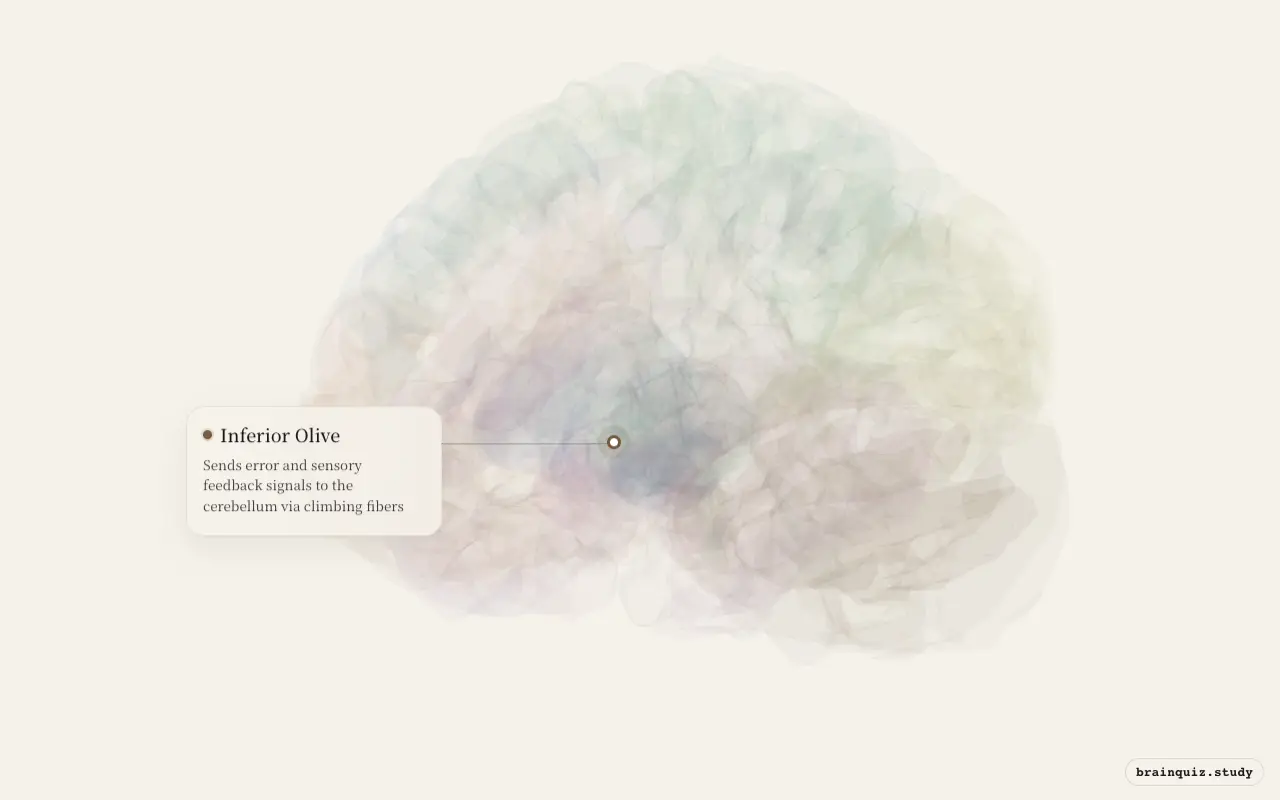
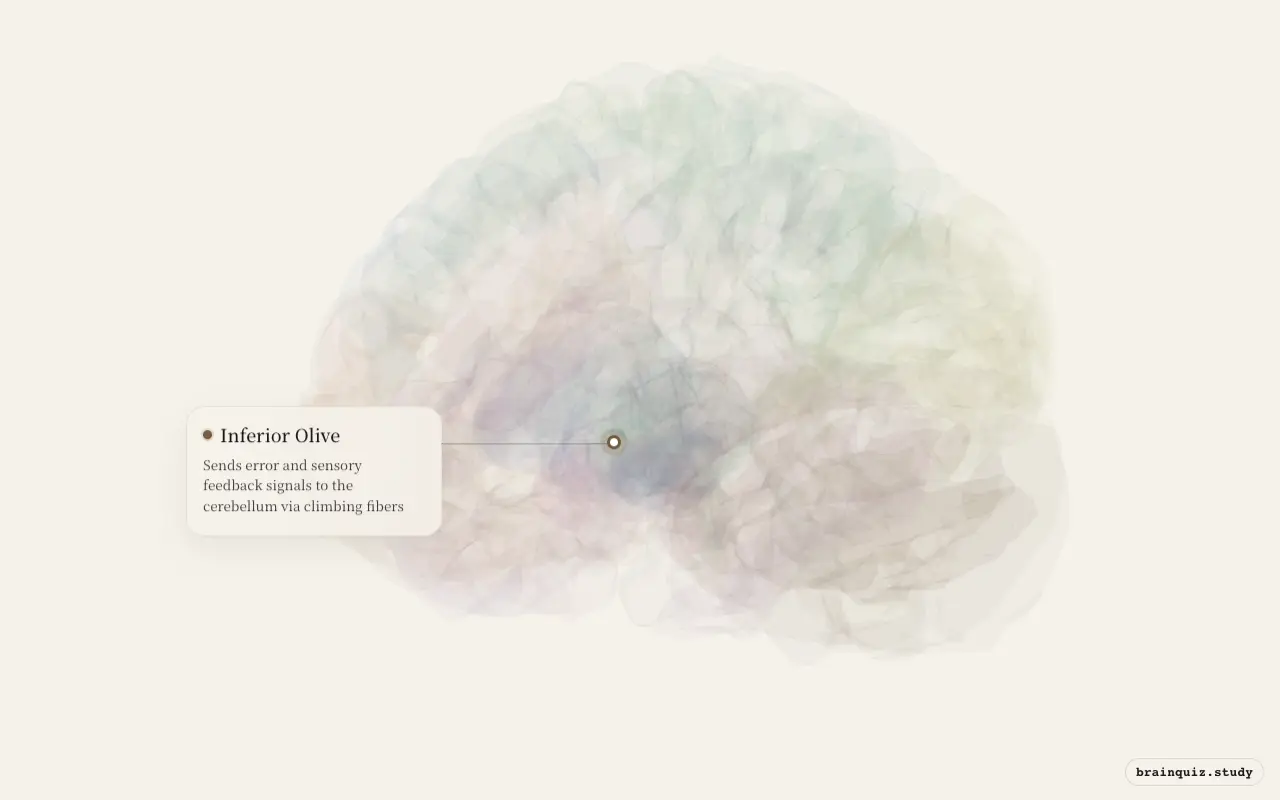
Where is the Inferior Olive located?
Sends error and sensory feedback signals to the cerebellum via climbing fibers.
What does the Inferior Olive do?
- Sends climbing fiber error signals to cerebellum
- Each climbing fiber wraps around a single Purkinje cell — powerful 1:1 teaching signal
- Compares intended vs. actual movement outcomes
Inferior Olive pathways and connections
- IO → Cerebellum (climbing fibers — error correction signals to Purkinje cells)
- IO ← Spinal cord + Cortex (receives sensory and motor feedback for comparison)
What happens when the Inferior Olive is damaged?
- Damage impairs motor learning — cerebellum can't update its internal models
- Olivocerebellar degeneration → ataxia and motor incoordination
Inferior Olive key facts
Atlas category: brainstem.
- Climbing fibers fire at ~1 Hz — rare but powerful signals (vs. mossy fibers which are high-frequency)
- Marr-Albus-Ito theory: climbing fiber activity triggers LTD in Purkinje cells = motor learning
- Inferior olive teaches the cerebellum via error signals — the 'teacher' in cerebellar learning
Inferior Olive exam tip
Inferior olive teaches the cerebellum via error signals (climbing fibers). Mossy fibers = sensory/motor input. Climbing fibers = error/teaching.
Common questions
What does the inferior olive do?
It compares movement-related information and sends error or teaching signals to cerebellar cortex, supporting motor adaptation and correction.
What are climbing fibres?
They are powerful projections from inferior olive to Purkinje cells. Their low-frequency signals can drive plasticity when movement outcomes differ from predictions.
How do climbing and mossy fibres differ?
Climbing fibres carry rare teaching or error signals from inferior olive; mossy fibres carry broader sensory and motor-context information into cerebellar circuits.