CA1 — Function, Location & Quiz
CA1 is a major output stage of the hippocampal circuit, receiving CA3 information through Schaffer collaterals before passing processed signals toward subiculum and entorhinal cortex. It is the field most closely associated with the original experimental description of long-term potentiation.
Its vulnerability to oxygen deprivation gives the tiny subfield large clinical importance. Selective CA1 injury after ischemia can produce profound anterograde memory difficulty even when the entire medial temporal lobe has not been destroyed.
Test this anatomy in the Brain Regions Quiz: 15 Questions With Answers or explore it on the interactive 3D brain.
Where is the CA1 located?
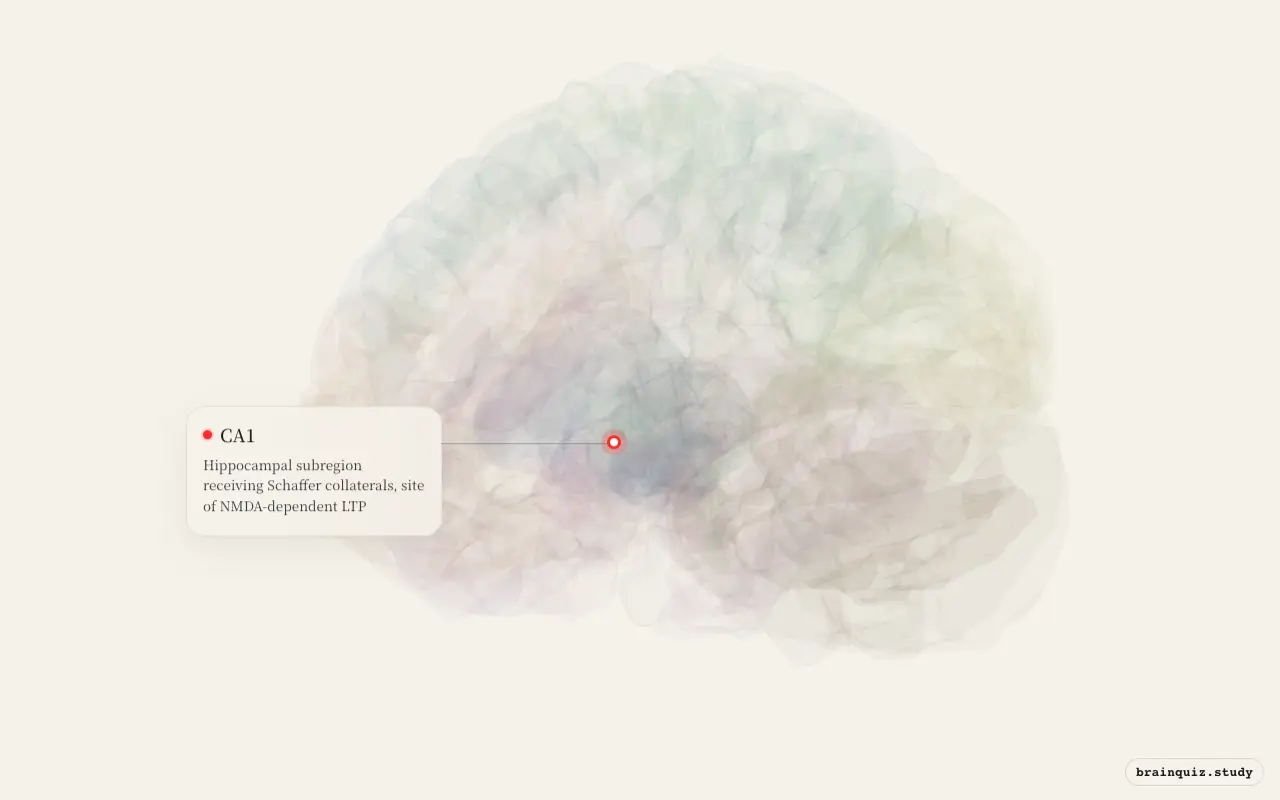
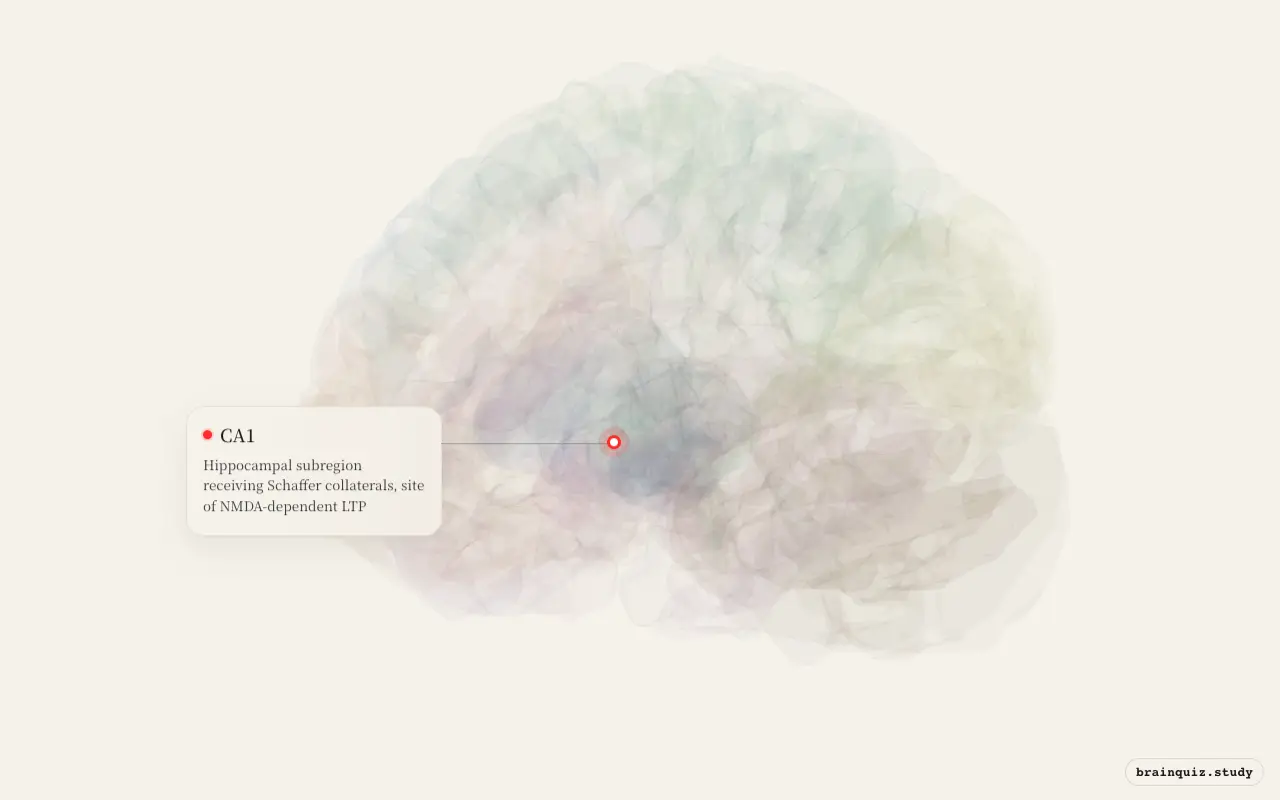
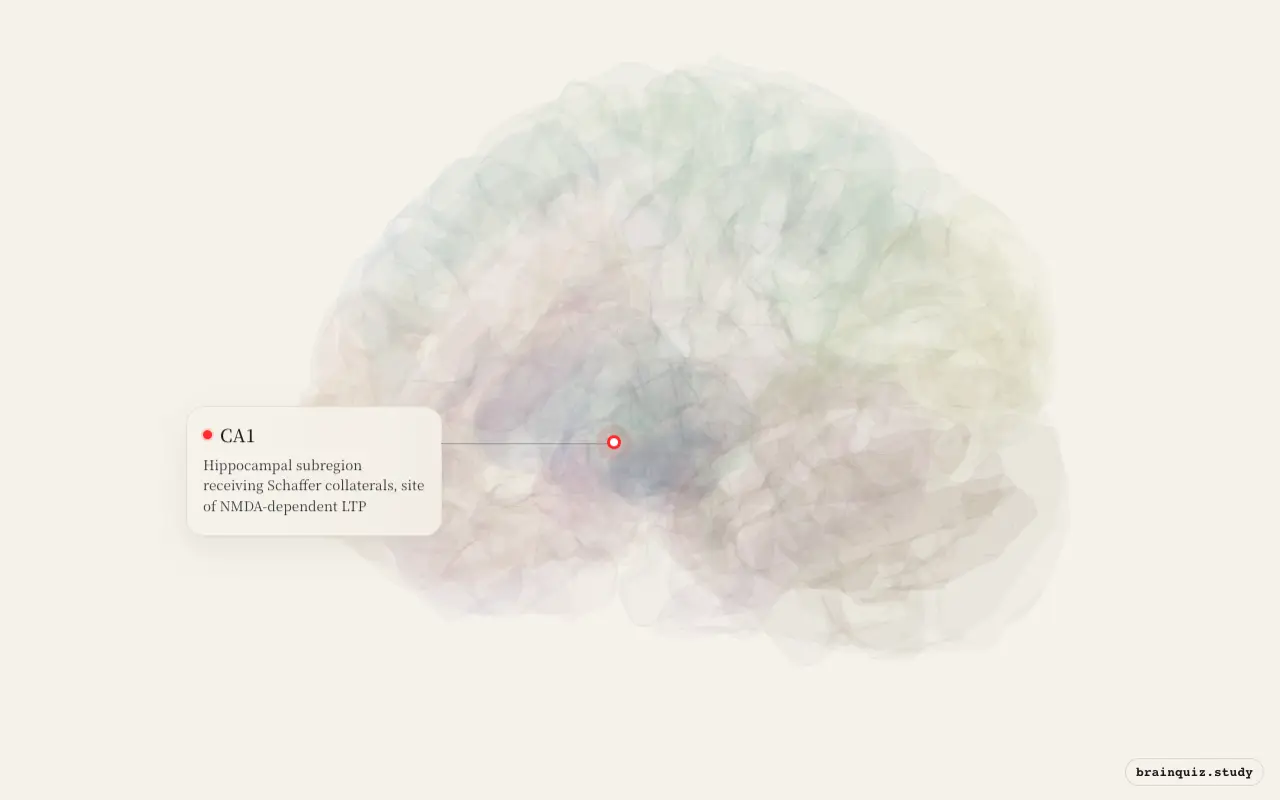
Hippocampal subregion receiving Schaffer collaterals, site of NMDA-dependent LTP.
What does the CA1 do?
- Output stage of hippocampal trisynaptic circuit
- Receives Schaffer collaterals from CA3
- Site where LTP (Long-Term Potentiation) was first described
CA1 pathways and connections
- CA3 → CA1 (Schaffer collaterals — where LTP was discovered)
- CA1 → Subiculum → Entorhinal cortex (hippocampal output pathway)
What happens when the CA1 is damaged?
- CA1 is especially vulnerable to ischemia/hypoxia — often damaged first in cardiac arrest
- Selective CA1 damage → anterograde amnesia
CA1 key facts
Atlas category: subcortical.
- Bliss & Lomo (1973): discovered LTP at Schaffer collateral → CA1 synapse
- Tonegawa knockout mice: lacking NMDA receptors in CA1 = no LTP = impaired spatial learning
- Tonegawa experiment proved the causal link between LTP and memory
CA1 exam tip
CA1 = where LTP was discovered (Bliss & Lomo) and where Tonegawa proved the LTP-memory link with NMDA knockouts.
Common questions
What does hippocampal CA1 do?
CA1 integrates input from CA3 and acts as a major hippocampal output stage, sending information toward subiculum and entorhinal cortex.
Which pathway connects CA3 to CA1?
Schaffer collateral axons project from CA3 to CA1. These synapses are the classic site at which long-term potentiation was first described.
Why is CA1 clinically vulnerable?
CA1 neurons are especially sensitive to ischemia and hypoxia, so they may be injured early after cardiac arrest and produce anterograde memory impairment.