CA3 — Function, Location & Quiz
CA3 is built to recover a complete memory when only part of the cue is present. Recurrent connections allow its neurons to reactivate a stored pattern, making the subfield resemble an autoassociative or content-addressable network.
This is the complement to dentate pattern separation, not a synonym for it. Dentate gyrus pulls similar inputs apart during encoding; CA3 uses partial input to fill gaps during retrieval before sending the result to CA1.
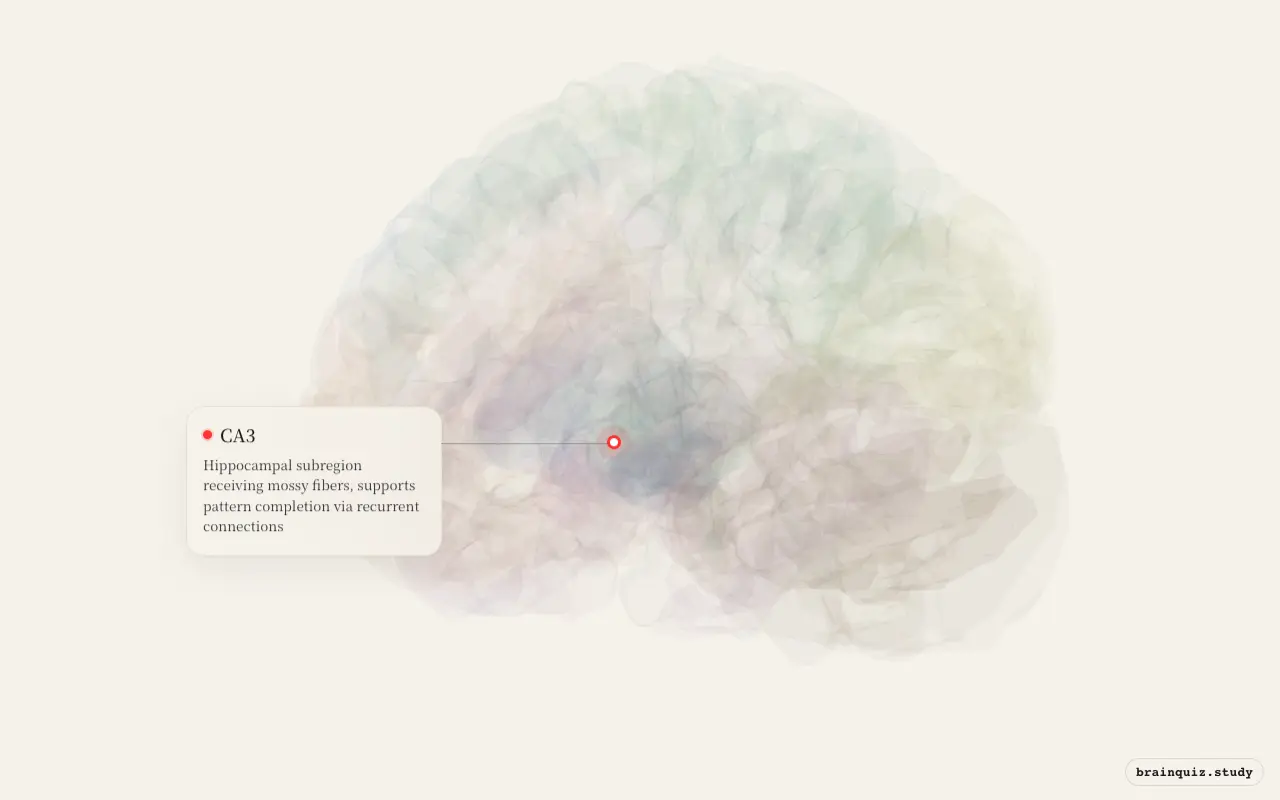
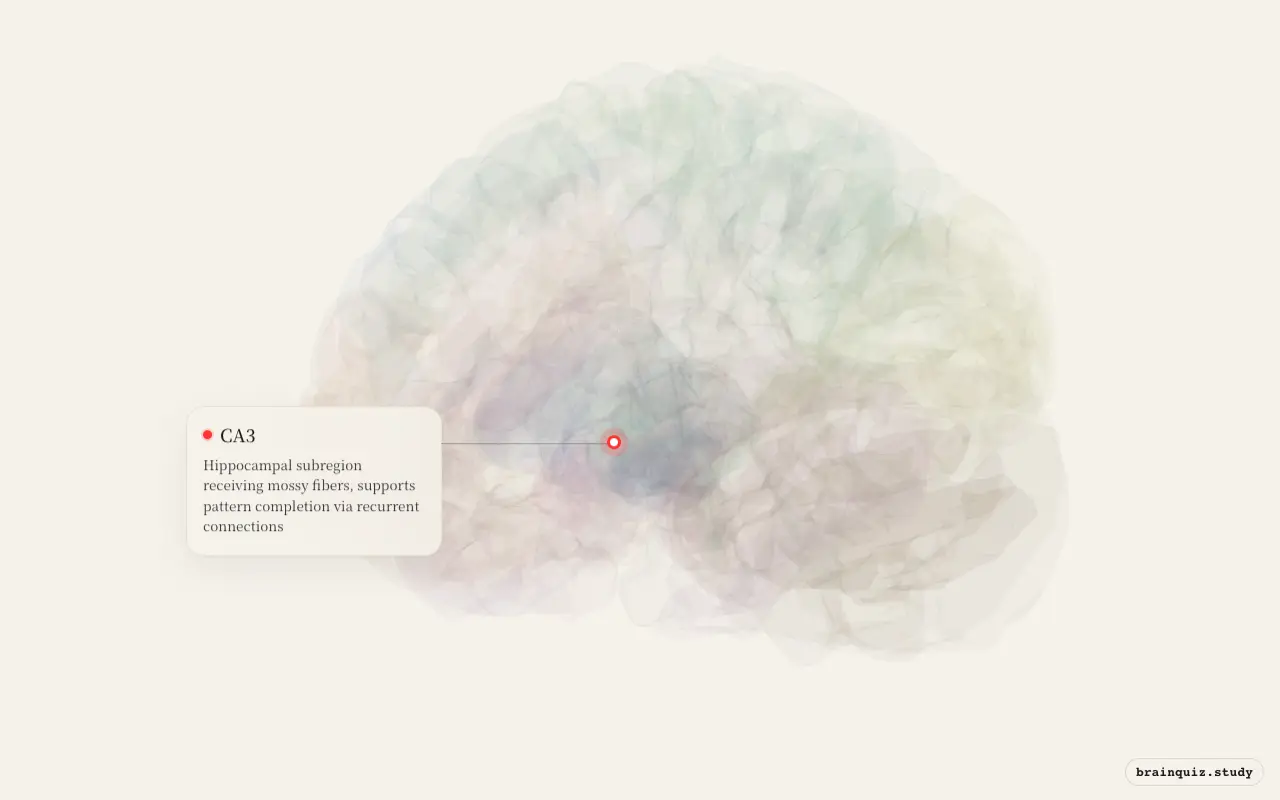
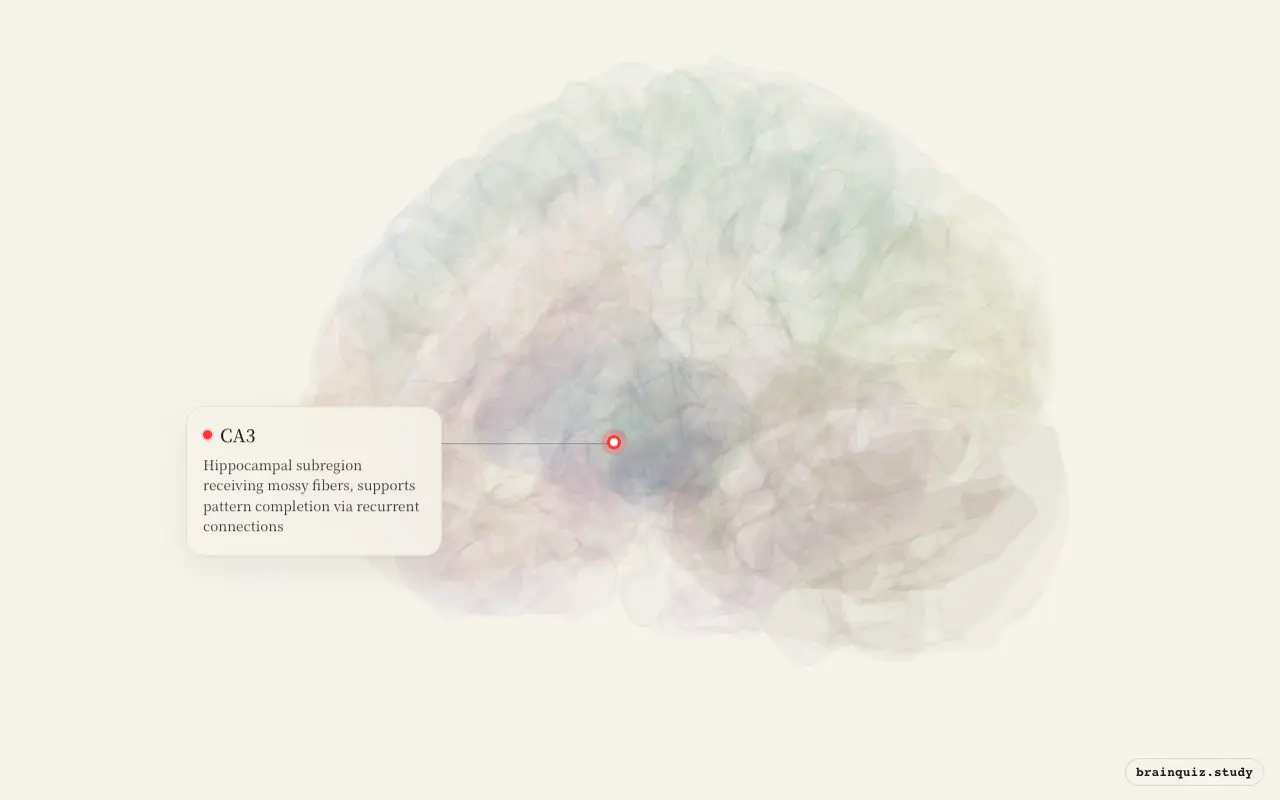
Test this anatomy in the Brain Regions Quiz: 15 Questions With Answers or explore it on the interactive 3D brain.
Where is the CA3 located?
Hippocampal subregion receiving mossy fibers, supports pattern completion via recurrent connections.
What does the CA3 do?
- Pattern completion — retrieving full memory from a partial cue
- Receives mossy fibers from dentate gyrus
- Autoassociative network — recurrent connections enable pattern completion
CA3 pathways and connections
- DG → CA3 (mossy fibers — sparse, powerful input)
- CA3 → CA1 (Schaffer collaterals — output of pattern completion)
- CA3 → CA3 (recurrent/autoassociative connections — the basis of pattern completion)
What happens when the CA3 is damaged?
- CA3 damage impairs ability to retrieve memories from partial cues
- Overactive pattern completion may contribute to false memories
CA3 key facts
Atlas category: subcortical.
- Pattern completion = hearing a song's first notes and recalling the whole melody
- Recurrent connections in CA3 make it an autoassociative network — like a content-addressable memory
- DG = pattern separation (making things distinct). CA3 = pattern completion (filling in gaps). Complementary processes
CA3 exam tip
DG = pattern separation. CA3 = pattern completion. These are complementary processes — separation for encoding, completion for retrieval.
Common questions
What does hippocampal CA3 do?
CA3 supports pattern completion, retrieving a fuller stored representation from a partial cue through its recurrent autoassociative connections.
Which pathways enter and leave CA3?
Dentate gyrus reaches CA3 through mossy fibres, and CA3 reaches CA1 through Schaffer collaterals. CA3 neurons also connect recurrently with one another.
How are CA3 and dentate gyrus different?
Dentate gyrus emphasizes pattern separation for distinct encoding; CA3 emphasizes pattern completion for retrieval from incomplete information.