Dentate Gyrus — Function, Location & Quiz
The dentate gyrus is the sparse entry stage of the classic hippocampal circuit. By turning similar incoming patterns into more distinct representations, it reduces the chance that today’s parking place or context will be confused with yesterday’s.
Pattern separation should not be swapped with CA3 pattern completion, which reconstructs a whole memory from a partial cue. The dentate gyrus is also notable for adult neurogenesis, although the extent of that process in adult humans remains debated.
Test this anatomy in the Brain Regions Quiz: 15 Questions With Answers or explore it on the interactive 3D brain.
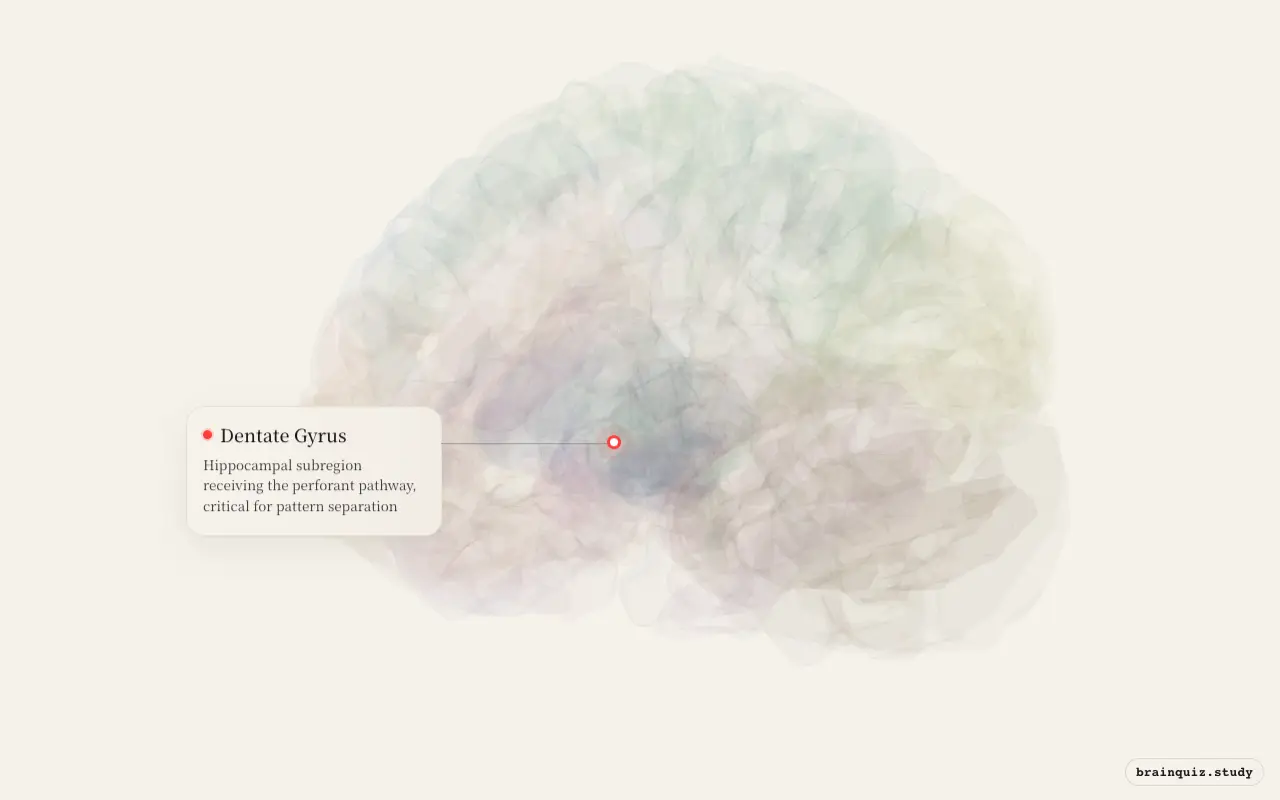
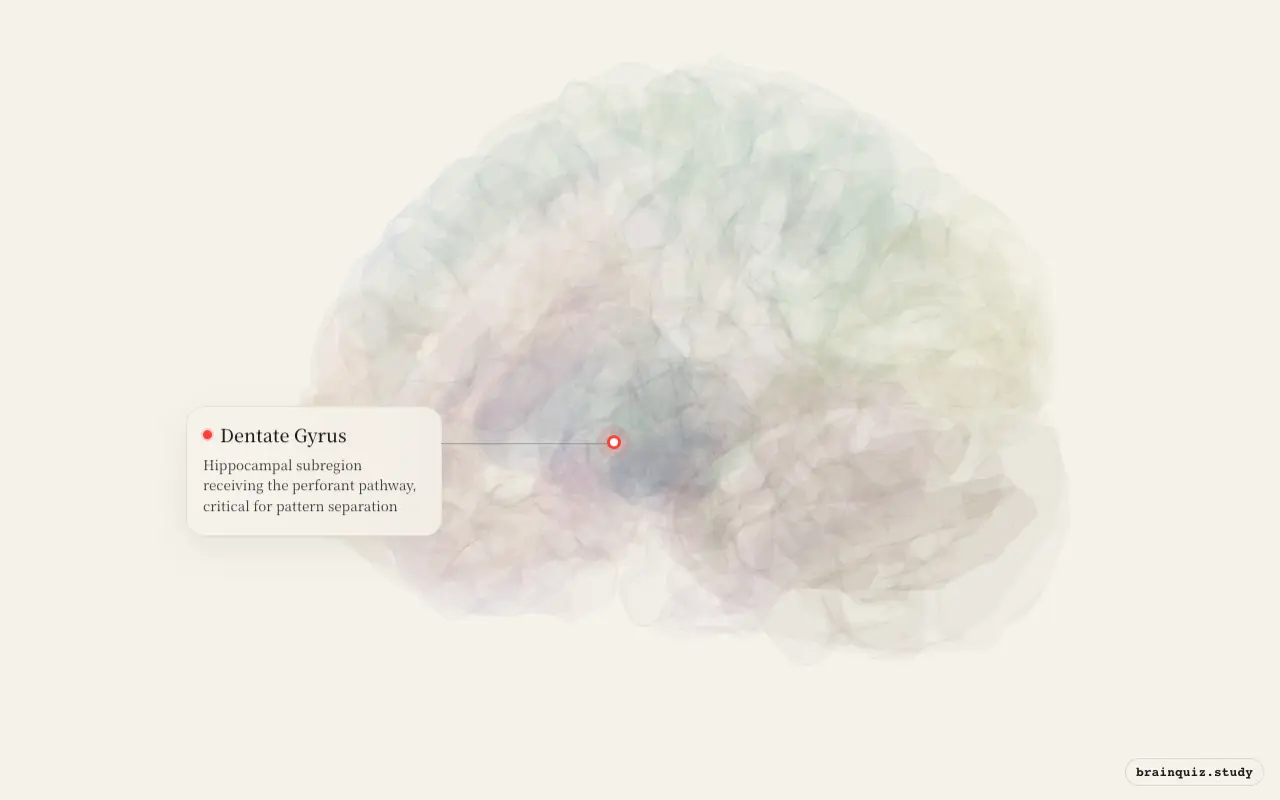
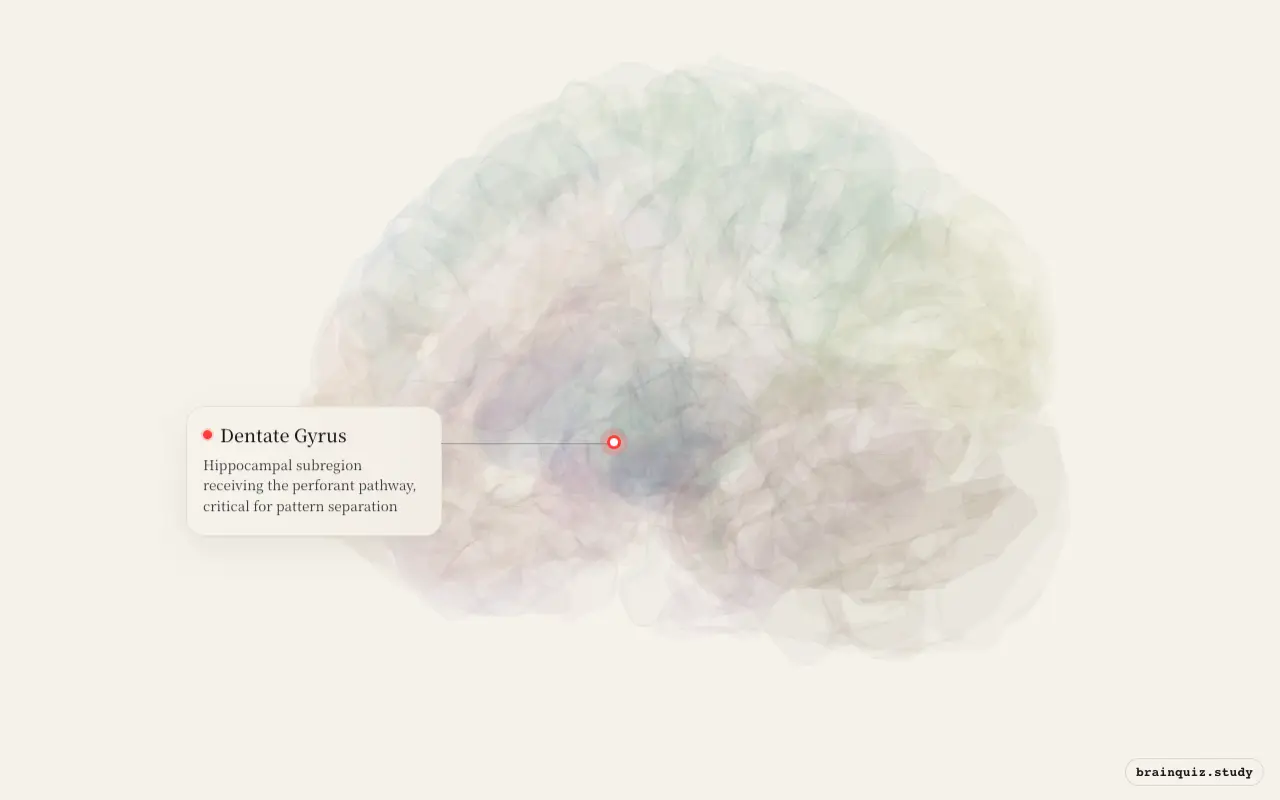
Where is the Dentate Gyrus located?
Hippocampal subregion receiving the perforant pathway, critical for pattern separation.
What does the Dentate Gyrus do?
- First relay in hippocampal trisynaptic circuit
- Pattern separation — making similar inputs distinct so memories don't blur together
- Adult neurogenesis — one of only two brain sites where new neurons are born in adults
Dentate Gyrus pathways and connections
- Entorhinal cortex → Dentate gyrus (perforant path — entry into hippocampus)
- DG → CA3 (mossy fibers — sparse but powerful connections)
What happens when the Dentate Gyrus is damaged?
- Reduced neurogenesis linked to depression — antidepressants may work partly by boosting DG neurogenesis
- Pattern separation failure may contribute to PTSD (overgeneralization of fear)
Dentate Gyrus key facts
Atlas category: subcortical.
- Pattern separation = making similar inputs distinct (e.g., distinguishing today's parking spot from yesterday's)
- Adult neurogenesis in DG — confirmed in rodents, debated in adult humans
- Granule cells of DG have very sparse firing — ensures distinct representations
Dentate Gyrus exam tip
DG = entry point to hippocampus, pattern separation, new neurons. Trisynaptic circuit: EC → DG → CA3 → CA1.
Common questions
What does the dentate gyrus do?
It performs pattern separation, making similar experiences more distinct, and serves as the first hippocampal relay in the trisynaptic circuit.
Where does the dentate gyrus receive input from?
It receives entorhinal input through the perforant path and sends sparse, powerful mossy-fibre projections to CA3.
Does adult neurogenesis occur in the dentate gyrus?
Adult-born dentate neurons are well established in rodents. New neuron production in adult humans has been reported, but its extent and persistence remain debated.