Entorhinal Cortex — Function, Location & Quiz
Entorhinal cortex is the main cortical gateway into and out of the hippocampal memory system. Object information arriving through perirhinal cortex and spatial context arriving through parahippocampal cortex meet here before taking direct or trisynaptic routes through the hippocampus.
Its grid-cell code makes location distinctive, but its clinical importance is equally high: entorhinal degeneration appears early in Alzheimer’s disease. Damage here can isolate otherwise present hippocampal circuitry from the cortical information it needs to encode new experience.
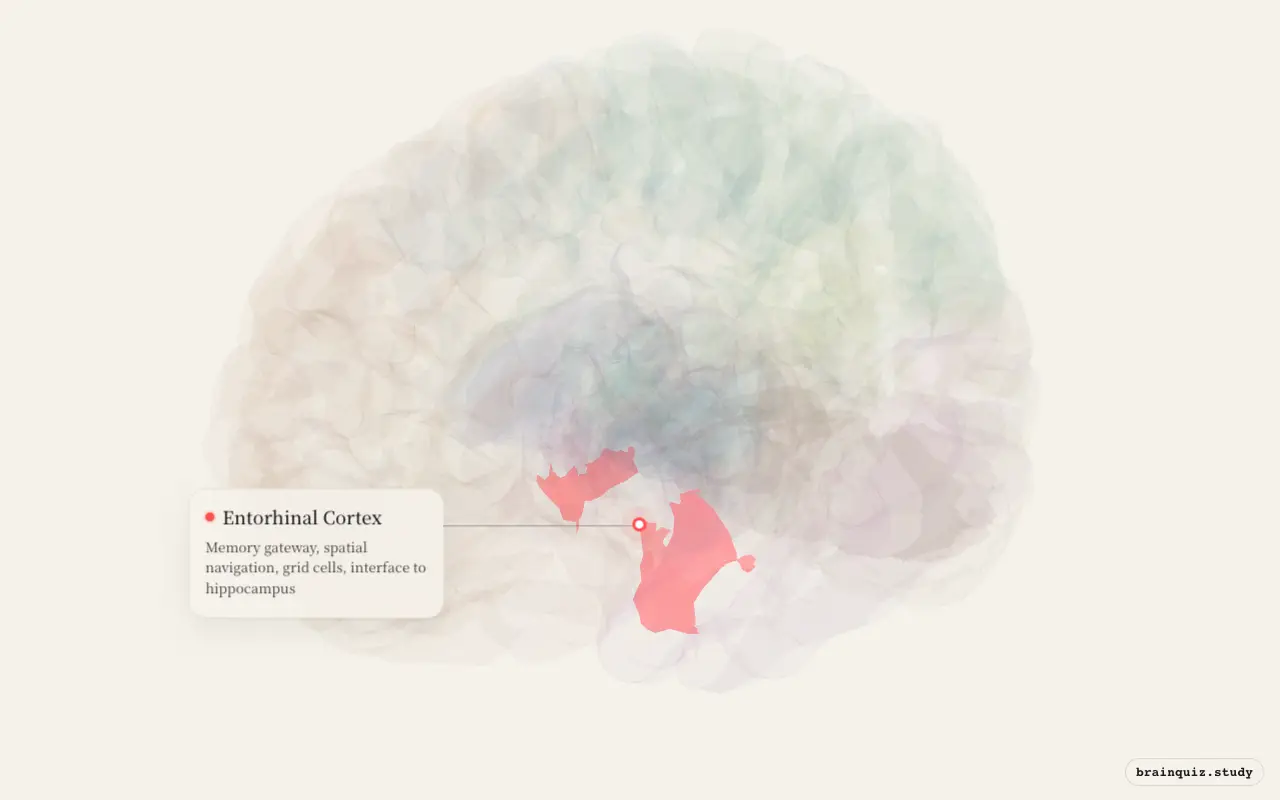
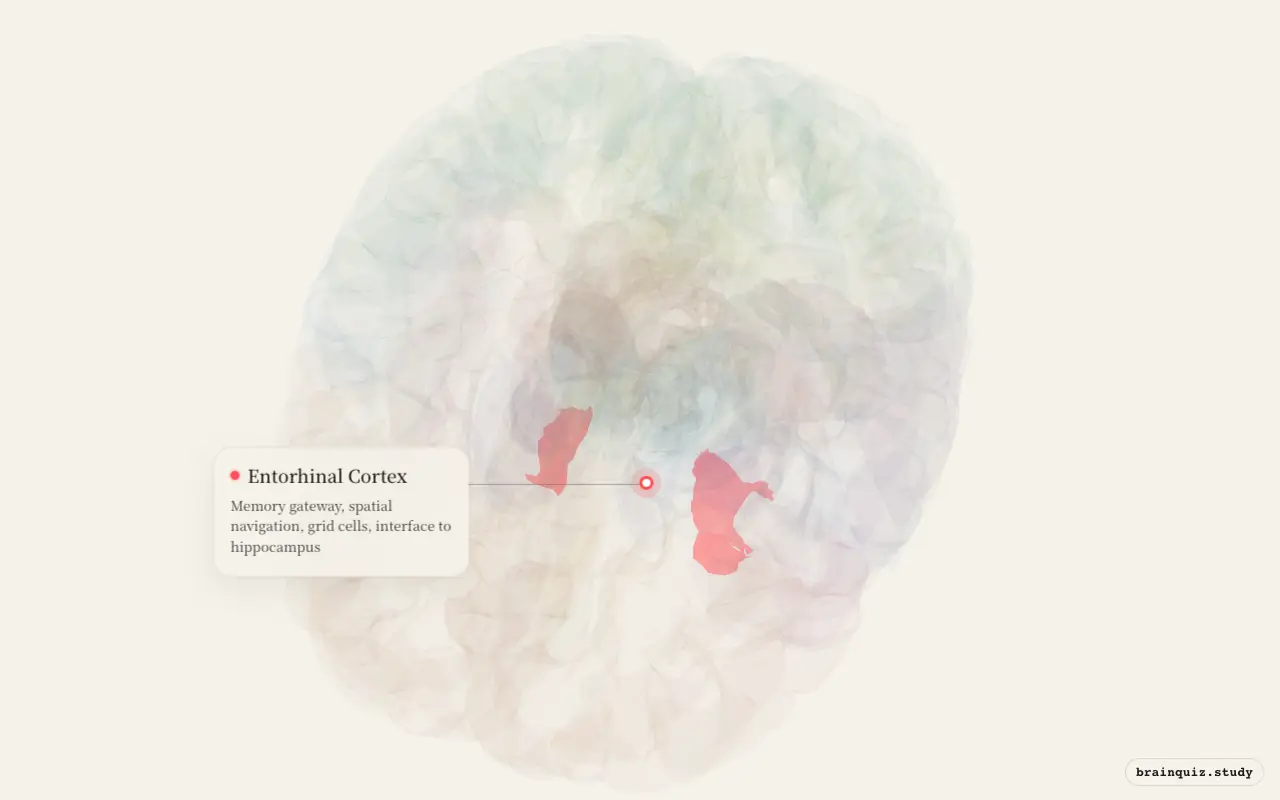
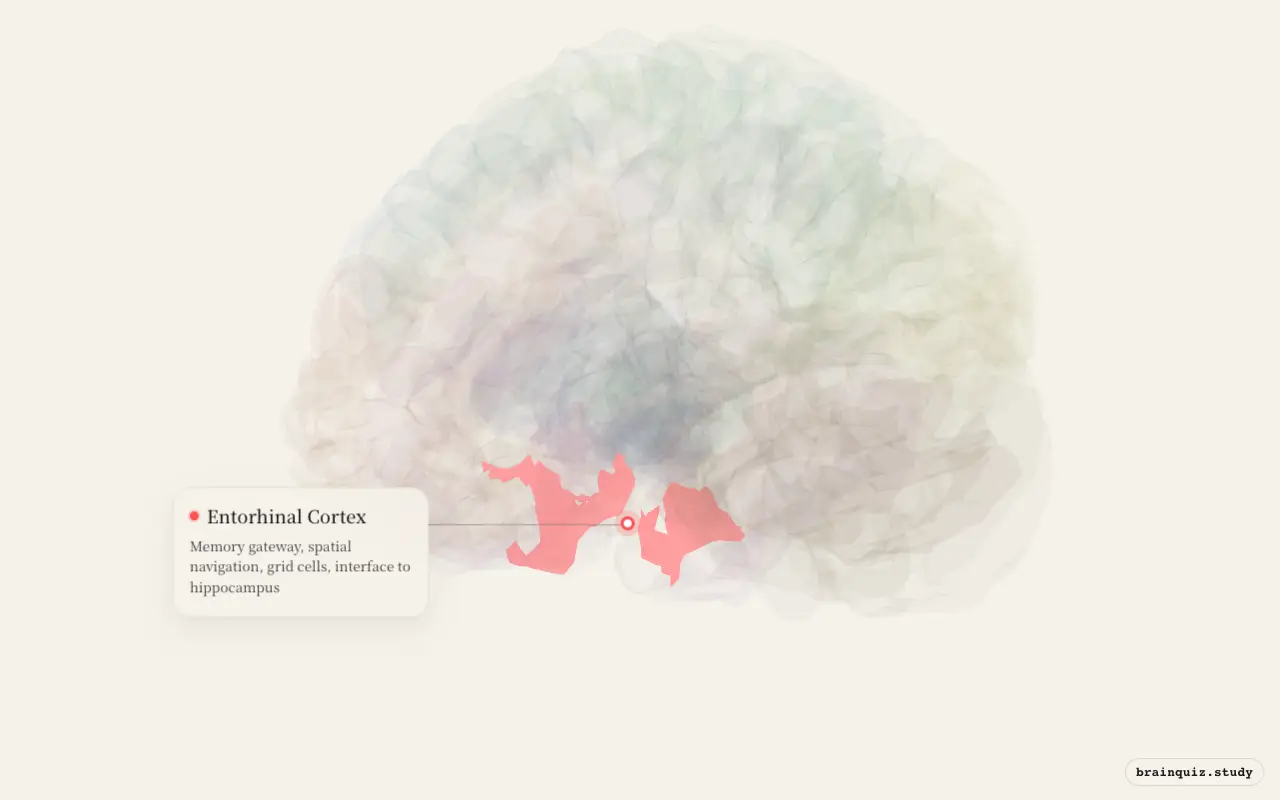
Test this anatomy in the Brain Regions Quiz: 15 Questions With Answers or explore it on the interactive 3D brain.
Where is the Entorhinal Cortex located?
Memory gateway, spatial navigation, grid cells, interface to hippocampus.
What does the Entorhinal Cortex do?
- Gateway to hippocampus — main cortical input
- Grid cells — hexagonal spatial firing patterns
- Memory encoding and retrieval interface
- Combines 'what' and 'where' information for episodic memory
Entorhinal Cortex pathways and connections
- EC layer II → Dentate gyrus (perforant path — trisynaptic circuit entry)
- EC layer III → CA1 (direct path, bypassing DG and CA3)
- EC ← Perirhinal cortex (object info) + Parahippocampal cortex (spatial info)
What happens when the Entorhinal Cortex is damaged?
- One of the FIRST areas to degenerate in Alzheimer's disease
- EC atrophy on MRI is an early biomarker for AD
- Damage → severe anterograde amnesia (cuts off hippocampal input)
Entorhinal Cortex key facts
Atlas category: cortical. Brodmann areas or landmark: BA 28, 34.
- Grid cells discovered by Moser & Moser (Nobel 2014) — fire in hexagonal patterns
- Different grid cells have different spacings → multi-scale spatial representation
- EC is the 'translator' between neocortex and hippocampus
Entorhinal Cortex exam tip
EC = entry point to hippocampus via perforant path. First to go in Alzheimer's. Contains grid cells (Moser & Moser).
Common questions
What does the entorhinal cortex do?
It interfaces neocortex with the hippocampus for memory encoding and retrieval, combines object and spatial information, and contains grid cells that represent location.
How does entorhinal cortex connect to the hippocampus?
Layer II projects through the perforant path to dentate gyrus, beginning the trisynaptic circuit, while layer III also sends a more direct projection to CA1.
Why is entorhinal cortex important in Alzheimer’s disease?
It is among the first regions to degenerate, and entorhinal atrophy can be an early imaging marker. Its loss disrupts the main cortical input to the hippocampus.
When does the Entorhinal Cortex light up?
- 🧭 When you get lost in a new city: Entorhinal grid cells fire in repeating patterns as you move, charting distance and direction.
- 🧠 When you get Alzheimer's disease: Tau tangles and neuronal loss begin in the entorhinal cortex, the gateway to the hippocampus.