What Is the Default Mode Network? Brain Regions and Function
Updated
The Default Mode Network is a set of brain regions active at rest and during self-referential thought. Core hubs include the medial prefrontal cortex, posterior cingulate cortex, and angular gyrus.
The default mode network was identified in the early 2000s by Marcus Raichle and colleagues. It showed that the brain remains highly active during rest, not passive. This network is important for understanding self-referential thought, memory, and social cognition, and its disruption is linked to several psychiatric and neurological conditions.
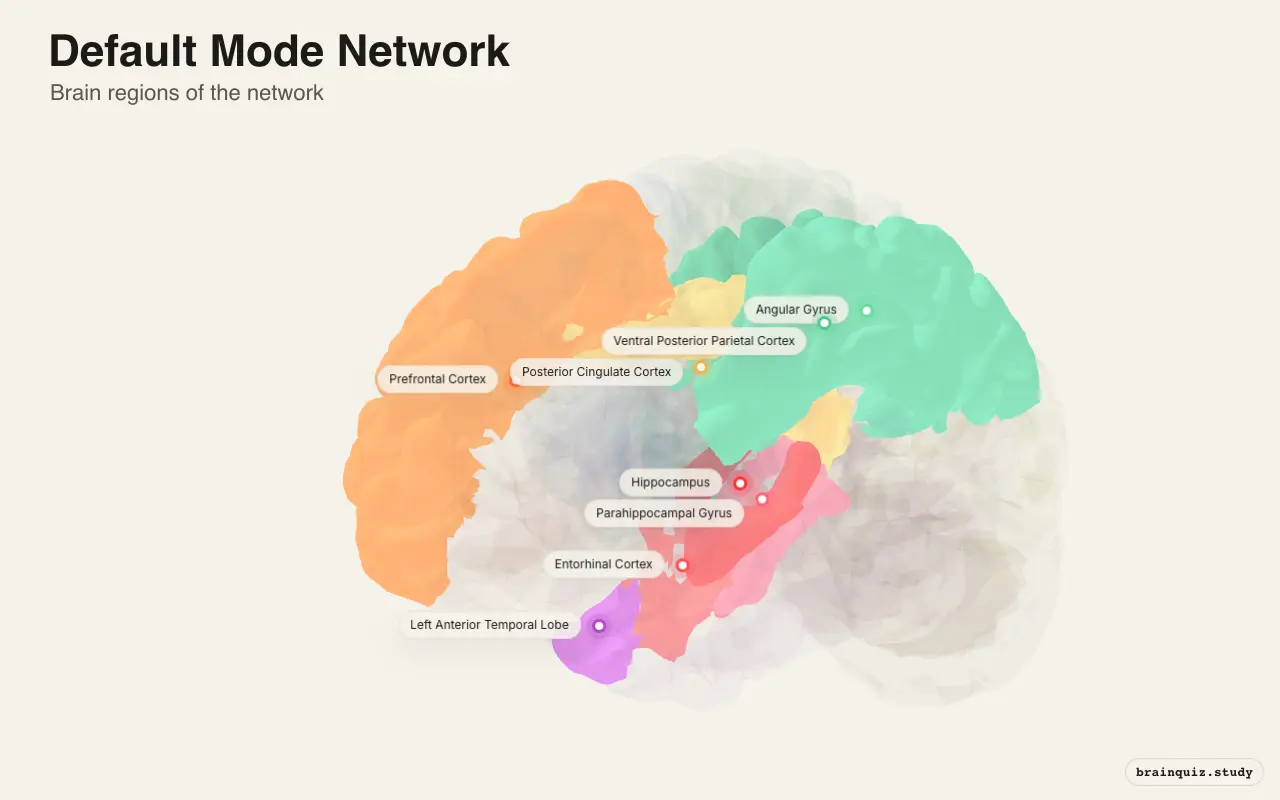
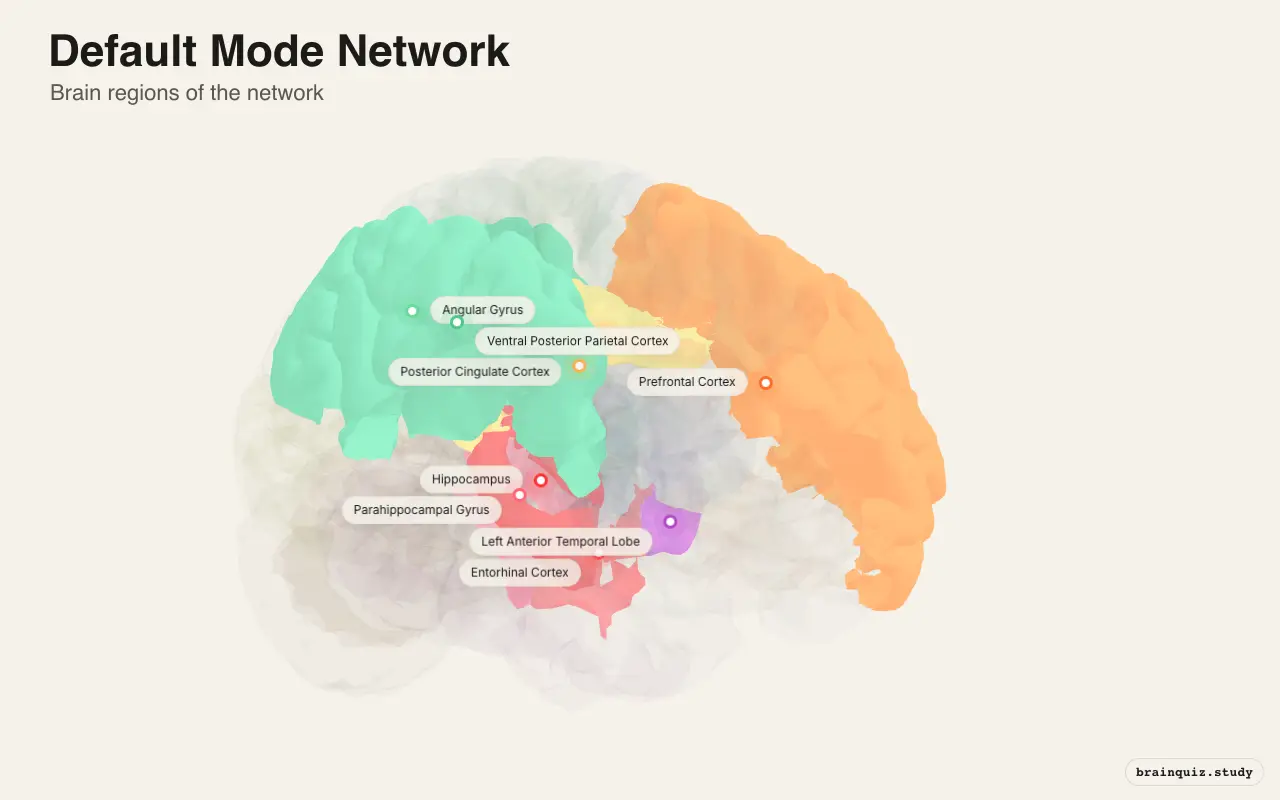
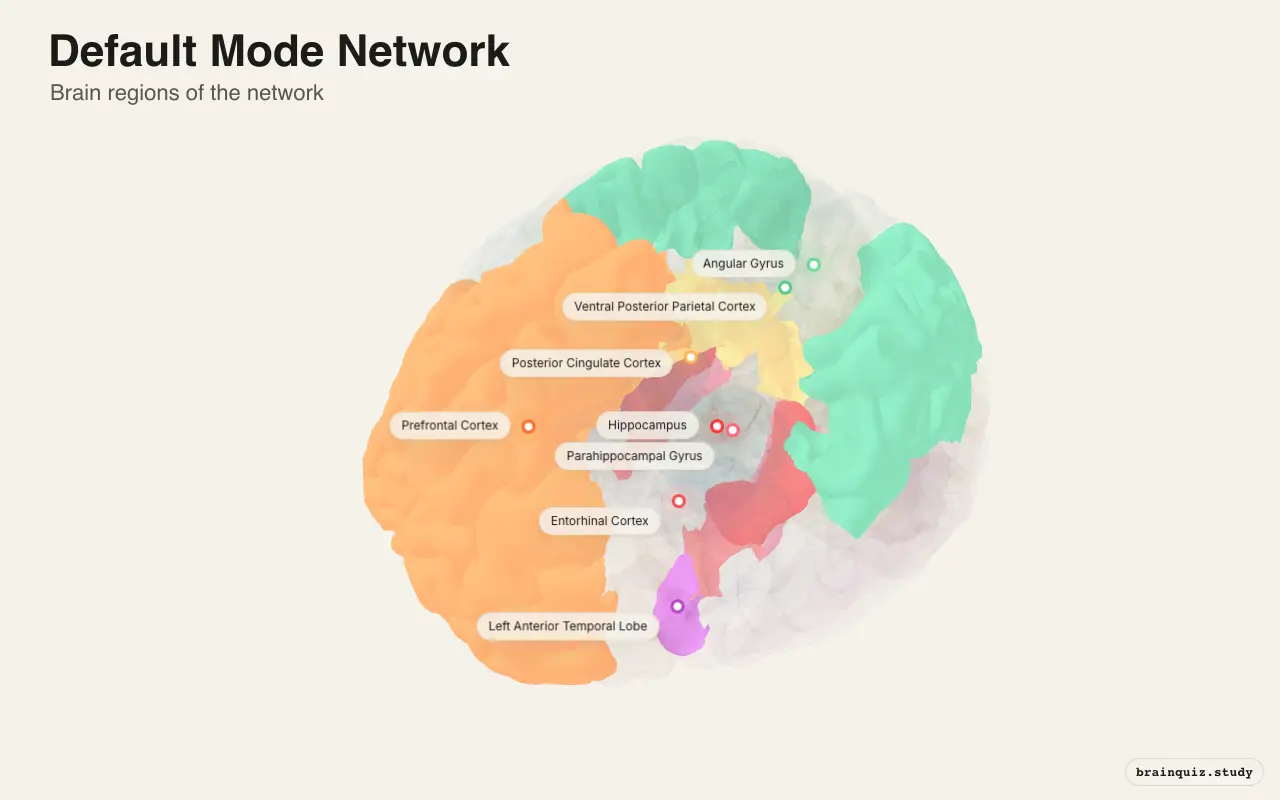
Which brain regions are in the Default Mode Network?
- Prefrontal Cortex: The medial prefrontal cortex supports self-referential evaluation, mentalizing, and integrating emotional information during spontaneous thought.
- Posterior Cingulate Cortex: The posterior cingulate cortex and adjacent precuneus act as a central hub for autobiographical memory and self-related processing.
- Angular Gyrus: The angular gyrus contributes to semantic processing, theory of mind, and retrieval of episodic memories.
- Hippocampus: The hippocampus is critical for forming and retrieving autobiographical memories and constructing future scenarios.
- Entorhinal Cortex: The entorhinal cortex relays information between the hippocampus and neocortex, supporting memory consolidation.
- Parahippocampal Gyrus: The parahippocampal gyrus processes contextual and spatial details during memory retrieval and scene construction.
- Left Anterior Temporal Lobe: The left anterior temporal lobe is a hub for semantic knowledge and conceptual associations.
- Ventral Posterior Parietal Cortex: The ventral posterior parietal cortex integrates sensory and memory information during self-referential processing.
What does the Default Mode Network do?
What does the Default Mode Network do? The default mode network is a large-scale brain system that is most active when you are not focused on the outside world. It supports self-referential thought, autobiographical memory, future simulation, theory of mind, and mind-wandering. These functions allow individuals to reflect on personal experiences, plan for the future, and understand others' mental states.
- Self-referential thought — The network supports thinking about one's own traits, feelings, and mental states.
- Autobiographical memory — It retrieves personal past events, including their emotional and contextual details, often vividly.
- Future simulation — It enables mental time travel to imagine possible future scenarios and plan ahead.
- Theory of mind — It underpins the ability to infer others' beliefs, intentions, and emotions during social interactions.
- Spontaneous thought — It is active during mind-wandering and daydreaming when attention drifts from the external world.
- Semantic memory — It contributes to general knowledge and conceptual processing independent of specific episodes.
When is the Default Mode Network active?
The default mode network is most active during rest, when the mind wanders, and during tasks that involve self-referential thinking, such as recalling memories or planning. It quiets down (deactivates) when you engage in externally focused attention tasks, such as solving a puzzle, navigating a busy street, or doing arithmetic.
- Daydreaming while waiting for a bus.
- Reflecting on a childhood memory before sleep.
- Imagining what you will do next weekend.
- Trying to guess what a friend is thinking.
- Drifting off during a boring lecture.
Default Mode Network vs Central Executive Network
The default mode network and central executive network often work in opposition. The DMN is active during internally directed thought, while the CEN engages during externally focused, goal-directed tasks. When one network's activity increases, the other typically decreases. They can also cooperate during tasks that require integrating internal knowledge with external demands, such as creative problem solving.
DMN vs CEN at a glance
| Aspect | Default Mode Network | Central Executive Network |
|---|---|---|
| Primary function | Internally directed thought and self-referential processing | Externally focused, goal-directed cognition and cognitive control |
| Key hubs | Medial prefrontal cortex, posterior cingulate, angular gyrus | Dorsolateral prefrontal cortex, posterior parietal cortex |
| During focused tasks | Deactivates to reduce interference | Activates to maintain focus |
| Mind-wandering | Supports spontaneous, unconstrained thought | Associated with lapses in task performance |
| Anti-correlation | Negatively correlated with CEN activity | Negatively correlated with DMN activity |
What happens when the Default Mode Network is disrupted?
Altered default mode network function is associated with several psychiatric and neurological conditions. These include major depressive disorder, attention-deficit/hyperactivity disorder, Alzheimer's disease, autism spectrum disorder, and schizophrenia. In many cases, the network fails to deactivate properly or shows abnormal connectivity with other brain systems.
- Major depressive disorder — Studies suggest hyperconnectivity within the DMN is linked to rumination, a core symptom of depression.
- ADHD — Failure of the DMN to deactivate during tasks is thought to relate to attentional lapses in ADHD.
- Alzheimer's disease — Early amyloid-beta deposition tends to occur in DMN hubs, possibly contributing to memory decline and cognitive impairment.
- Autism spectrum disorder — Altered DMN connectivity during social cognition tasks is seen in some individuals with autism, though findings vary.
- Schizophrenia — Disrupted switching between the DMN and salience network is associated with symptoms of schizophrenia and cognitive deficits.
How does the Default Mode Network work with other networks?
The default mode network does not work in isolation. It interacts with the salience network and central executive network in what is called the triple network model. The salience network detects important internal or external events and helps switch between the DMN (for internal focus) and CEN (for external tasks). This dynamic switching allows the brain to flexibly shift attention between self-related thought and goal-directed behavior. Dysfunction in this switching is linked to several psychiatric disorders.
- Salience Network suppresses Default Mode Network — The anterior insula of the salience network deactivates the DMN when task-relevant external stimuli are detected, shifting the brain from internal mentation to externally focused processing.
- Default Mode Network anticorrelated Central Executive Network — The DMN and CEN show robust anticorrelation: when one increases activity, the other decreases. This reciprocal relationship ensures efficient toggling between internally and externally directed cognition.
How do scientists find the Default Mode Network?
Researchers typically identify the default mode network using resting-state functional MRI, which measures correlated spontaneous activity between brain regions. A seed region, such as the posterior cingulate cortex, can be used to map connected areas, or independent component analysis can isolate the network. A limitation is that resting-state correlations do not prove direct anatomical connections or causal interactions.
Key facts about the Default Mode Network
- Marcus Raichle and colleagues coined the term 'default mode' in 2001.
- The posterior cingulate cortex and precuneus are among the most metabolically active regions at rest.
- The DMN is anti-correlated with the central executive network during task performance.
Sources
- Raichle ME et al. (2001). A default mode of brain function. PNAS, 98(2), 676–682.
- Buckner RL, Andrews-Hanna JR, Schacter DL (2008). The brain's default network. Annals of the New York Academy of Sciences, 1124, 1–38.
- Yeo BTT et al. (2011). The organization of the human cerebral cortex estimated by intrinsic functional connectivity. Journal of Neurophysiology, 106(3), 1125–1165.