What Is the Central Executive Network? Brain Regions and Function
Updated
The Central Executive Network is a frontoparietal brain system for goal-directed cognition. Core regions include the dorsolateral prefrontal cortex, posterior parietal cortex, and caudate, supporting working memory and cognitive control.
First characterized in large-scale brain imaging studies, the Central Executive Network has become a key framework for understanding how the brain sustains attention and guides behavior. Its coordinated activity explains moment-to-moment control over thought and action, and its dysfunction is implicated in several psychiatric and neurological conditions. Researchers continue to map its architecture to link brain organization with cognition.
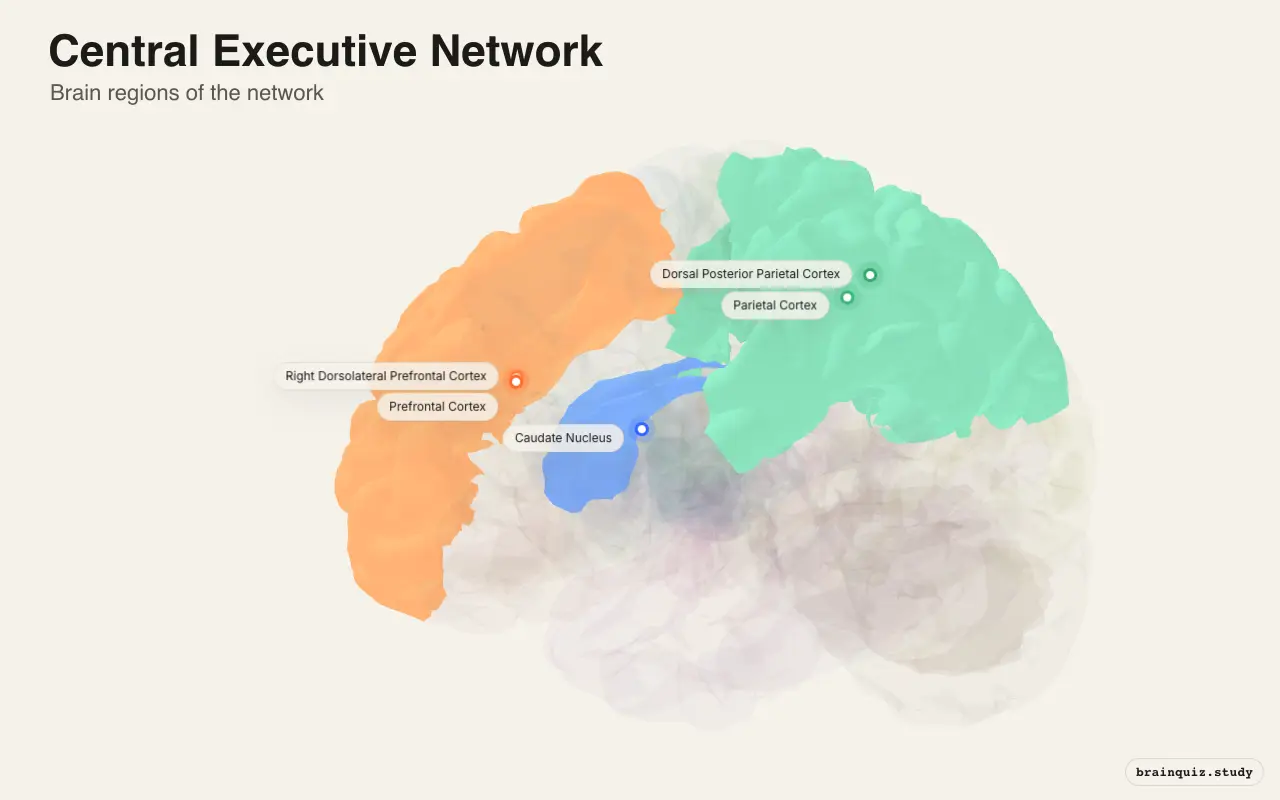
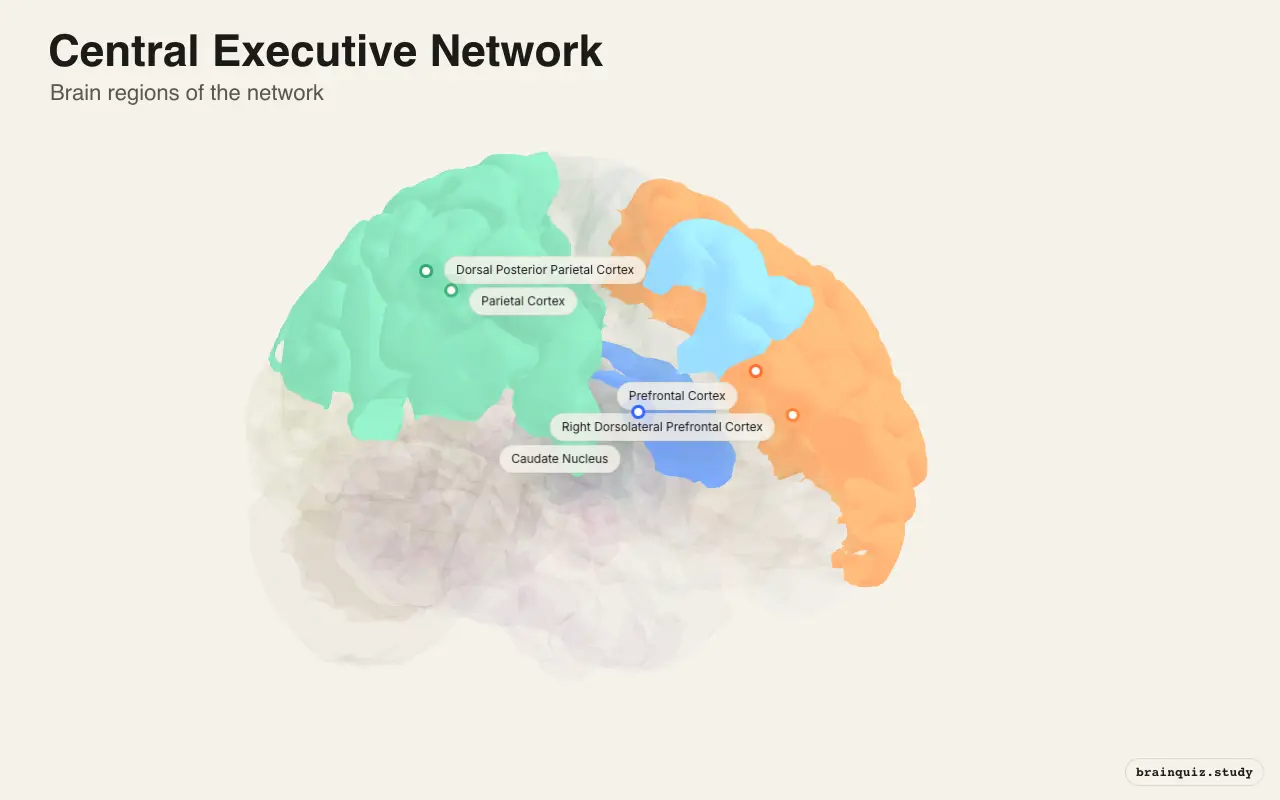
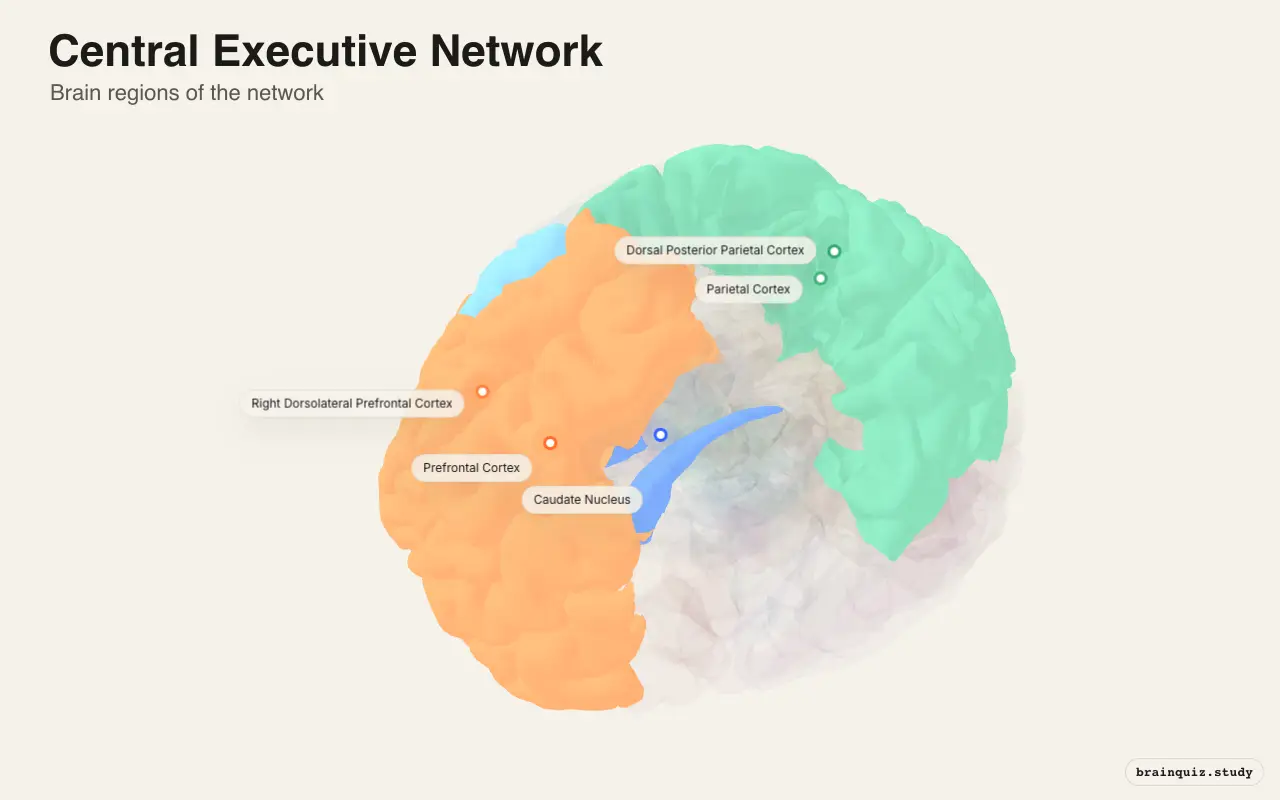
Which brain regions are in the Central Executive Network?
- Right Dorsolateral Prefrontal Cortex: The right dorsolateral prefrontal cortex is a principal hub for working memory maintenance and top-down control of attention, biasing processing toward task-relevant information.
- Prefrontal Cortex: The broader prefrontal cortex supports planning, cognitive flexibility, and inhibitory control, integrating goals with current context.
- Dorsal Posterior Parietal Cortex: The dorsal posterior parietal cortex maintains spatial and attentional priorities, interacting with prefrontal areas to update task representations.
- Parietal Cortex: The parietal cortex contributes to attentional orienting and the manipulation of information in working memory.
- Caudate Nucleus: The caudate nucleus is part of the frontostriatal loop, supporting action selection and the learning of task contingencies.
What does the Central Executive Network do?
What does the Central Executive Network do? The Central Executive Network is a large-scale brain system that supports goal-directed cognition, including working memory maintenance, cognitive control, and decision-making. It acts when you need to hold information in mind, ignore distractions, and choose among competing responses. By coordinating activity across frontal and parietal regions, this network enables flexible, adaptive behavior in complex environments.
- Working memory maintenance — Holds and updates information over short delays, allowing goal-relevant data to guide behavior.
- Goal-directed planning — Formulates and evaluates sequences of actions to achieve desired outcomes in novel situations.
- Cognitive flexibility — Shifts attention and strategies when task demands change, enabling adaptive responding in changing environments.
- Inhibitory control — Suppresses prepotent or irrelevant responses, allowing selection of context-appropriate actions and overriding automatic tendencies.
- Logical reasoning — Manipulates abstract relationships and applies rules to solve novel problems, engaging in sequential deduction.
When is the Central Executive Network active?
The Central Executive Network is most active during externally focused, cognitively demanding tasks that require sustained attention, working memory, or problem-solving. It engages when you perform mental arithmetic, plan a route, or make a difficult decision. Activity decreases during rest, mind-wandering, and self-referential thought, when the default mode network takes over.
- Solving a multistep math problem in your head.
- Planning the sequence of stops for several errands.
- Ignoring your phone notification while writing an email.
- Switching from reading to answering a spoken question.
- Remembering a new phone number long enough to dial it.
Central Executive Network vs Default Mode Network
The Central Executive Network and the Default Mode Network show opposing activity patterns. The CEN activates during externally driven, task-focused cognition, while the DMN dominates during rest and internal thought. They are typically anticorrelated: as one increases, the other decreases. This dynamic balance allows the brain to shift between outward attention and inward reflection depending on current demands.
CEN vs DMN at a glance
| Aspect | Central Executive Network | Default Mode Network |
|---|---|---|
| Primary state | Task-focused, goal-directed cognition | Rest, self-referential thought |
| Core hubs | Dorsolateral prefrontal cortex, posterior parietal cortex | Medial prefrontal cortex, posterior cingulate, angular gyrus |
| Activity pattern | Increases during demanding cognitive tasks | Increases during passive rest and mind-wandering |
| Functional role | Top-down control, working memory | Internal mentation, autobiographical memory |
| Relationship | Anticorrelated with DMN | Anticorrelated with CEN |
What happens when the Central Executive Network is disrupted?
Disruptions in Central Executive Network function are associated with several psychiatric and neurological conditions. In many disorders, altered connectivity or abnormal activation of this network correlates with cognitive difficulties such as poor attention, impaired working memory, or reduced cognitive control. These findings are associations, not necessarily causes, and individual variability is high.
- ADHD — In ADHD, studies suggest the Central Executive Network shows reduced activation during tasks requiring sustained attention, which may contribute to inattention symptoms.
- Schizophrenia — Schizophrenia is associated with reduced functional connectivity within the Central Executive Network, which is thought to underlie cognitive deficits such as impaired working memory.
- Mild cognitive impairment — In mild cognitive impairment, compensatory hyperactivation of the Central Executive Network may occur during memory tasks, possibly reflecting increased cognitive effort.
- Major depression — Major depression is linked to disrupted anticorrelation between the Central Executive Network and the default mode network, which may relate to rumination and cognitive control problems.
How does the Central Executive Network work with other networks?
The Central Executive Network does not work in isolation. In Menon's triple network model, the salience network monitors internal and external stimuli and switches between the Central Executive Network and the default mode network. When a salient event requires attention, the salience network activates the Central Executive Network and deactivates the default mode network. This switching mechanism is crucial for adaptive behavior, and dysfunction in any of these networks can disrupt the balance between task focus and rest.
- Salience Network activates Central Executive Network — The salience network engages the central executive network to allocate cognitive resources toward the detected salient stimulus, enabling goal-directed analysis and response planning.
- Default Mode Network anticorrelated Central Executive Network — The DMN and CEN show robust anticorrelation: when one increases activity, the other decreases. This reciprocal relationship ensures efficient toggling between internally and externally directed cognition.
How do scientists find the Central Executive Network?
Researchers typically identify the Central Executive Network using resting-state functional MRI, which measures correlated spontaneous activity between brain regions. Seed-based analysis places a region of interest in a core hub like the dorsolateral prefrontal cortex and maps its functional connections, while independent component analysis separates distinct networks automatically. A limitation is that these methods rely on indirect hemodynamic signals and may miss faster neural dynamics.
Key facts about the Central Executive Network
- The Central Executive Network was first delineated in the early 2000s through resting-state fMRI studies of intrinsic connectivity networks.
- The network is also referred to as the frontoparietal network because its major hubs are in frontal and parietal cortex.
- Its anticorrelation with the default mode network is one of the most replicated findings in human neuroimaging.
Sources
- Seeley WW et al. (2007). Dissociable intrinsic connectivity networks for salience processing and executive control. Journal of Neuroscience, 27(9), 2349–2356.
- Menon V (2011). Large-scale brain networks and psychopathology: a unifying triple network model. Trends in Cognitive Sciences, 15(10), 483–506.
- Yeo BTT et al. (2011). The organization of the human cerebral cortex estimated by intrinsic functional connectivity. Journal of Neurophysiology, 106(3), 1125–1165.