Right Dorsolateral Prefrontal Cortex — Function & Quiz
The right dorsolateral prefrontal cortex becomes especially useful after a memory has surfaced. Rather than storing the episode, it evaluates whether the retrieved information is accurate and relevant, working hardest when confidence is low.
That monitoring role distinguishes it from the hippocampus, which supplies recollective content. Right-sided prefrontal damage can therefore leave memories available yet weaken the filter that rejects a plausible but false match.
Test this anatomy in the Brain Networks Quiz: Default Mode, Salience & More or explore it on the interactive 3D brain.
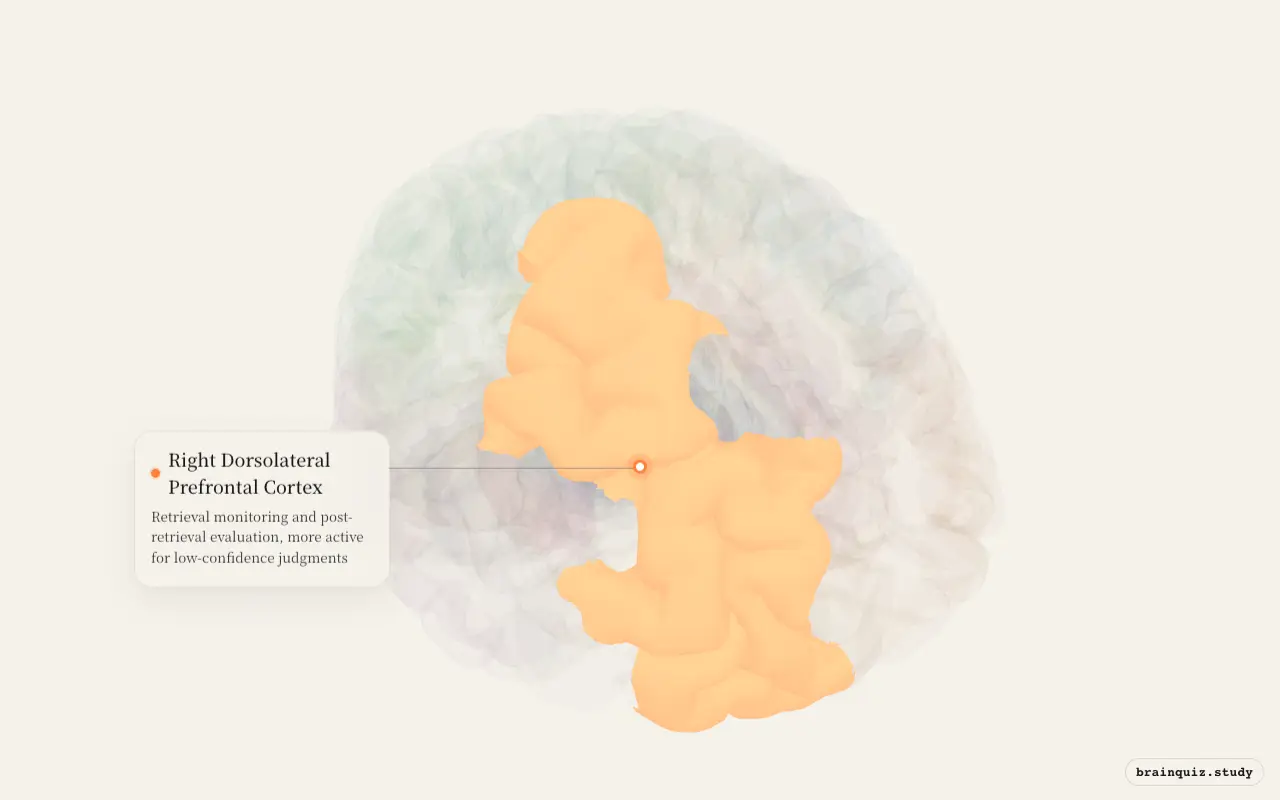
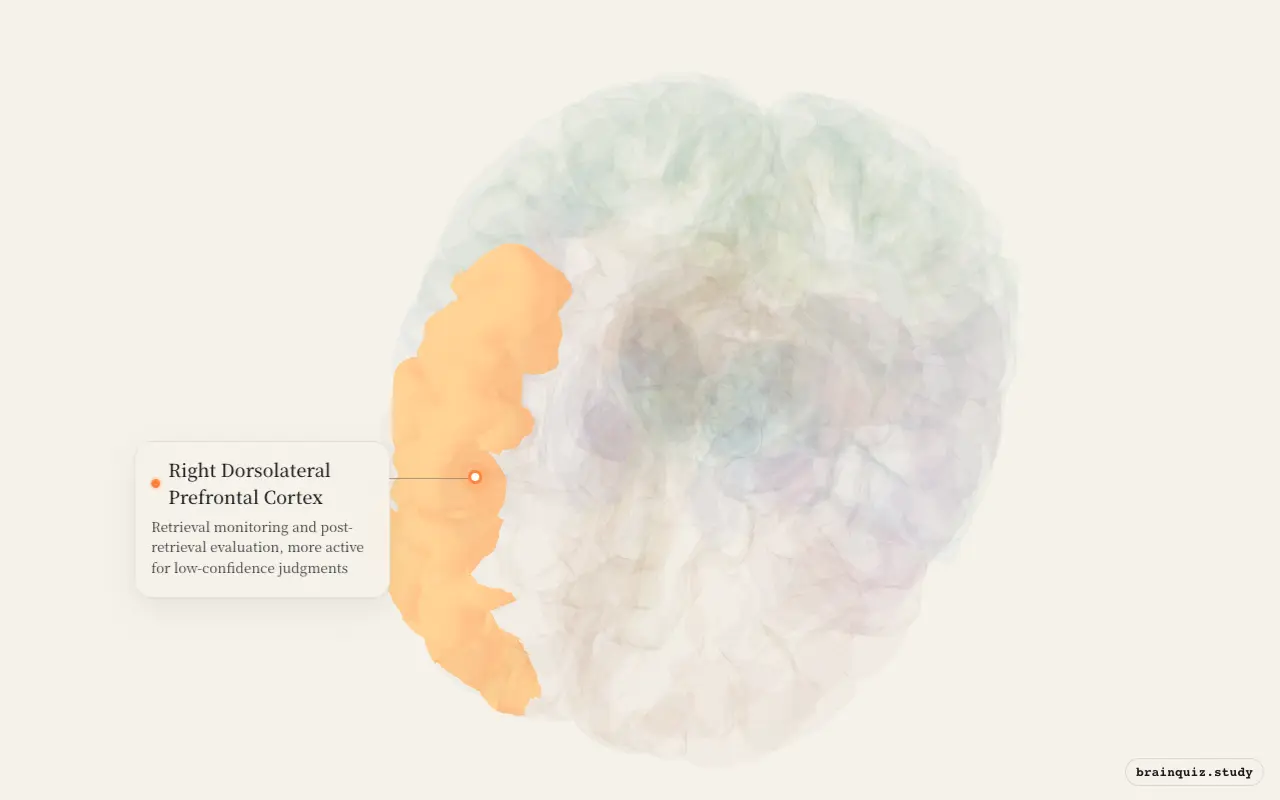
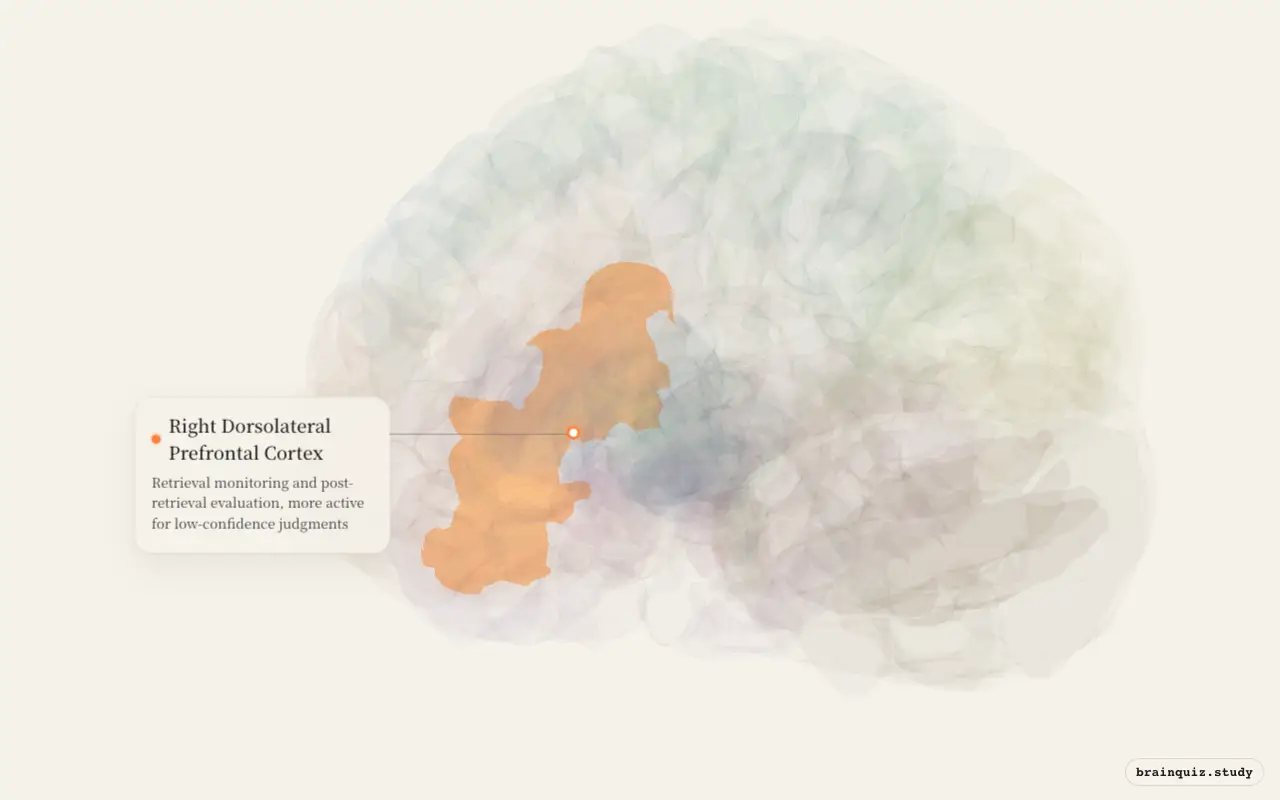
Where is the Right Dorsolateral Prefrontal Cortex located?
Retrieval monitoring and post-retrieval evaluation, more active for low-confidence judgments.
What does the Right Dorsolateral Prefrontal Cortex do?
- Monitoring retrieval accuracy — post-retrieval evaluation
- Evaluating whether retrieved information is correct or relevant
- More active for LOW-confidence than high-confidence recognition judgments
Right Dorsolateral Prefrontal Cortex pathways and connections
- Right dlPFC ↔ Hippocampus (retrieval monitoring — checks hippocampal output)
- Right dlPFC ↔ Parietal cortex (attention during retrieval)
What happens when the Right Dorsolateral Prefrontal Cortex is damaged?
- Patient B.G. — right dlPFC lesion caused abnormally high false alarm rate
- Without right dlPFC monitoring, patients accept false memories as real
Right Dorsolateral Prefrontal Cortex key facts
Atlas category: cortical. Brodmann areas or landmark: BA 9, 46 (right dorsolateral prefrontal cortex).
- More active for LOW-confidence than high-confidence recognition — works harder when uncertain
- Patient B.G. demonstrates that right dlPFC is critical for filtering out false memories
- Distinguishes correct from incorrect retrieval — the brain's fact-checker
Right Dorsolateral Prefrontal Cortex exam tip
Right dlPFC = the brain's fact-checker during memory retrieval. Patient B.G. = high false alarms without it.
Common questions
What does the right dorsolateral prefrontal cortex do during retrieval?
It monitors retrieved information, checks accuracy and relevance, and helps reject false memories. Activity is often greater for uncertain, low-confidence decisions.
How is right DLPFC different from the hippocampus?
The hippocampus is central to forming and recovering episodic content; right DLPFC evaluates that output and supports controlled decisions about whether it is trustworthy.
What can a right DLPFC lesion do to recognition memory?
It can increase false alarms, so unfamiliar items are more often accepted as remembered. The deficit reflects impaired monitoring rather than total loss of stored information.
When does the Right Dorsolateral Prefrontal Cortex light up?
- 🤔 When you have a word on the tip of your tongue: You evaluate every partial word that comes to mind, deciding if it's correct.