What happens in your brain when you have a word on the tip of your tongue?
Updated
When a word is on the tip of your tongue, your left anterior temporal lobe activates related concepts, your anterior cingulate detects the retrieval conflict, your left inferior frontal gyrus searches for the word's sounds, and right DLPFC monitors unsuccessful candidates.
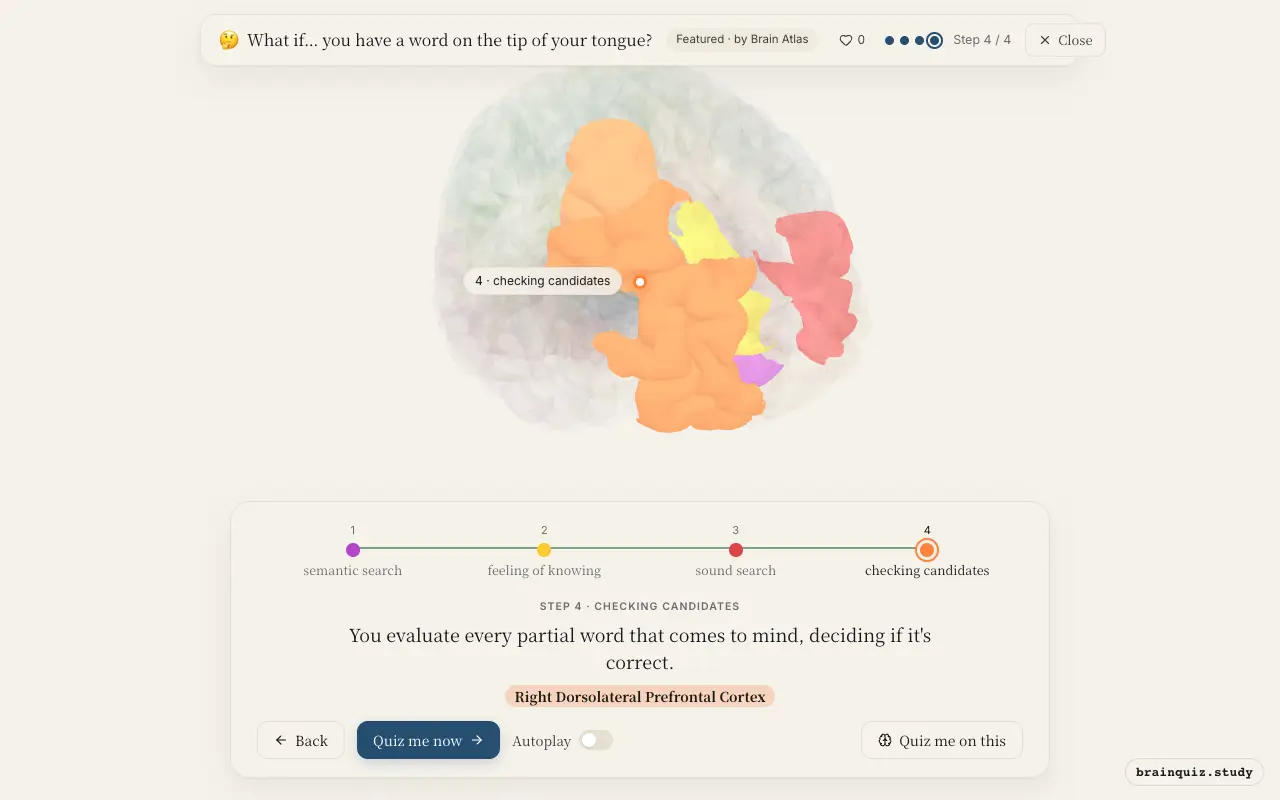
Watch it light up on the 3D brain
Brain regions that light up
| Order | Region | What it does here |
|---|---|---|
| 1 | Left Anterior Temporal Lobe | You try to retrieve the concept, activating related words and meanings. |
| 2 | Anterior Cingulate Cortex | You sense you know the word but can't produce it, creating a mental conflict. |
| 3 | Left Inferior Frontal Gyrus | You try to assemble the word's sounds, often retrieving only fragments or similar words. |
| 4 | Right Dorsolateral Prefrontal Cortex | You evaluate every partial word that comes to mind, deciding if it's correct. |
1. Left Anterior Temporal Lobe: semantic search
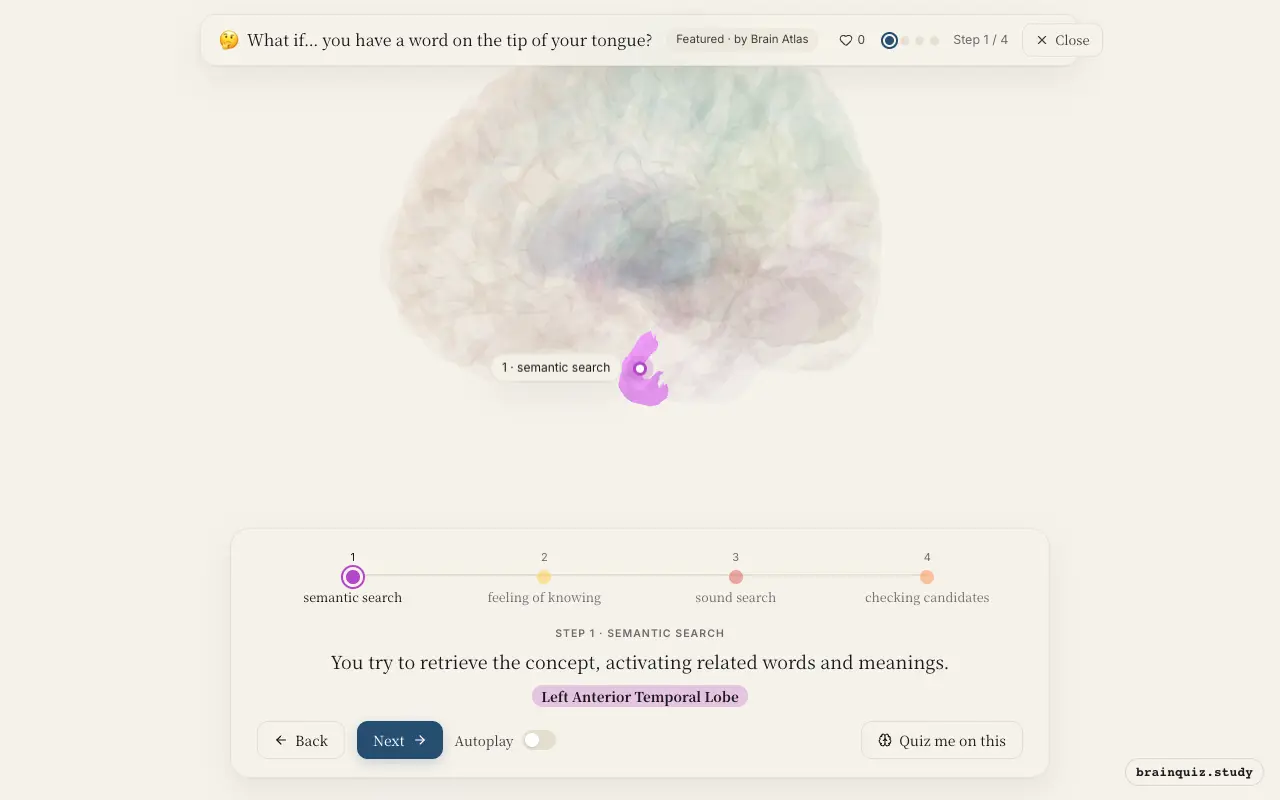
The left anterior temporal lobe acts as a hub for semantic memory, spreading activation among related concepts. When you try to recall a word, this region partially activates the target concept along with its close associates, giving you a sense of familiarity but not enough to produce the exact term.
2. Anterior Cingulate Cortex: feeling of knowing
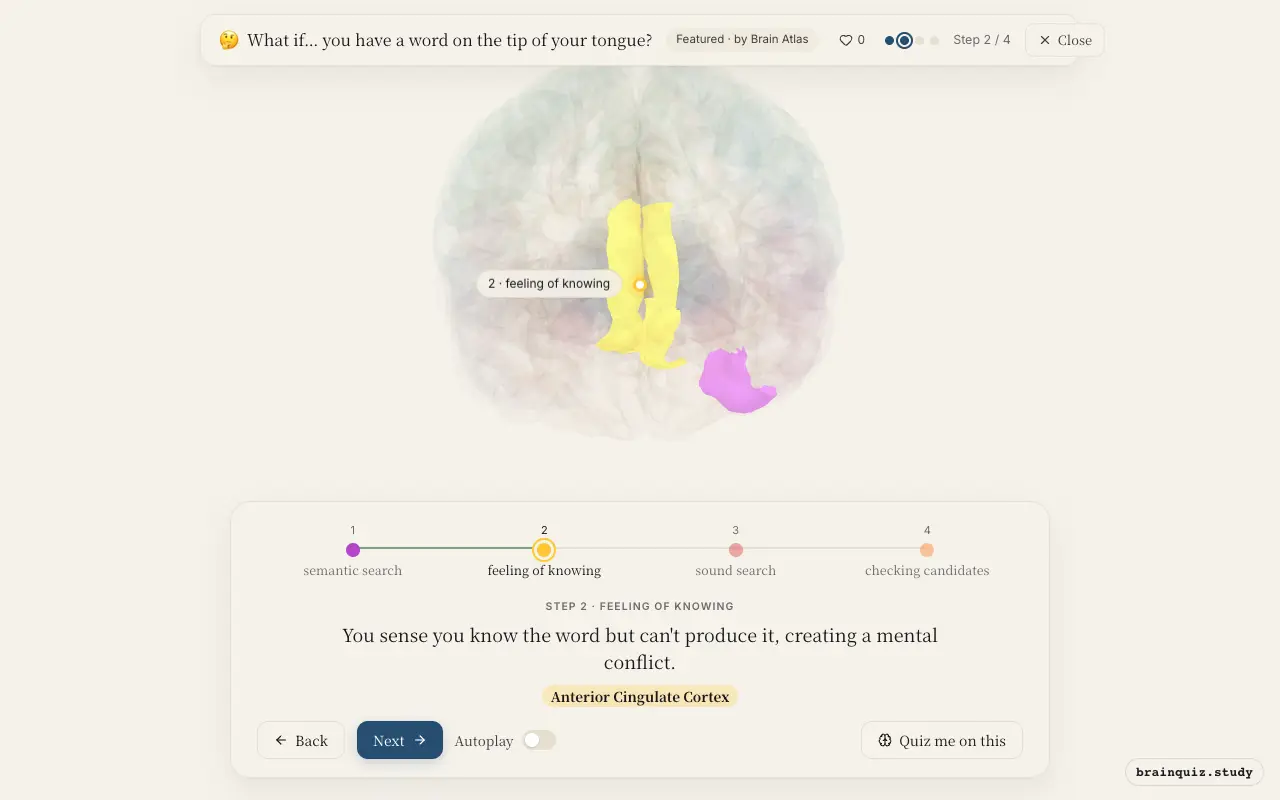
The anterior cingulate cortex monitors ongoing performance for errors and conflicts. In a tip-of-the-tongue state, it detects the discrepancy between your strong feeling of knowing and your inability to produce the word, generating a sense of frustration and motivating continued search.
3. Left Inferior Frontal Gyrus: sound search
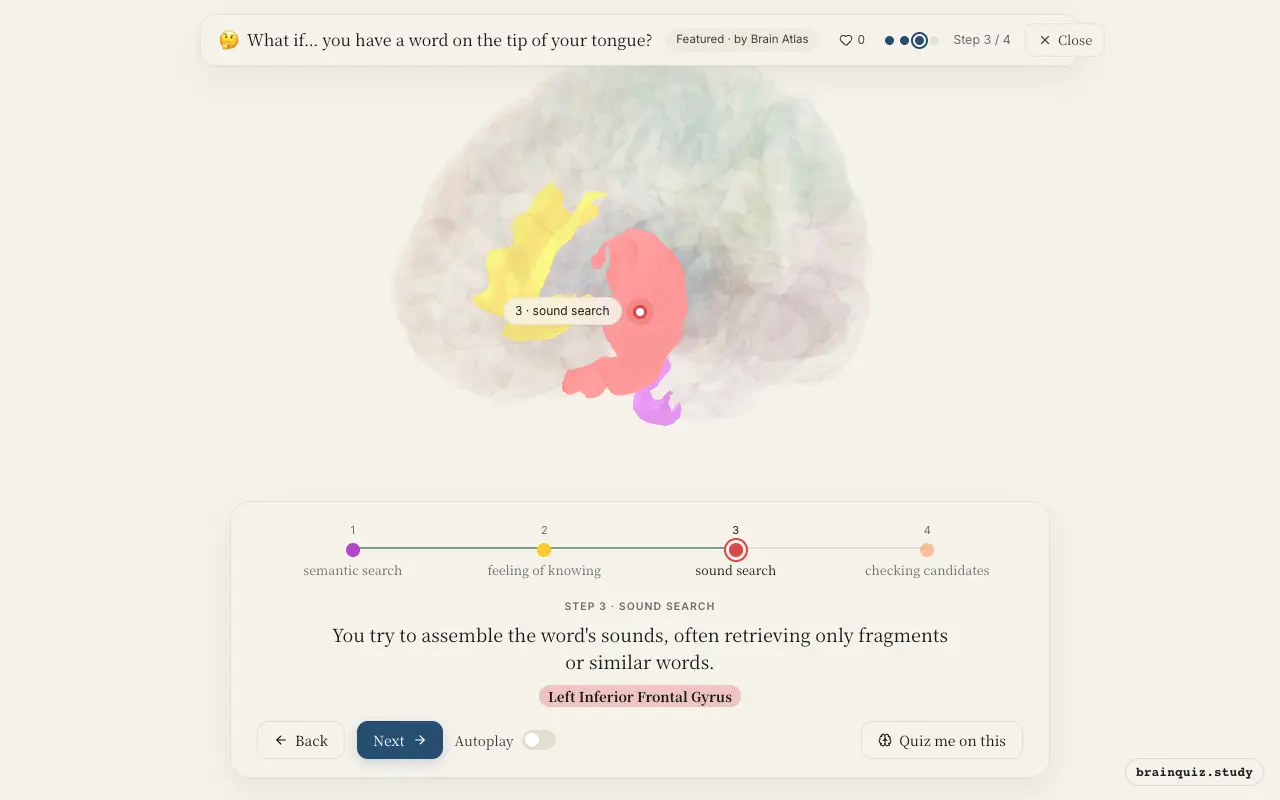
The left inferior frontal gyrus, overlapping Broca's area, is essential for phonological encoding and speech planning. During a TOT state, it attempts to assemble the word's sound form from partial information, often producing only a fragment or a similar-sounding word, which explains why you might recall the first letter or syllable count.
4. Right Dorsolateral Prefrontal Cortex: checking candidates
The right dorsolateral prefrontal cortex is responsible for monitoring retrieved information and evaluating whether it matches the desired target. In a tip-of-the-tongue state, this region stays highly active as you sift through candidate words, rejecting incorrect ones and prolonging the search until you either find the word or give up.
Good to know
- Tip-of-the-tongue states are more common for proper names and low-frequency words, reflecting weaker memory traces.
- People in a TOT state can often recall the word's first letter or number of syllables, showing partial phonological access.
- TOT frequency increases with age, possibly due to slower retrieval or reduced inhibitory control.
TOT vs successful recall
During successful recall, the left inferior frontal gyrus and temporal lobe work together smoothly, and the anterior cingulate shows minimal conflict. In TOT, conflict activation rises, and the right DLPFC prolongs monitoring of candidate words. The key difference is the unresolved mismatch between semantic and phonological access.
Test yourself
Which brain region is most involved in detecting the conflict of knowing a word but failing to produce it?
The left inferior frontal gyrus is thought to be crucial for what aspect of the tip-of-the-tongue state?
Compared with successful recall, tip-of-the-tongue states show increased activity in which region?
0 of 3 answered · 0 correct
Simplified: many regions work together at once, and this shows the main players in the order they act.