What happens in your brain when you walk into a room and forget why?
Updated
Walking into a new room is thought to involve the parahippocampal gyrus and hippocampus treating it as a new event, which may disrupt prefrontal goal maintenance, with the anterior cingulate cortex signaling the error.
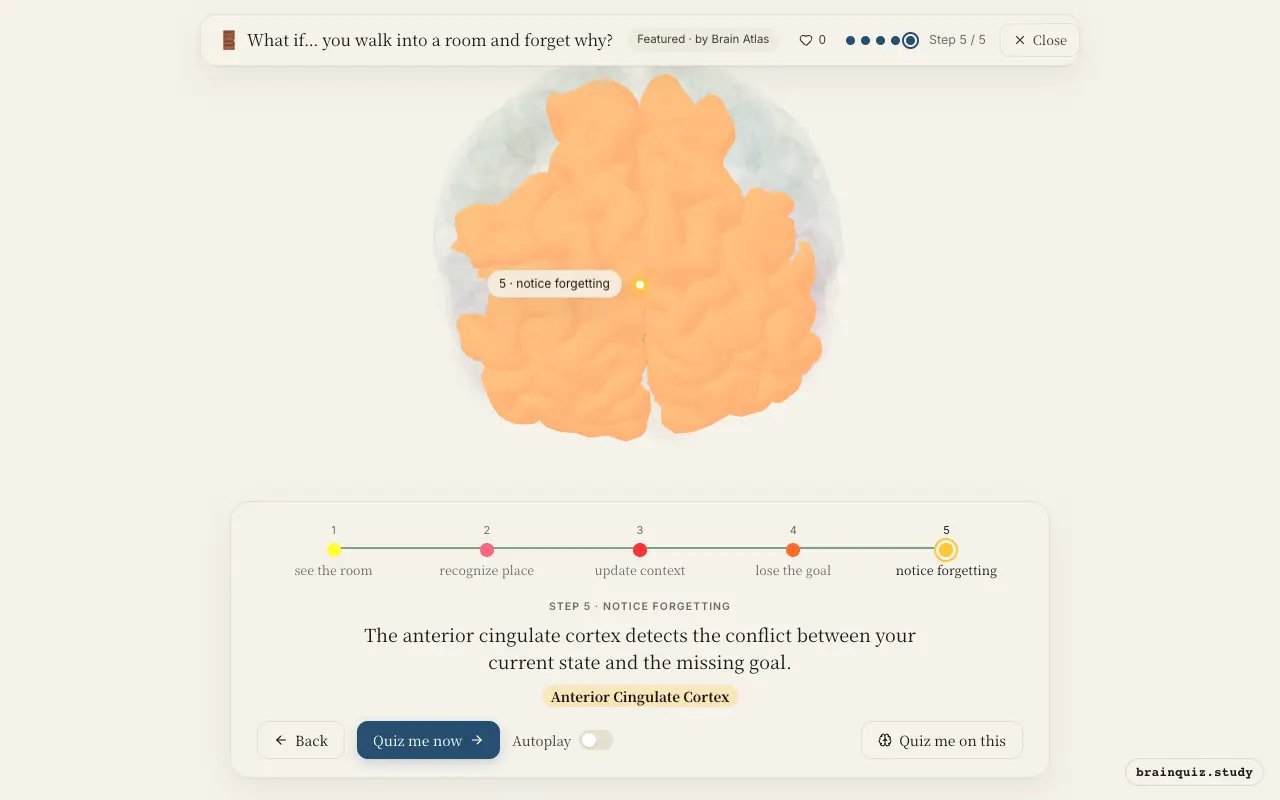
Watch it light up on the 3D brain
Brain regions that light up
| Order | Region | What it does here |
|---|---|---|
| 1 | Visual Cortex | Your visual cortex rapidly processes the layout and objects of the new room. |
| 2 | Parahippocampal Gyrus | The parahippocampal gyrus identifies the room as a distinct spatial scene. |
| 3 | Hippocampus | Your hippocampus encodes the new context, creating an event boundary that separates memories. |
| 4 | Prefrontal Cortex | The prefrontal cortex may fail to maintain your original intention across the transition. |
| 5 | Anterior Cingulate Cortex | The anterior cingulate cortex detects the conflict between your current state and the missing goal. |
1. Visual Cortex: see the room
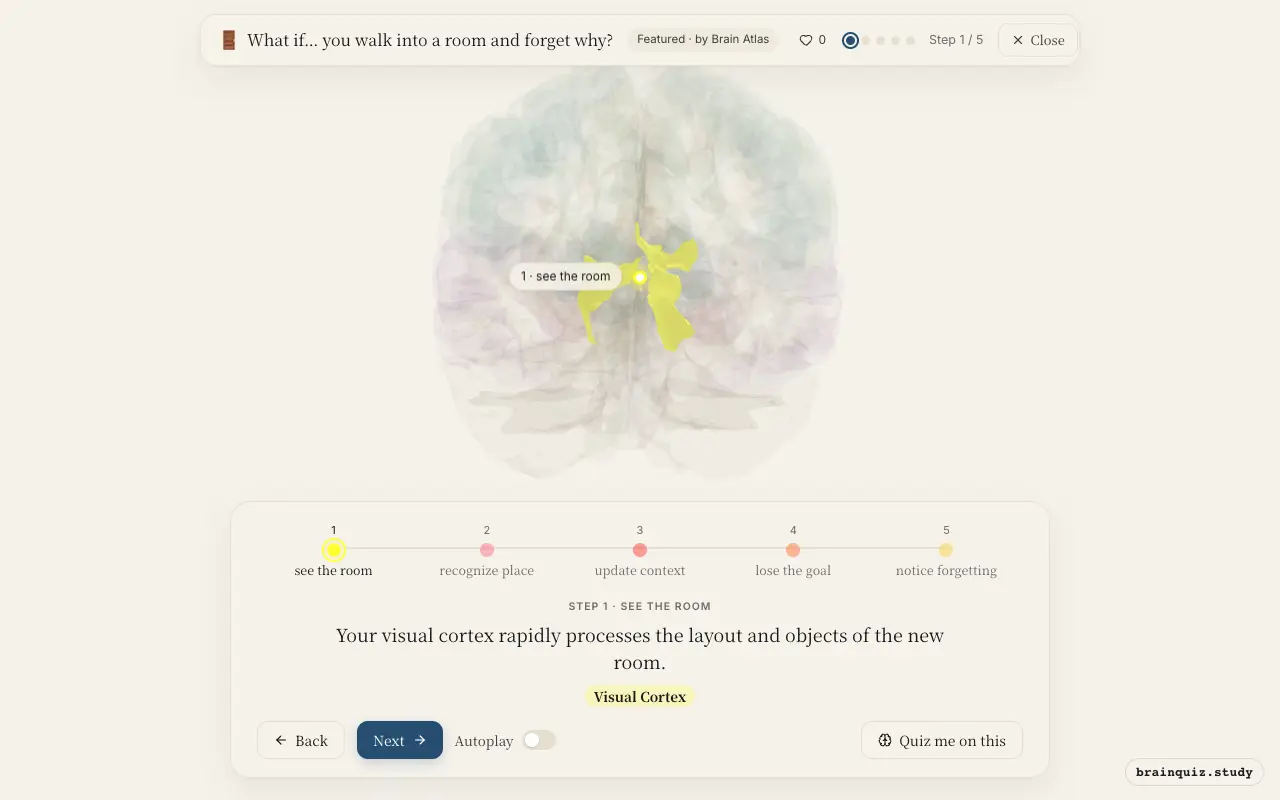
The visual cortex in the occipital lobe extracts edges, motion, and orientation, constructing a coherent representation of the unfamiliar space. This bottom-up sensory stream provides the raw material for spatial context updating.
2. Parahippocampal Gyrus: recognize place
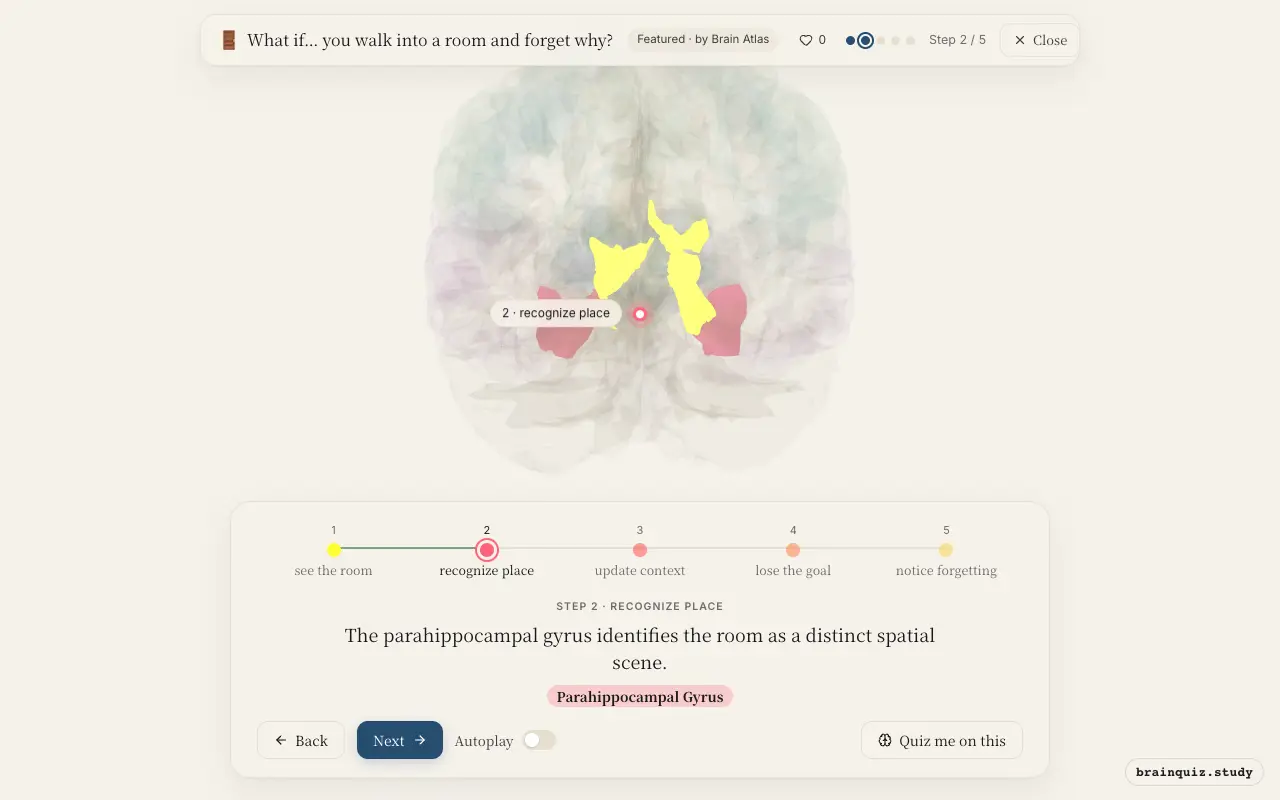
This region, especially the parahippocampal place area, is tuned to scenes and landmarks. It signals that you have entered a new environment, setting the stage for an event boundary.
3. Hippocampus: update context
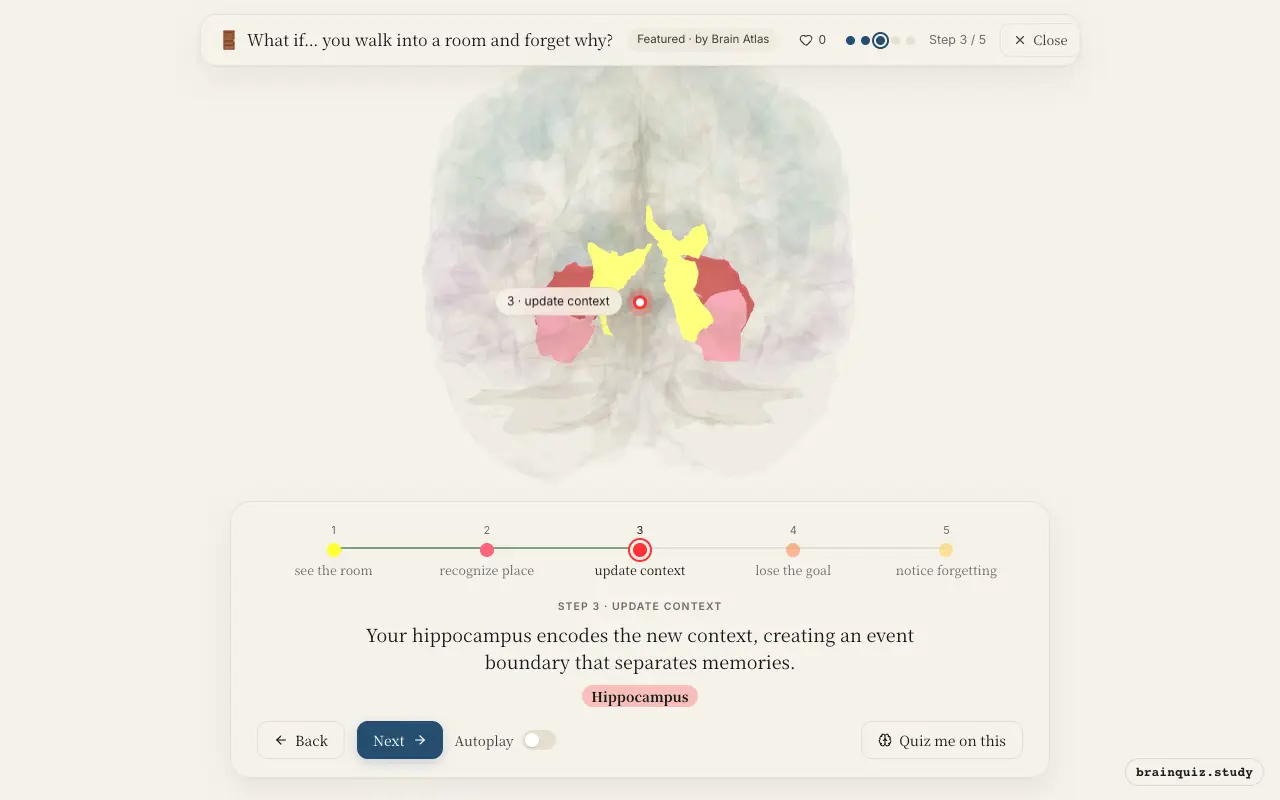
The hippocampus binds together the elements of the current episode. When the context shifts, it essentially closes the previous memory file and opens a new one, making the prior intention less accessible.
4. Prefrontal Cortex: lose the goal
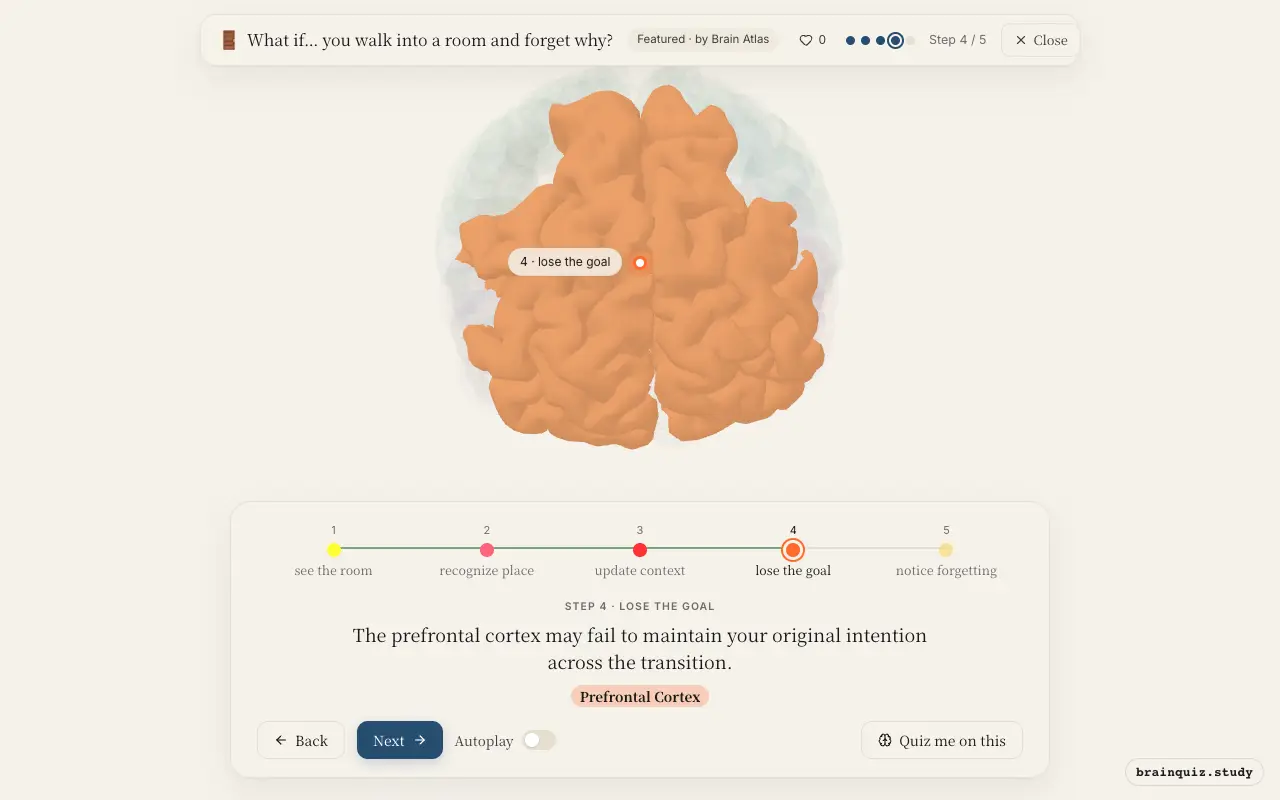
Working memory in the dorsolateral prefrontal cortex actively holds goals in mind. But when context changes, that active representation may be disrupted or displaced by new sensory input, so the goal is no longer in the foreground.
5. Anterior Cingulate Cortex: notice forgetting
This region monitors for errors and conflicts between expected and actual outcomes. When you realize you have forgotten, it generates a conflict signal that prompts you to search for the lost intention.
Good to know
- The 'doorway effect' is thought to occur because event boundaries impair memory for information from the immediately preceding context.
- Studies suggest that passing through a doorway impairs memory for recently formed associations, particularly when the context change is salient.
- The hippocampus is critical for context-dependent memory retrieval; lesions there cause profound anterograde amnesia.
Forgetting due to doorway vs. time delay
When you simply forget due to delay, the memory trace weakens gradually through decay or interference, without a sharp context shift. The doorway effect produces a sudden drop in accessibility because the hippocampal representation is updated by new spatial input, not because time passed.
Test yourself
Which brain region is most directly responsible for detecting that you have forgotten your purpose?
The 'doorway effect' is best explained by:
Which region is specialized for recognizing scenes and places?
0 of 3 answered · 0 correct
Simplified: many regions work together at once, and this shows the main players in the order they act.