Parahippocampal Gyrus — Function, Location & Quiz
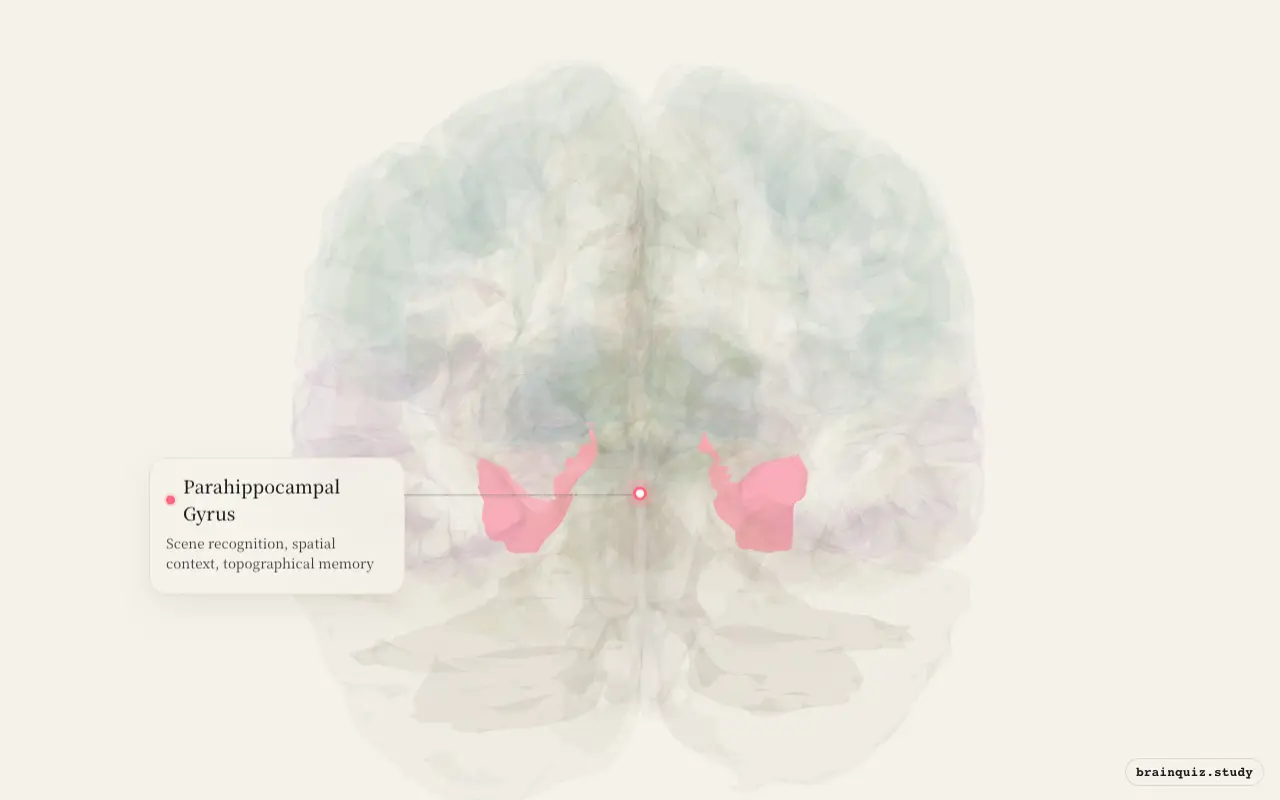
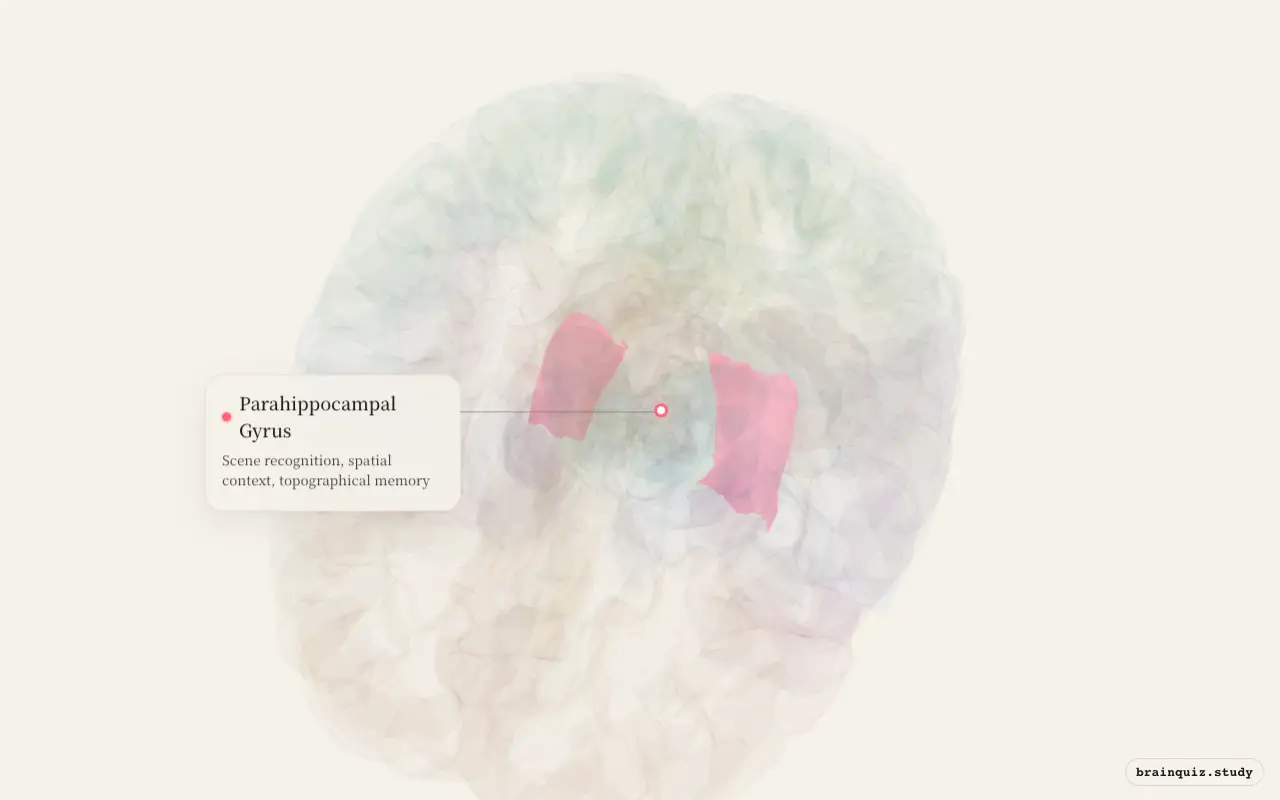
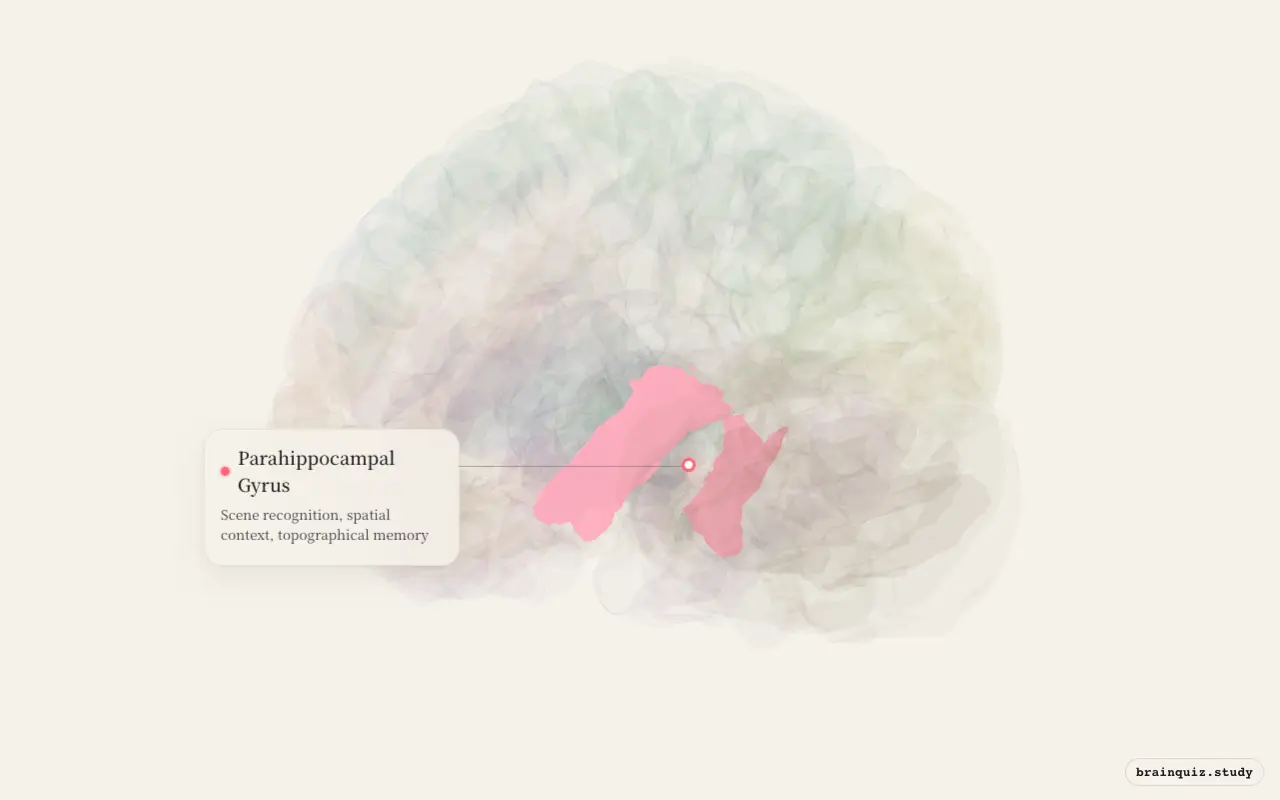
The parahippocampal gyrus supplies the memory system with the setting around an event. Its scene-selective territory responds strongly to places and layouts, complementing fusiform systems for faces and perirhinal systems for item familiarity.
That division explains why a person can identify objects yet become lost in familiar surroundings after relevant damage. The structure is not the hippocampus itself; it is adjacent cortical territory that channels spatial context toward entorhinal and hippocampal circuits.
Test this anatomy in the Brain Regions Quiz: 15 Questions With Answers or explore it on the interactive 3D brain.
Where is the Parahippocampal Gyrus located?
Scene recognition, spatial context, topographical memory.
What does the Parahippocampal Gyrus do?
- Scene and place recognition (parahippocampal place area — PPA)
- Spatial context and topographical memory
- Familiarity-based recognition (perirhinal cortex)
- Contextual associations — binding objects to places
Parahippocampal Gyrus pathways and connections
- PHC → Entorhinal cortex → Hippocampus (spatial context input)
- PHC ← Retrosplenial cortex, parietal cortex (spatial info)
- Perirhinal → EC (object identity input to memory system)
What happens when the Parahippocampal Gyrus is damaged?
- Damage → topographical disorientation (can't navigate familiar places)
- Parahippocampal lesion → inability to learn new spatial layouts
- Perirhinal lesion → impaired familiarity judgments (but recollection may be spared)
Parahippocampal Gyrus key facts
Atlas category: cortical. Brodmann areas or landmark: BA 36 (perirhinal), BA 35, 37 (parahippocampal).
- Epstein & Kanwisher (1998): PPA responds strongly to scenes/places, not faces or objects
- PPA + retrosplenial cortex + hippocampus = the brain's navigation system
- Dual-process theory: perirhinal = familiarity, hippocampus = recollection
Parahippocampal Gyrus exam tip
PPA = scenes/places. FFA = faces. These are the two most-tested category-selective areas. Know Epstein & Kanwisher.
Common questions
What does the parahippocampal gyrus do?
It supports scene recognition, spatial context, topographical memory and associations between objects and the places in which they appear.
What is the parahippocampal place area?
The PPA is scene-selective parahippocampal cortex that responds strongly to places and spatial layouts, in contrast with fusiform regions that prefer faces.
What happens after parahippocampal damage?
Damage can cause topographical disorientation and difficulty learning new spatial layouts even when basic vision and object recognition remain available.
When does the Parahippocampal Gyrus light up?
- 🅿️ When you forget where you parked: The parahippocampal gyrus processes the visual scene but stores a shallow representation of the parking area.
- 🤔 When you get déjà vu: The parahippocampal gyrus evaluates the spatial layout and triggers a sense of familiarity.
- 🚪 When you walk into a room and forget why: The parahippocampal gyrus identifies the room as a distinct spatial scene.
- 🧭 When you get lost in a new city: The parahippocampal gyrus tries to match the scene to any familiar place memory.
- 🗺️ When you read a map: The parahippocampal gyrus identifies the map as a spatial scene, not just a flat image.