What happens in your brain when you get lost in a new city?
Updated
As you wander, your visual cortex processes unfamiliar sights, the parahippocampal gyrus recognizes scenes, the entorhinal cortex maps space, the hippocampus tries to build a cognitive map, and the prefrontal cortex plans next moves.
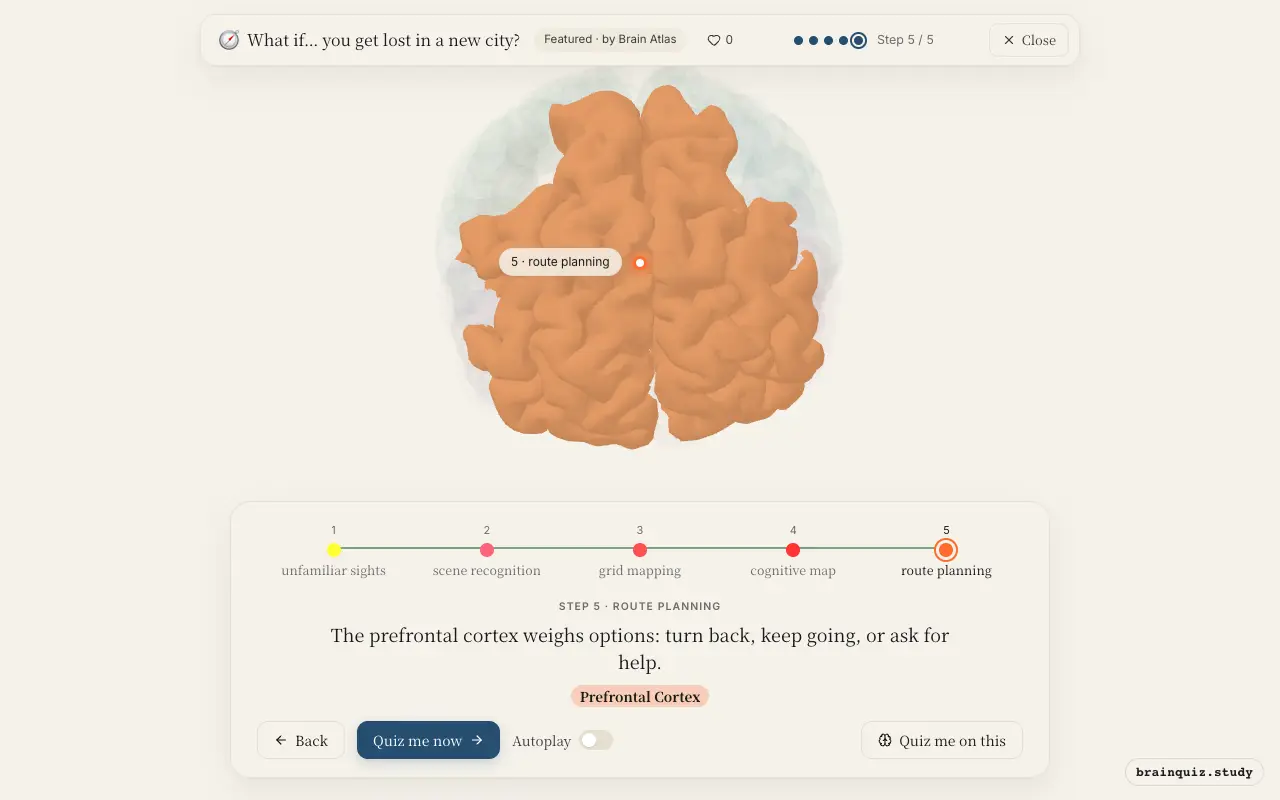
Watch it light up on the 3D brain
Brain regions that light up
| Order | Region | What it does here |
|---|---|---|
| 1 | Visual Cortex | Your visual cortex processes the streams of unfamiliar buildings, cars, and people. |
| 2 | Parahippocampal Gyrus | The parahippocampal gyrus tries to match the scene to any familiar place memory. |
| 3 | Entorhinal Cortex | Entorhinal grid cells fire in repeating patterns as you move, charting distance and direction. |
| 4 | Hippocampus | Your hippocampus attempts to assemble a cognitive map from these spatial signals. |
| 5 | Prefrontal Cortex | The prefrontal cortex weighs options: turn back, keep going, or ask for help. |
1. Visual Cortex: unfamiliar sights
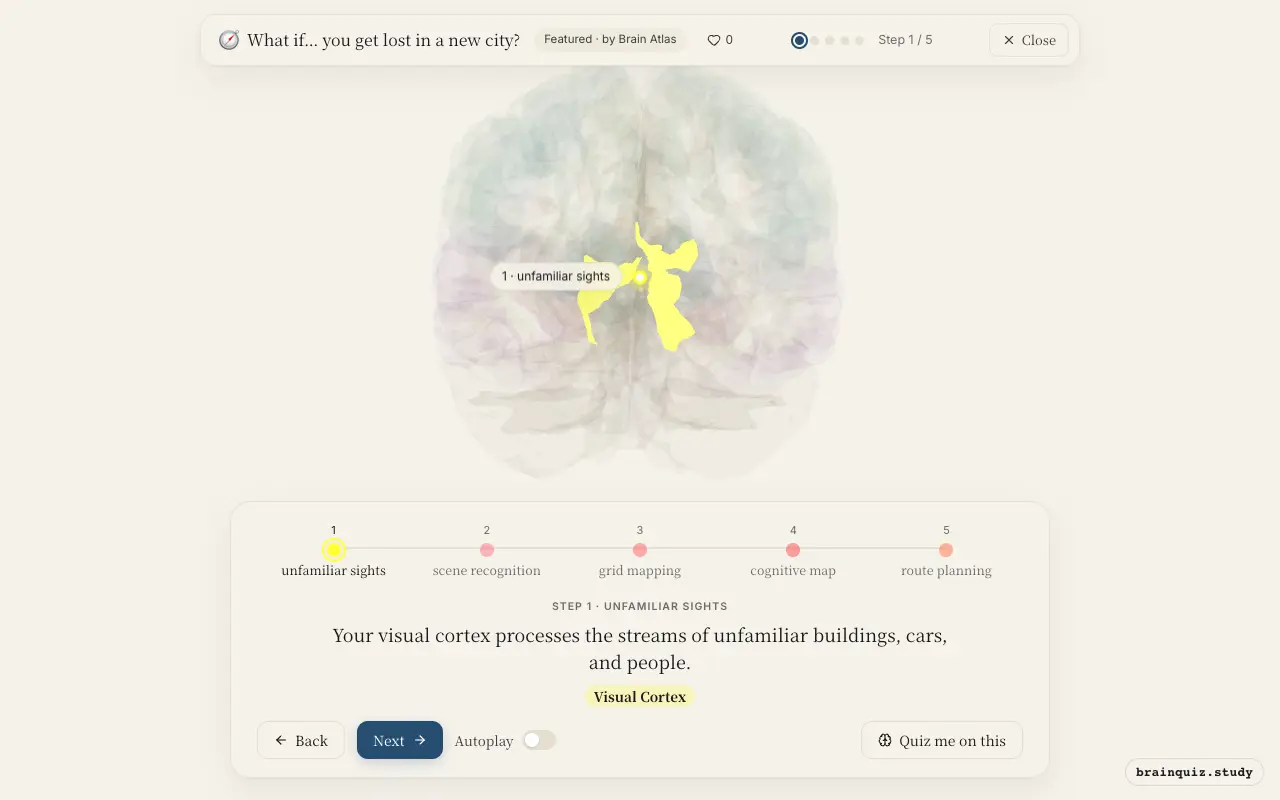
The primary visual cortex extracts edges, orientation, and motion from the scene. This raw visual information is then sent to higher visual areas for more complex processing, such as object and scene recognition. Without this initial analysis, you couldn't perceive the city around you at all.
2. Parahippocampal Gyrus: scene recognition
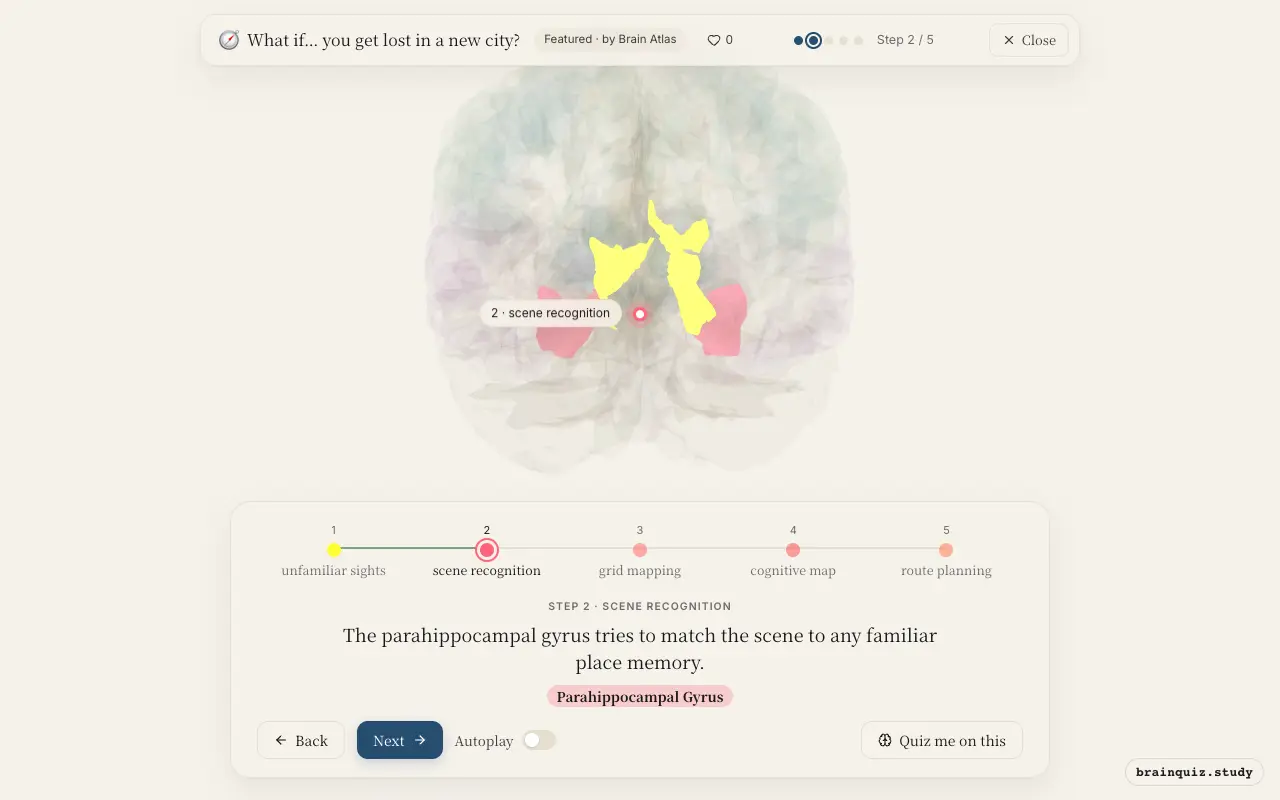
The parahippocampal place area (PPA) encodes the spatial layout of scenes and landmarks, such as buildings and streets. It compares the current view with stored representations, but in a new city, no strong match is found, adding to the feeling of unfamiliarity. Damage to this region impairs the ability to recognize places.
3. Entorhinal Cortex: grid mapping
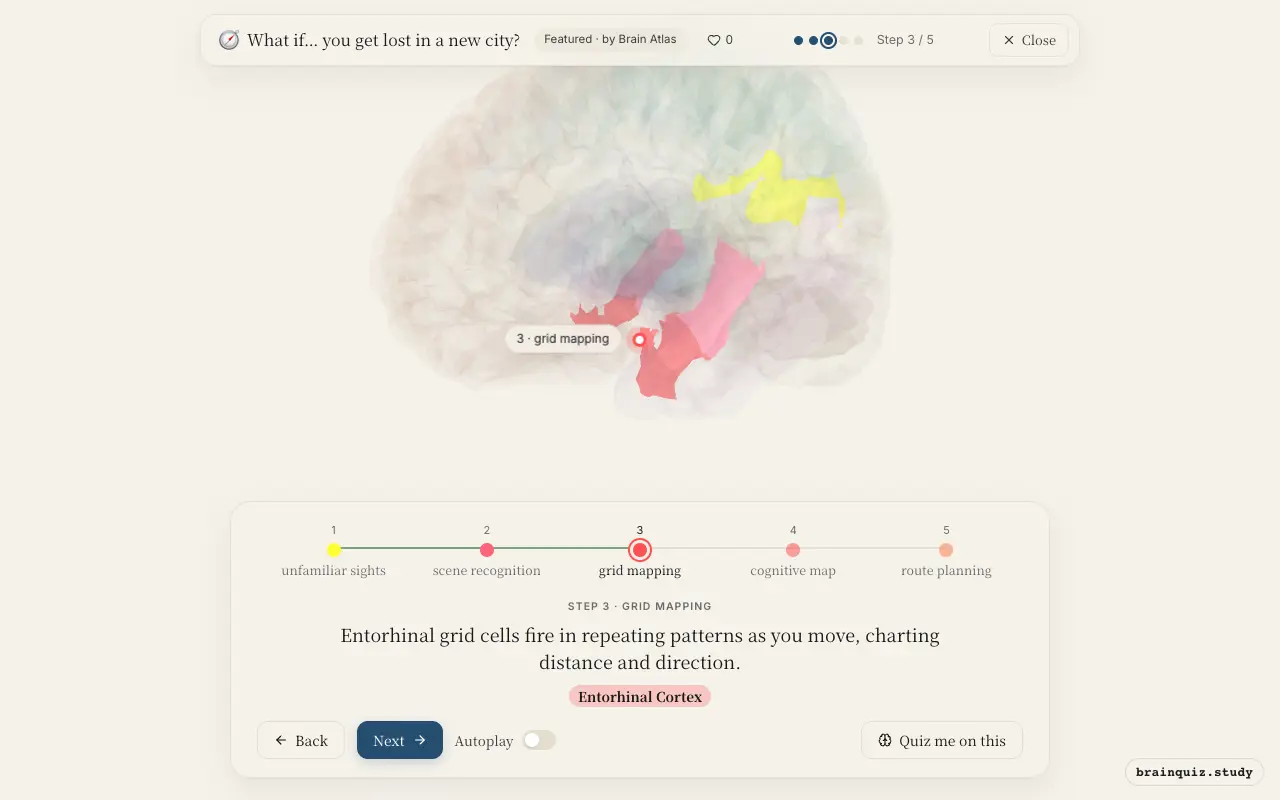
Grid cells in the entorhinal cortex create a hexagonal coordinate system for space, updating as you walk. This metric information about distances and directions is sent to the hippocampus, allowing the brain to track your position even without landmarks. Without this, you would have a poor sense of how far you've traveled.
4. Hippocampus: cognitive map
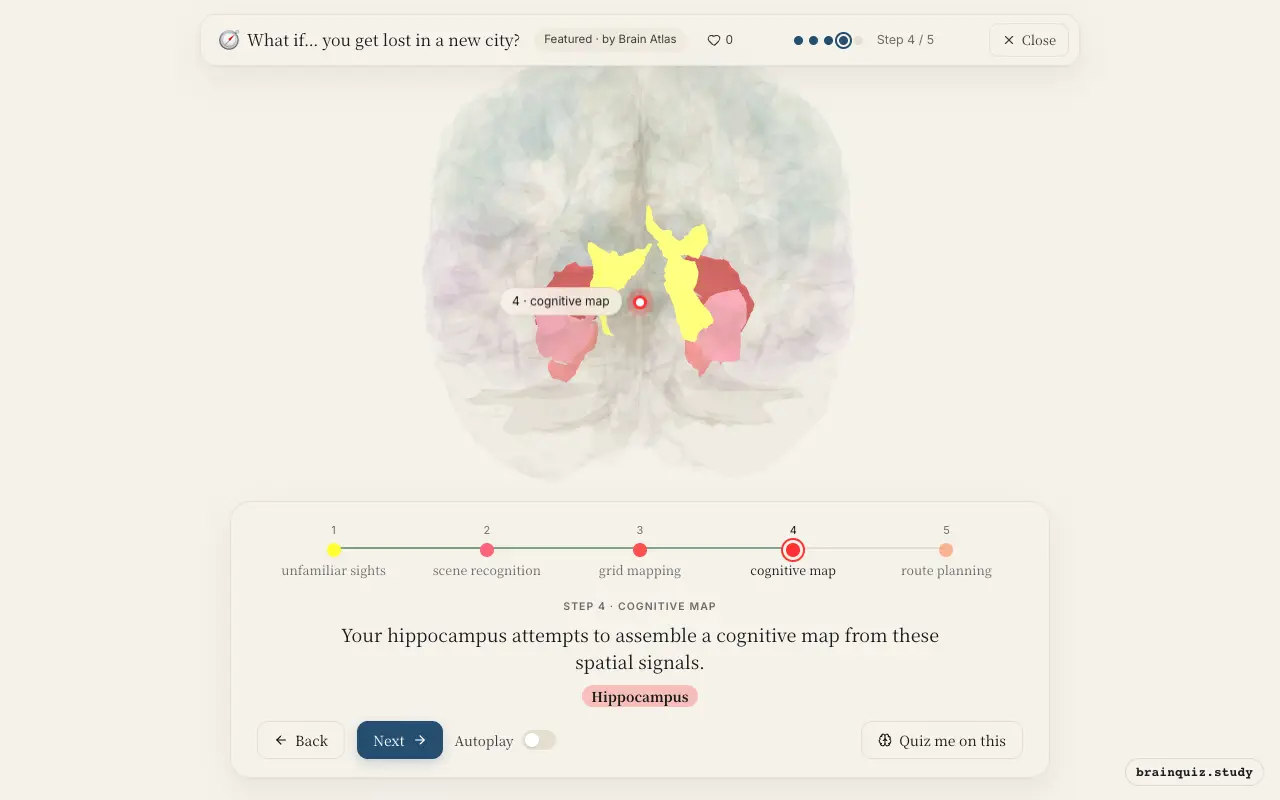
Place cells in the hippocampus fire at specific locations, integrating grid cell input with sensory landmarks to form a coherent map of the environment. In an unfamiliar city, this map is incomplete or inaccurate, leading to disorientation. The hippocampus also retrieves memories of similar places, but those may not match.
5. Prefrontal Cortex: route planning
The dorsolateral prefrontal cortex supports working memory, holding the goal of finding your way while evaluating possible routes. It integrates information from the hippocampus and parietal cortex to make decisions under uncertainty. It also inhibits impulsive choices, like randomly wandering, in favor of a more deliberate strategy.
Good to know
- The anterior cingulate cortex signals conflict when your expected landmarks fail to appear, an early neural marker of being lost.
- Grid cells in the entorhinal cortex were discovered in rodents and are thought to underlie metric spatial coding in humans as well.
- The amygdala may activate in response to the stress of being lost, which can impair prefrontal planning and hippocampal memory retrieval.
New city vs familiar route
In a familiar city, the hippocampus retrieves an existing cognitive map, and the caudate may execute the route as a learned habit, requiring little prefrontal effort. In a new city, no map exists, so the entorhinal cortex and hippocampus must build one from scratch, with the prefrontal cortex constantly making decisions.
Test yourself
Which brain region is most important for recognizing a place as unfamiliar?
Where are grid cells, which provide a metric for space, located?
Which region detects the mismatch that tells you something is wrong when you're lost?
0 of 3 answered · 0 correct
Simplified: many regions work together at once, and this shows the main players in the order they act.