What happens in your brain when you hear your name in a crowd?
Updated
Your auditory cortex first processes the sound; Wernicke's area recognizes it as your name; the anterior cingulate flags it as salient; the insula contributes to self-awareness; the amygdala triggers an emotional response, preparing you to respond.
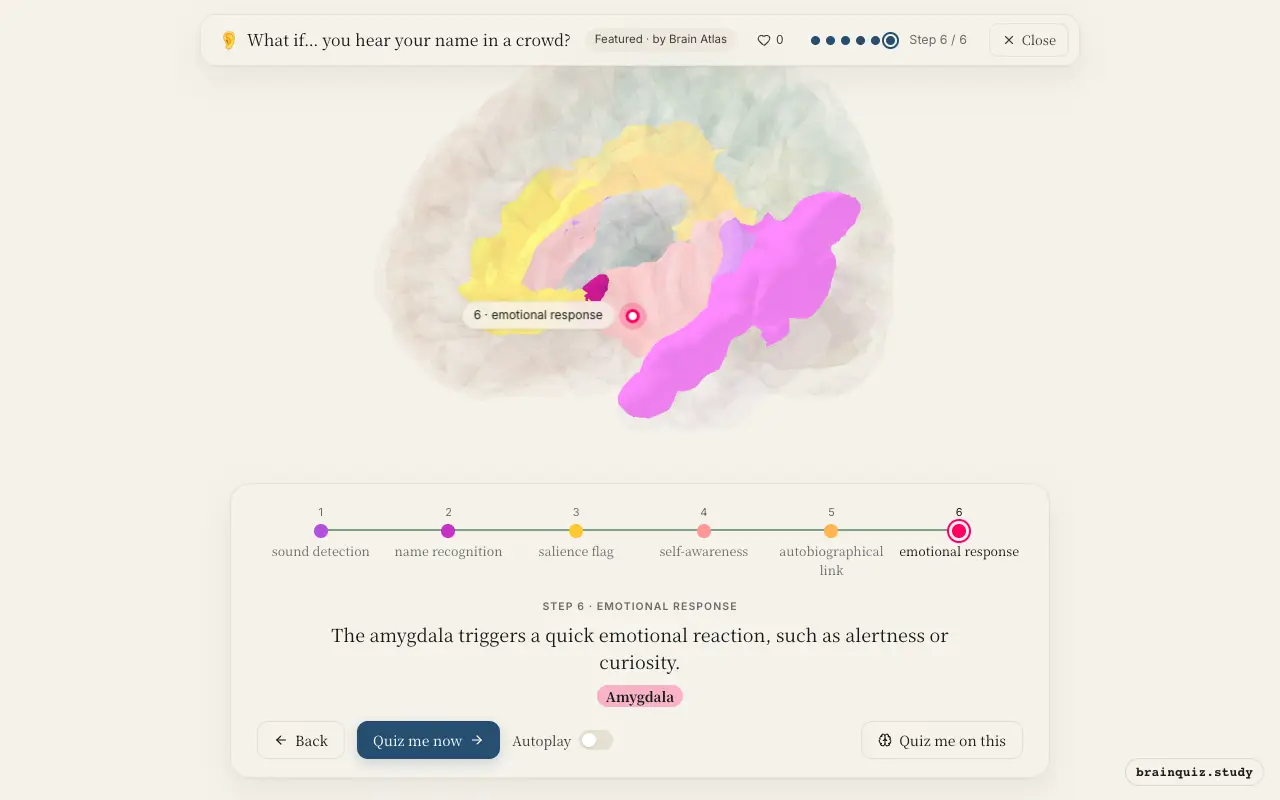
Watch it light up on the 3D brain
Brain regions that light up
| Order | Region | What it does here |
|---|---|---|
| 1 | Auditory Cortex | Your auditory cortex processes the acoustic signal, separating your name from background noise. |
| 2 | Wernicke's Area | Wernicke's area decodes the phonemes into a meaningful word: your name. |
| 3 | Anterior Cingulate Cortex | The anterior cingulate flags your name as personally salient, interrupting ongoing attention. |
| 4 | Insula | The insula contributes to the felt sense that this stimulus is about you. |
| 5 | Posterior Cingulate Cortex | The posterior cingulate connects your name to personal memories and self-identity. |
| 6 | Amygdala | The amygdala triggers a quick emotional reaction, such as alertness or curiosity. |
1. Auditory Cortex: sound detection
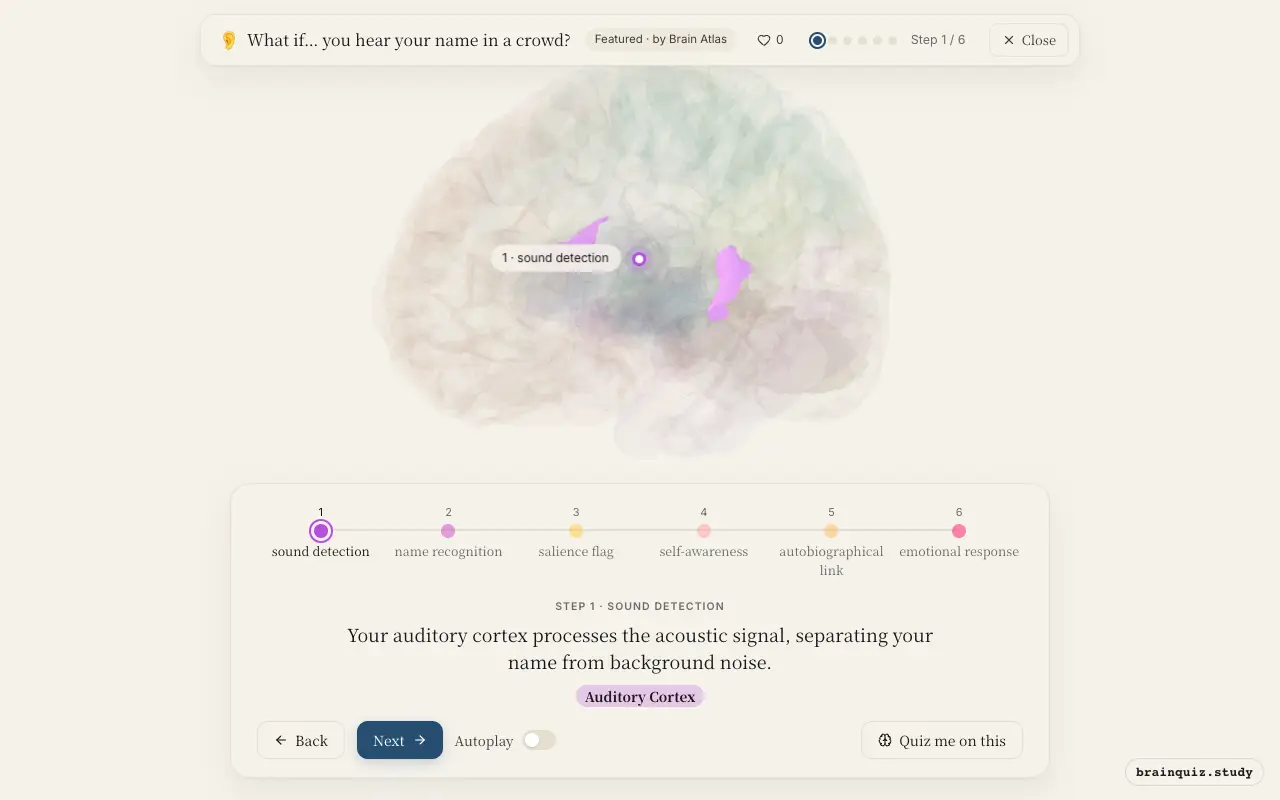
The auditory cortex receives input from the ears via the thalamus and decodes pitch, timing, and acoustic features. It parses the complex auditory scene, allowing later regions to identify speech sounds. This initial processing is automatic and happens within milliseconds.
2. Wernicke's Area: name recognition
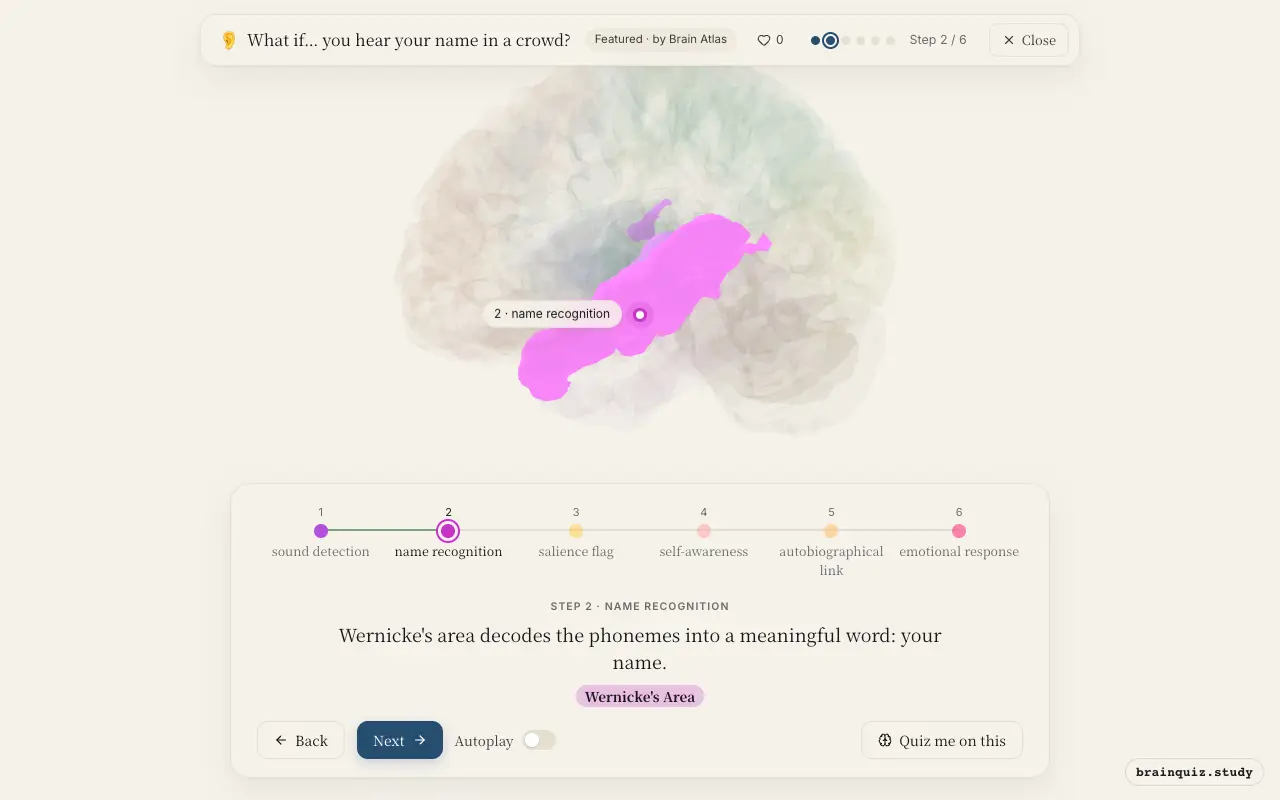
This region maps the sound pattern onto stored lexical representations, recognizing the sequence as a familiar proper noun. Because your name is highly practiced, recognition is rapid and automatic. It then sends this semantic information to higher-order association areas.
3. Anterior Cingulate Cortex: salience flag
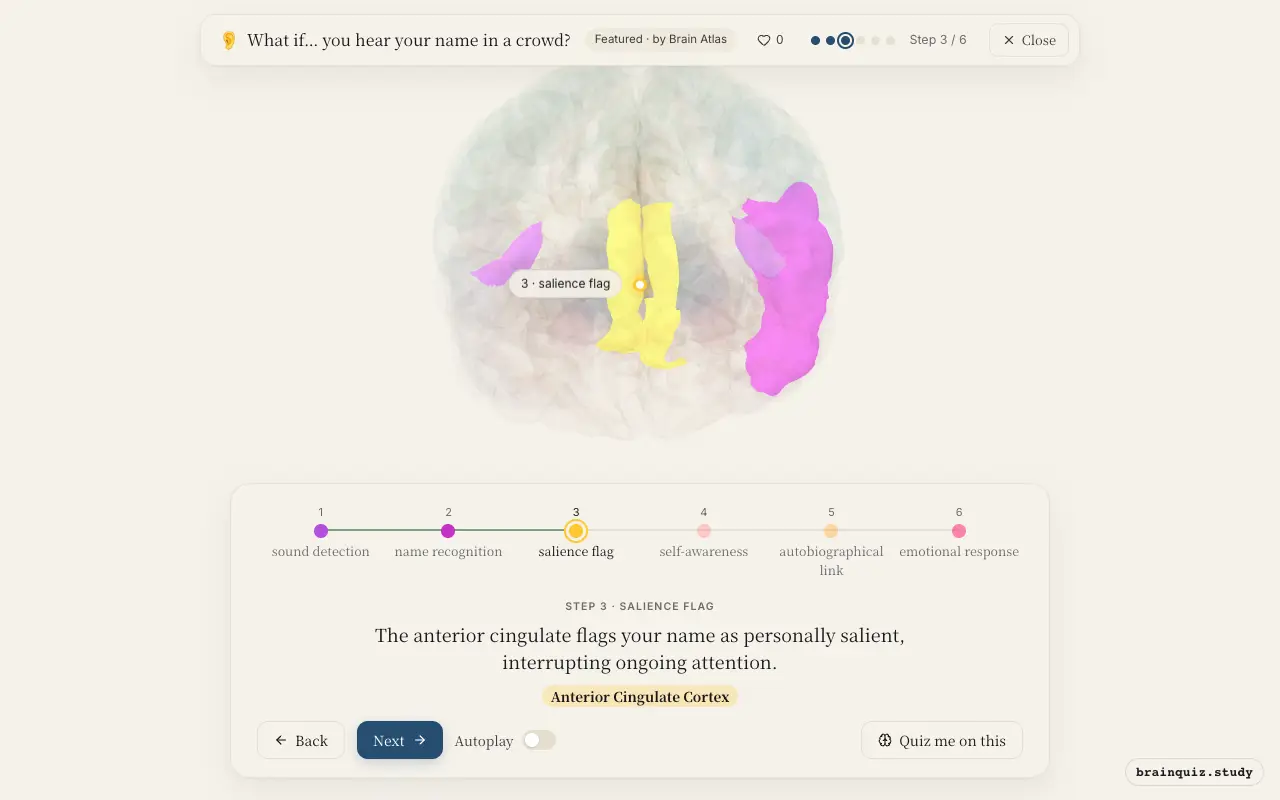
As part of the salience network, the ACC detects conflict between the unexpected self-relevant stimulus and your current focus. It triggers a shift in attention, recruiting prefrontal and parietal regions to orient toward the sound. This response is thought to be rapid and unconscious.
4. Insula: self-awareness
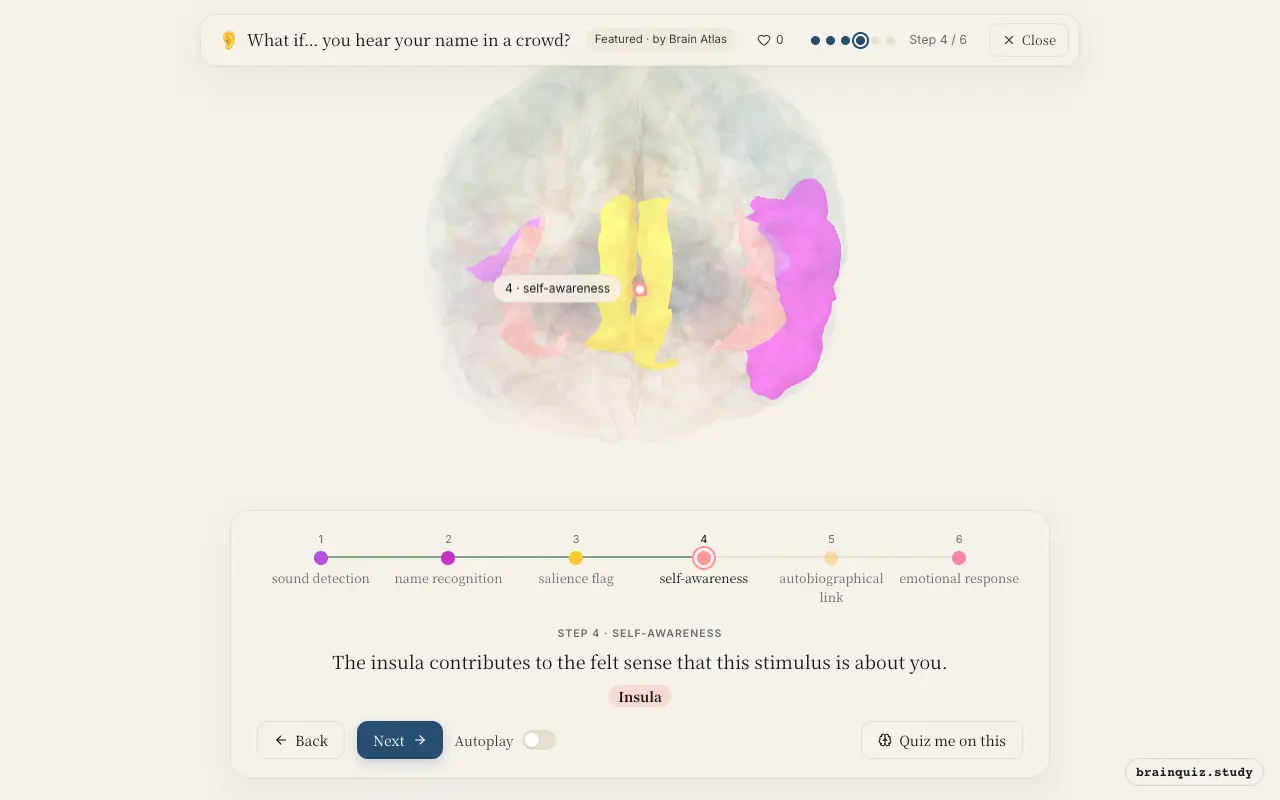
The insula integrates interoceptive signals, producing a subjective awareness of 'me-ness'. Activation here correlates with emotional and bodily reactions to self-relevant stimuli. It helps you consciously register that your name was called, rather than just any name. Studies suggest the insula is a key node for self-awareness.
5. Posterior Cingulate Cortex: autobiographical link
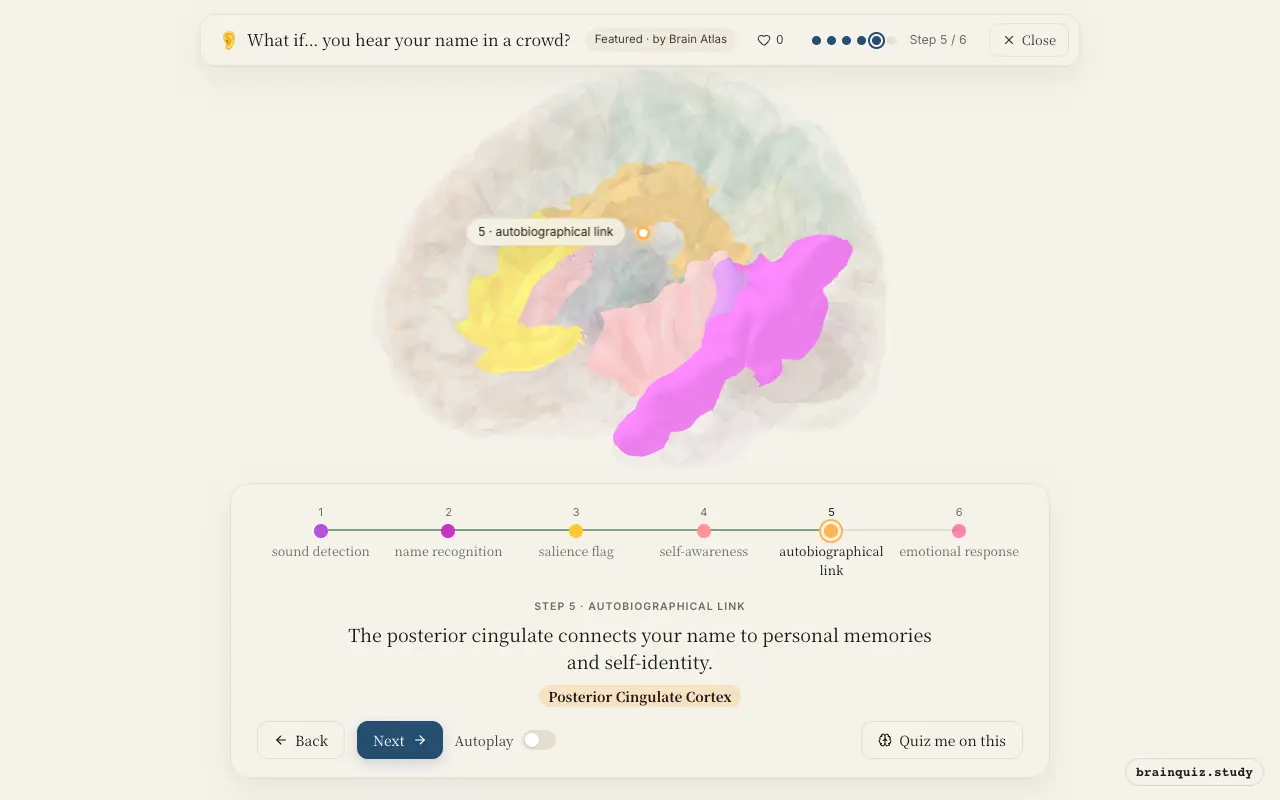
As a hub of the default mode network, the posterior cingulate is active during self-referential thought and autobiographical memory retrieval. It links the heard name to your life narrative, reinforcing that the stimulus is uniquely yours. This region is also involved in maintaining a continuous sense of self.
6. Amygdala: emotional response
The amygdala evaluates the emotional significance of hearing your name, especially in a social context. It can activate the autonomic nervous system, causing a slight increase in heart rate or heightened attention. This response prepares you to engage with the person who called you.
Good to know
- The cocktail party effect describes the ability to focus on one conversation while filtering out background noise, but hearing your own name often breaks through the filter.
- The salience network, including the anterior cingulate and insula, is thought to detect behaviorally relevant stimuli and switch attention.
- Self-referential processing consistently activates the posterior cingulate cortex and medial prefrontal cortex.
Your name vs a stranger's name
When you hear a stranger's name, auditory and language areas activate similarly, but the salience network and self-referential regions show much less response. Your own name triggers stronger anterior cingulate, insula, and posterior cingulate activity, reflecting its personal relevance. This difference is thought to underlie the cocktail party effect.
Test yourself
Which brain region first processes the acoustic signal of your name?
The salience of your own name is primarily detected by the...
Hearing your name in a crowd is an example of the...
0 of 3 answered · 0 correct
Simplified: many regions work together at once, and this shows the main players in the order they act.