Wernicke's Area — Function, Location & Quiz
Wernicke’s area links heard language with meaning in the usually dominant posterior temporal cortex. It is commonly paired with Broca’s area, but their classic syndromes differ in both anatomy and the direction of failure: comprehension breaks down here while speech remains fluent.
Fluency can hide the severity of the deficit. A patient may produce effortless sentences that contain substitutions or invented words and may not recognize that the message is incomprehensible, making awareness another useful contrast with Broca’s aphasia.
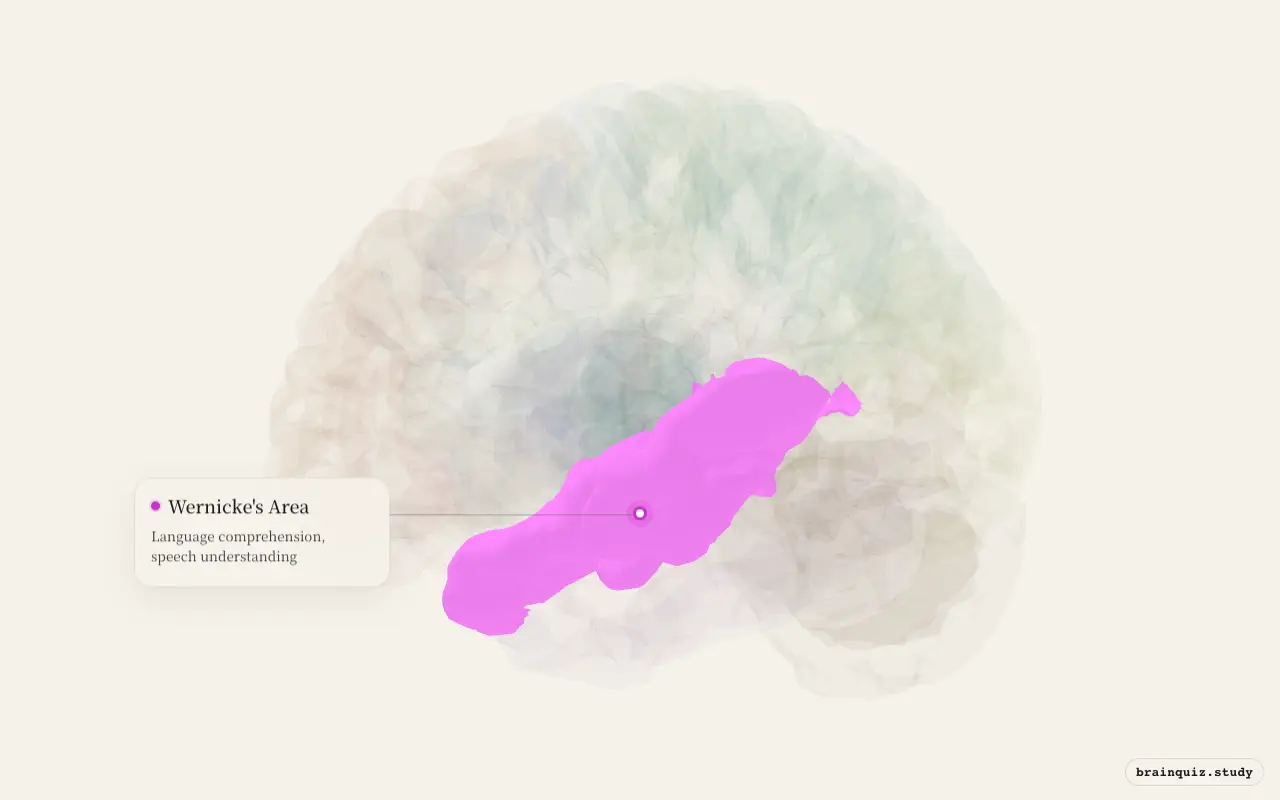
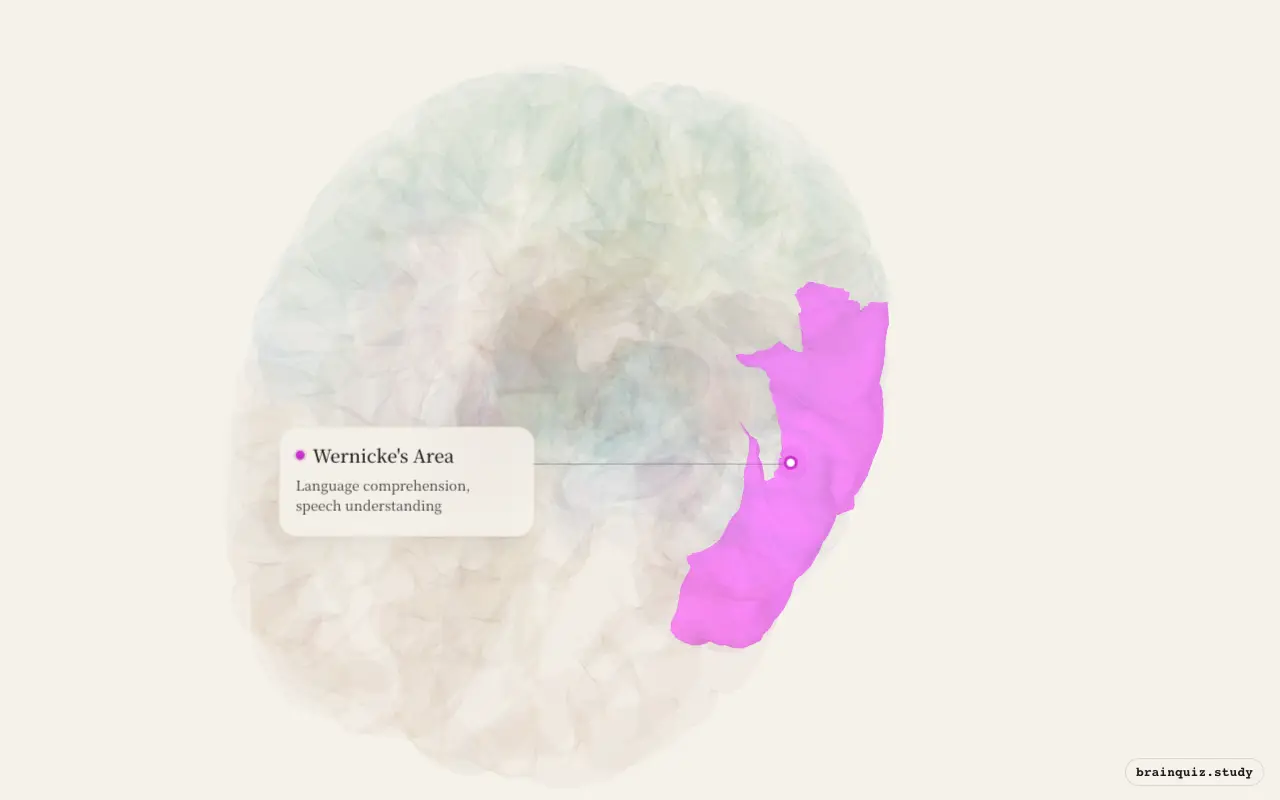
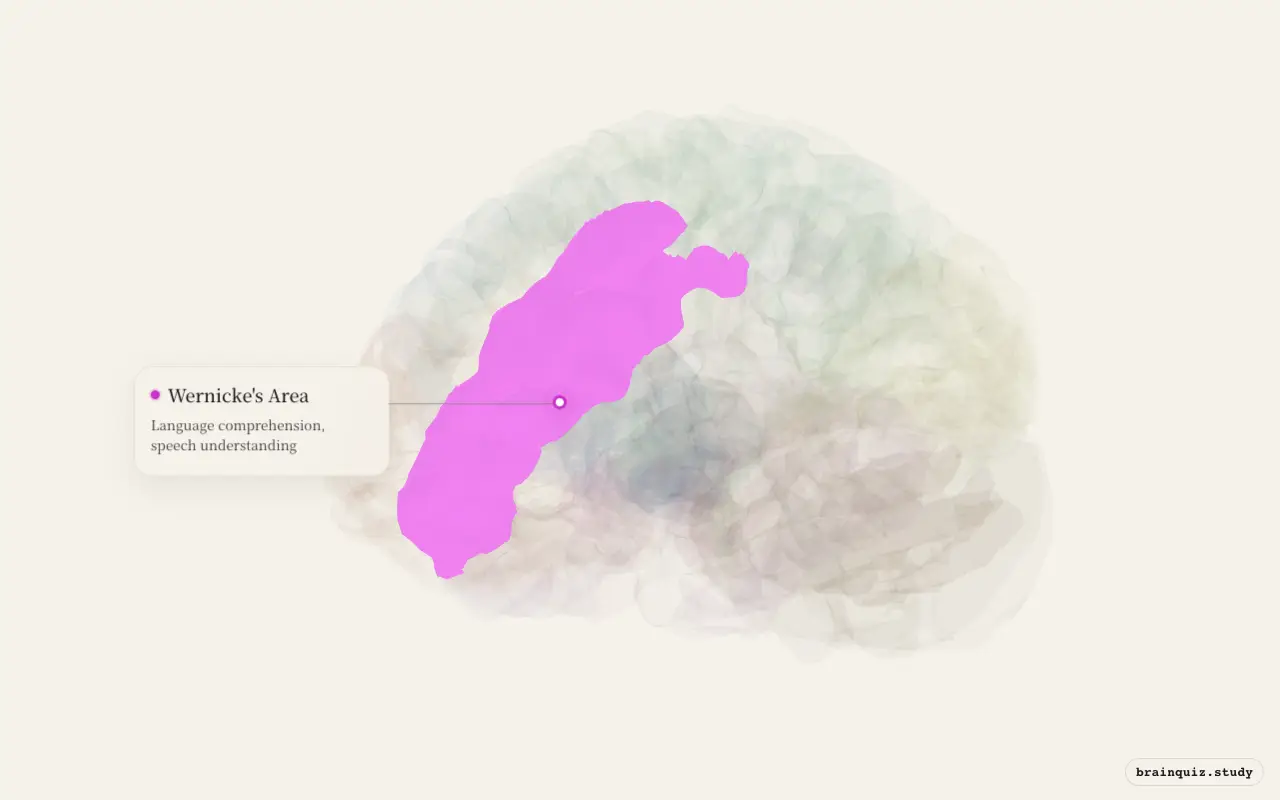
Test this anatomy in the Brodmann Areas Quiz: 15 Questions With Answers or explore it on the interactive 3D brain.
Where is the Wernicke's Area located?
Language comprehension, speech understanding.
What does the Wernicke's Area do?
- Language comprehension — understanding speech
- Semantic processing of words and sentences
- Phonological processing and word recognition
- Interface between auditory input and meaning
Wernicke's Area pathways and connections
- Arcuate fasciculus → Broca's area (production)
- Wernicke's ← Auditory cortex (sound input)
- Wernicke's ↔ Angular gyrus (reading comprehension)
What happens when the Wernicke's Area is damaged?
- Wernicke's aphasia — fluent but meaningless speech, poor comprehension
- Patients unaware of their deficit (anosognosia for language)
- Neologisms and word salad: 'I want to gleep the frumpet zooly'
- Carl Wernicke (1874) described this after autopsy of aphasic patient
Wernicke's Area key facts
Atlas category: cortical. Brodmann areas or landmark: BA 22 (posterior superior temporal gyrus).
- Wernicke-Geschwind model: arcuate fasciculus connects Wernicke's → Broca's
- Conduction aphasia: arcuate fasciculus damage → can't repeat but comprehension and production intact
- Modern view: language is more distributed than Wernicke-Geschwind model suggests
- fMRI shows Wernicke's area activates for both spoken and sign language
Wernicke's Area exam tip
Wernicke's = fluent nonsense (they don't know it). Broca's = effortful but meaningful (they DO know it). Conduction = can't repeat.
Common questions
What does Wernicke’s area do?
It supports spoken-language comprehension, semantic processing, phonological recognition and the connection between auditory word forms and meaning.
Where is Wernicke’s area located?
It is classically placed in the dominant posterior superior temporal gyrus, usually on the left, and is associated with Brodmann area 22.
What does Wernicke’s aphasia sound like?
Speech is fluent but may be empty, incorrect or filled with neologisms, while comprehension is poor. Patients are often less aware of the deficit than people with Broca’s aphasia.
When does the Wernicke's Area light up?
- 😂 When you laugh at a joke: Wernicke's area decodes the joke's language and meaning.
- 👂 When you hear your name in a crowd: Wernicke's area decodes the phonemes into a meaningful word: your name.
- 📖 When you read a book: Wernicke's area decodes the meaning of words and sentences.
- 💭 When you talk to yourself: Wernicke's area processes the 'sound' of your inner voice to ensure the message makes sense.
- 🧠 When you learn a new language: Wernicke's area maps the sound patterns to meaning, allowing comprehension.
- 🧠 When you learn a new word: Wernicke's area tries to match the sound to known word forms.
- 😊 When you get a compliment: Wernicke's area decodes the words and grammar to grasp the compliment's meaning.
- 😠 When you argue with someone: You decode the meaning of the words and sentences being spoken.