What happens in your brain when you laugh at a joke?
Updated
First Wernicke's area decodes the words, then the prefrontal cortex spots the unexpected twist. The ventral tegmental area releases dopamine into the nucleus accumbens, producing pleasure, before the motor cortex triggers the physical laughter.
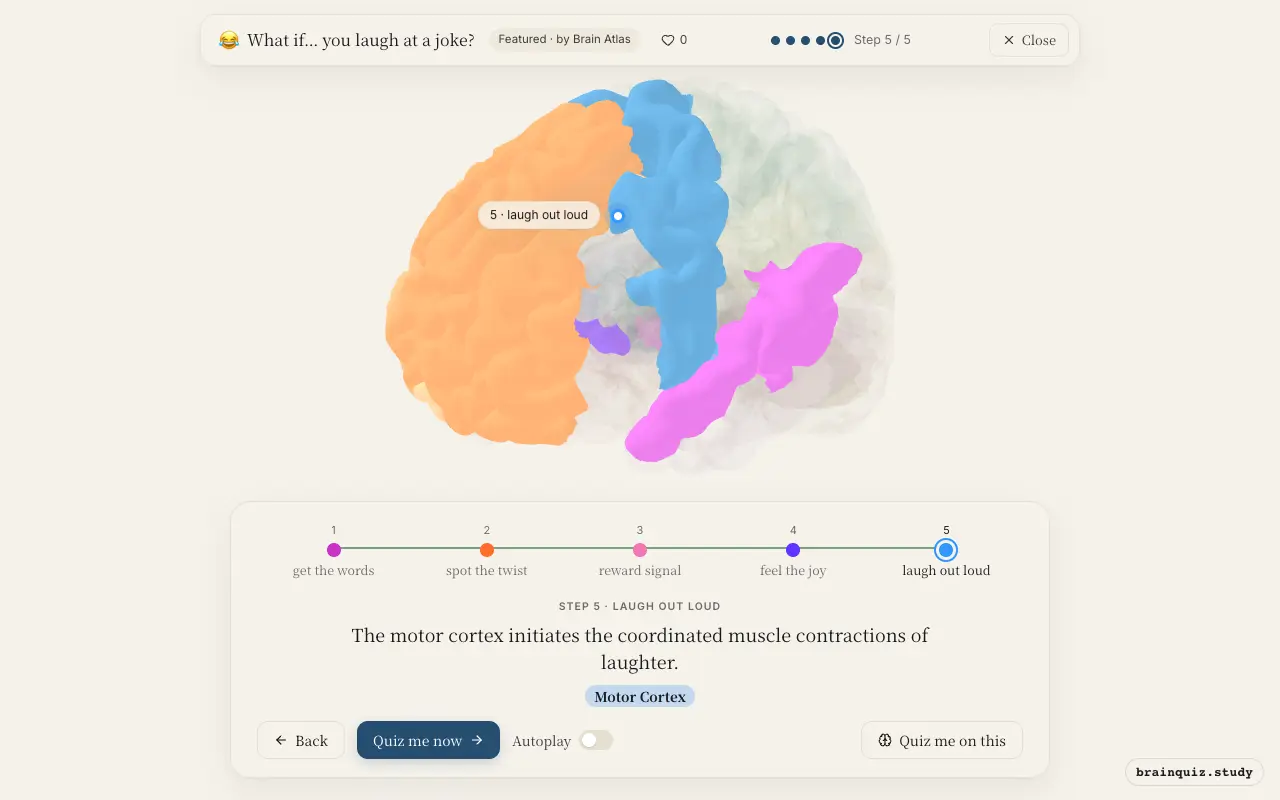
Watch it light up on the 3D brain
Brain regions that light up
| Order | Region | What it does here |
|---|---|---|
| 1 | Wernicke's Area | Wernicke's area decodes the joke's language and meaning. |
| 2 | Prefrontal Cortex | The prefrontal cortex detects the incongruity between setup and punchline. |
| 3 | Ventral Tegmental Area | The ventral tegmental area fires dopamine neurons in response to the joke. |
| 4 | Nucleus Accumbens | The nucleus accumbens receives dopamine, generating the sensation of amusement. |
| 5 | Motor Cortex | The motor cortex initiates the coordinated muscle contractions of laughter. |
1. Wernicke's Area: get the words
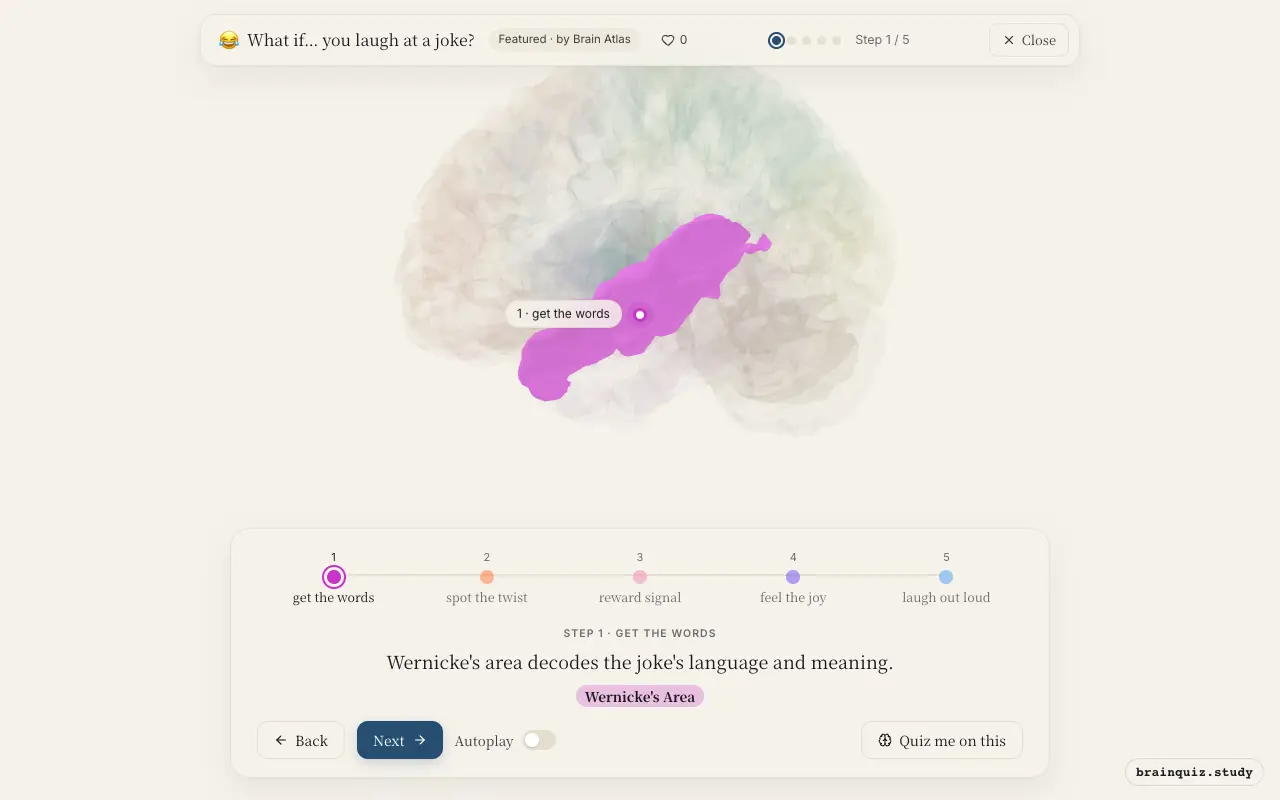
This region in the left temporal lobe processes word meanings and integrates semantic content. It integrates the semantic content, preparing the brain to detect the punchline. Without this step, the joke would be unheard or misunderstood.
2. Prefrontal Cortex: spot the twist
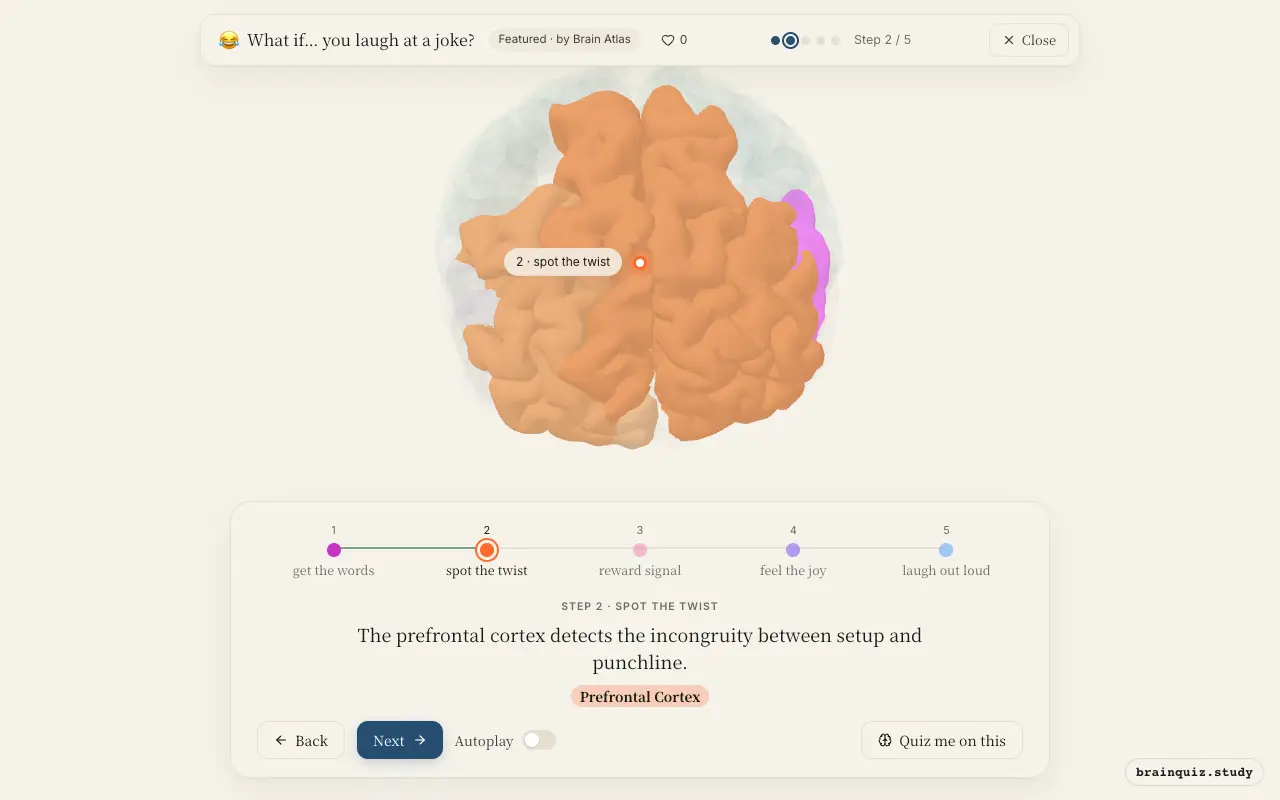
This frontal lobe region compares the expected ending with the actual punchline. It identifies the violation of prediction, a key element of humor. The prefrontal cortex then works to resolve the incongruity, which triggers the amusement.
3. Ventral Tegmental Area: reward signal
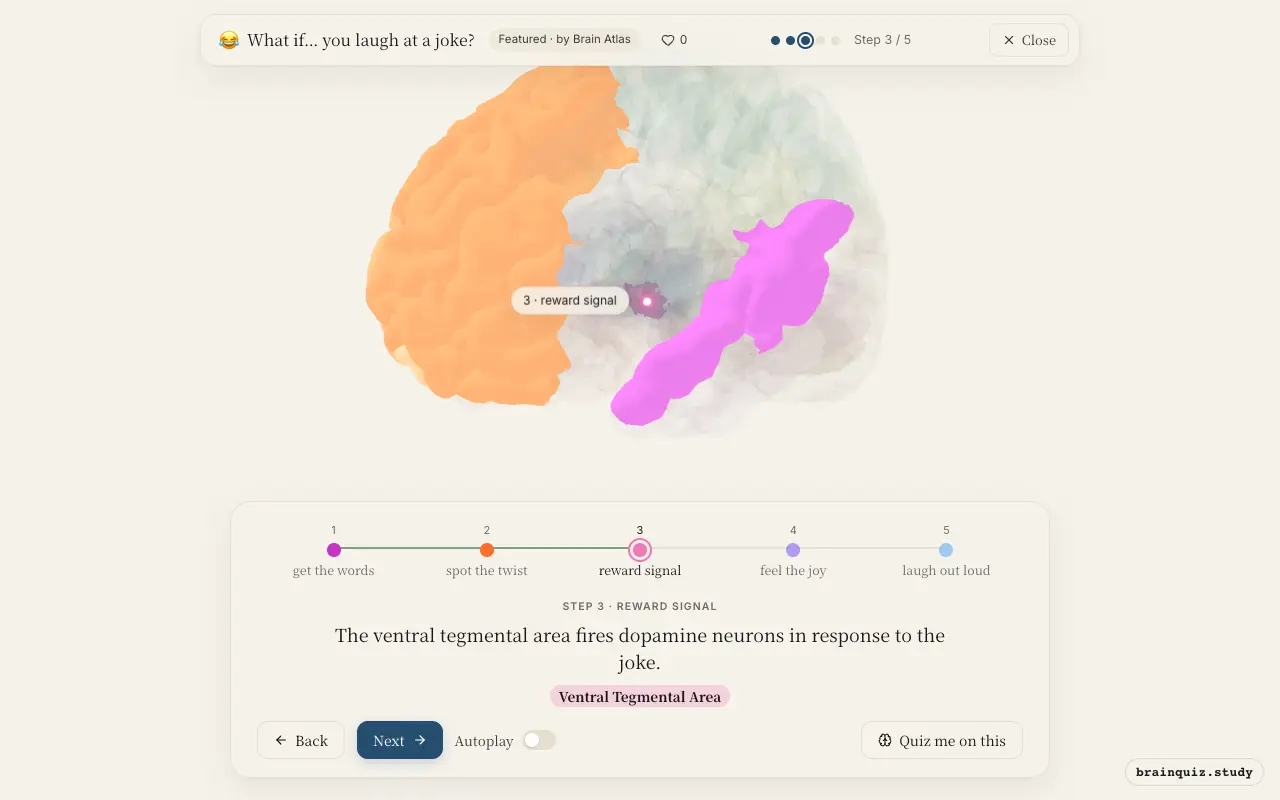
Located in the midbrain, the VTA is a hub for reward signaling. When the joke is understood as funny, it releases dopamine into target regions. This dopamine surge signals reward and reinforces the behavior of seeking humor.
4. Nucleus Accumbens: feel the joy
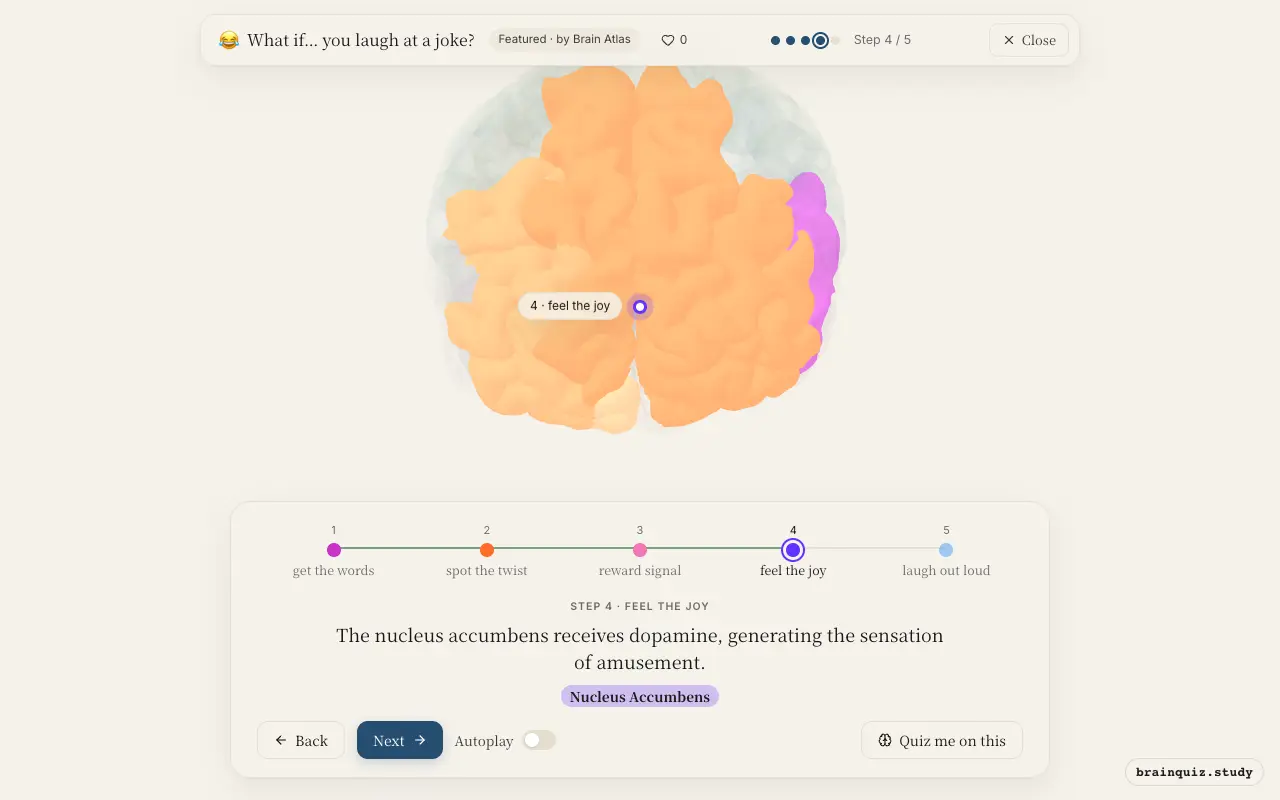
This structure in the basal forebrain is a key part of the reward circuit. Dopamine binding here drives motivation and reward-related learning. Its activation is thought to be central to the euphoric component of laughter.
5. Motor Cortex: laugh out loud
This region in the frontal lobe sends commands to facial, laryngeal, and respiratory muscles. It triggers the rhythmic vocalizations and facial expressions that characterize laughter. The cerebellum also helps fine-tune the timing of these movements.
Good to know
- The cerebellum coordinates the rapid, rhythmic contractions of laughter, ensuring smooth bursts of sound.
- Laughter is associated with the release of endorphins, which may contribute to its pain-relieving effects.
- The facial nucleus in the brainstem controls the muscles used in smiling and laughter.
Joke Laughter vs. Ticklish Laughter
Joke laughter relies on language and cognitive processing, engaging Wernicke's area and prefrontal cortex before the reward system. Ticklish laughter is more reflexive, tapping somatosensory pathways and the hypothalamus, with less involvement of cortical language areas.
Test yourself
Which region is responsible for understanding the words of a joke?
What neurotransmitter is primarily associated with the pleasure of getting a joke?
Which region triggers the actual physical act of laughing?
0 of 3 answered · 0 correct
Simplified: many regions work together at once, and this shows the main players in the order they act.