Nucleus Accumbens — Function, Location & Quiz
The nucleus accumbens sits where motivation can be converted into action. Its dopamine signal is better understood as incentive salience or “wanting” than pleasure itself, which helps explain why compulsive seeking can grow even when enjoyment does not.
Context from hippocampus, emotion from amygdala and control signals from prefrontal cortex converge on this ventral striatal region. Drugs of abuse recruit the same mesolimbic circuitry, making the accumbens central to addiction without reducing reward to one isolated pleasure centre.
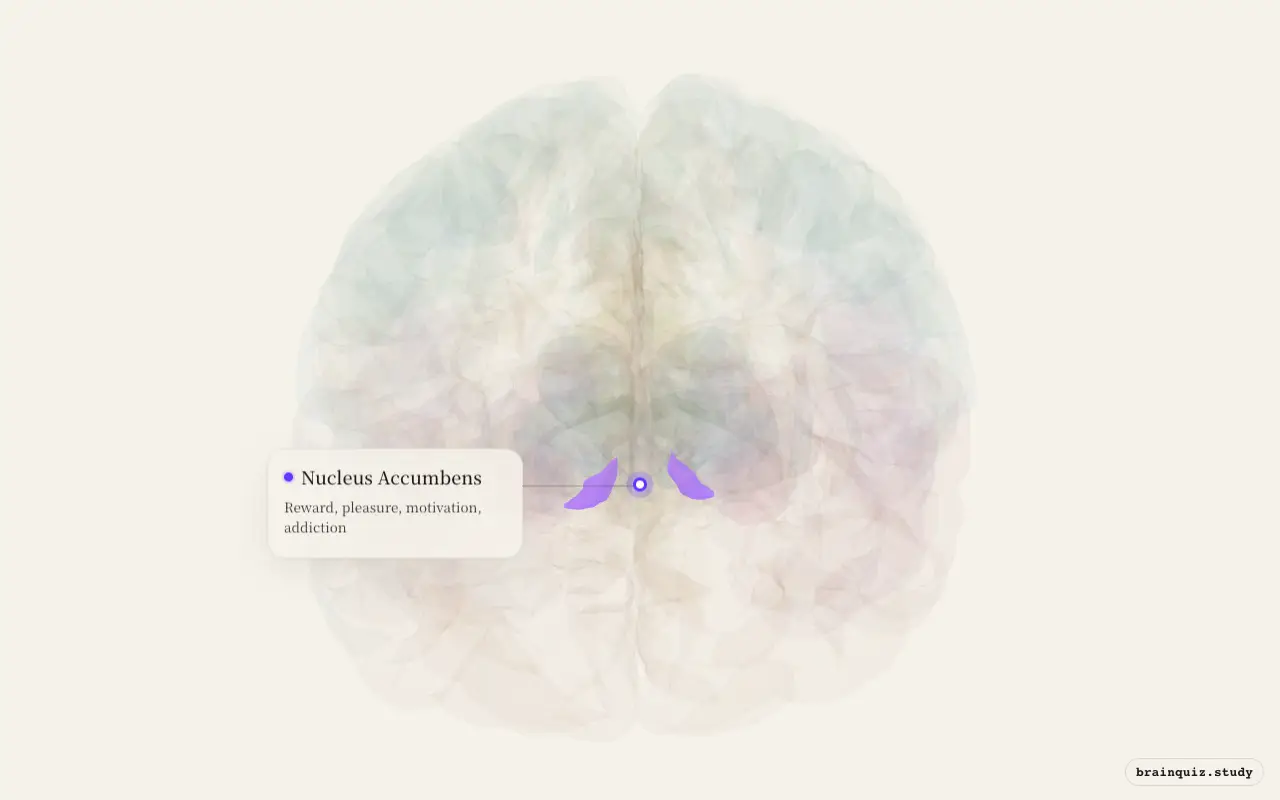
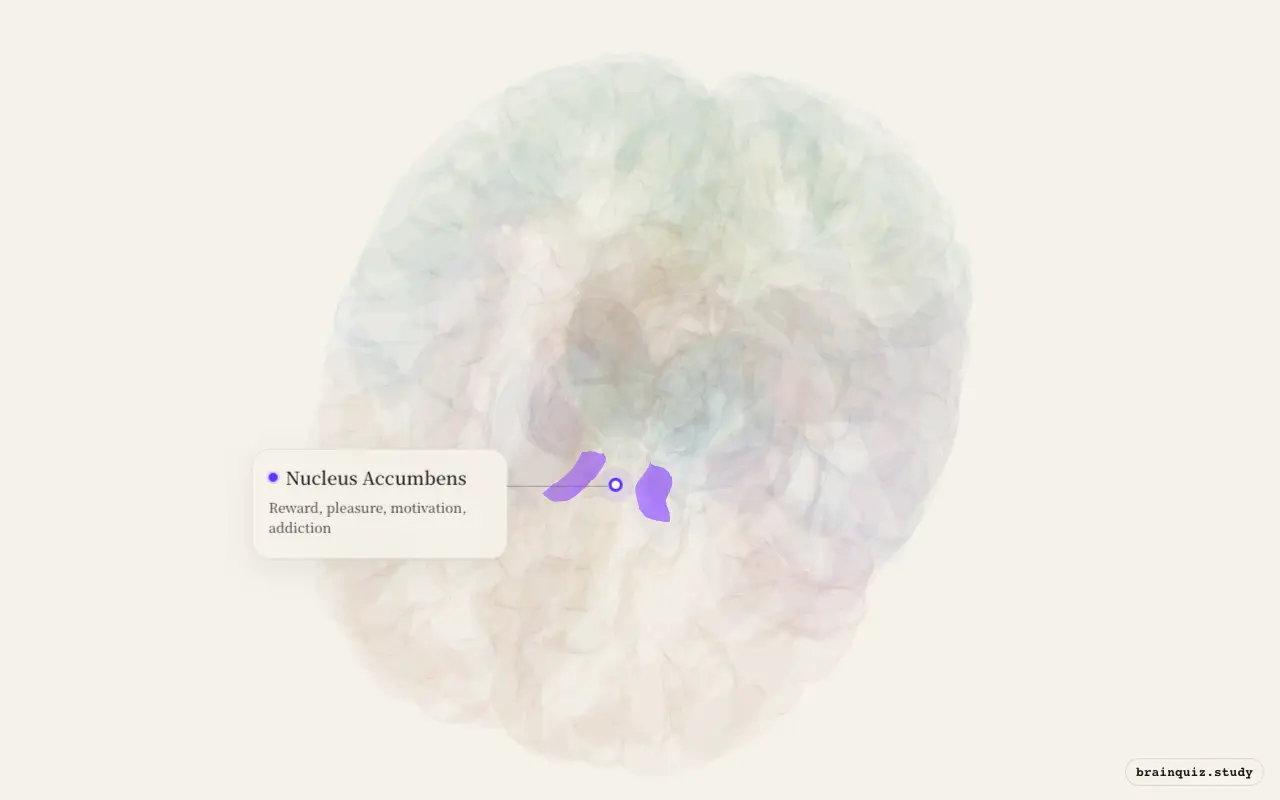
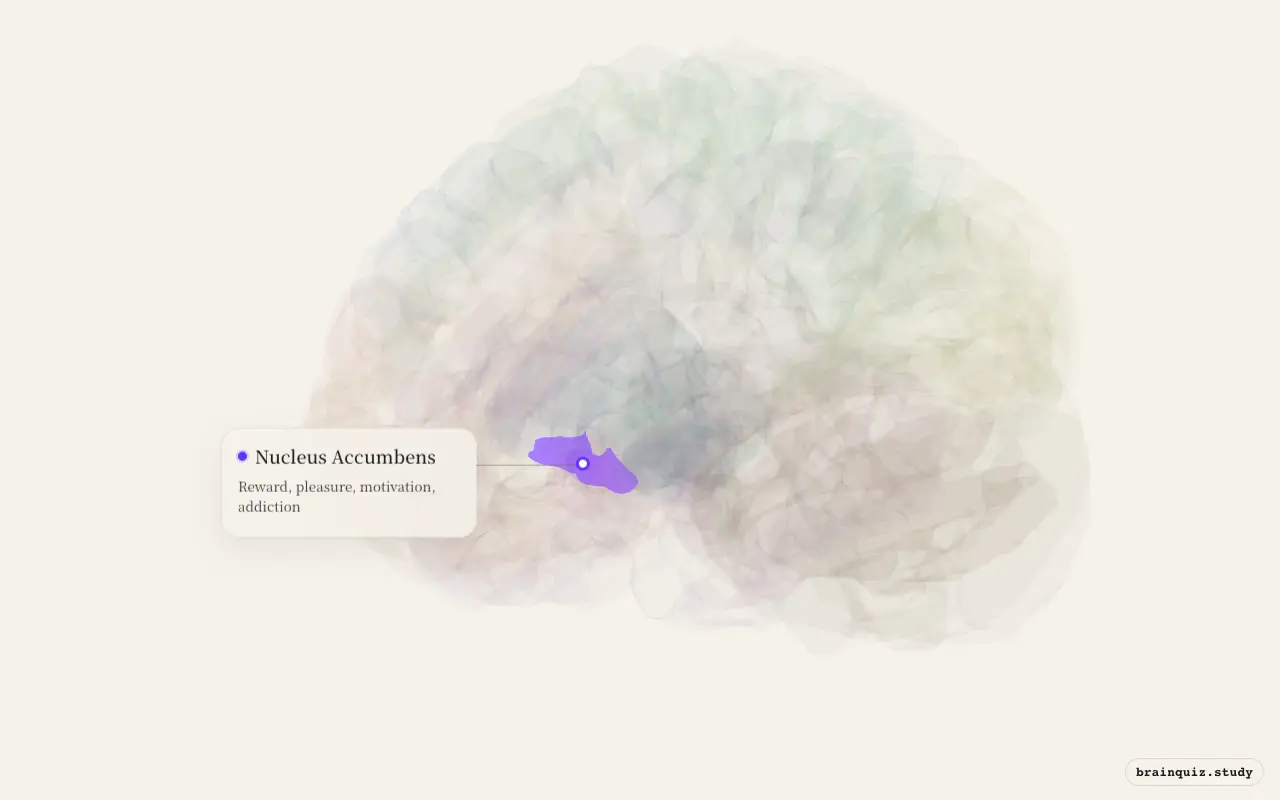
Test this anatomy in the Neurotransmitter Pathways Quiz: Dopamine, Serotonin & More or explore it on the interactive 3D brain.
Where is the Nucleus Accumbens located?
Reward, pleasure, motivation, addiction.
What does the Nucleus Accumbens do?
- Reward processing and motivation
- Pleasure and hedonic responses
- Addiction — drug reward circuitry
- Motivational salience — wanting vs. liking
Nucleus Accumbens pathways and connections
- VTA → NAc (mesolimbic dopamine pathway — the 'reward pathway')
- NAc ↔ PFC (translating motivation into action)
- NAc ← Amygdala, Hippocampus (emotional and contextual input)
What happens when the Nucleus Accumbens is damaged?
- All drugs of abuse increase dopamine in NAc
- Addiction: sensitized 'wanting' (dopamine) without increased 'liking' (opioid)
- Deep brain stimulation of NAc explored for treatment-resistant depression and addiction
- Anhedonia in depression linked to NAc dysfunction
Nucleus Accumbens key facts
Atlas category: subcortical.
- Berridge & Robinson: dopamine = 'wanting' (incentive salience), NOT 'liking' (pleasure)
- NAc has shell (limbic, novelty) and core (motor output) subdivisions
- Olds & Milner (1954): rats self-stimulated to exhaustion — electrode likely near NAc/VTA
Nucleus Accumbens exam tip
NAc = where motivation meets action. Dopamine = wanting, opioids = liking. This distinction is crucial for understanding addiction.
Common questions
What does the nucleus accumbens do?
It integrates reward, context and emotional information to support motivation, reinforcement learning and action directed toward valued outcomes.
Is dopamine in the nucleus accumbens the same as pleasure?
Not exactly. Dopamine is strongly associated with incentive salience or “wanting,” while hedonic “liking” depends more on localized opioid-related mechanisms.
Which pathway supplies nucleus accumbens dopamine?
The mesolimbic pathway projects from the ventral tegmental area to nucleus accumbens, and drugs of abuse increase dopamine within this circuit.
When does the Nucleus Accumbens light up?
- ❤️ When you fall in love: Nucleus accumbens floods with dopamine, producing intense pleasure.
- 😂 When you laugh at a joke: The nucleus accumbens receives dopamine, generating the sensation of amusement.
- 💔 When you get your heart broken: The nucleus accumbens, a reward center, experiences withdrawal when the partner is gone.
- 🥹 When you feel nostalgic: The nucleus accumbens receives dopamine, producing a warm, pleasurable feeling.
- 🎵 When you get goosebumps from music: The nucleus accumbens releases dopamine, creating intense pleasure.
- 🏆 When you feel proud: The nucleus accumbens receives dopamine, creating pleasure and motivation.
- 🌟 When you feel hopeful: The nucleus accumbens fires as you anticipate the good outcome.
- 🍽️ When you feel hungry: Dopamine release in the nucleus accumbens motivates food-seeking behavior.