What happens in your brain when you feel nostalgic?
Updated
Nostalgia activates the hippocampus to retrieve autobiographical memories, the amygdala to tag them emotionally, the posterior cingulate cortex for self-referential processing, the prefrontal cortex for evaluation, and the nucleus accumbens for pleasure and reward.
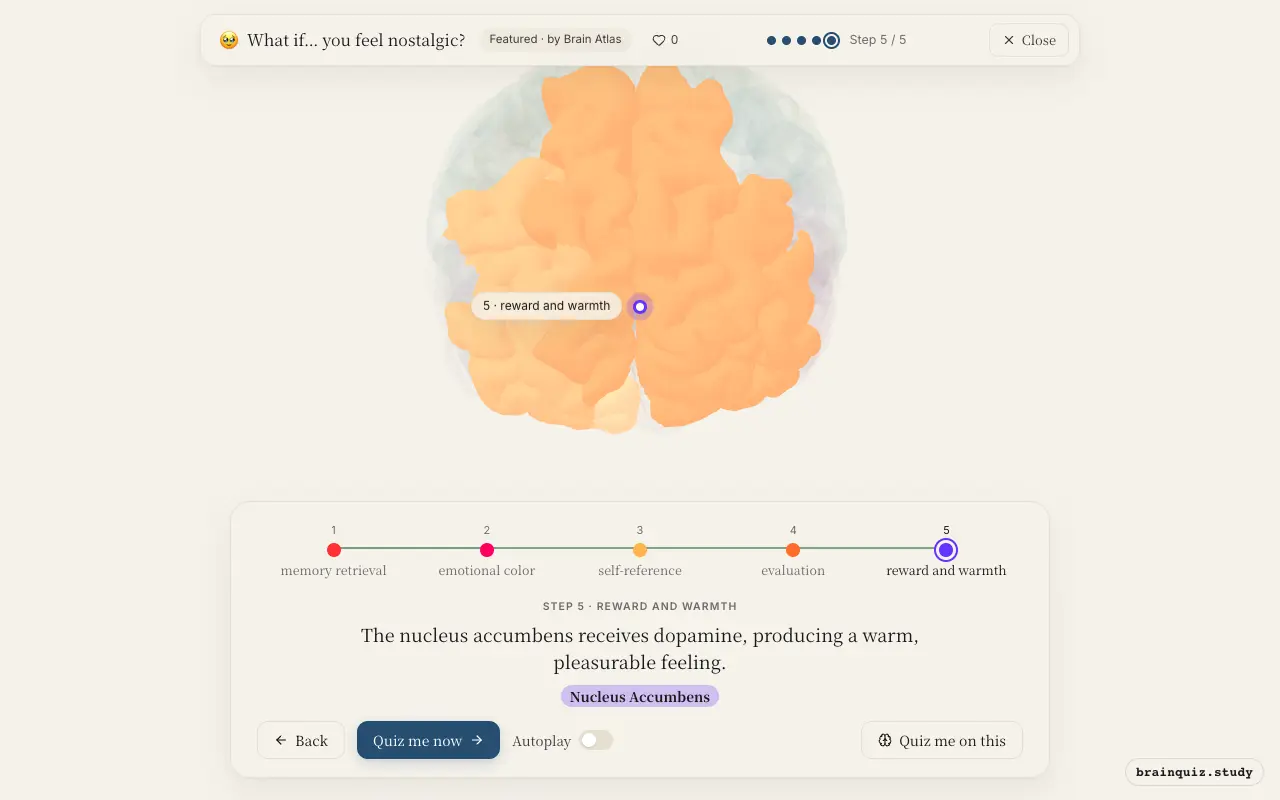
Watch it light up on the 3D brain
Brain regions that light up
| Order | Region | What it does here |
|---|---|---|
| 1 | Hippocampus | The hippocampus reactivates autobiographical memories tied to the nostalgic cue. |
| 2 | Amygdala | The amygdala assigns emotional significance, especially warmth and social connection. |
| 3 | Posterior Cingulate Cortex | The posterior cingulate cortex integrates memories with the sense of self. |
| 4 | Prefrontal Cortex | The prefrontal cortex evaluates memories and places them in context. |
| 5 | Nucleus Accumbens | The nucleus accumbens receives dopamine, producing a warm, pleasurable feeling. |
1. Hippocampus: memory retrieval
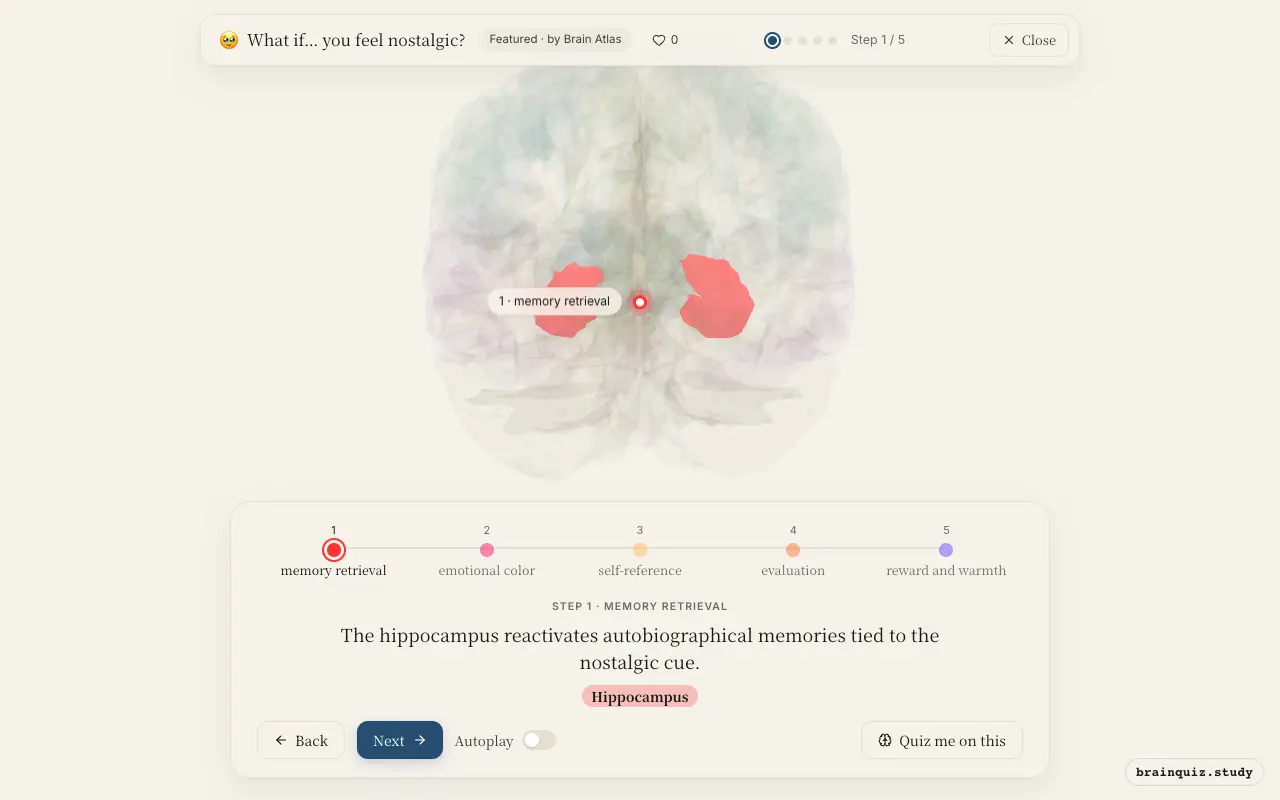
The hippocampus is essential for forming and retrieving episodic memories. In nostalgia, it reconstructs past personal events, often triggered by sensory cues like music or smells. Studies suggest the hippocampus shows increased activity when recalling positive autobiographical memories.
2. Amygdala: emotional color
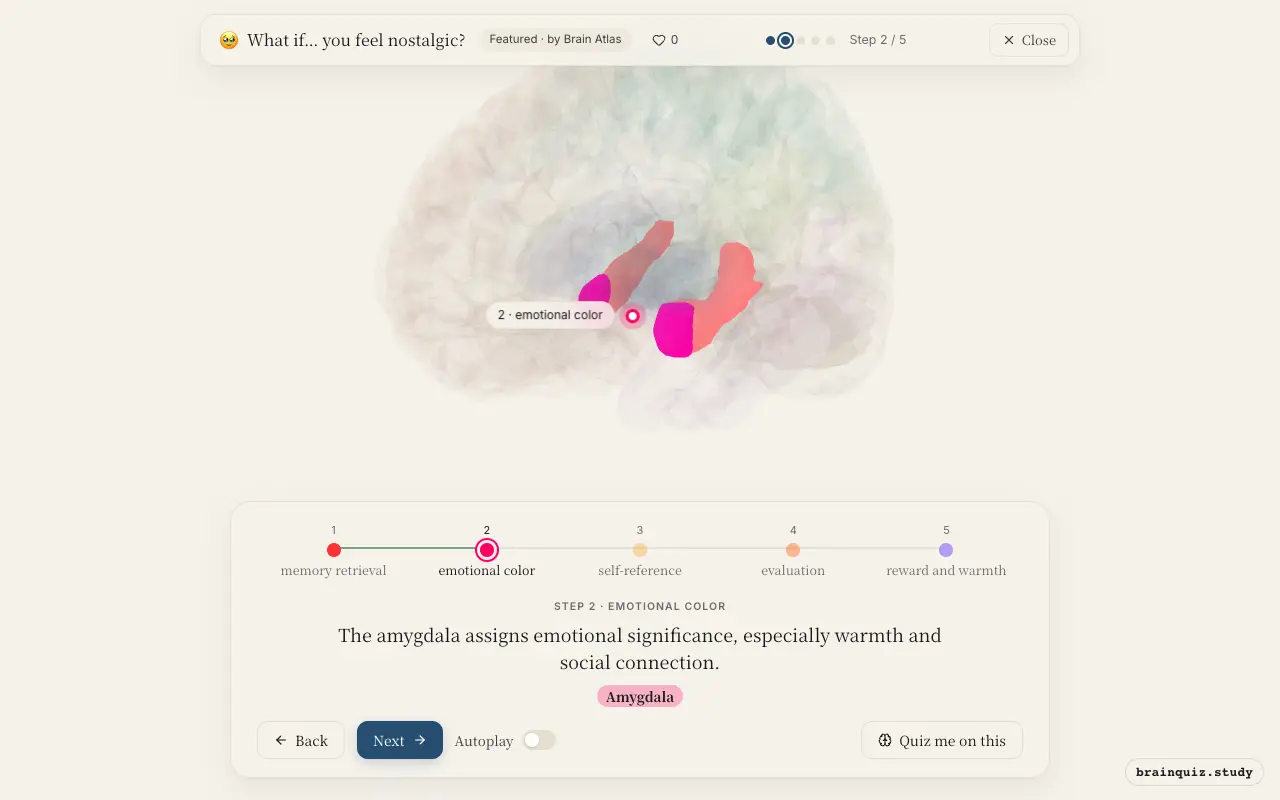
The amygdala is well known for processing emotional salience, especially fear, but it also responds to positive emotional memories. In nostalgia, it tags retrieved memories with positive affect, making them feel personally meaningful.
3. Posterior Cingulate Cortex: self-reference
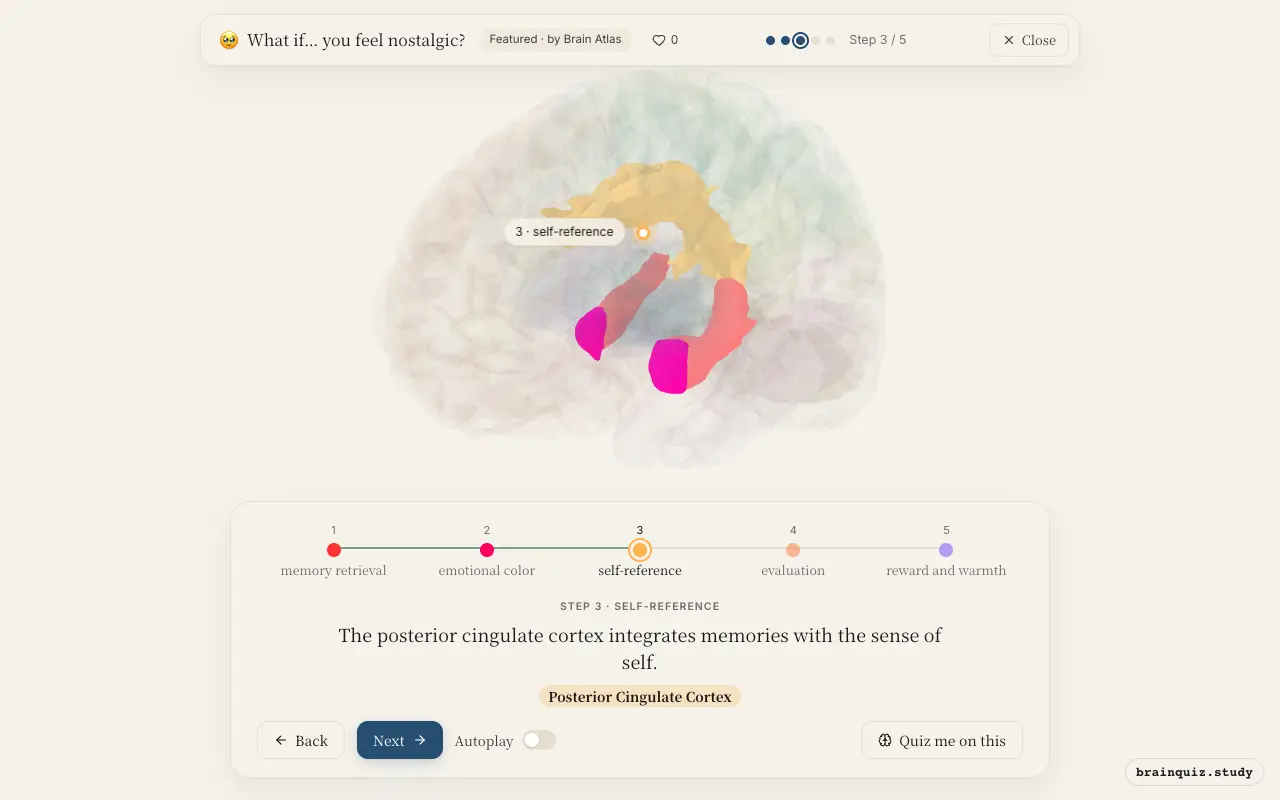
The posterior cingulate cortex is a hub of the default mode network, active during self-referential thought and autobiographical recollection. It binds retrieved memories to one's identity, enhancing the feeling of continuity across time.
4. Prefrontal Cortex: evaluation
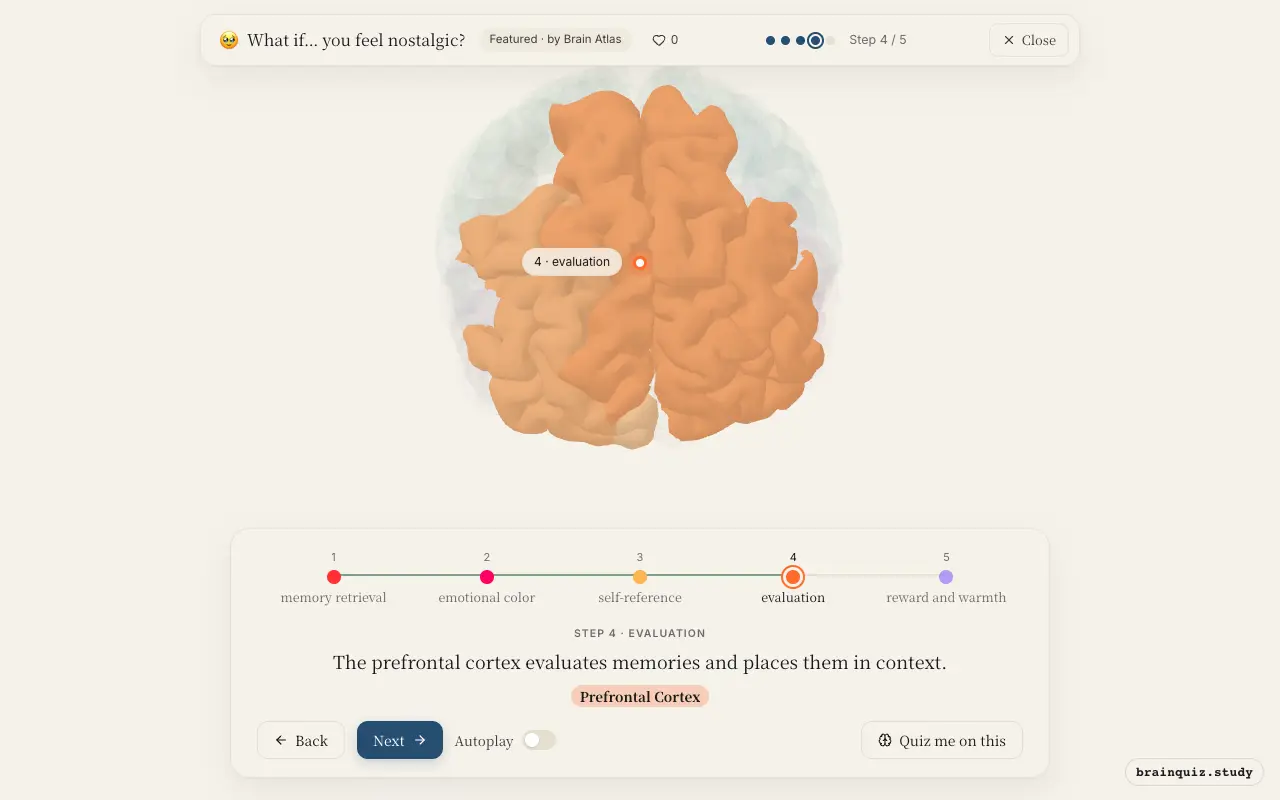
The medial prefrontal cortex, part of the broader prefrontal cortex, is involved in self-appraisal and social cognition. In nostalgia, it assesses the meaning and relevance of memories, sometimes contrasting past with present.
5. Nucleus Accumbens: reward and warmth
The nucleus accumbens is central to reward processing and motivation. Nostalgic reflection often elicits a positive, sometimes bittersweet pleasure, and neuroimaging studies find increased activity in this ventral striatal region.
Good to know
- Nostalgia was once considered a neurological disease, but is now recognized as a predominantly positive, self-relevant emotion.
- Sensory cues, particularly music and smells, are potent triggers of nostalgic memories due to direct connections to the hippocampus and amygdala.
- Nostalgia increases feelings of social connectedness and meaning in life, which may be reflected in default mode network activity.
Nostalgia vs. Rumination
Nostalgia is a bittersweet but generally positive recollection of past events, engaging reward circuitry like the nucleus accumbens. Rumination, in contrast, is repetitive negative thinking about past mistakes, typically associated with increased activity in the amygdala and decreased prefrontal control, without the same pleasurable component.
Test yourself
Which brain region is most responsible for retrieving autobiographical memories during nostalgia?
The warm, pleasurable feeling of nostalgia is primarily linked to activity in which region?
Which network is most engaged when nostalgia integrates memories with the sense of self?
0 of 3 answered · 0 correct
Simplified: many regions work together at once, and this shows the main players in the order they act.