What happens in your brain when you feel hopeful?
Updated
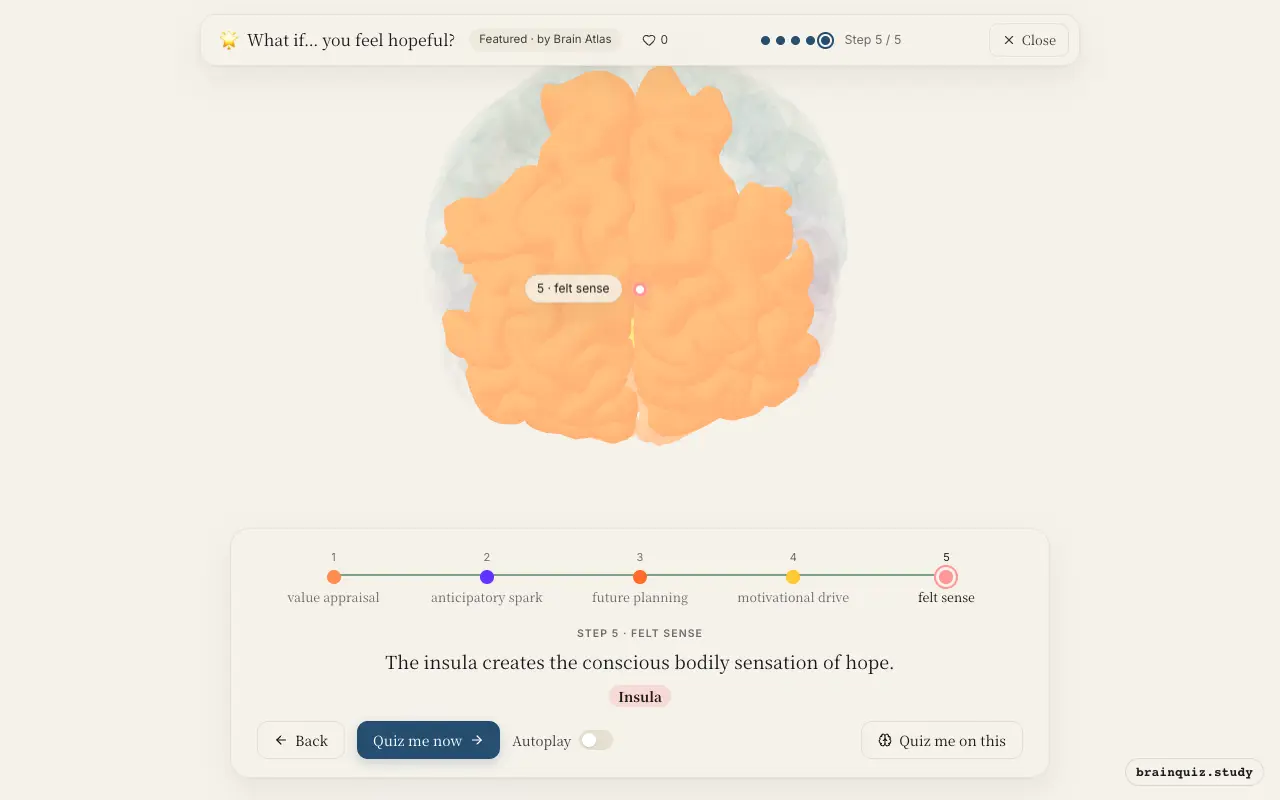
Hope activates the orbitofrontal cortex for positive valuation, nucleus accumbens for reward anticipation, prefrontal cortex for future planning, anterior cingulate for motivation, and insula for the felt sense.
Watch it light up on the 3D brain
Brain regions that light up
| Order | Region | What it does here |
|---|---|---|
| 1 | Orbitofrontal Cortex | The orbitofrontal cortex evaluates the situation as potentially rewarding. |
| 2 | Nucleus Accumbens | The nucleus accumbens fires as you anticipate the good outcome. |
| 3 | Prefrontal Cortex | The prefrontal cortex imagines the positive future and plans steps. |
| 4 | Anterior Cingulate Cortex | The anterior cingulate cortex sustains motivation and effort. |
| 5 | Insula | The insula creates the conscious bodily sensation of hope. |
1. Orbitofrontal Cortex: value appraisal
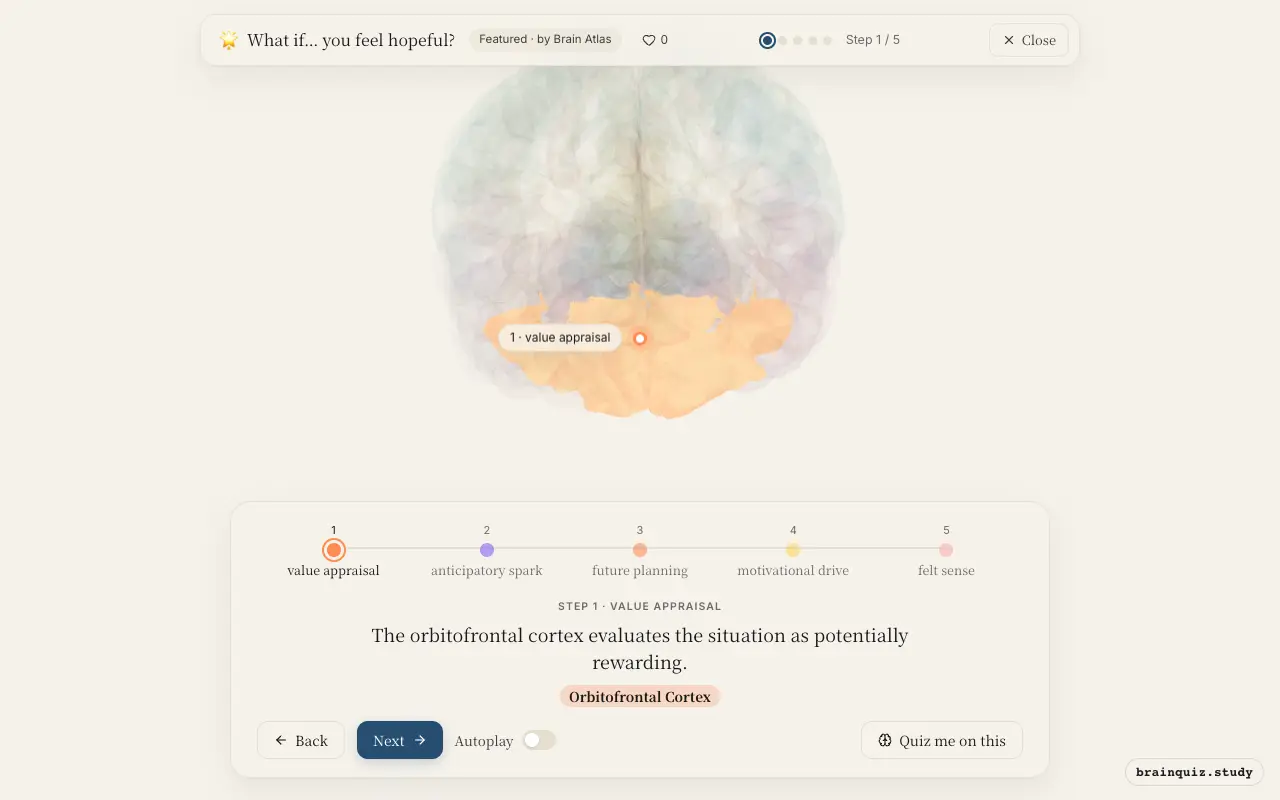
This region processes reward value and is active when we consider positive outcomes. It helps assign an emotional valence to future possibilities, marking them as desirable. The orbitofrontal cortex integrates sensory and emotional information to guide value-based decisions.
2. Nucleus Accumbens: anticipatory spark
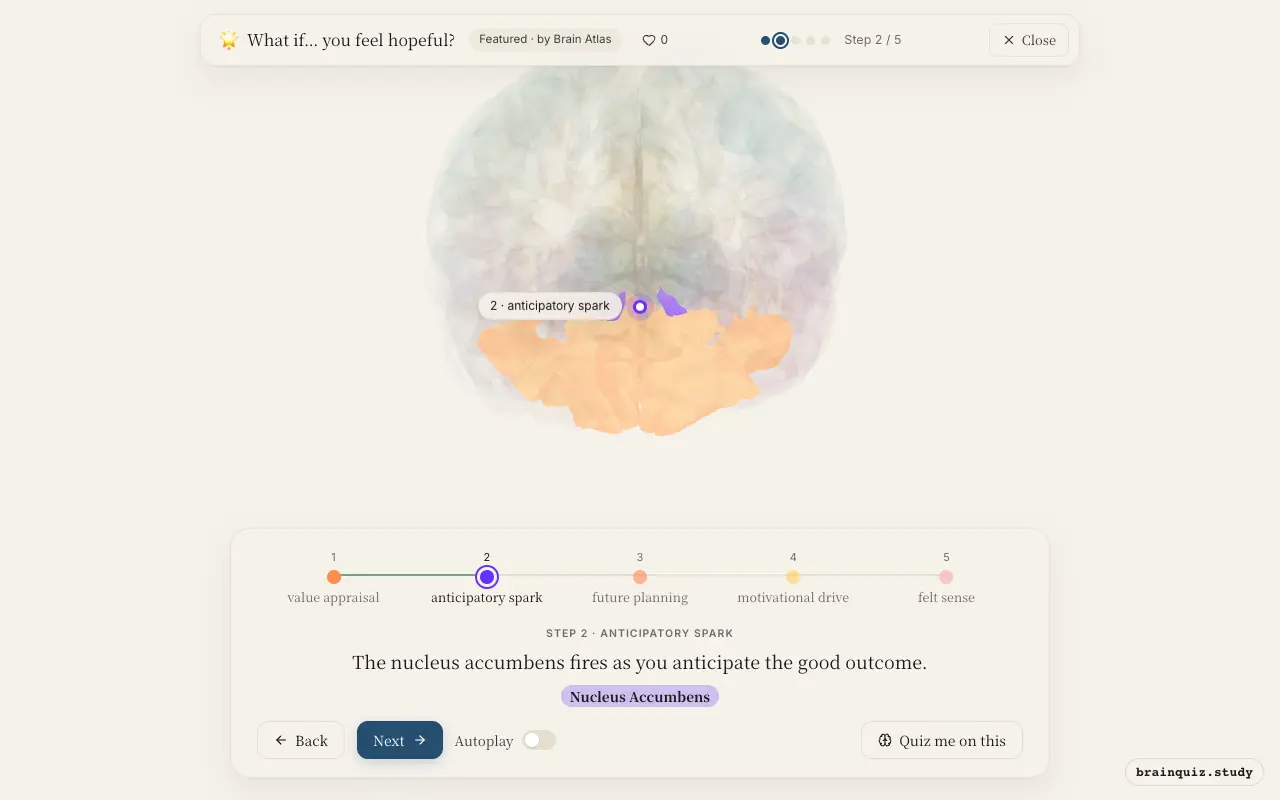
Receiving dopamine from the ventral tegmental area, the nucleus accumbens signals reward anticipation and motivation. Its activation is associated with the pleasurable expectation of future gain. This drives approach behavior and the energizing feeling of hope.
3. Prefrontal Cortex: future planning
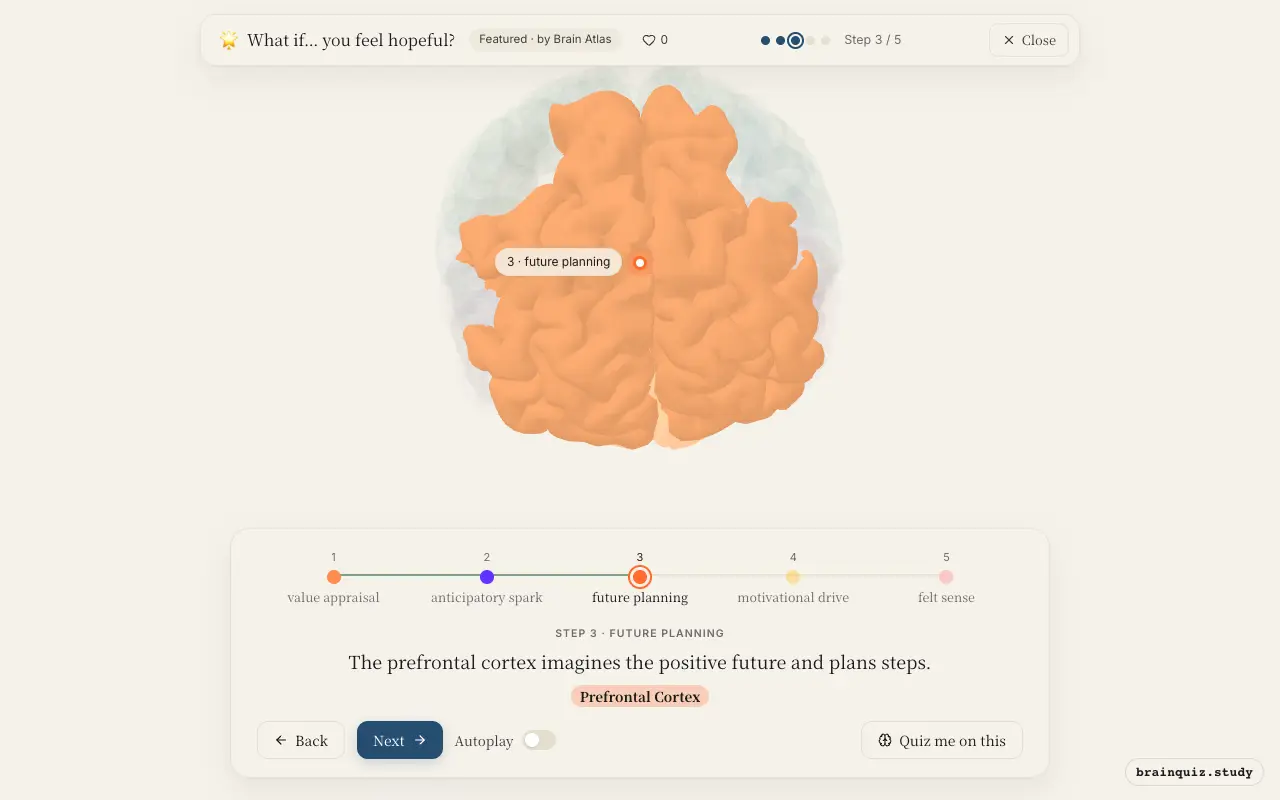
Executive functions in the prefrontal cortex support working memory and mental simulation. It allows you to hold the goal in mind and devise strategies to achieve it. This cognitive elaboration distinguishes hope from mere wishing.
4. Anterior Cingulate Cortex: motivational drive
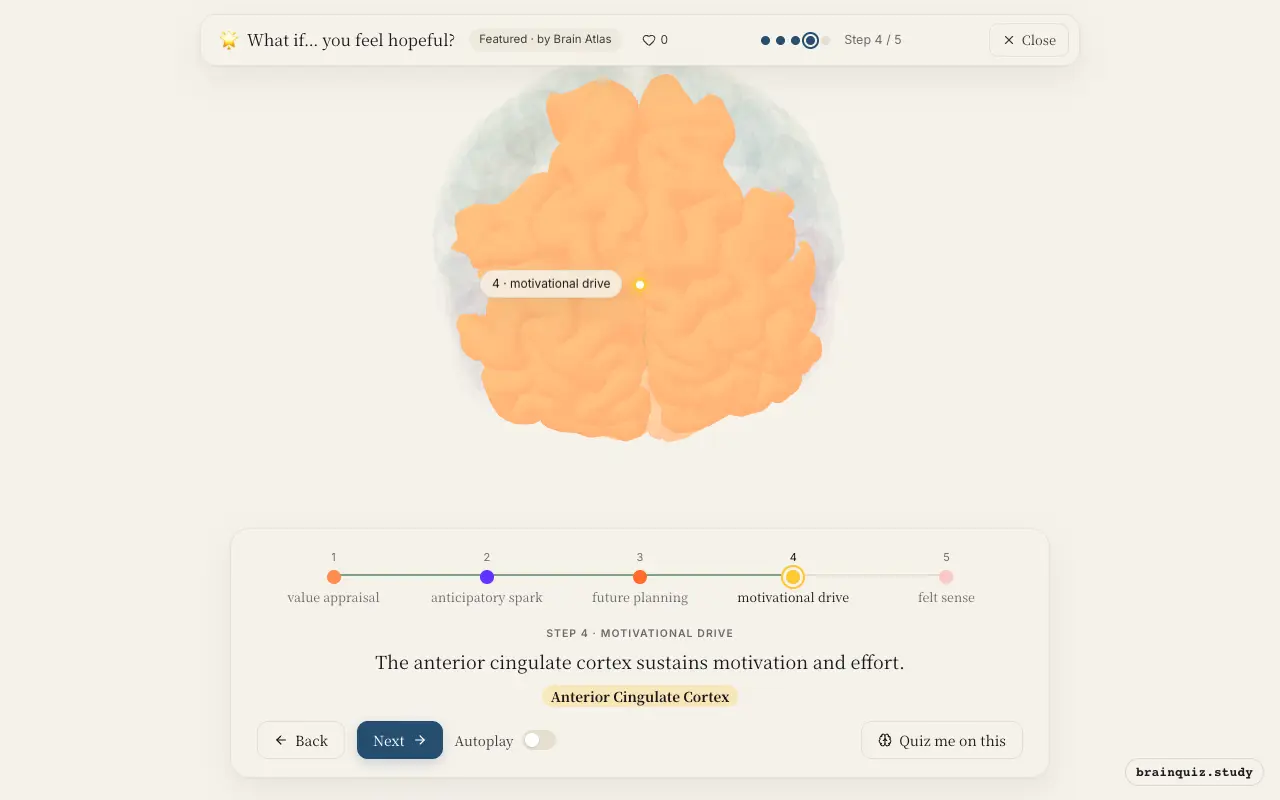
The anterior cingulate integrates emotional and cognitive signals, monitoring conflict and driving persistence. It helps convert the anticipated reward into sustained goal-directed behavior. Its activity reflects the motivational intensity of hope.
5. Insula: felt sense
The insula processes interoceptive signals from the body, such as heart rate and visceral changes. It translates physiological arousal into a subjective feeling state. This gives hope its characteristic uplifting, expansive quality.
Good to know
- The ventral tegmental area releases dopamine into the nucleus accumbens during anticipation of reward.
- The hippocampus retrieves memories of past successes, helping to predict positive outcomes.
- Insular activity correlates with interoceptive awareness, giving hope its bodily feeling.
Hope vs. Fearful Anticipation
Both involve anticipation, but hope recruits reward circuitry like the nucleus accumbens and orbitofrontal cortex, while fear activates the amygdala and threat-detection networks. Hope biases toward approach, fear toward avoidance.
Test yourself
Which region assigns positive value during hope?
Dopamine release in the nucleus accumbens during hope is primarily from which region?
Which region gives hope its felt bodily sensation?
0 of 3 answered · 0 correct
Simplified: many regions work together at once, and this shows the main players in the order they act.