Insula — Function, Location & Quiz
The insula is a cortical island hidden beneath the lips of the lateral sulcus, which is why it disappears from ordinary surface diagrams. It integrates signals from inside the body with emotion and salience, helping a heartbeat, pain or visceral reaction become a felt state.
Its role is broader than taste, another common shorthand. Disgust, empathy, autonomic regulation and addiction all recruit insular systems, and damage can change both bodily awareness and the motivational force of an urge.
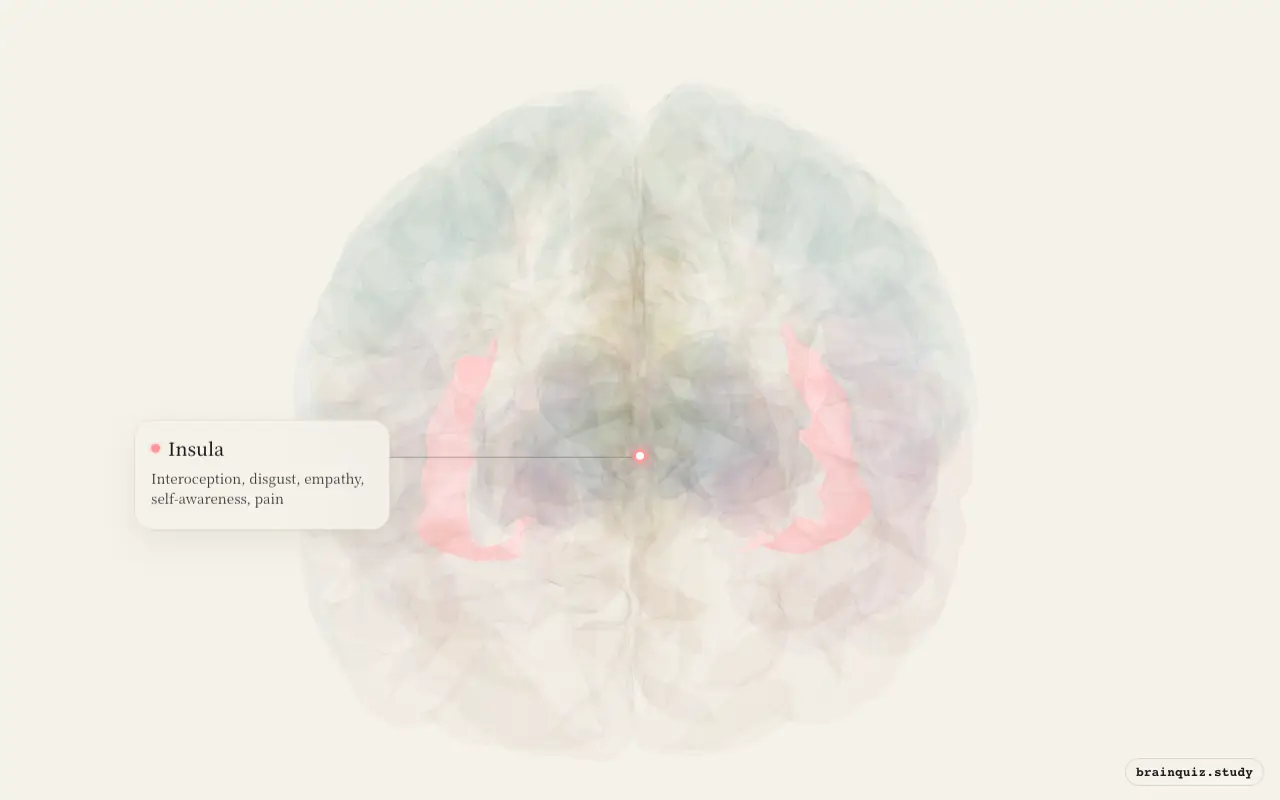
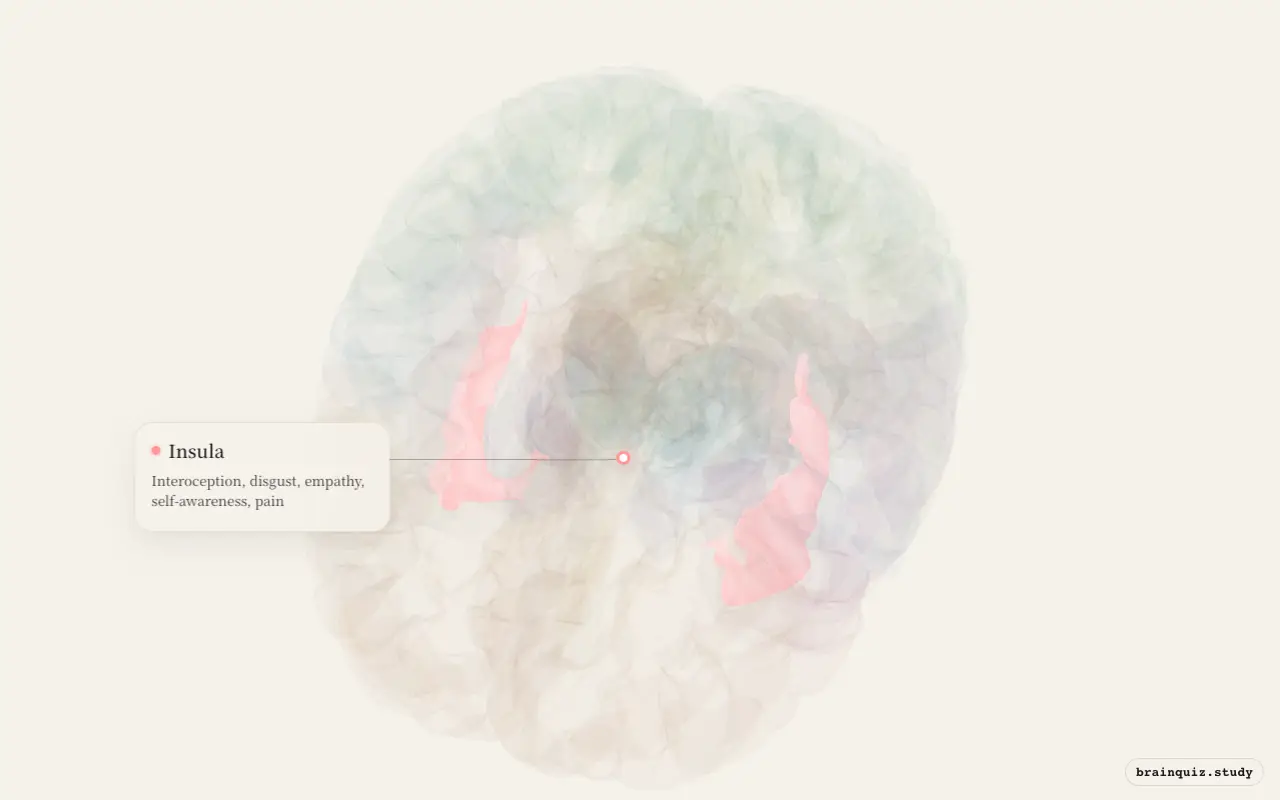
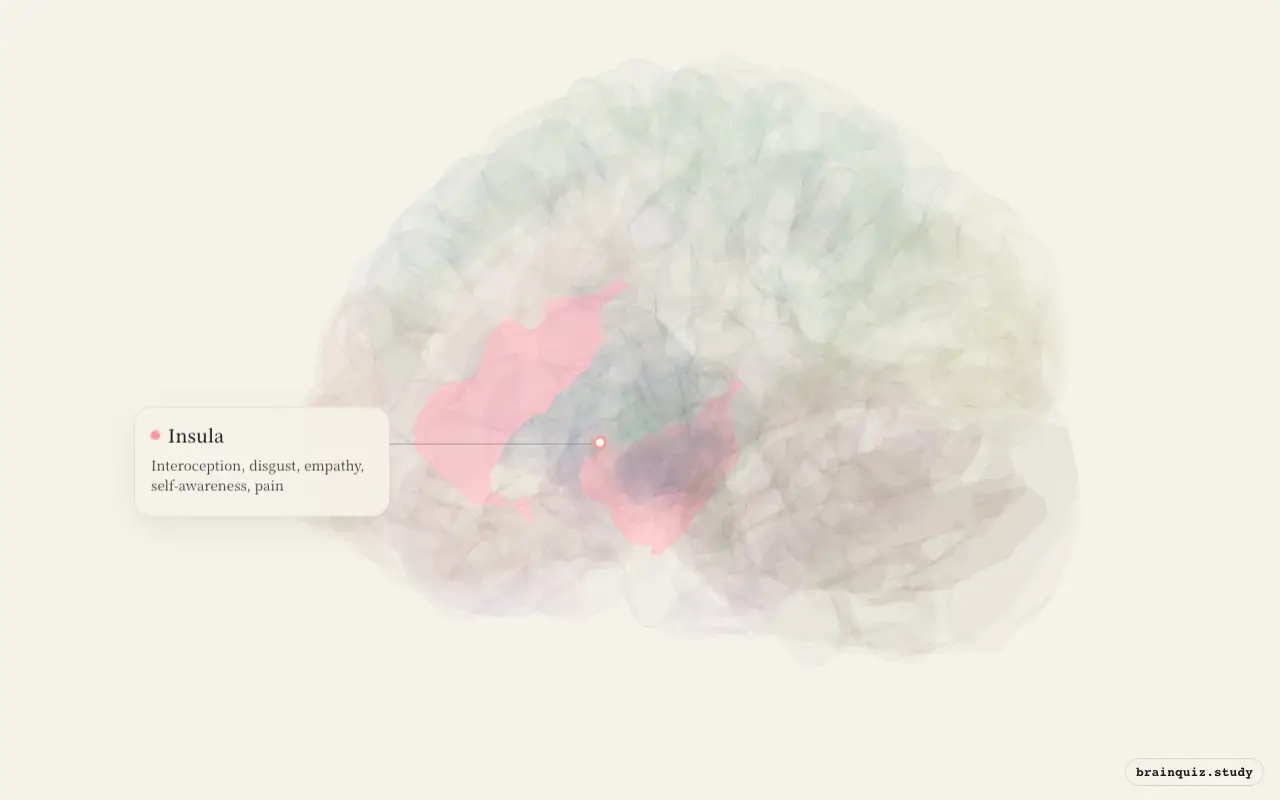
Test this anatomy in the Brain Networks Quiz: Default Mode, Salience & More or explore it on the interactive 3D brain.
Where is the Insula located?
Interoception, disgust, empathy, self-awareness, pain.
What does the Insula do?
- Interoception — awareness of internal body states (heartbeat, hunger, pain)
- Disgust perception (taste and moral disgust)
- Empathy and emotional awareness
- Autonomic nervous system regulation
- Subjective feeling states and self-awareness
Insula pathways and connections
- Anterior insula ↔ ACC (salience network)
- Insula ← Thalamus (visceral afferents)
- Insula ↔ Amygdala (emotional integration)
What happens when the Insula is damaged?
- Lesion → loss of disgust recognition (and impaired empathy)
- Craig's theory: anterior insula creates 'the feeling of being alive'
- Stroke in insular cortex → emotional flatness, autonomic dysregulation
- Addiction: insula damage can lead to sudden loss of urge to smoke
Insula key facts
Atlas category: cortical. Brodmann areas or landmark: BA 13, 14, 16 (insular cortex).
- Contains Von Economo neurons (spindle cells) — shared only with ACC, great apes, whales
- Hub of the salience network — determines what's important right now
- Critchley: anterior insula activation correlates with interoceptive accuracy
- Right anterior insula active when you notice your own heartbeat
Insula exam tip
Insula = interoception + disgust + salience. It's hidden deep in the lateral sulcus — the 'island of Reil.'
Common questions
What does the insula do?
It supports interoception, disgust, emotional awareness, empathy, autonomic regulation and detection of salient events.
Where is the insula located?
It is buried deep within the lateral sulcus beneath parts of the frontal, parietal and temporal lobes, which cover it from an external view.
Which brain network includes the insula?
The anterior insula and dorsal anterior cingulate are core hubs of the salience network, which helps prioritize important internal and external signals.
When does the Insula light up?
- ❤️ When you fall in love: The insula maps bodily arousal, creating fluttery, excited feelings.
- 😒 When you feel jealous: Your insula turns the emotional threat into a bodily sensation—tight chest, flushed face.
- 😢 When you cry: The insula monitors the bodily changes of crying, such as tears and a lump in the throat.
- 😠 When you get angry: The insula processes the visceral sensations that accompany anger, like a churning stomach.
- 😳 When you feel embarrassed: Your insula generates the physical sensations of embarrassment, like blushing and a racing heart.
- 💔 When you get your heart broken: The insula generates the physical sensations of heartbreak, like chest tightness or nausea.
- 😰 When you feel anxious before an exam: The insula perceives your racing heart and sweaty palms, feeding these sensations back into the anxiety loop.
- 🎵 When you get goosebumps from music: The insula registers the physical sensation of goosebumps on your skin.