Thalamus — Function, Location & Quiz
The thalamus is often called a relay station, but it is an active gate rather than a passive cable junction. Different nuclei route visual, auditory, somatosensory, motor and executive signals while cortical feedback helps determine what is amplified or suppressed.
It is also distinct from the smaller hypothalamus below it: thalamic questions usually concern information flow to cortex, while hypothalamic questions concern homeostasis and endocrine control. A thalamic stroke can therefore combine sensory loss with severe central pain or higher-order language effects.
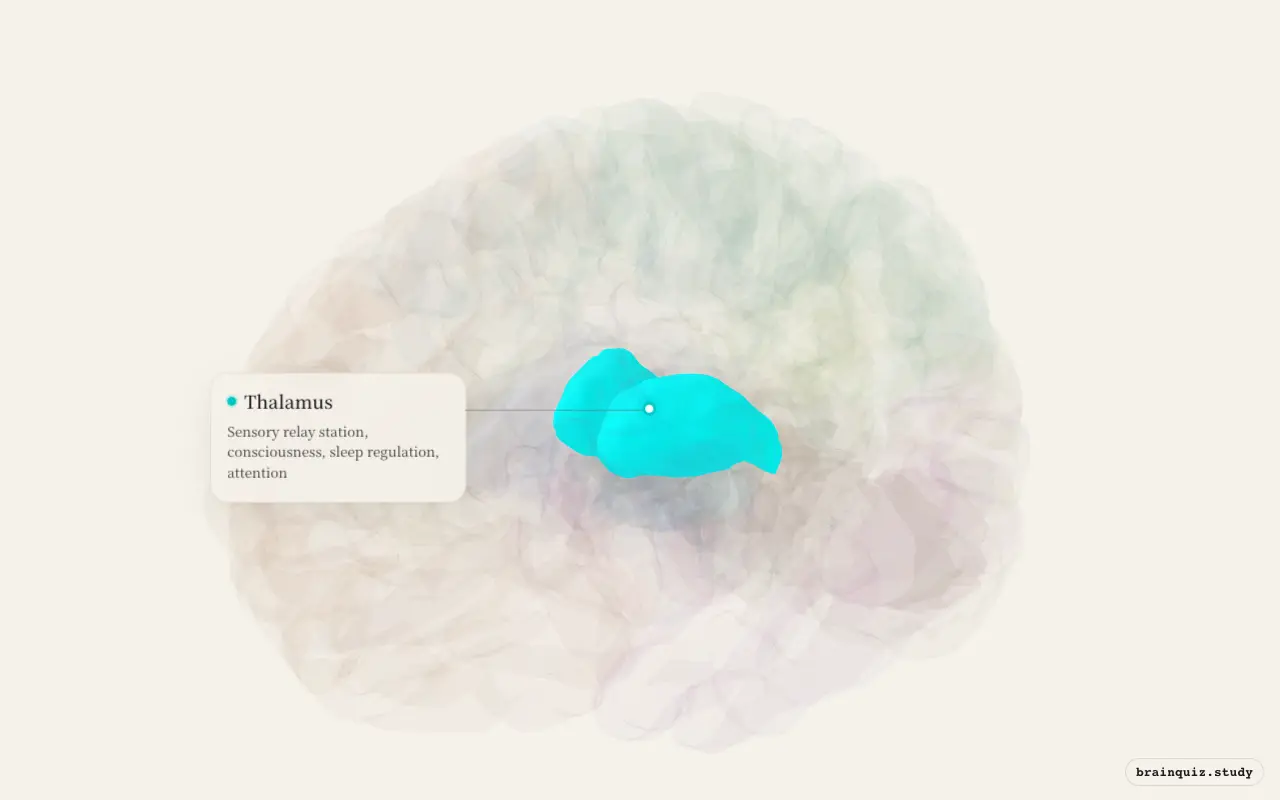
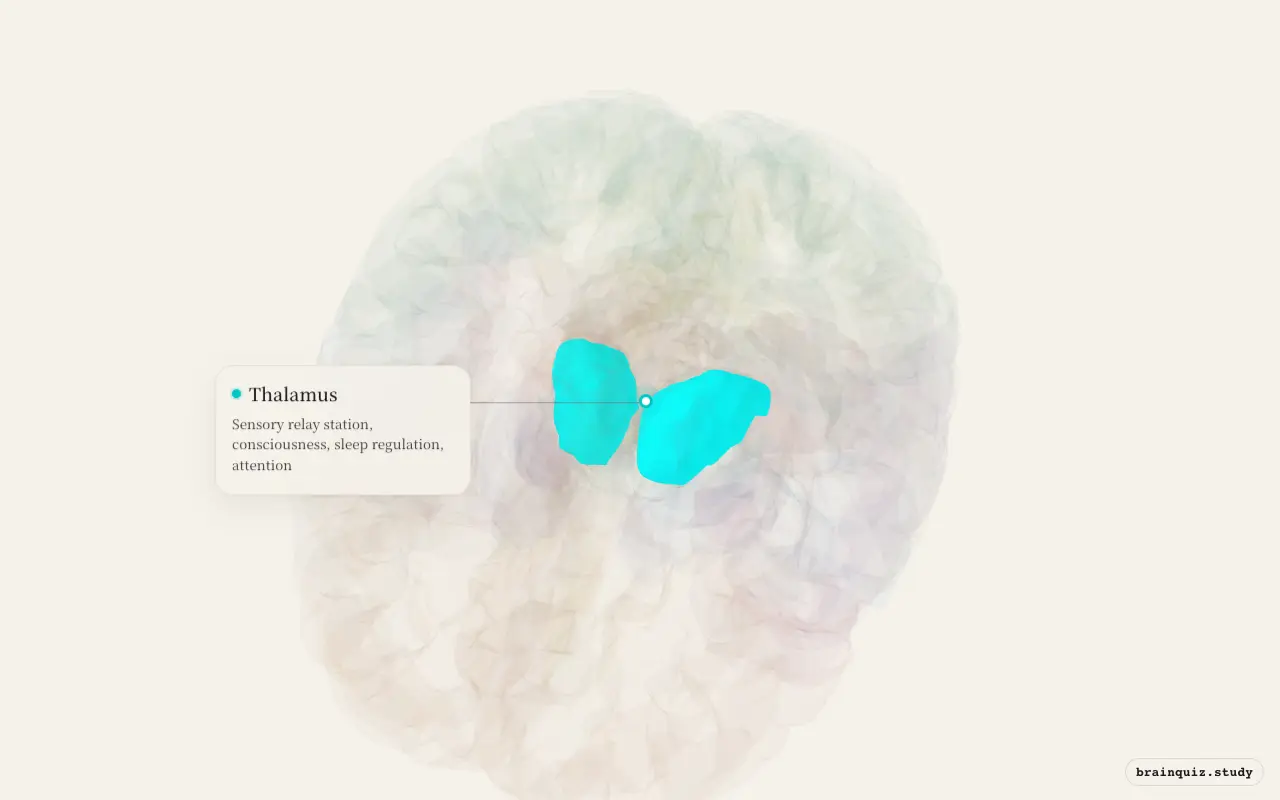
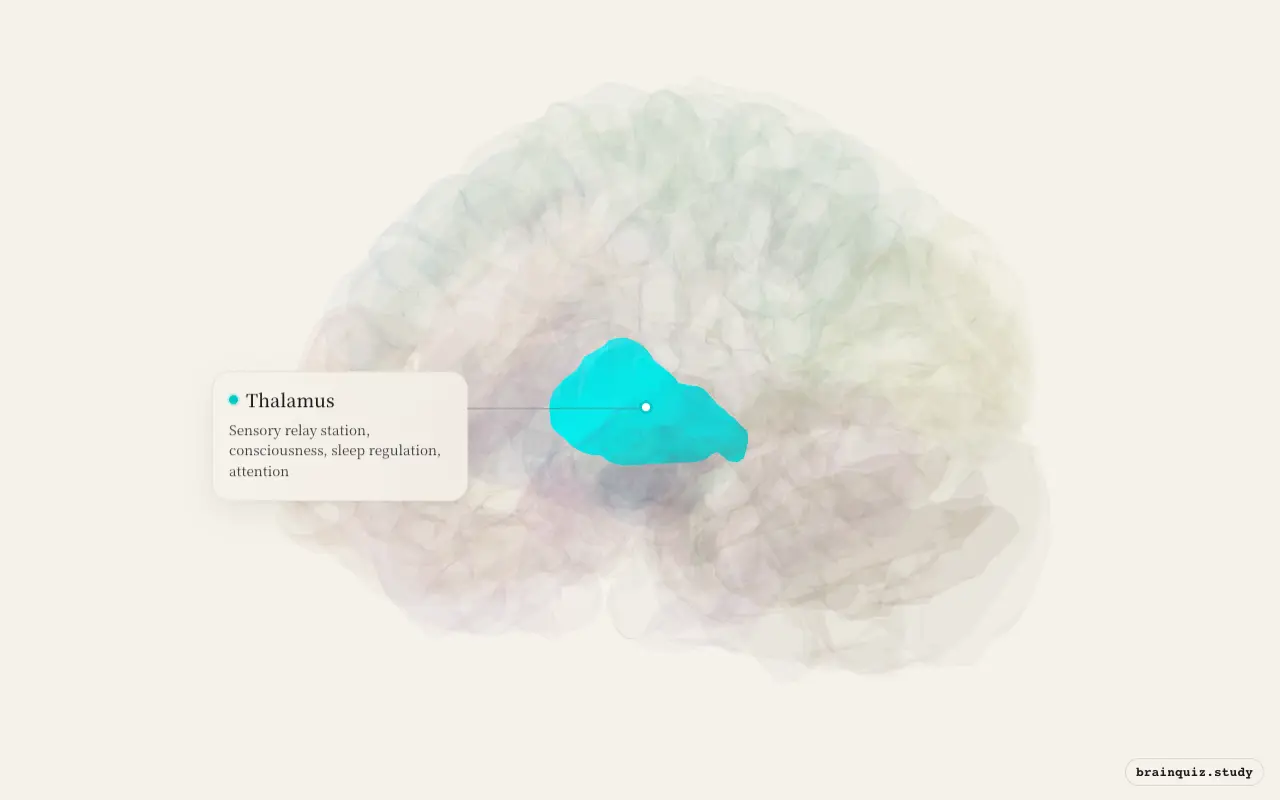
Test this anatomy in the Brain Regions Quiz: 15 Questions With Answers or explore it on the interactive 3D brain.
Where is the Thalamus located?
Sensory relay station, consciousness, sleep regulation, attention.
What does the Thalamus do?
- Sensory relay station — routes all senses (except olfaction) to cortex
- LGN: visual relay. MGN: auditory relay. VPL/VPM: somatosensory relay
- Pulvinar: attention and visual salience
- Mediodorsal nucleus: connects to PFC (executive functions)
- Reticular nucleus: gating — filters what reaches cortex
Thalamus pathways and connections
- All sensory pathways relay through specific thalamic nuclei
- Thalamus ↔ Cortex (thalamocortical loops — every cortical area)
- Thalamus ↔ Basal ganglia (motor loops)
- Reticular nucleus: inhibitory shell around thalamus (gating)
What happens when the Thalamus is damaged?
- Thalamic stroke → contralateral sensory loss, thalamic pain syndrome (Dejerine-Roussy)
- Thalamic aphasia (pulvinar/MD lesion) — language deficits despite intact cortex
- Fatal familial insomnia — prion disease targeting thalamus → inability to sleep → death
Thalamus key facts
Atlas category: subcortical.
- NOT a passive relay — actively gates and modulates information flow
- During sleep: thalamic reticular nucleus generates spindles (12-14 Hz) for memory consolidation
- Every cortical area sends more fibers BACK to thalamus than it receives — massive feedback
- Sherman & Guillery: 'drivers' (relay) vs. 'modulators' (feedback) in thalamic circuits
Thalamus exam tip
Thalamus = gateway to cortex. Know the nuclei: LGN (vision), MGN (hearing), VPL (body touch), VPM (face touch), MD (PFC), Pulvinar (attention).
Common questions
What does the thalamus do?
It gates and relays information between subcortical systems and cortex. Nearly every sensory modality except olfaction passes through a specialized thalamic nucleus.
Which thalamic nuclei should students know?
LGN relays vision, MGN hearing, VPL body sensation, VPM facial sensation, mediodorsal nucleus prefrontal signals and pulvinar attentional information.
What is thalamic pain syndrome?
After some thalamic strokes, initial contralateral sensory loss can be followed by severe, persistent central pain, a pattern known as Dejerine–Roussy syndrome.
When does the Thalamus light up?
- 😱 When you get jump-scared: The sudden sight or sound races through the thalamus, your brain's sensory switchboard.
- 😲 When you get surprised: The thalamus rapidly relays the unexpected sensory signal to cortical and subcortical areas.
- 🤧 When you sneeze: The thalamus relays nasal irritation signals to the cerebral cortex.
- ❄️ When you shiver in the cold: Cold signals from skin reach the thalamus, the brain's sensory switchboard.
- 🦶 When you stub your toe: The pain signal reaches the thalamus, the brain's sensory relay station, which routes it to the cortex.
- 🥶 When you get brain freeze: The thalamus relays the pain signal to the cerebral cortex.
- 💓 When you feel your heart race: The thalamus routes the interoceptive signal to the insula and cingulate cortex.
- ✋ When you get an itch: Itch signals from the skin arrive at the thalamus.