What happens in your brain when you get surprised?
Updated
Surprise triggers a rapid chain: the thalamus relays the unexpected stimulus, the amygdala flags it as salient, the anterior cingulate detects the prediction error, the prefrontal cortex reassesses the situation, and the locus coeruleus boosts arousal for focused attention.
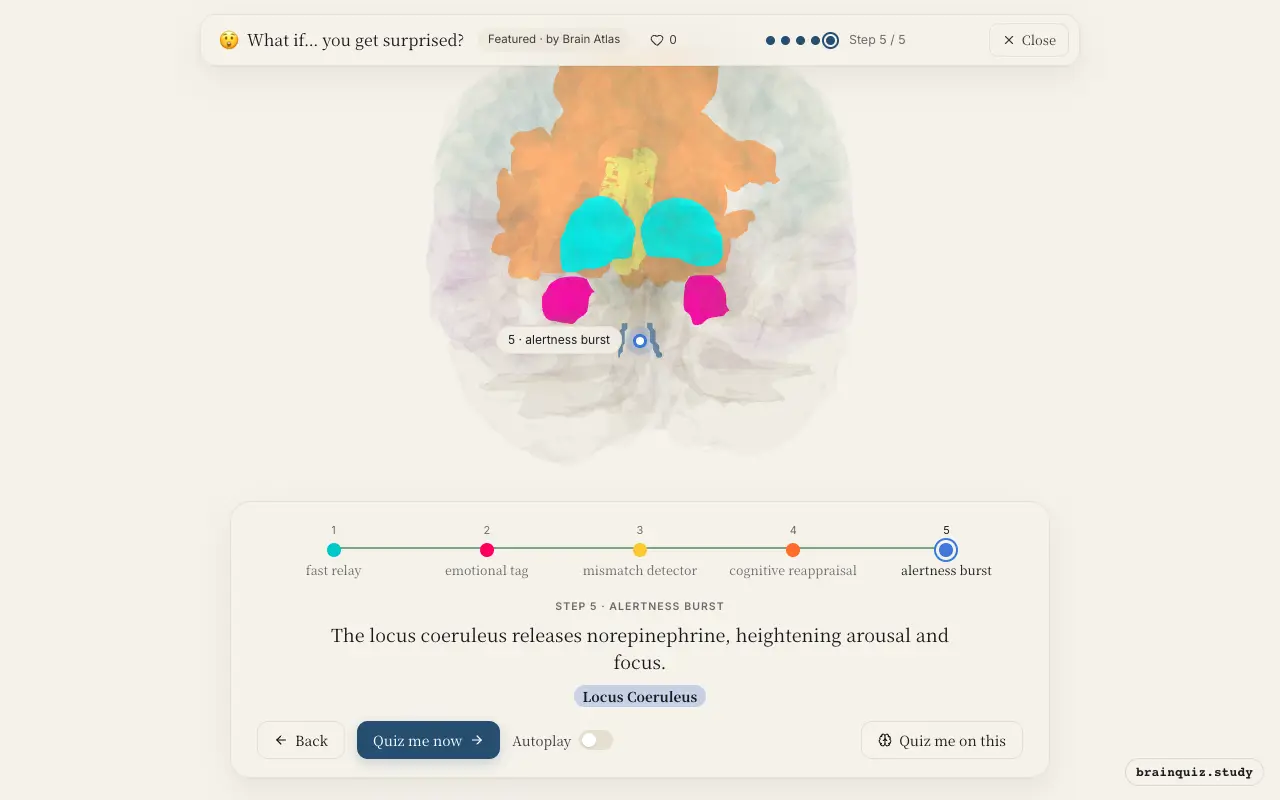
Watch it light up on the 3D brain
Brain regions that light up
| Order | Region | What it does here |
|---|---|---|
| 1 | Thalamus | The thalamus rapidly relays the unexpected sensory signal to cortical and subcortical areas. |
| 2 | Amygdala | The amygdala instantly flags the stimulus as salient, triggering an emotional response. |
| 3 | Anterior Cingulate Cortex | The anterior cingulate cortex detects the mismatch between expectation and actual outcome, signaling surprise. |
| 4 | Prefrontal Cortex | The prefrontal cortex evaluates the surprising event and updates your mental model. |
| 5 | Locus Coeruleus | The locus coeruleus releases norepinephrine, heightening arousal and focus. |
1. Thalamus: fast relay
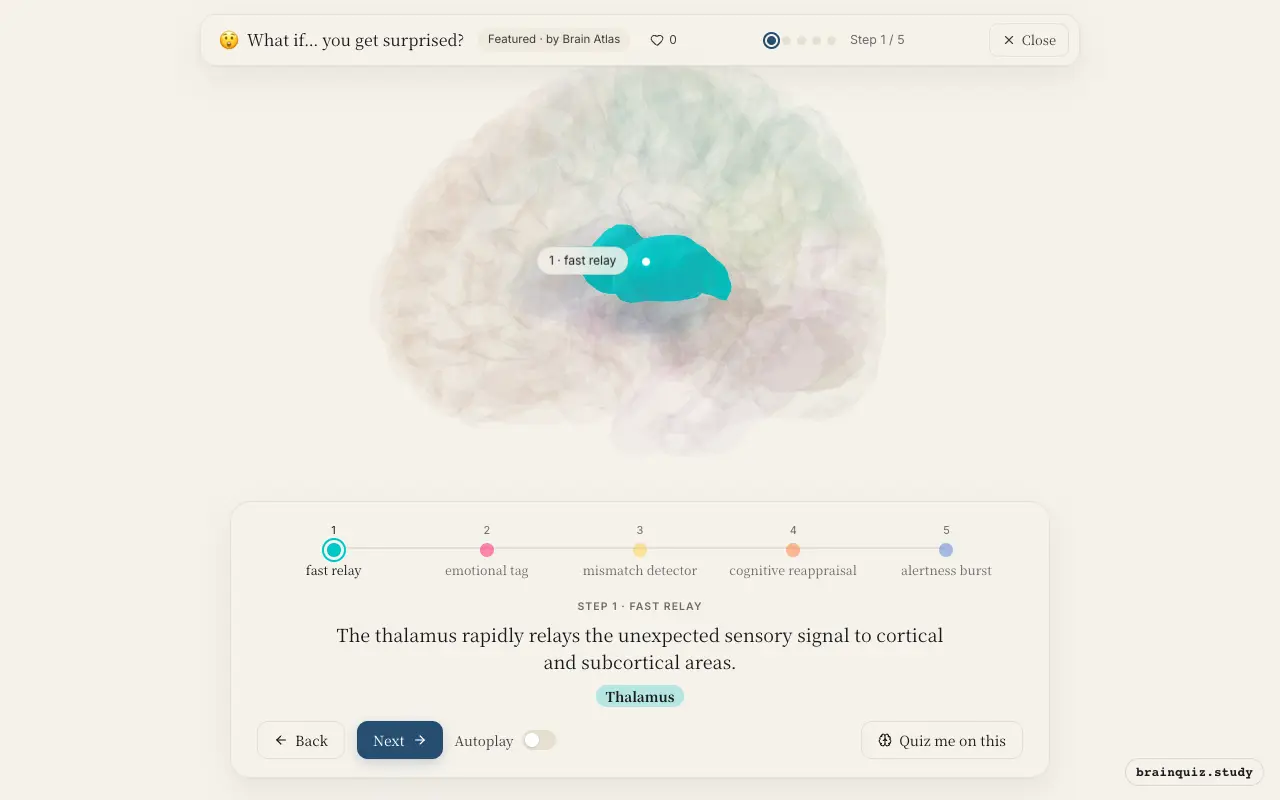
As the brain's sensory hub, the thalamus receives input from ears, eyes, or skin and sends it to the amygdala and cortex almost simultaneously. This fast relay allows the brain to react to surprise before conscious awareness of the stimulus.
2. Amygdala: emotional tag
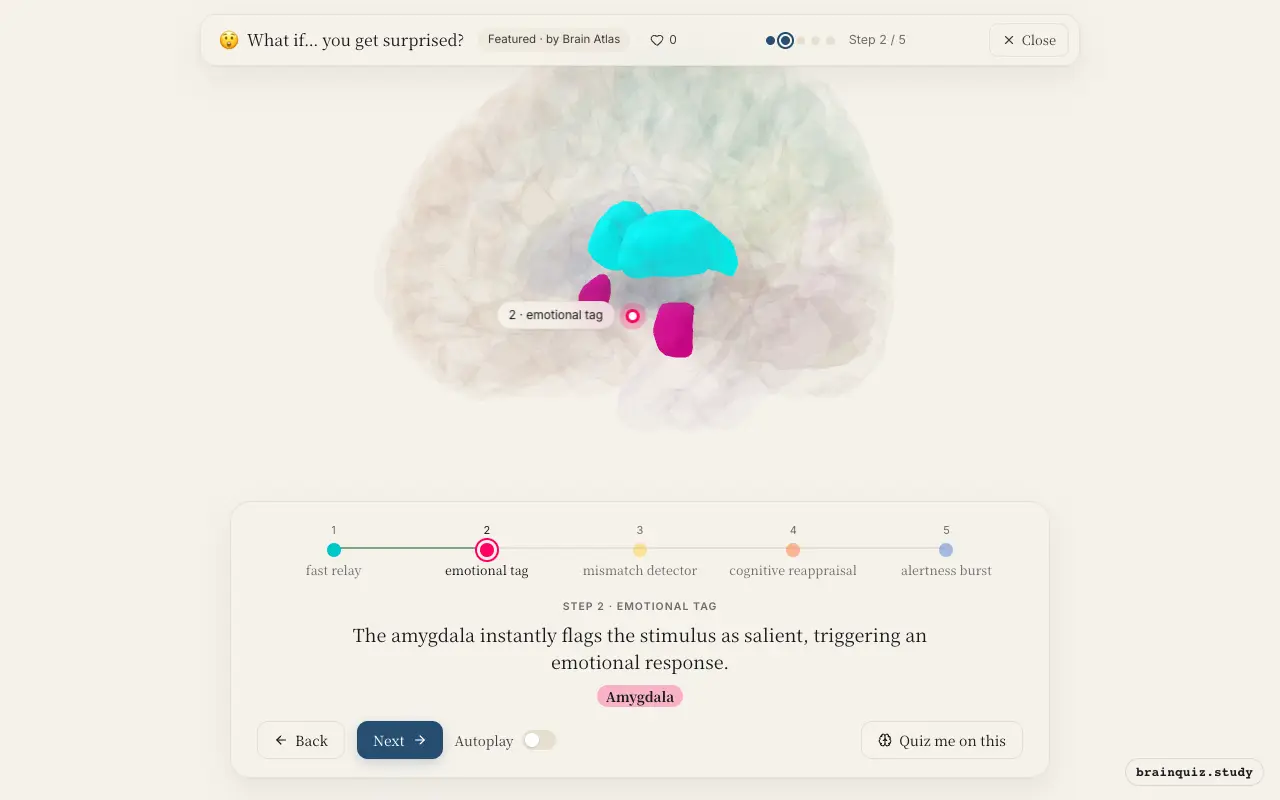
The amygdala receives a direct, fast pathway from the thalamus, enabling a quick threat or novelty assessment. It initiates bodily responses like increased heart rate and facial expressions of surprise, especially if the surprise is startling or negative.
3. Anterior Cingulate Cortex: mismatch detector
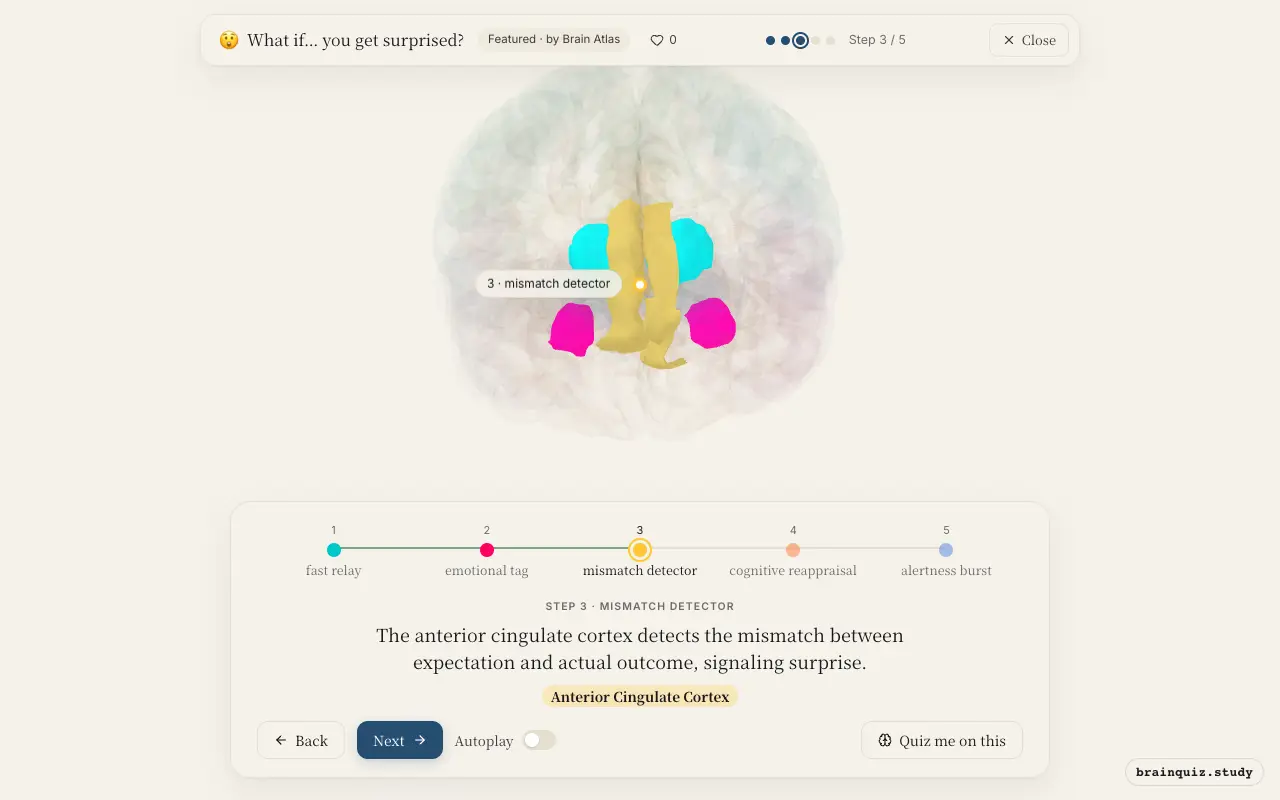
This region monitors ongoing events against predictions; a surprising stimulus generates a prediction error signal. The anterior cingulate then directs attention to the unexpected event and may trigger a cognitive shift to update expectations.
4. Prefrontal Cortex: cognitive reappraisal
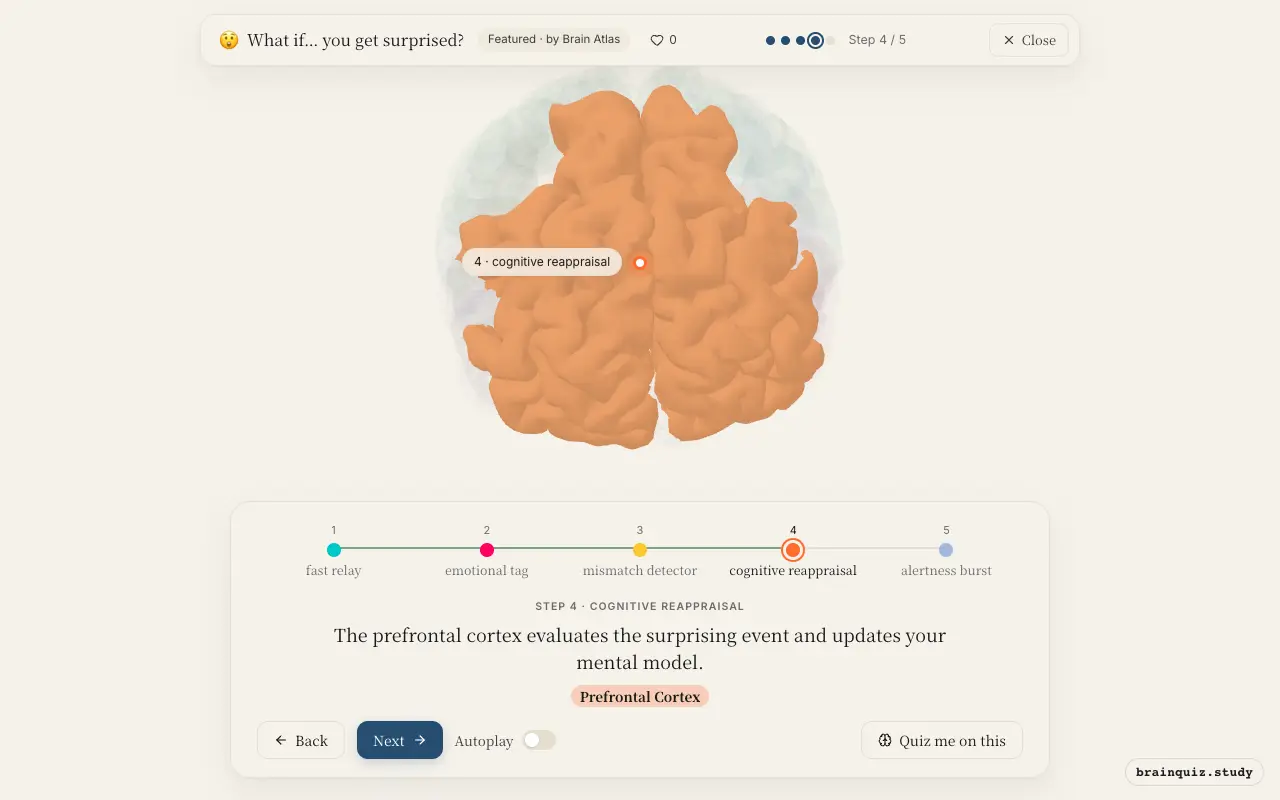
The prefrontal cortex, especially dorsolateral regions, engages to interpret the surprise: is it harmless, threatening, or rewarding? It integrates context and memory to decide how to respond, helping to regulate the initial emotional reaction.
5. Locus Coeruleus: alertness burst
The locus coeruleus, a brainstem nucleus, projects widely to the cortex and releases norepinephrine. This neuromodulator increases neural gain, making neurons more responsive and sharpening attention to the surprising stimulus, preparing the body for action.
Good to know
- The startle reflex, often part of surprise, is mediated by the brainstem and occurs very quickly after a stimulus.
- Surprise is closely linked to prediction error, a concept central to learning theories such as the Rescorla–Wagner model.
- The hippocampus is also activated during surprising events to encode them into long-term memory, as novelty enhances memory consolidation.
Surprise vs. Fear
While surprise is a brief, neutral response to the unexpected, fear is a sustained threat response involving the amygdala and hypothalamus. In surprise, the anterior cingulate and prefrontal cortex quickly reassess; in fear, the amygdala remains active, triggering a fight-or-flight response via the sympathetic nervous system.
Test yourself
Which brain region first receives most sensory information during a surprising event?
What role does the anterior cingulate cortex play in surprise?
Which neurotransmitter is released by the locus coeruleus to increase alertness during surprise?
0 of 3 answered · 0 correct
Simplified: many regions work together at once, and this shows the main players in the order they act.