Anterior Cingulate Cortex — Function, Location & Quiz
The anterior cingulate cortex links the cost of an action to the need for control. It is often described as an alarm system, but the stronger idea is that it detects conflict, errors, pain and effort signals that should change what the rest of the brain does next.
Its dorsal and ventral portions are easy to blur together. Dorsal circuitry is more closely tied to conflict and cognitive control, while subgenual circuitry is prominent in mood; lesions or dysfunction can therefore affect initiative, pain experience or depression rather than a single sensory or motor skill.
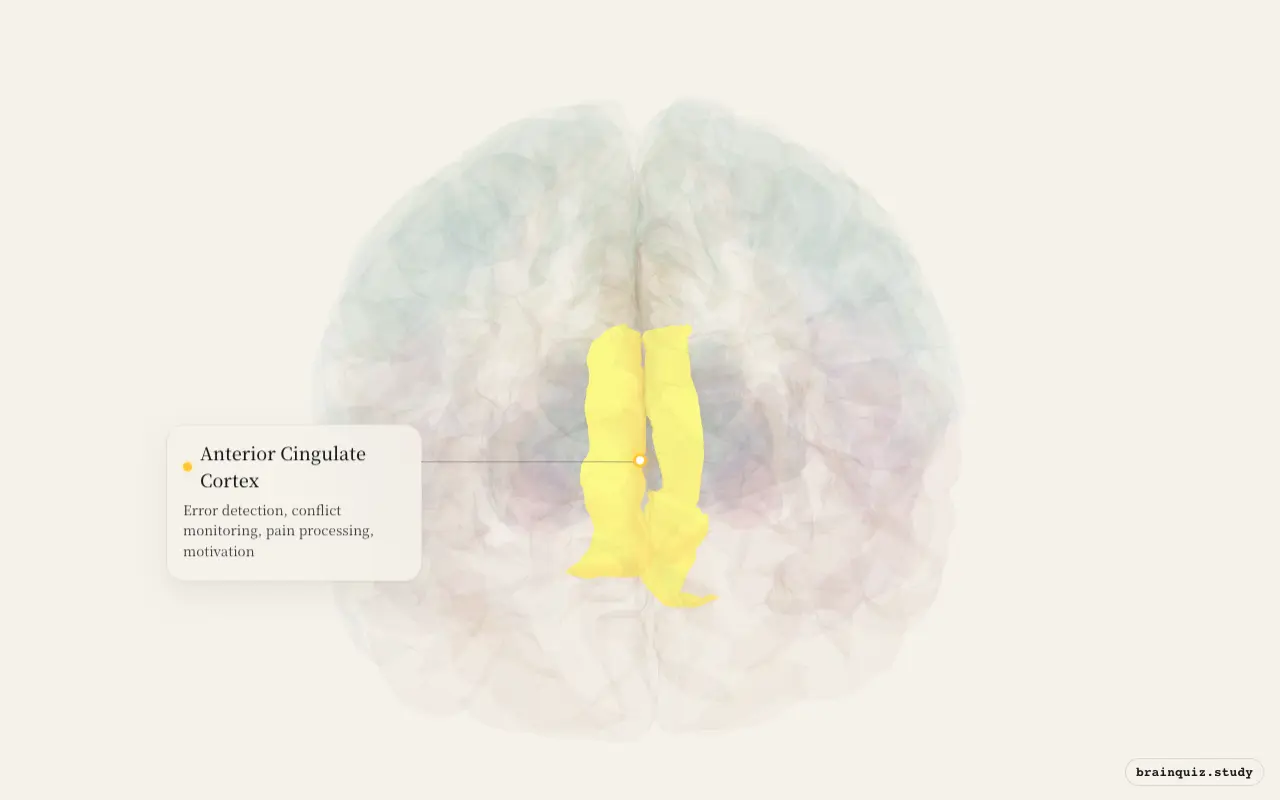
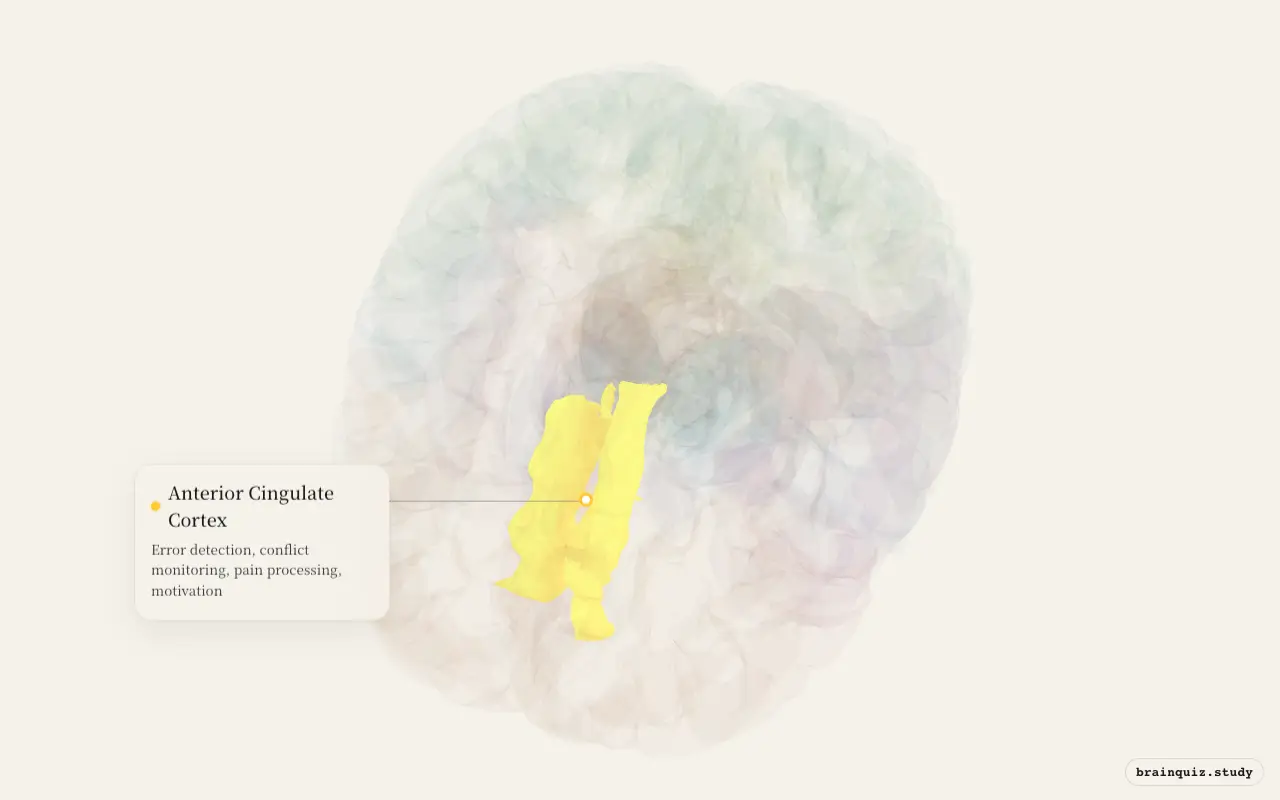
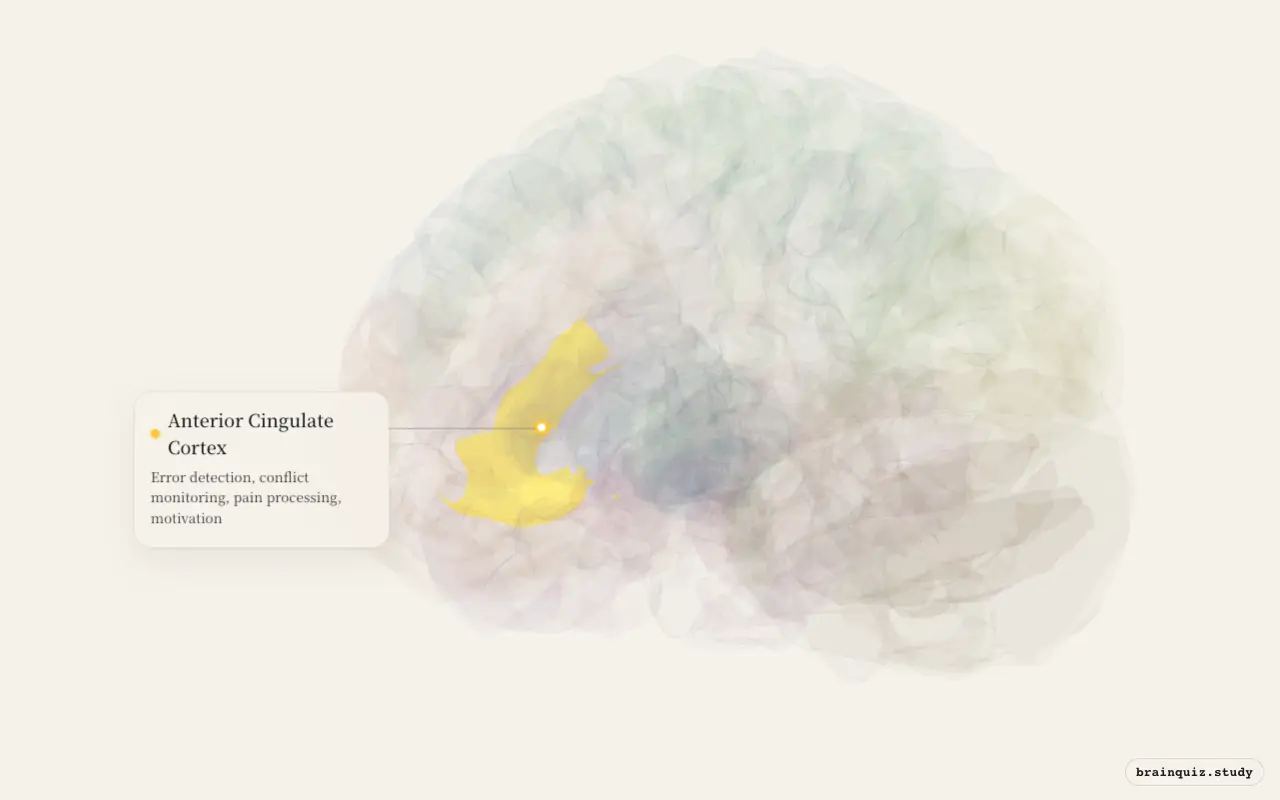
Test this anatomy in the Brain Networks Quiz: Default Mode, Salience & More or explore it on the interactive 3D brain.
Where is the Anterior Cingulate Cortex located?
Error detection, conflict monitoring, pain processing, motivation.
What does the Anterior Cingulate Cortex do?
- Conflict monitoring and error detection
- Pain processing (affective component — the 'suffering')
- Motivation and effort allocation
- Autonomic regulation (heart rate, blood pressure)
Anterior Cingulate Cortex pathways and connections
- dACC → dlPFC (signals need for increased control)
- ACC ↔ Amygdala (emotional conflict)
- ACC ↔ Insula (pain matrix)
- Salience network hub (with anterior insula)
What happens when the Anterior Cingulate Cortex is damaged?
- Bilateral lesion → akinetic mutism (awake but no spontaneous movement or speech)
- Cingulotomy (surgical lesion) historically used for intractable pain and OCD
- Dysfunction linked to depression (subgenual ACC — target for deep brain stimulation)
- ADHD associated with reduced ACC activation during conflict tasks
Anterior Cingulate Cortex key facts
Atlas category: cortical. Brodmann areas or landmark: BA 24 (dorsal), BA 32 (subgenual/ventral).
- Botvinick's conflict monitoring theory: ACC detects response conflict (e.g., Stroop task)
- ERN (Error-Related Negativity) ERP component generated by ACC
- Subgenual ACC (BA 25) is Brodmann area targeted by Mayberg's DBS for depression
- Spindle neurons (Von Economo neurons) — unique large neurons found in ACC and insula
Anterior Cingulate Cortex exam tip
ACC = the brain's 'alarm system.' dACC = cognitive (conflict, error). sgACC = emotional (mood, depression target).
Common questions
What does the anterior cingulate cortex do?
It monitors conflict and errors, contributes to the affective component of pain, allocates effort and helps regulate autonomic responses.
Which network includes the anterior cingulate cortex?
The dorsal anterior cingulate and anterior insula are major hubs of the salience network, which helps identify information that deserves immediate control or attention.
What happens after bilateral anterior cingulate damage?
Severe bilateral injury can produce akinetic mutism, in which a person is awake but shows little spontaneous movement or speech. Subgenual dysfunction is also linked to mood disorders.
When does the Anterior Cingulate Cortex light up?
- 😒 When you feel jealous: Your anterior cingulate cortex detects the mismatch between what you want and what's happening.
- 😢 When you cry: The anterior cingulate cortex processes the feeling of distress and the urge to cry.
- 😠 When you get angry: The anterior cingulate cortex detects the mismatch between expectations and the provoking event.
- 😳 When you feel embarrassed: The anterior cingulate flags the mismatch between your action and social norms.
- 💔 When you get your heart broken: Social rejection activates the anterior cingulate, which also processes physical pain.
- 😰 When you feel anxious before an exam: The anterior cingulate detects conflict between your desire to succeed and the possibility of failure, adding to distress.
- 😔 When you feel guilty: The anterior cingulate flags a mismatch between your action and internal rules.
- 🧠 When you feel lonely: The anterior cingulate cortex fires, signalling the ache of social disconnection.