What Is the Limbic Network? Brain Regions and Function
Updated
The Limbic Network is a set of brain regions that includes the hippocampus, amygdala, and orbitofrontal cortex. It is central to emotion, memory, and motivated behavior.
Paul Broca first described the 'great limbic lobe' in 1878. James Papez proposed a circuit for emotion in 1937. Paul MacLean later popularized the term 'limbic system' to encompass these regions and their roles in emotion and memory.
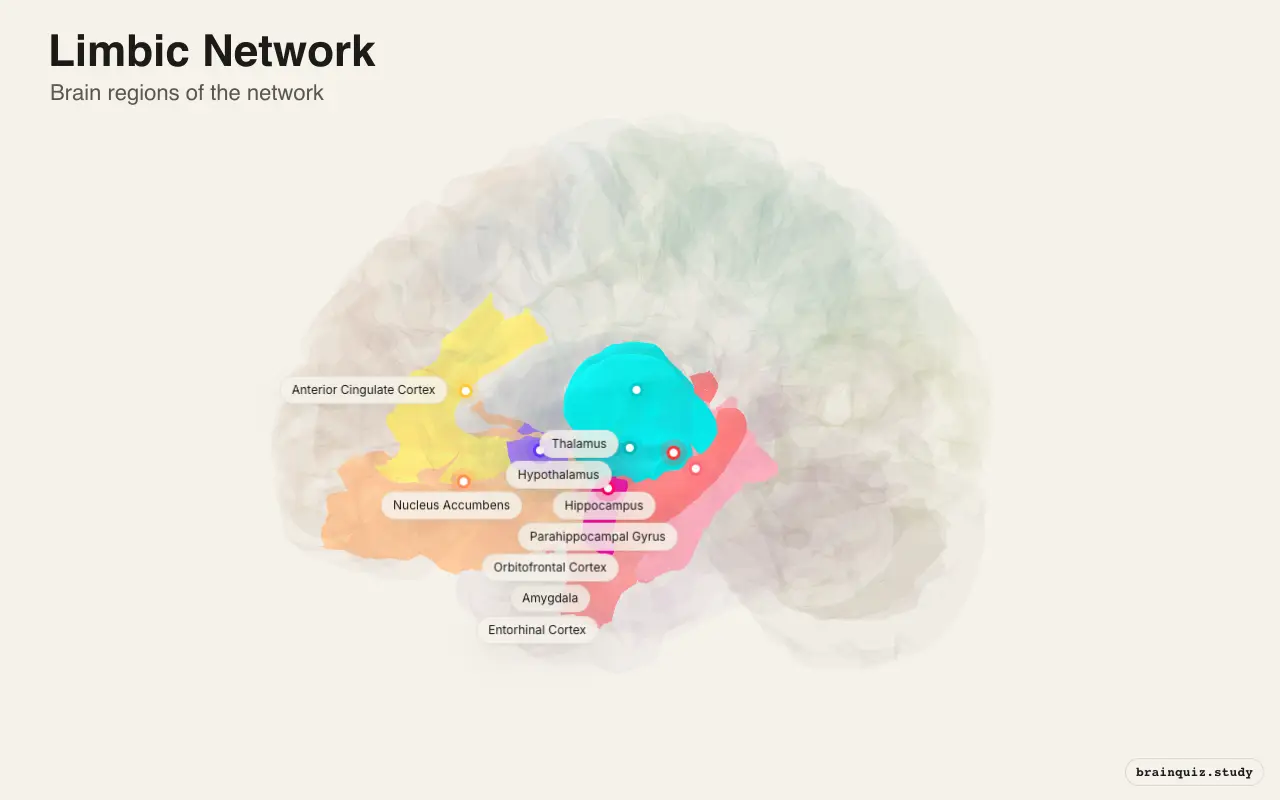
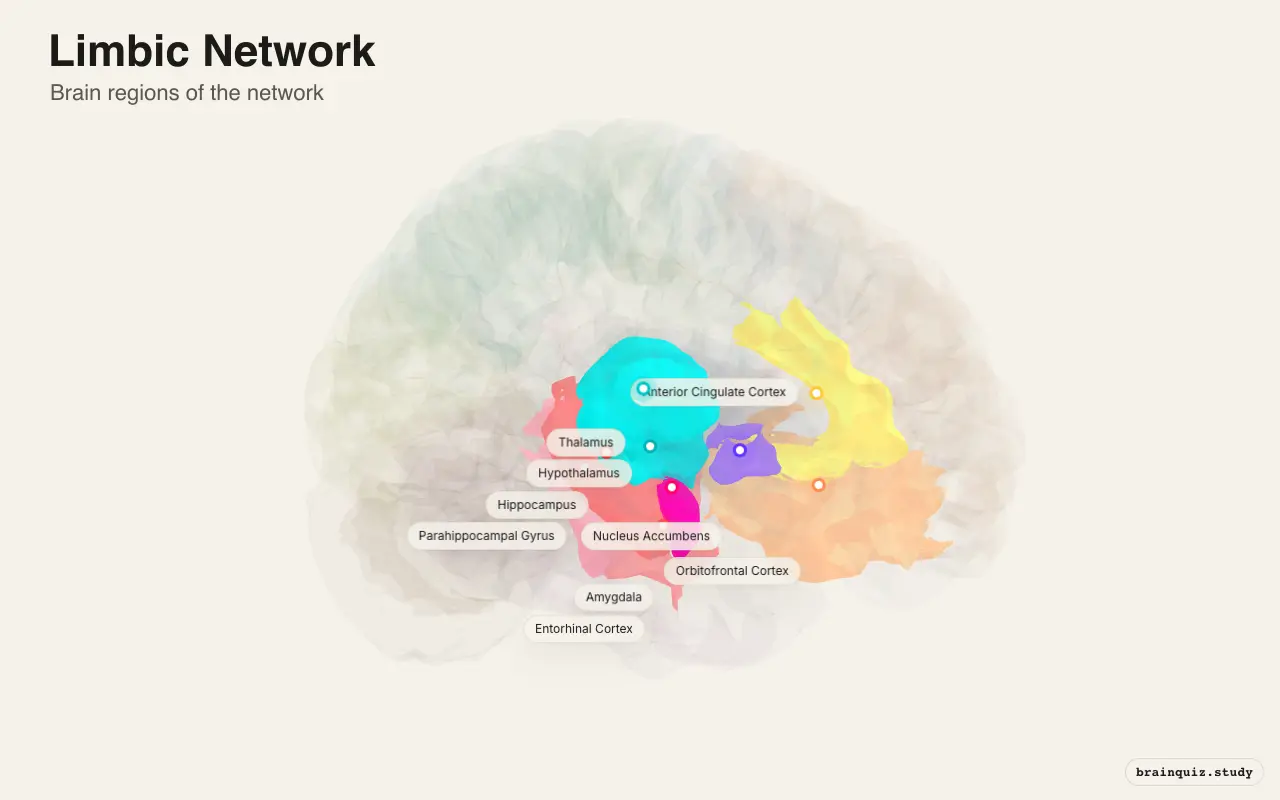
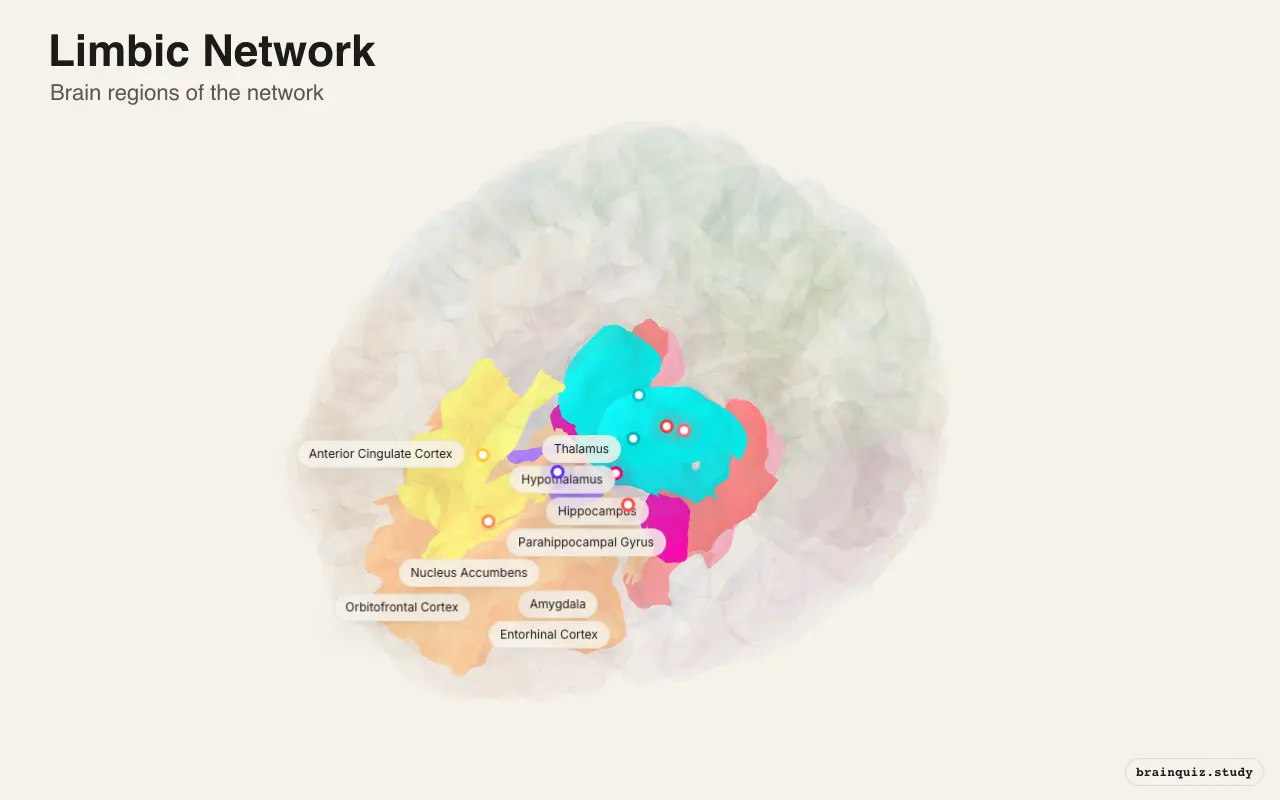
Which brain regions are in the Limbic Network?
- Hippocampus: Critical for forming new episodic memories and spatial navigation; it consolidates short-term memories into long-term storage.
- Amygdala: Central to processing emotions, especially fear and threat, and modulates memory strength based on emotional salience.
- Entorhinal Cortex: Main gateway between the hippocampus and neocortex; provides the hippocampus with multimodal sensory information for memory encoding.
- Parahippocampal Gyrus: Involved in contextual and spatial processing; supports recognition of scenes and places, linking them to memories.
- Orbitofrontal Cortex: Represents reward value and expected outcomes; guides decision-making and adaptive behavior based on emotional and social cues.
- Anterior Cingulate Cortex: Integrates emotion with cognitive control; monitors conflict and errors, and regulates autonomic responses to emotional stimuli.
- Hypothalamus: Controls autonomic and endocrine functions; orchestrates physiological responses to emotion, such as stress hormones and body temperature.
- Nucleus Accumbens: Key hub for reward and motivation; translates motivational signals into action and is implicated in pleasure and reinforcement learning.
- Thalamus: Relays sensory and limbic information between subcortical and cortical areas; the anterior thalamus is a key node in the Papez circuit for memory.
What does the Limbic Network do?
The limbic network is a collection of brain regions that together support emotion, memory, and motivation. It links internal states with external events, enabling learning from experience and guiding behavior. Key structures include the hippocampus for memory, the amygdala for emotional significance, and the orbitofrontal cortex for reward evaluation. These regions interact through circuits like the Papez circuit to integrate cognitive and visceral information.
- Episodic memory encoding — The hippocampus and entorhinal cortex work together to encode and consolidate new personal experiences into long-term memory.
- Emotional processing — The amygdala detects emotionally significant stimuli and initiates fear responses, including autonomic arousal and defensive behaviors.
- Reward valuation — The orbitofrontal cortex and nucleus accumbens compute the value of rewards and use that information to drive motivated behavior.
- Autonomic regulation — The hypothalamus coordinates autonomic and endocrine responses to emotional states, such as changes in heart rate and stress hormone release.
- Spatial memory — The hippocampus and parahippocampal gyrus support contextual and spatial memory formation, enabling navigation and scene recognition.
- Emotional memory modulation — The amygdala enhances memory consolidation for emotionally arousing events by modulating hippocampal and cortical plasticity.
When is the Limbic Network active?
The limbic network is most active during tasks involving emotional stimuli, memory encoding and retrieval, and reward-based decision-making. It shows high activity when encountering novelty, threat, or social cues. It quiets down when engaged in tasks that require focused attention on non-emotional, well-learned routines, as other networks take over.
- Feeling a surge of fear when you hear a sudden loud noise.
- Remembering where you parked your car this morning.
- Choosing a favorite snack because you anticipate it will taste good.
- Feeling your heart race when you see an angry face.
- Navigating through a familiar neighborhood using landmarks.
Limbic Network vs Salience Network
The salience network detects behaviorally relevant stimuli and orchestrates switching between the default mode and central executive networks. The limbic network, in contrast, is more directly involved in generating emotional responses, forming memories, and evaluating rewards. The two interact: the salience network's anterior insula can signal the limbic system to respond to salient emotional cues, while the limbic system's outputs influence what the salience network deems important.
LimbN vs SN at a glance
| Aspect | Limbic Network | Salience Network |
|---|---|---|
| Primary function | Emotion and memory | Detecting salience and switching |
| Key hub | Amygdala | Anterior insula |
| Response to stimuli | Generates emotional reaction | Flags stimuli for attention |
| Influence on networks | Modulates memory consolidation | Shifts between DMN and CEN |
| Typical activation | During emotional or mnemonic tasks | During unexpected or salient events |
| Clinical relevance | Amnesia, emotional disorders | Psychosis, impaired attention |
What happens when the Limbic Network is disrupted?
Damage to the limbic network can profoundly affect memory, emotion, and behavior. Bilateral hippocampal lesions cause severe anterograde amnesia, while amygdala damage impairs fear conditioning. Limbic encephalitis leads to rapid memory loss and psychiatric symptoms. These disruptions highlight the network's essential role in normal cognitive and emotional function.
- Anterograde amnesia — Bilateral hippocampal damage, as in patient HM, leads to an inability to form new declarative memories while old memories remain intact.
- Urbach-Wiethe disease — Calcification of the amygdala impairs fear conditioning and recognition of fearful facial expressions, while other emotions may be spared.
- Limbic encephalitis — Autoimmune inflammation of limbic structures causes subacute memory loss, confusion, and psychiatric symptoms such as hallucinations.
- Temporal lobe epilepsy — Mesial temporal sclerosis, involving hippocampal atrophy, is a common pathological finding and is associated with recurrent seizures and memory deficits.
- Korsakoff syndrome — Thiamine deficiency damages the mammillary bodies and anterior thalamus, disrupting the Papez circuit and causing severe anterograde amnesia.
How does the Limbic Network work with other networks?
The limbic network does not work in isolation. It interacts closely with the default mode network during autobiographical memory and future thinking. It also communicates with the salience network to assign emotional importance to external events. During emotional learning, the amygdala modulates activity in visual and prefrontal areas. The central executive network is recruited when emotional regulation or cognitive reappraisal is needed, with the anterior cingulate as a bridge. These interactions allow the brain to adapt flexibly to changing environmental demands.
How do scientists find the Limbic Network?
Researchers typically map the limbic network using resting-state functional MRI, measuring correlated spontaneous activity between its regions. Seed-based connectivity from the hippocampus or amygdala reveals stable functional connections. Independent component analysis can also identify the network as a coherent pattern. One limitation is that these methods infer connectivity from correlation, not direct anatomical connections; thus, they may not capture all functional interactions, especially those that are task-dependent.
Key facts about the Limbic Network
- Paul Broca coined the term 'limbic lobe' in 1878 to describe a ring of cortex on the medial surface of the brain.
- James Papez proposed in 1937 that a circuit including the hippocampus, mammillary bodies, anterior thalamus, and cingulate gyrus underlies emotion.
- Patient HM's bilateral medial temporal lobe resection in 1953 led to profound anterograde amnesia, establishing the medial temporal lobe's role in memory.
Sources
- Papez JW (1937). A proposed mechanism of emotion. Archives of Neurology and Psychiatry, 38(4), 725–743.
- Rolls ET (2015). Limbic systems for emotion and for memory, but no single limbic system. Cortex, 62, 119–157.