Brain Networks — The Large-Scale Networks of the Human Brain
Updated
Brain networks are sets of brain regions that work together. The best-known networks include the default mode, salience, central executive, dorsal attention, ventral attention, language, sensorimotor, visual, and limbic networks.
Neuroscience once focused on single brain regions for specific functions, but complex behaviors arise from coordinated activity across many areas. Modern methods show that the brain organizes into large-scale networks, where distant regions interact dynamically. Understanding these networks is essential for linking brain structure to cognition and mental health.
The 9 brain networks at a glance
| Network | Core regions | Main job |
|---|---|---|
| Default Mode Network | Prefrontal Cortex, Posterior Cingulate Cortex, Angular Gyrus, Hippocampus | Self-referential thought and introspection · Autobiographical memory retrieval |
| Salience Network | Anterior Cingulate Cortex, Insula, Amygdala, Substantia Nigra | Detection of novel and behaviorally salient stimuli · Switching between internal (DMN) and external (CEN) attention |
| Central Executive Network | Right Dorsolateral Prefrontal Cortex, Prefrontal Cortex, Dorsal Posterior Parietal Cortex, Parietal Cortex | Working memory maintenance and manipulation · Goal-directed planning and decision-making |
| Dorsal Attention Network | Frontal Eye Fields, Dorsal Posterior Parietal Cortex, Parietal Cortex, Occipital Cortex | Voluntary spatial attention and visual search · Saccadic eye movement planning |
| Ventral Attention Network | Ventral Posterior Parietal Cortex, Insula, Anterior Cingulate Cortex, Temporal Cortex | Stimulus-driven reorienting of attention · Detection of unexpected but relevant events |
| Language Network | Broca's Area, Wernicke's Area, Left Inferior Frontal Gyrus, Angular Gyrus | Speech production and motor planning for articulation · Auditory language comprehension |
| Sensorimotor Network | Motor Cortex, Somatosensory Cortex, Premotor Cortex, Putamen | Voluntary movement initiation and execution · Somatosensory processing (touch, proprioception) |
| Visual Network | Visual Cortex, Occipital Cortex, Fusiform Gyrus, Thalamus | Edge detection, orientation, and spatial frequency analysis (V1) · Color and form processing (V4/fusiform) |
| Limbic Network | Hippocampus, Amygdala, Entorhinal Cortex, Parahippocampal Gyrus | Episodic memory encoding and consolidation · Emotional processing and fear conditioning |
What is a large-scale brain network?
A large-scale brain network, also called an intrinsic network, is a set of brain regions whose activity fluctuates together over time, even at rest. This coordinated activity is measured as functional connectivity, the statistical dependence between regions. Common parcellations of the human brain, such as the Yeo 2011 seven-network atlas, identify seven major networks, though finer parcellations can reveal up to 17 networks. These networks correspond to different functional domains.
Explore each network
- Default Mode Network — The Default Mode Network is a set of brain regions active at rest and during self-referential thought. Core hubs include the medial prefrontal cortex, posterior cingulate cortex, and angular gyrus.
- Salience Network — The Salience Network is a set of brain regions—including the anterior insula, dorsal anterior cingulate cortex, and amygdala—that detects salient internal and external events and switches between the default mode and executive networks.
- Central Executive Network — The Central Executive Network is a frontoparietal brain system for goal-directed cognition. Core regions include the dorsolateral prefrontal cortex, posterior parietal cortex, and caudate, supporting working memory and cognitive control.
- Dorsal Attention Network — The Dorsal Attention Network is a set of brain areas including the frontal eye fields, dorsal posterior parietal cortex, and premotor cortex. It controls voluntary, goal-directed attention to spatial locations and features.
- Ventral Attention Network — The Ventral Attention Network is a brain system for detecting unexpected, behaviorally relevant stimuli and reorienting attention. Core regions include ventral posterior parietal cortex, insula, anterior cingulate cortex, and temporal cortex. It acts as a circuit breaker for focused attention.
- Language Network — The Language Network is a left-lateralized brain system for language. Core regions include Broca's area and Wernicke's area, with the arcuate fasciculus as a key connection, supporting speech, comprehension, and syntax.
- Sensorimotor Network — The Sensorimotor Network is a set of brain regions, including the motor cortex, somatosensory cortex, premotor cortex, and subcortical loops, that coordinates voluntary movement and integrates sensory feedback.
- Visual Network — The Visual Network is the brain system that processes visual information. Core regions include the occipital cortex, fusiform gyrus, and posterior parietal cortex. It handles object recognition and spatial vision.
- Limbic Network — The Limbic Network is a set of brain regions that includes the hippocampus, amygdala, and orbitofrontal cortex. It is central to emotion, memory, and motivated behavior.
The triple network model
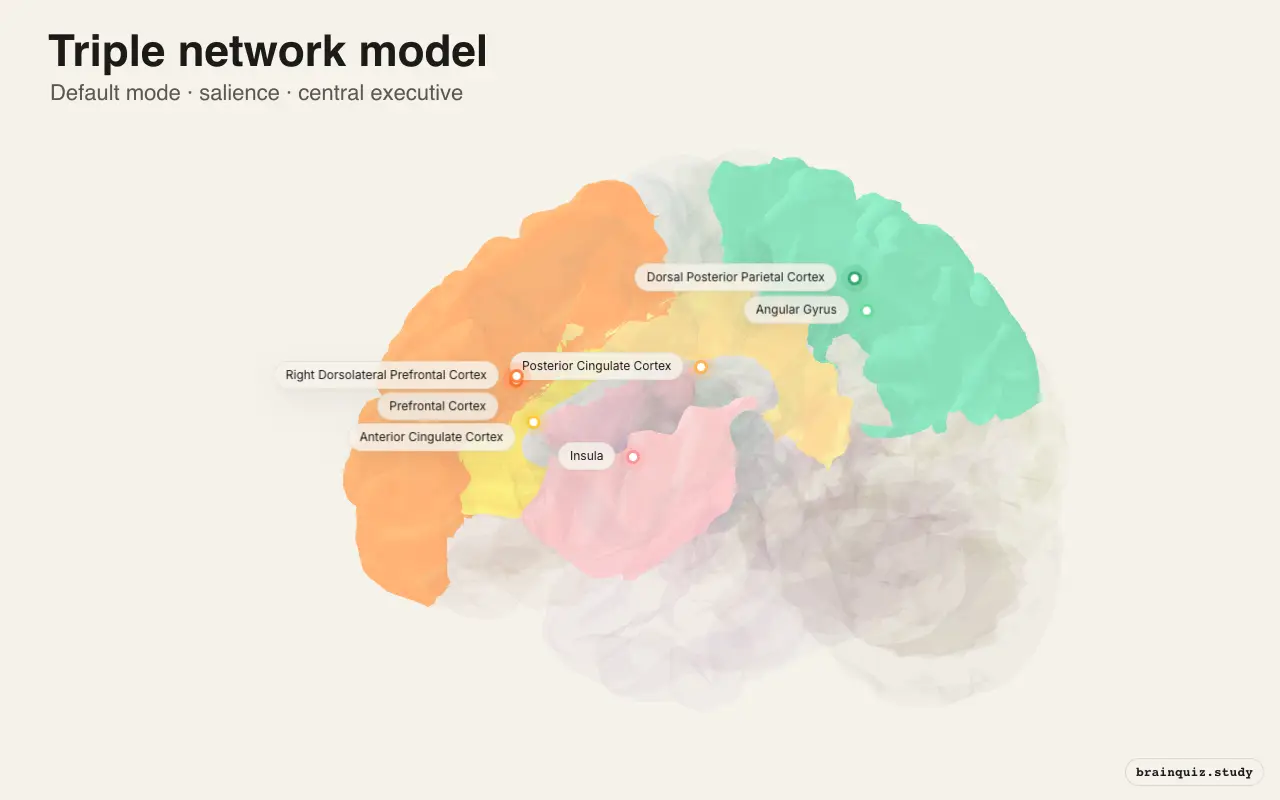
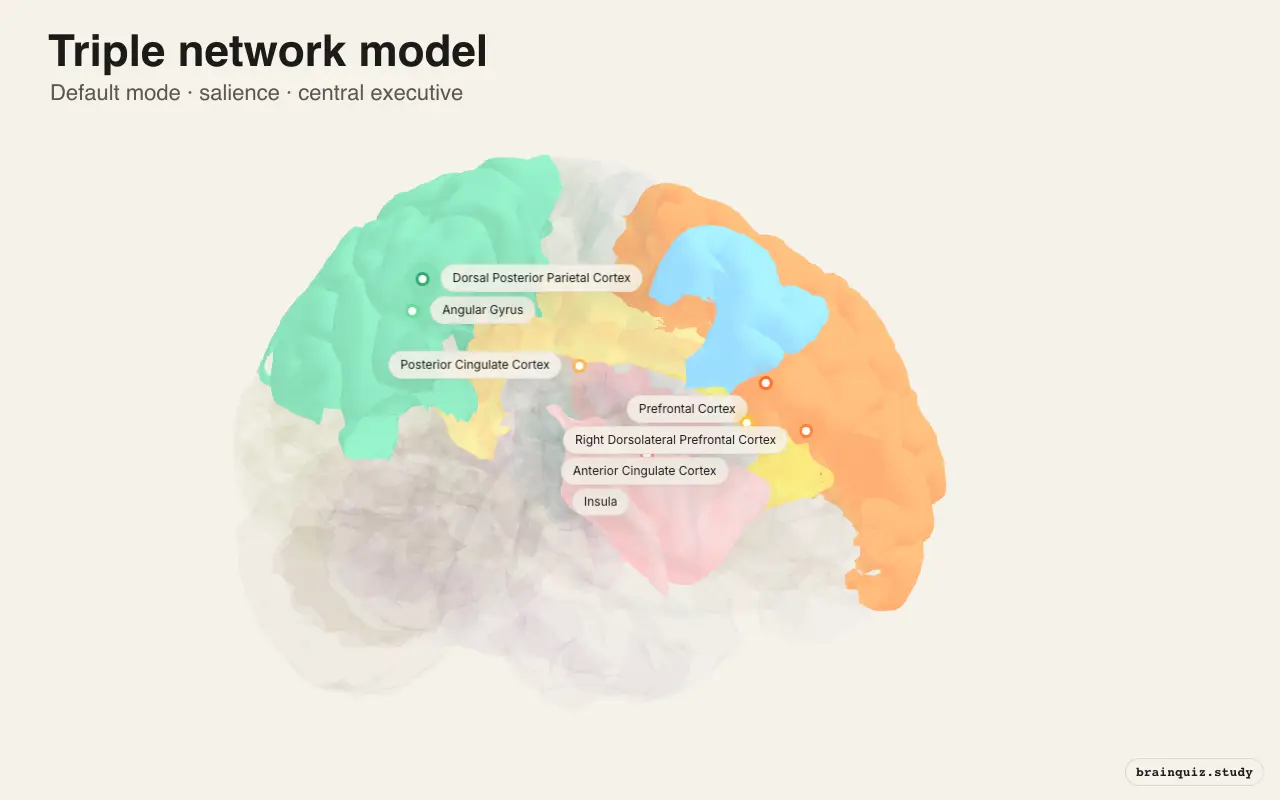
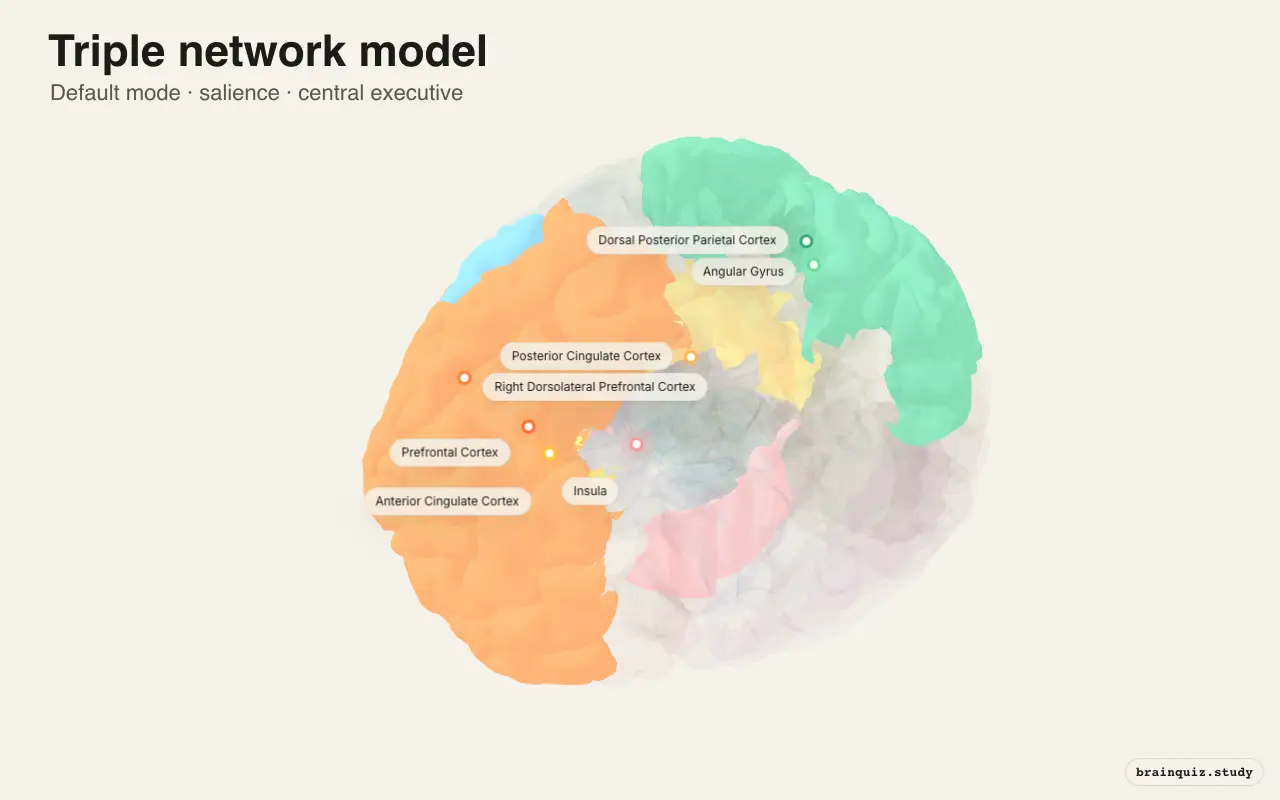
Menon's triple network model proposes that three core networks—the salience network, default mode network, and central executive network—underlie many cognitive functions. The salience network detects salient stimuli and toggles between the default mode network, active during internally focused thought, and the central executive network, active during externally focused tasks. This dynamic switching is thought to be crucial for adaptive behavior, and disruptions in this balance are linked to several psychiatric conditions.
- Salience Network suppresses Default Mode Network — The anterior insula of the salience network deactivates the DMN when task-relevant external stimuli are detected, shifting the brain from internal mentation to externally focused processing.
- Salience Network activates Central Executive Network — The salience network engages the central executive network to allocate cognitive resources toward the detected salient stimulus, enabling goal-directed analysis and response planning.
- Default Mode Network anticorrelated Central Executive Network — The DMN and CEN show robust anticorrelation: when one increases activity, the other decreases. This reciprocal relationship ensures efficient toggling between internally and externally directed cognition.
How are brain networks measured?
Brain networks are typically measured using resting-state functional MRI, which records spontaneous brain activity while a person lies still. Functional connectivity between regions is estimated using seed-based correlation, where a region is chosen and its activity correlated with others, or independent component analysis (ICA), which separates the whole brain into distinct networks. A limitation is that resting-state measures are indirect and correlation does not imply causation.
Brain networks and mental health
Altered brain network connectivity has been associated with several mental health conditions. In depression, the default mode network often shows increased connectivity, while in ADHD, the salience and attention networks may be disrupted. Schizophrenia research finds abnormal connectivity in the central executive network, and Alzheimer's disease is linked to reduced default mode network activity. These findings are correlational and do not establish causality.
- Schizophrenia — Aberrant salience network switching leads to inappropriate DMN intrusion during task states, contributing to hallucinations and disorganized thought. CEN hypoconnectivity underlies cognitive deficits.
- Major Depressive Disorder — DMN hyperconnectivity drives persistent rumination. Reduced SN-CEN coupling impairs the ability to disengage from negative self-referential thought and engage with the external world.
- ADHD — Failure of the salience network to suppress the DMN during attention-demanding tasks causes mind-wandering and attentional lapses. CEN underactivation reduces sustained cognitive control.
- Autism Spectrum Disorder — Atypical salience network function alters how social stimuli are prioritized. Reduced DMN connectivity during social cognition tasks impairs theory of mind and self-other distinction.
- Frontotemporal Dementia — Progressive salience network degeneration (beginning with anterior insula atrophy) causes loss of empathy, social awareness, and emotional regulation. The DMN may become aberrantly dominant.
Sources
- Yeo BTT et al. (2011). The organization of the human cerebral cortex estimated by intrinsic functional connectivity. Journal of Neurophysiology, 106(3), 1125–1165.
- Menon V (2011). Large-scale brain networks and psychopathology: a unifying triple network model. Trends in Cognitive Sciences, 15(10), 483–506.
- Raichle ME et al. (2001). A default mode of brain function. PNAS, 98(2), 676–682.
- Seeley WW et al. (2007). Dissociable intrinsic connectivity networks for salience processing and executive control. Journal of Neuroscience, 27(9), 2349–2356.
- Corbetta M, Shulman GL (2002). Control of goal-directed and stimulus-driven attention in the brain. Nature Reviews Neuroscience, 3(3), 201–215.