What Is the Language Network? Brain Regions and Function
Updated
The Language Network is a left-lateralized brain system for language. Core regions include Broca's area and Wernicke's area, with the arcuate fasciculus as a key connection, supporting speech, comprehension, and syntax.
Classical neuropsychology identified language areas through lesion studies in the 19th century, but the network concept emerged with modern neuroimaging. The language network matters because language is a core human ability, and its disruption reveals brain organization and underpins communication, thought, and social interaction.
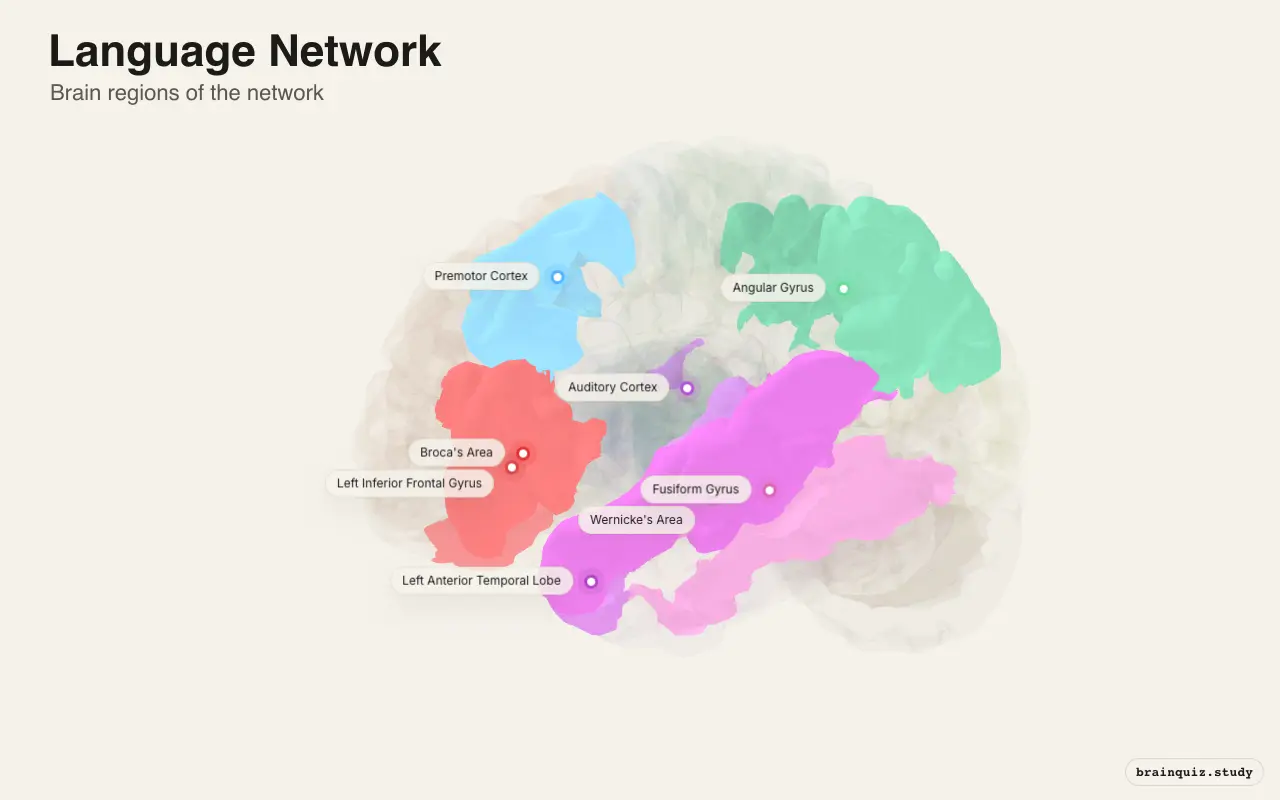
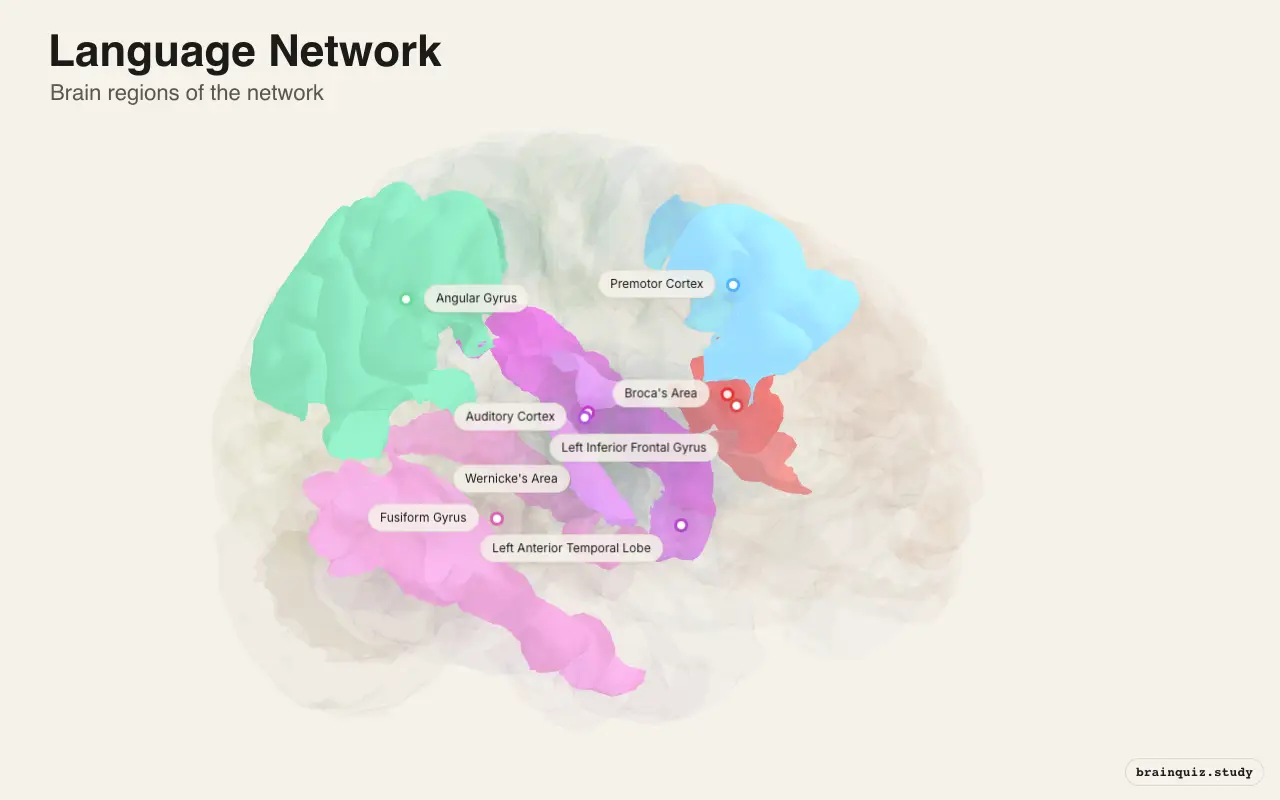
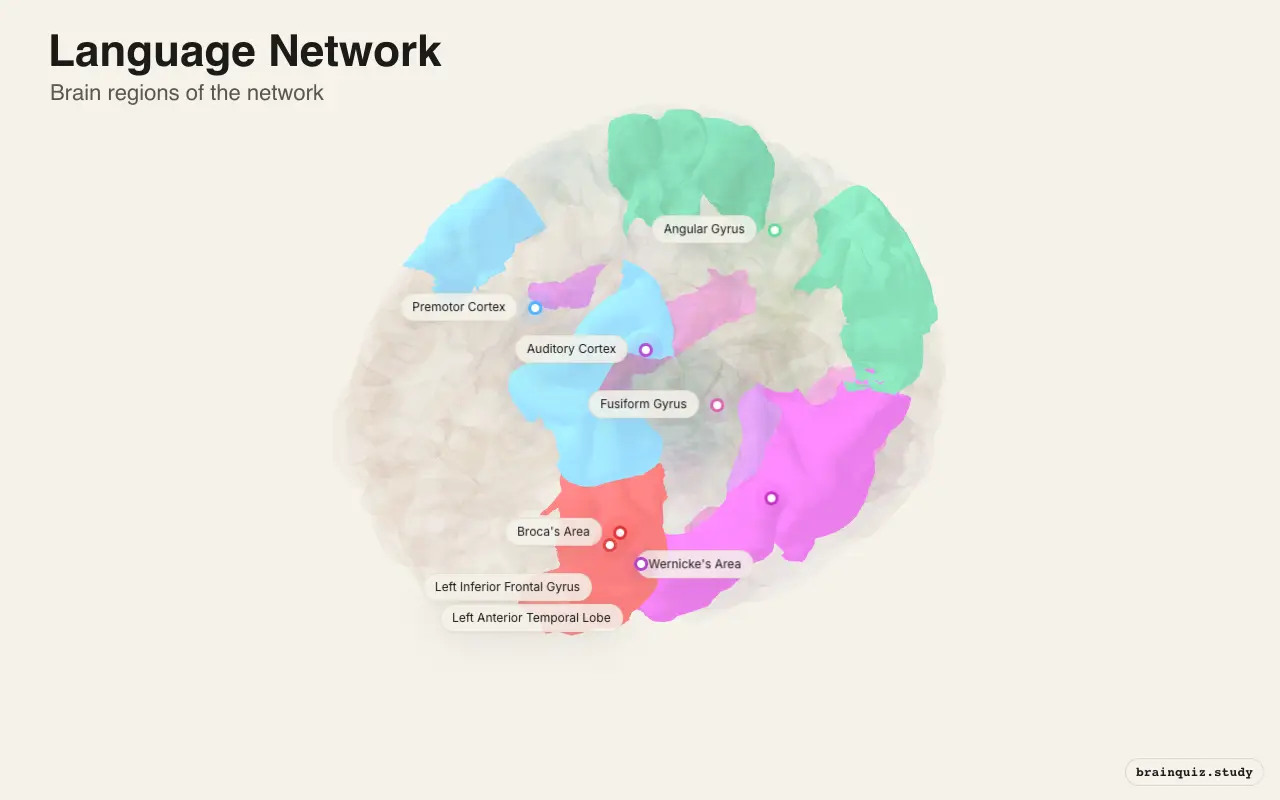
Which brain regions are in the Language Network?
- Broca's Area: Speech production and motor planning for articulation; lesions impair fluent speech output.
- Wernicke's Area: Auditory language comprehension and semantic access; damage leads to fluent but meaningless speech.
- Left Inferior Frontal Gyrus: Encompasses Broca's area and adjacent cortex; supports syntactic processing and working memory.
- Angular Gyrus: Integrates visual and auditory information for reading and semantic retrieval, linking print to sound.
- Left Anterior Temporal Lobe: Hub for semantic memory and conceptual knowledge, combining information across modalities in a modality-general store.
- Premotor Cortex: Involved in motor planning for speech and may support phonological rehearsal in the dorsal stream.
- Auditory Cortex: Processes speech sounds and is essential for early auditory language comprehension in the temporal lobe.
- Fusiform Gyrus: Supports visual word form recognition, especially in the left hemisphere for reading.
What does the Language Network do?
What does the Language Network do? The language network is a left-lateralized set of brain regions that supports all levels of linguistic processing. It handles speech production, comprehension, syntax, semantics, and reading. The network operates through dorsal and ventral streams: the dorsal stream (arcuate fasciculus) links phonological and motor areas for speech and syntax, while the ventral stream (extreme capsule and inferior fronto-occipital fasciculus) supports semantic processing. It activates for both spoken and signed language.
- Speech production — Broca's area and premotor cortex plan and execute the motor commands for fluent articulation.
- Auditory comprehension — Wernicke's area and auditory cortex decode speech sounds into meaningful words and sentences.
- Syntactic parsing — Left inferior frontal regions analyze grammatical structure and word order to build sentence meaning.
- Semantic retrieval — Angular gyrus and anterior temporal lobe access stored conceptual knowledge associated with words.
- Reading — Fusiform gyrus recognizes visual word forms, linking orthography to phonology and meaning.
- Verbal working memory — A frontal-parietal loop maintains phonological information for verbal rehearsal and short-term retention.
When is the Language Network active?
The language network is most active during speech perception, production, and inner verbal thought. It engages during reading, writing, and sign language. Activity decreases during rest, non-linguistic tasks, and when attention is directed to spatial or emotional processing, though some regions may remain active during self-directed thought.
- Listening to a friend explain directions.
- Reading a text message and planning a reply.
- Writing an email or a shopping list.
- Rehearsing a phone number in your head.
Language Network vs Default Mode Network
The language network and default mode network (DMN) show an anticorrelated relationship: when language demands increase, DMN activity decreases, and vice versa. The DMN is active during rest, self-reflection, and social cognition, while the language network engages in externally focused linguistic tasks. However, the angular gyrus is shared: it supports semantic retrieval in the language network but also participates in the DMN's self-referential processing. This overlap suggests competition for the same cortical resources.
LN vs DMN at a glance
| Aspect | Language Network | Default Mode Network |
|---|---|---|
| Primary function | Supports language processing | Supports self-referential thought |
| Resting state | Shows low activity at rest | Shows high activity at rest |
| External tasks | Activates during speech and reading | Deactivates during focused tasks |
| Key hubs | Broca's and Wernicke's areas | Medial prefrontal and posterior cingulate |
| Shared region | Angular gyrus for semantics | Angular gyrus for self-processing |
What happens when the Language Network is disrupted?
Damage to the language network produces characteristic aphasias. The type of impairment depends on lesion location: frontal lesions often cause non-fluent aphasia, temporal lesions often cause fluent aphasia, and white matter disconnection causes conduction aphasia. Neurodegenerative diseases can also progressively affect language, as in semantic dementia and primary progressive aphasia.
- Broca's aphasia — Non-fluent speech with relatively preserved comprehension is associated with damage to the left inferior frontal gyrus.
- Wernicke's aphasia — Fluent but meaningless speech with poor comprehension is linked to posterior superior temporal gyrus lesions.
- Conduction aphasia — Impaired repetition with relatively intact comprehension and production is often associated with arcuate fasciculus damage.
- Semantic dementia — Progressive loss of word meaning and object knowledge is associated with anterior temporal lobe atrophy.
How does the Language Network work with other networks?
The language network interacts with domain-general control networks, such as the frontoparietal network, to support effortful language tasks like learning new words or resolving ambiguity. It also coordinates with the default mode network during internally generated language, such as mind-wandering or future thinking. The auditory and motor networks contribute to speech perception and production, while the visual network feeds orthographic information during reading. These interactions enable flexible language use across contexts.
How do scientists find the Language Network?
Researchers identify the language network using resting-state fMRI functional connectivity. By placing a seed in Broca's area, they observe correlated activity in Wernicke's area, the angular gyrus, and other regions, forming a coherent network. Independent component analysis (ICA) also reveals this network as a distinct spatial pattern. A limitation is that resting-state scans reflect intrinsic organization but may not capture task-specific dynamics.
Key facts about the Language Network
- Paul Broca identified the left inferior frontal gyrus as critical for speech production in 1861.
- Carl Wernicke described the posterior superior temporal gyrus's role in comprehension in 1874.
- The arcuate fasciculus, a white matter tract connecting Broca's and Wernicke's areas, is essential for repetition.
Sources
- Fedorenko E, Hsieh PJ, Nieto-Castañón A, Whitfield-Gabrieli S, Kanwisher N (2010). New method for fMRI investigations of language: defining ROIs functionally in individual subjects. Journal of Neurophysiology, 104(2), 1177–1194.
- Hickok G, Poeppel D (2007). The cortical organization of speech processing. Nature Reviews Neuroscience, 8(5), 393–402.