Premotor Cortex — Function, Location & Quiz
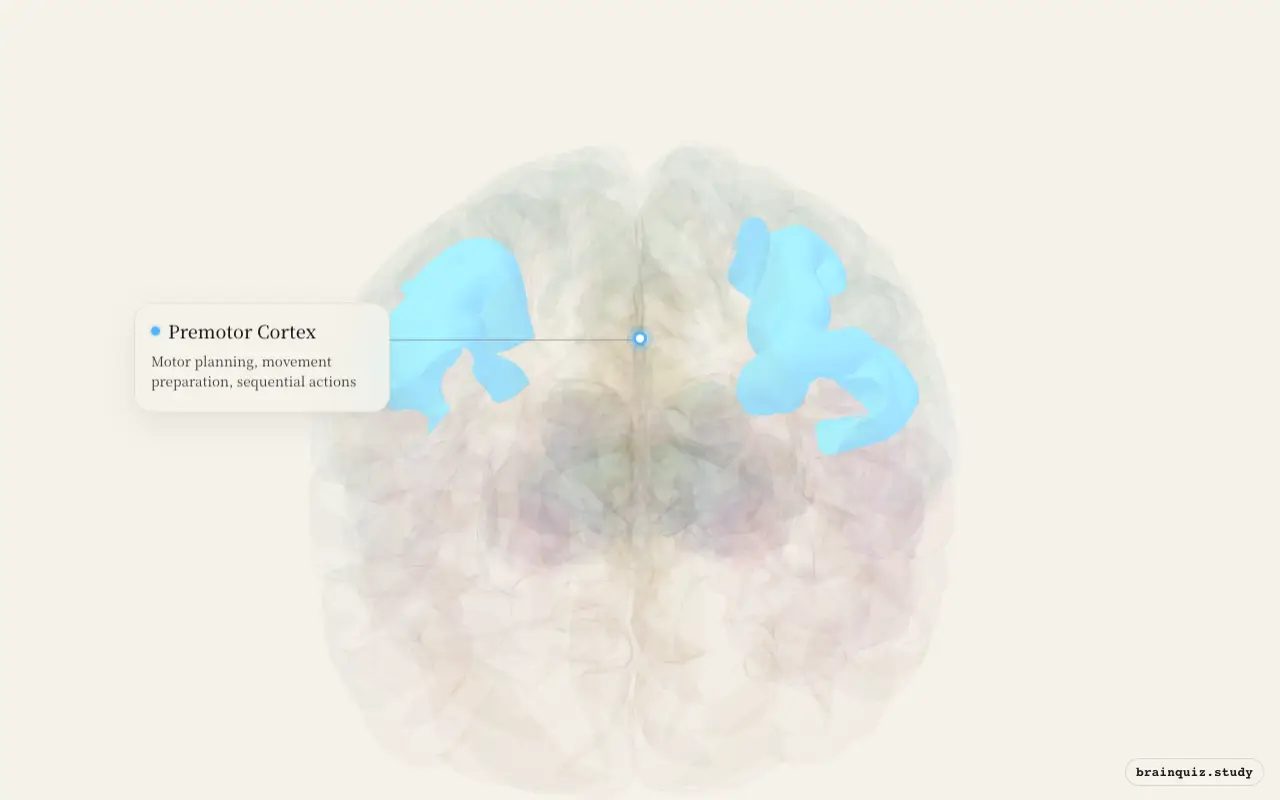
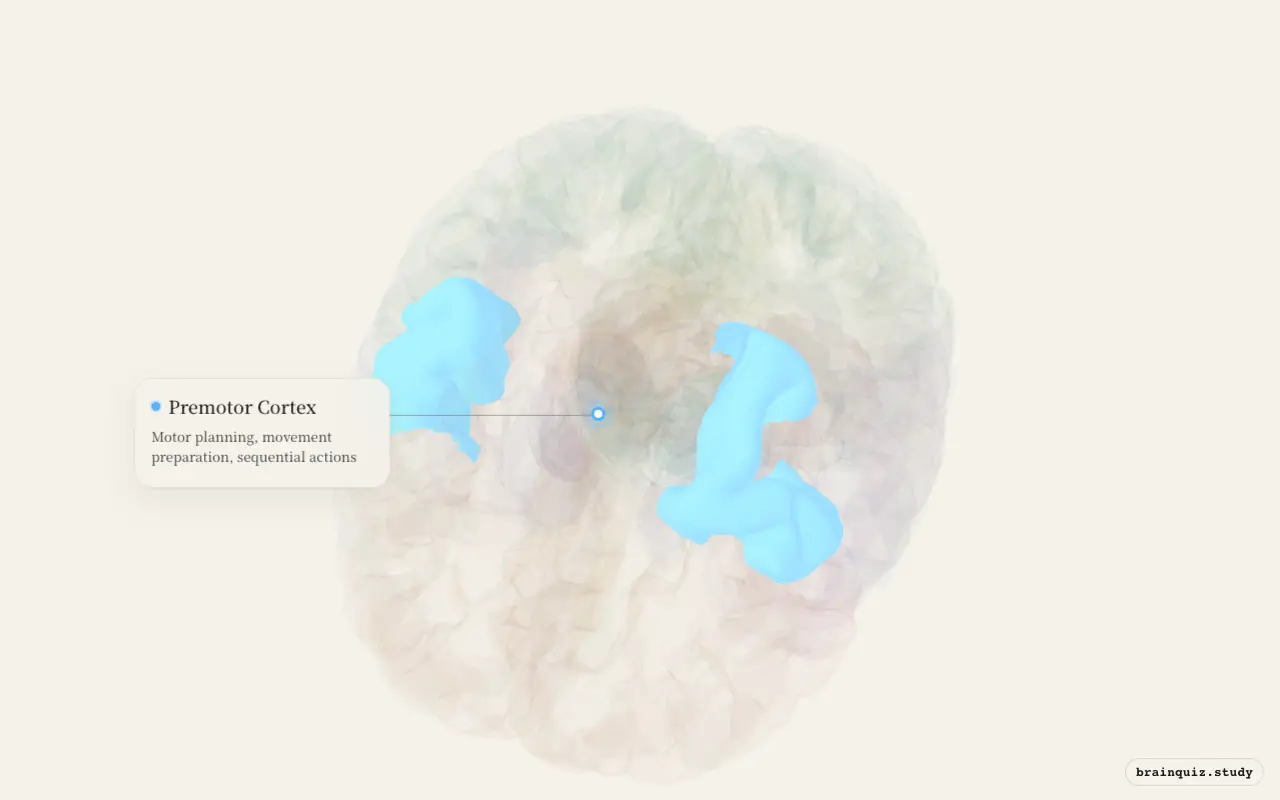
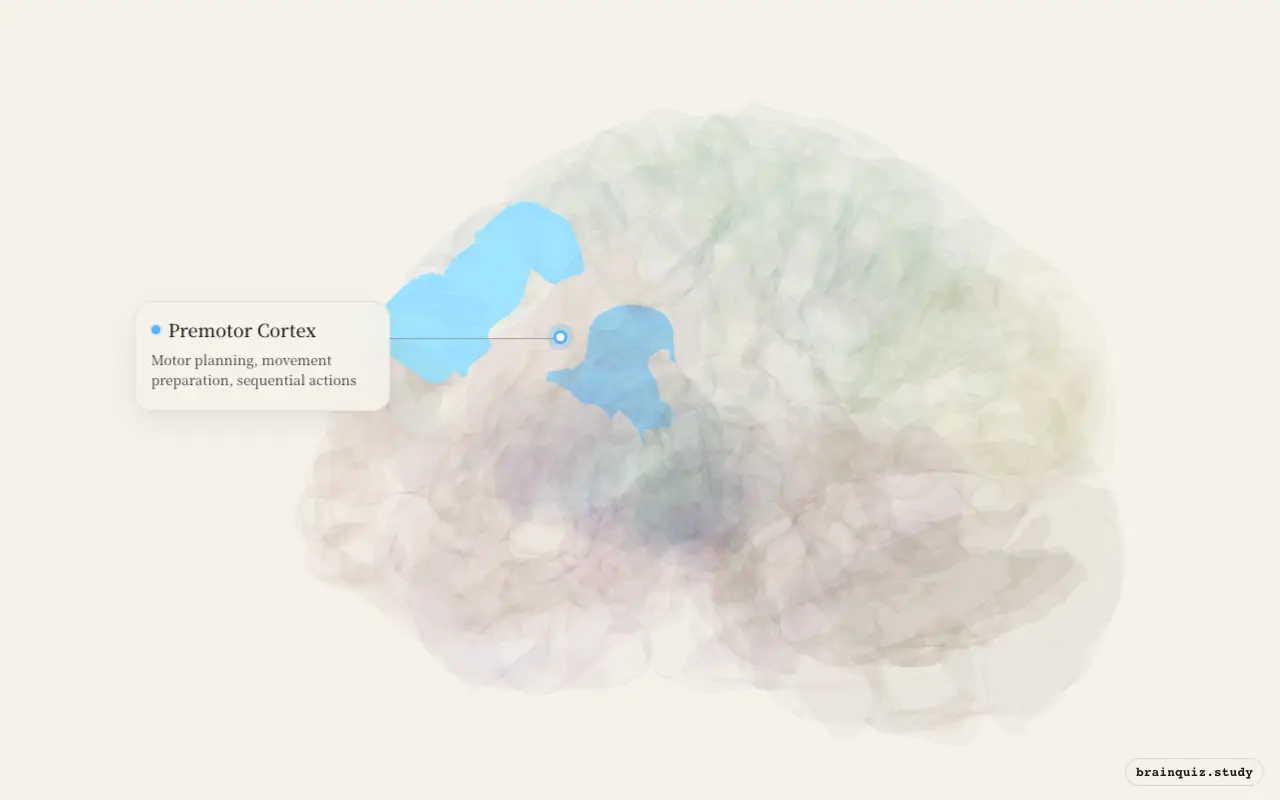
The premotor cortex prepares movements before primary motor cortex sends them downstream. Its lateral portion is especially associated with sensory-guided actions, while the medial supplementary motor area helps initiate internally generated sequences and coordinate both hands.
That planning role explains a counterintuitive lesion: strength may remain available even when a learned action cannot be organized correctly. Apraxia is therefore not paralysis; it is a failure to turn an intention and intact muscles into the appropriate skilled sequence.
Test this anatomy in the Lesion Localization Quiz: 15 Clinical Questions or explore it on the interactive 3D brain.
Where is the Premotor Cortex located?
Motor planning, movement preparation, sequential actions.
What does the Premotor Cortex do?
- Motor planning and preparation before execution
- Sequencing of complex movements
- Sensory-guided movements (reaching, grasping)
- SMA: internally generated movements and bimanual coordination
Premotor Cortex pathways and connections
- Premotor → M1 (sends planned movements for execution)
- Premotor ← Parietal cortex (visuomotor transformation)
- SMA ↔ Basal ganglia (sequence learning)
What happens when the Premotor Cortex is damaged?
- Lesion → apraxia (inability to perform learned movements despite intact motor function)
- SMA lesion → alien hand syndrome (contralateral hand acts independently)
- SMA syndrome: transient mutism and contralateral akinesia after surgery
Premotor Cortex key facts
Atlas category: cortical. Brodmann areas or landmark: BA 6 (lateral = premotor, medial = SMA).
- Mirror neurons first discovered in macaque F5 (premotor homologue) by Rizzolatti
- Readiness potential (Bereitschaftspotential) originates in SMA — 1-2 seconds before movement
- Libet experiment: SMA activity precedes conscious 'will to move'
Premotor Cortex exam tip
Premotor = HOW to move (sensory-guided). SMA = WHEN to move (internally generated sequences).
Common questions
What does the premotor cortex do?
It plans and prepares movements, organizes sequences and converts sensory information into actions. The supplementary motor area contributes to internally generated movement and bimanual coordination.
How is premotor cortex different from motor cortex?
Premotor regions organize how and when an action should occur; primary motor cortex is more directly involved in executing the voluntary movement through descending motor commands.
Can premotor damage cause weakness?
Its characteristic deficit is apraxia—impaired performance of learned actions despite enough strength and basic motor capacity. Supplementary motor injury can also cause transient akinesia or mutism.
When does the Premotor Cortex light up?
- 💭 When you talk to yourself: The premotor cortex plans the muscle movements needed to articulate the words, even if you don't speak aloud.
- 🏋️ When you lift weights: Premotor cortex assembles the sequence of muscle activations needed for the lift.
- ⚾ When you catch a ball: The premotor cortex plans the sequence of muscle activations needed to move your hand.
- ⚽ When you take a penalty kick under pressure: Your premotor cortex sequences the muscle movements for the run-up and kick.
- 🚴 When you ride a bike: The premotor cortex plans the sequence of muscle activations.
- 🏊 When you swim: Premotor cortex plans the sequence of arm and leg movements for each stroke.
- 💃 When you dance: The premotor cortex maps the steps into a sequence before you move.
- 🧗 When you go rock climbing: The premotor cortex sequences your next moves based on the visual map.