Parietal Cortex — Function, Location & Quiz
The parietal cortex is where sensation becomes a usable map for attention and action. It combines information across modalities rather than serving as a second primary sensory strip, which is why its lesions disturb space, calculation or skilled action in ways that intact eyes and muscles cannot explain.
Laterality is the high-yield distinction. Right parietal injury is strongly associated with neglect of left space, while dominant left parietal injury can disrupt symbolic skills and produce the cluster known as Gerstmann syndrome.
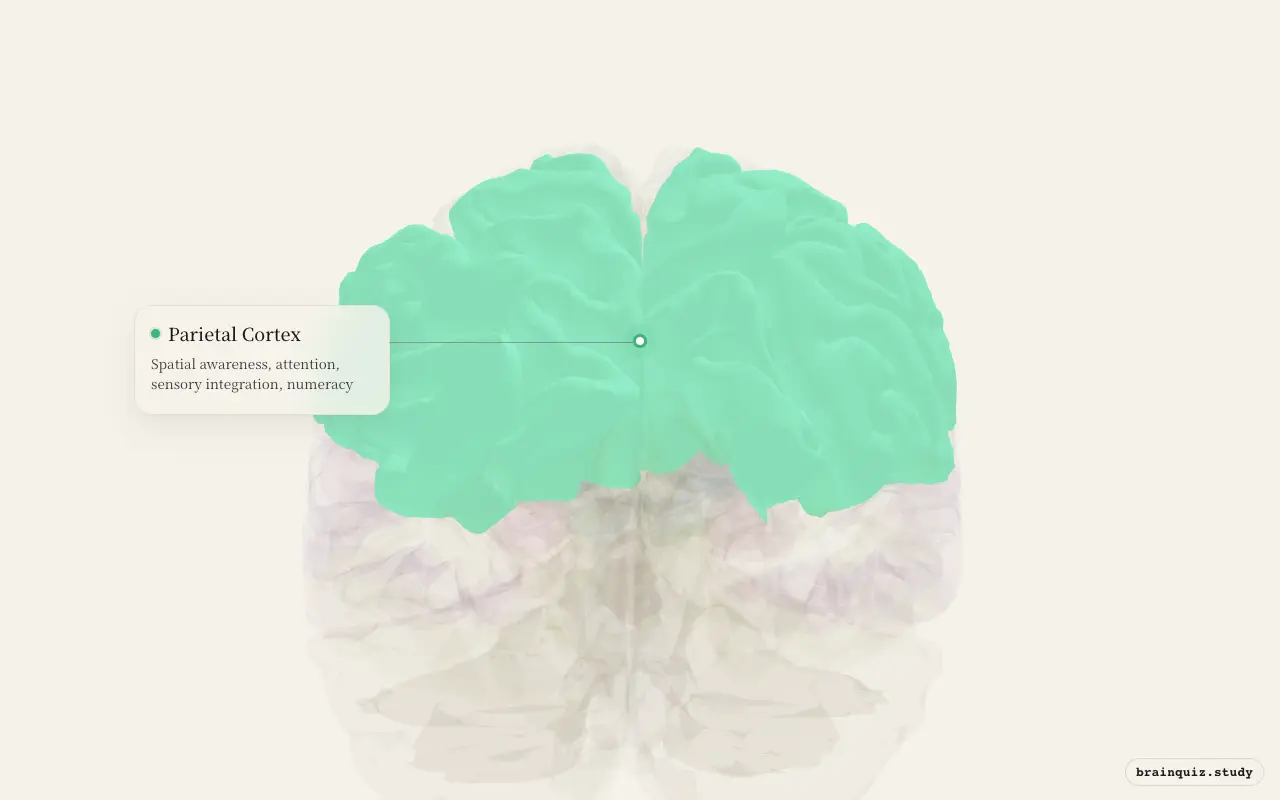
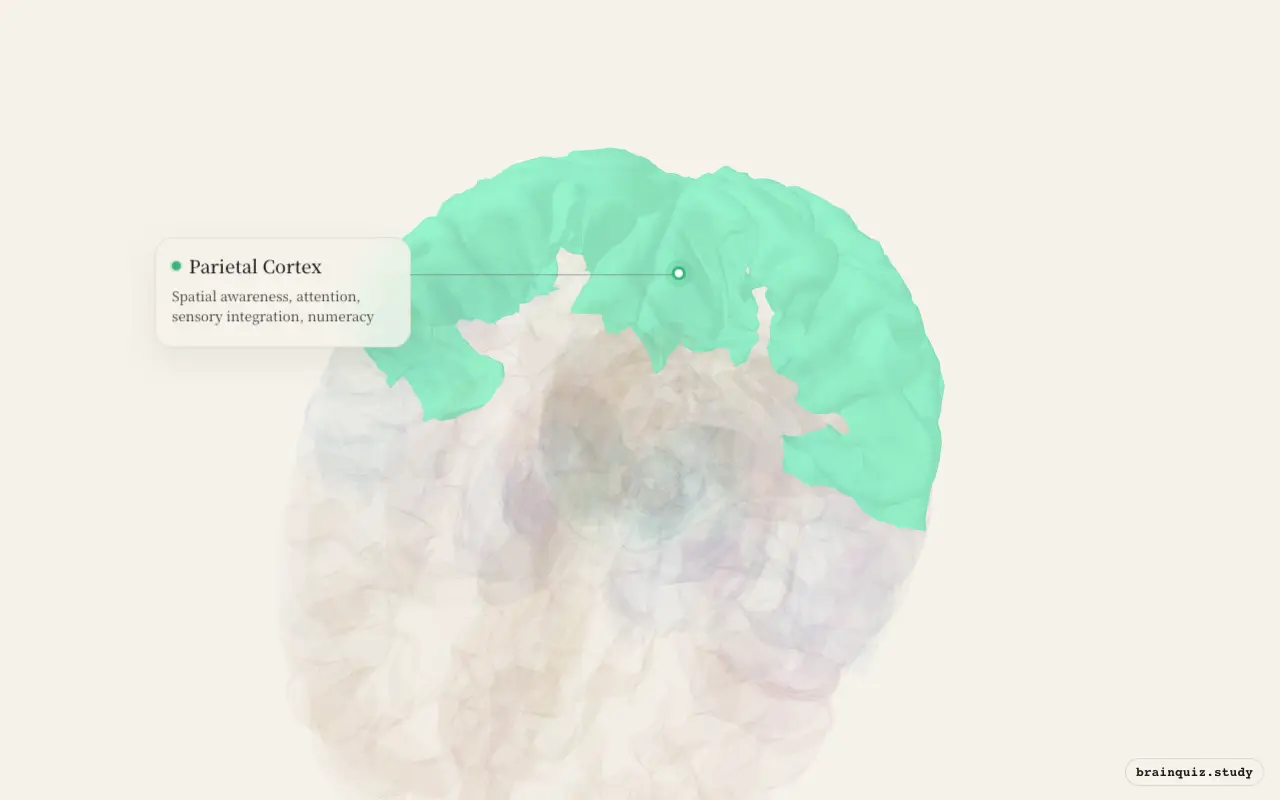
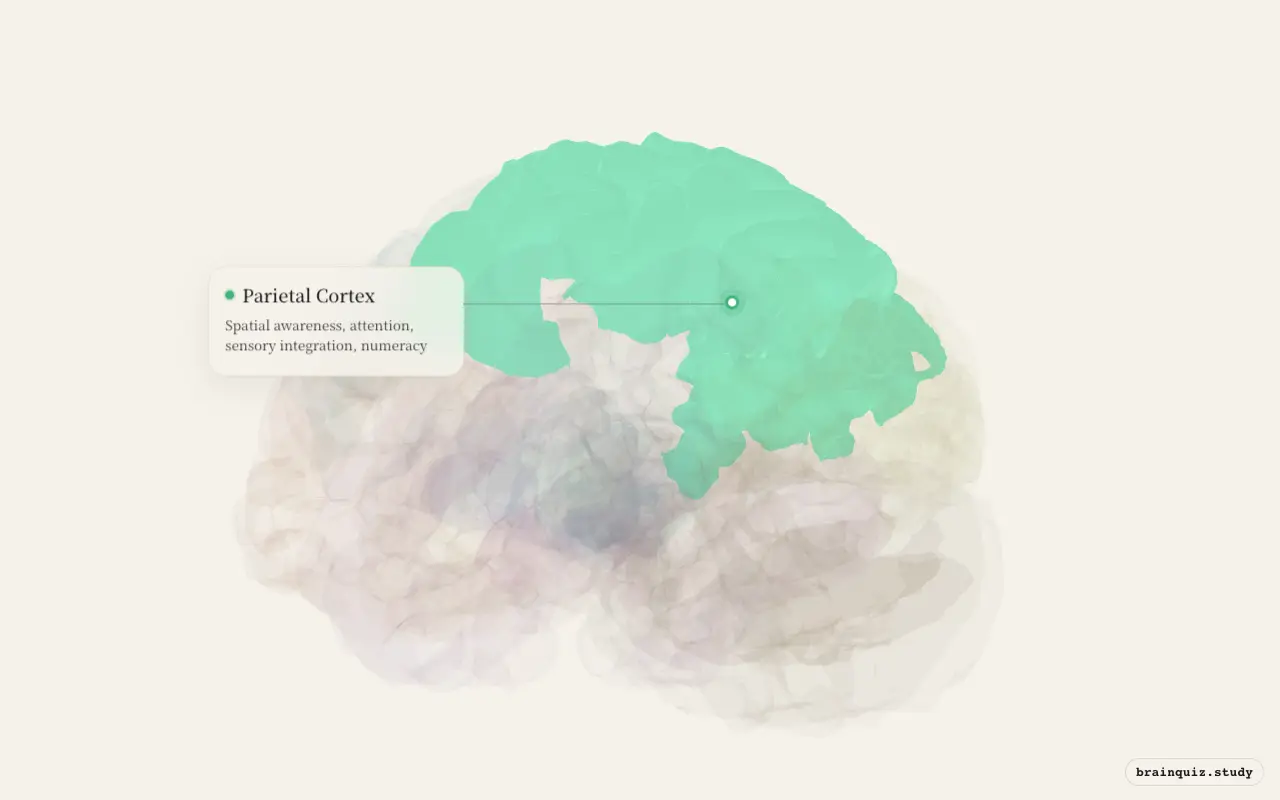
Test this anatomy in the Lesion Localization Quiz: 15 Clinical Questions or explore it on the interactive 3D brain.
Where is the Parietal Cortex located?
Spatial awareness, attention, sensory integration, numeracy.
What does the Parietal Cortex do?
- Spatial awareness and visuospatial processing
- Attention — especially orienting and disengaging
- Sensory integration — combining visual, auditory, somatosensory
- Numerical cognition and mental arithmetic
- Tool use and action understanding
Parietal Cortex pathways and connections
- Dorsal stream terminus ('where/how' pathway from V1)
- Parietal ↔ Frontal (frontoparietal attention network)
- Parietal ↔ Temporal (ventral attention for reorienting)
What happens when the Parietal Cortex is damaged?
- Right parietal lesion → hemispatial neglect (ignore left side of space)
- Bilateral parietal → Balint's syndrome (simultanagnosia, optic ataxia, ocular apraxia)
- Gerstmann syndrome (dominant parietal): agraphia, acalculia, finger agnosia, left-right confusion
- Ideomotor apraxia — can't pantomime tool use despite intact motor function
Parietal Cortex key facts
Atlas category: cortical. Brodmann areas or landmark: BA 5, 7 (superior parietal), BA 39, 40 (inferior parietal).
- Intraparietal sulcus (IPS) contains neurons tuned to numerosity
- Corbetta & Shulman: dorsal attention network (top-down) vs. ventral attention (bottom-up surprise)
- Posterior parietal cortex is where vision meets action — critical for reaching and grasping
Parietal Cortex exam tip
Right parietal = SPACE (neglect). Left parietal = SYMBOLS (language, math, praxis). Know the lateralization!
Common questions
What does the parietal cortex do?
It supports spatial awareness, attention, multisensory integration, numerical cognition and the transformation of visual information into reaching or tool-use actions.
Why does a right parietal lesion cause neglect?
Right parietal attention systems are crucial for representing space. Damage can make the patient fail to attend to the left side even though early visual and sensory pathways may still carry information.
What is Gerstmann syndrome?
It is a dominant parietal syndrome classically combining agraphia, acalculia, finger agnosia and left-right confusion, often associated with the left angular gyrus.
When does the Parietal Cortex light up?
- 🌌 When you feel awe looking at the stars: The parietal cortex integrates spatial information, registering the immense scale of the star field.
- 🧠 When you multitask: The parietal cortex shifts attentional resources to the new task.
- 🎮 When you play a video game: The parietal cortex integrates visual and spatial info, guiding attention to important game elements.
- ⚾ When you catch a ball: The parietal cortex computes the ball's trajectory and your hand's position.
- ♟️ When you play chess: Your parietal cortex integrates the board layout and directs attention to key squares.
- 💡 When you have a lucid dream: Parietal regions integrate sensory and spatial information, making the dream world feel real.
- 🧮 When you solve a maths problem: The parietal cortex represents numerical quantities and directs attention to the problem.
- 🧠 When you hold a phone number in your head: Parietal cortex holds the sound sequence of the digits.