What happens in your brain when you feel awe looking at the stars?
Updated
The visual cortex processes the starry sky, the parietal cortex registers vastness, the prefrontal cortex appraises it as awe-inspiring, the insula generates the bodily feeling, and the posterior cingulate quiets to diminish self-focus.
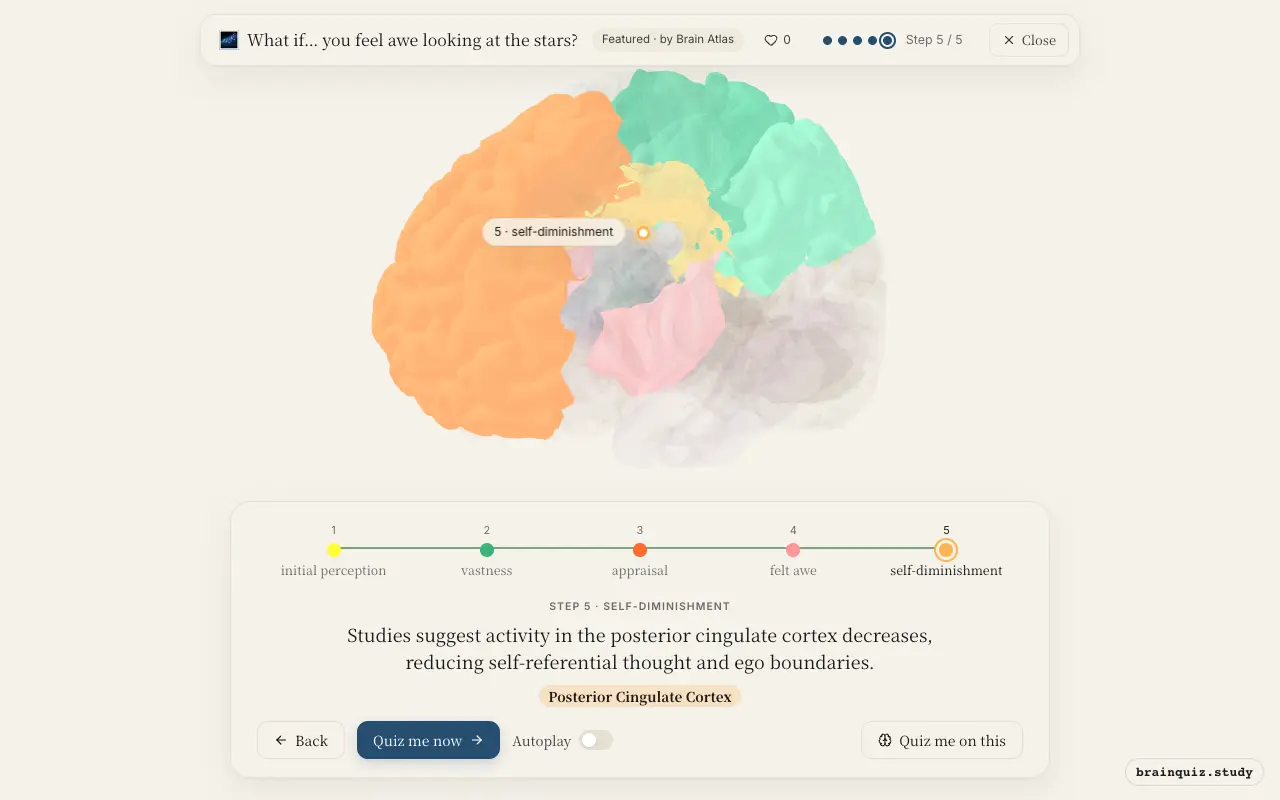
Watch it light up on the 3D brain
Brain regions that light up
| Order | Region | What it does here |
|---|---|---|
| 1 | Visual Cortex | The visual cortex decodes the points of light as stars against the dark sky. |
| 2 | Parietal Cortex | The parietal cortex integrates spatial information, registering the immense scale of the star field. |
| 3 | Prefrontal Cortex | The prefrontal cortex evaluates the scene, recognizing its significance as something greater than oneself. |
| 4 | Insula | The insula processes the bodily sensations of awe, like chills or a lump in the throat. |
| 5 | Posterior Cingulate Cortex | Studies suggest activity in the posterior cingulate cortex decreases, reducing self-referential thought and ego boundaries. |
1. Visual Cortex: initial perception
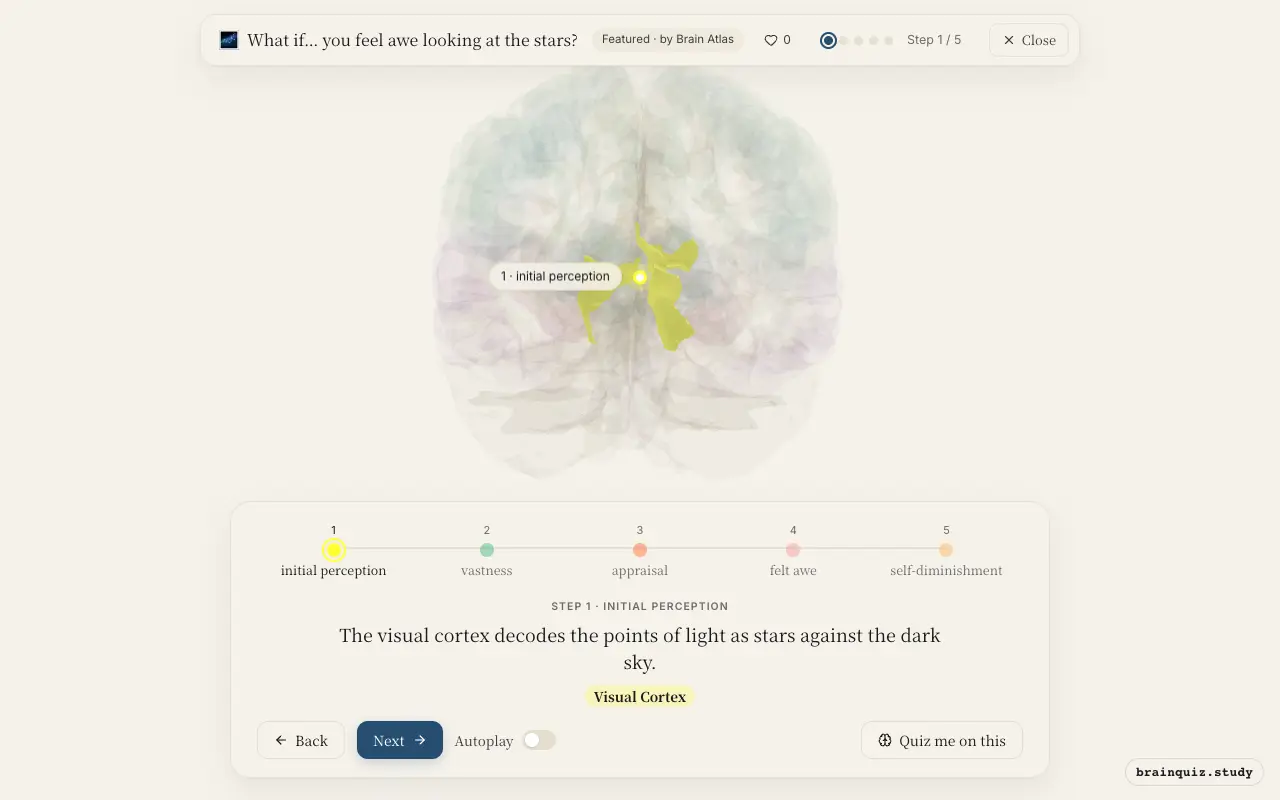
The primary visual cortex in the occipital lobe receives input from the retina and processes basic features like edges, contrast, and orientation. In this scenario, it constructs the raw visual scene of the night sky, detecting the small, bright points of starlight against a dark background. This early processing is necessary before higher areas can interpret the scene's meaning.
2. Parietal Cortex: vastness
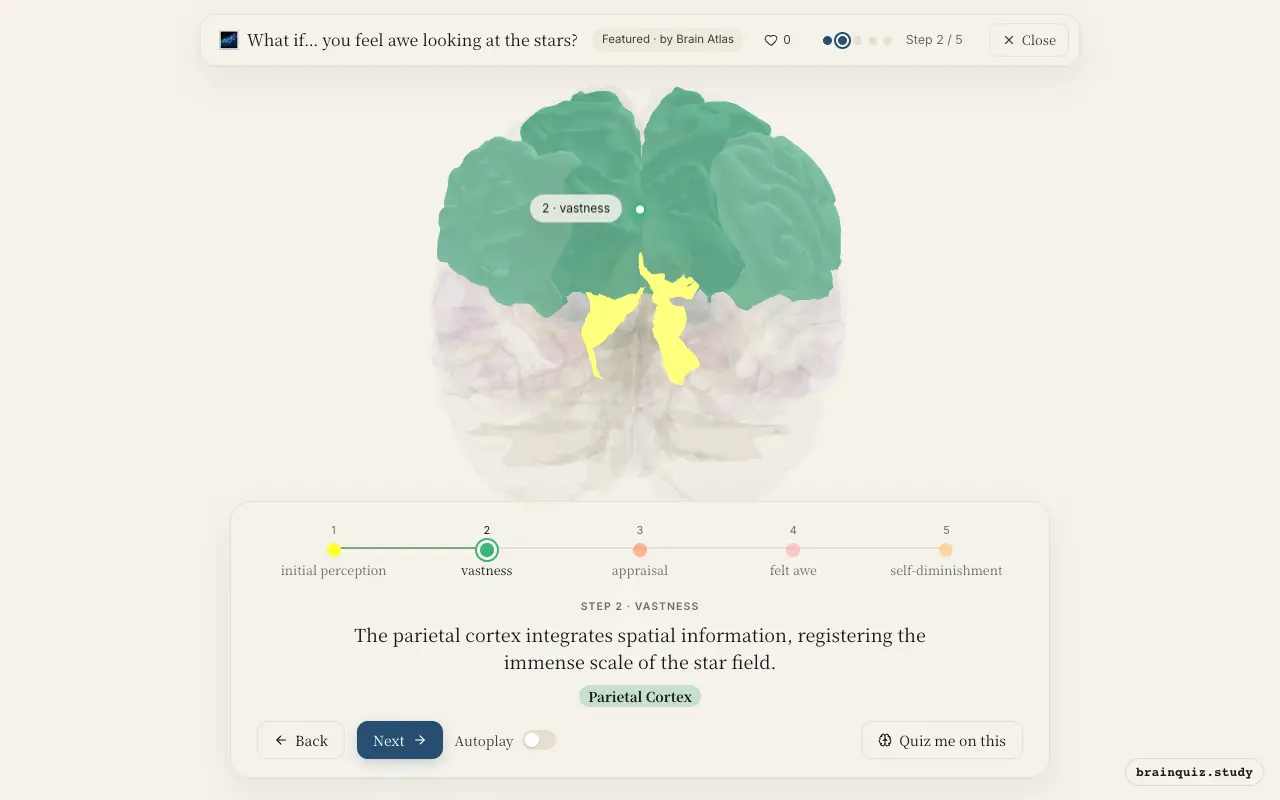
The parietal cortex, particularly the posterior parietal areas, combines visual information with spatial attention and body schema. When looking at the stars, it helps you perceive the depth and distance of the celestial dome, creating a sense of vastness. This spatial processing is thought to contribute to the overwhelming quality of the experience, as your brain grapples with scales far beyond everyday perception.
3. Prefrontal Cortex: appraisal
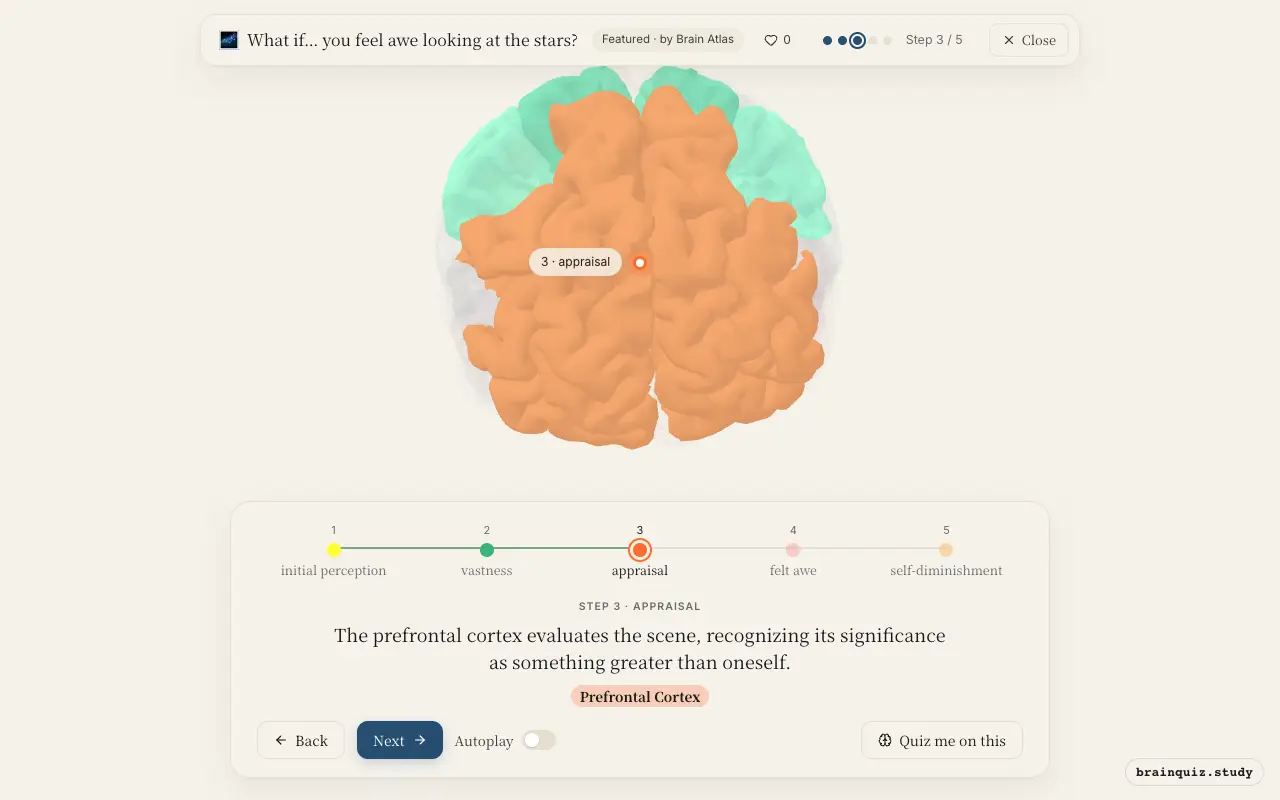
The prefrontal cortex, especially the dorsolateral and ventromedial regions, is involved in higher-order cognitive functions such as meaning-making and self-reflection. It appraises the starry sky as a profound and novel stimulus, triggering a shift in perspective. This appraisal likely initiates the emotional response by tagging the experience as awe-inspiring, rather than ordinary or threatening.
4. Insula: felt awe
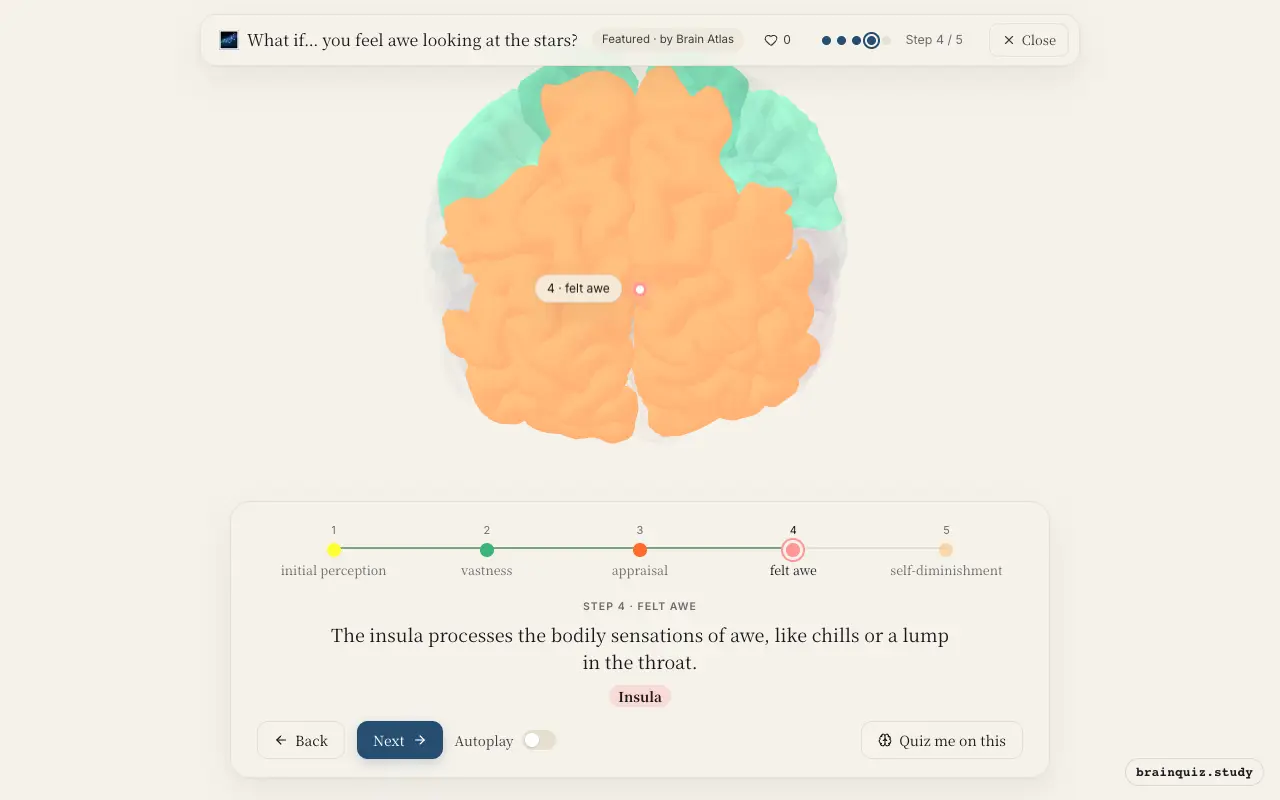
The insula is a key region for interoception, the perception of internal bodily states. During awe, the insula becomes active, translating the cognitive appraisal into physical feelings such as goosebumps, a slowed breath, or a sense of expansion in the chest. This interoceptive signal is thought to be central to the subjective experience of awe, distinguishing it from purely intellectual appreciation.
5. Posterior Cingulate Cortex: self-diminishment
The posterior cingulate cortex is a major hub of the default mode network, which is active during self-focused rumination and mind-wandering. Studies suggest that awe lowers activity in this region, corresponding to a diminished sense of self-importance and increased feelings of connection to something larger. This neural quieting is thought to underlie the 'small self' phenomenon often reported during awe.
Good to know
- Awe is associated with reduced activity in the default mode network, which includes the posterior cingulate cortex.
- The insula is active during emotional experiences that involve bodily sensations, such as chills or goosebumps.
- The parietal cortex integrates spatial information, helping us perceive vast distances.
Awe vs Fear
Awe from the stars decreases default mode network activity and engages the insula for positive bodily sensations. Fear activates the amygdala and sympathetic nervous system for threat detection and fight-or-flight. Both are intense emotions, but awe diminishes the self-boundary while fear contracts it.
Test yourself
Which brain region is most directly responsible for processing the visual details of the stars?
How does the posterior cingulate cortex respond during awe, according to some studies?
The feeling of chills or goosebumps during awe is likely mediated by which region?
0 of 3 answered · 0 correct
Simplified: many regions work together at once, and this shows the main players in the order they act.