What happens in your brain when you play chess?
Updated
Playing chess engages your visual cortex to process the board, parietal cortex to track spatial positions, prefrontal cortex to plan and weigh moves, caudate nucleus to recall learned patterns, and motor cortex to execute your chosen move.
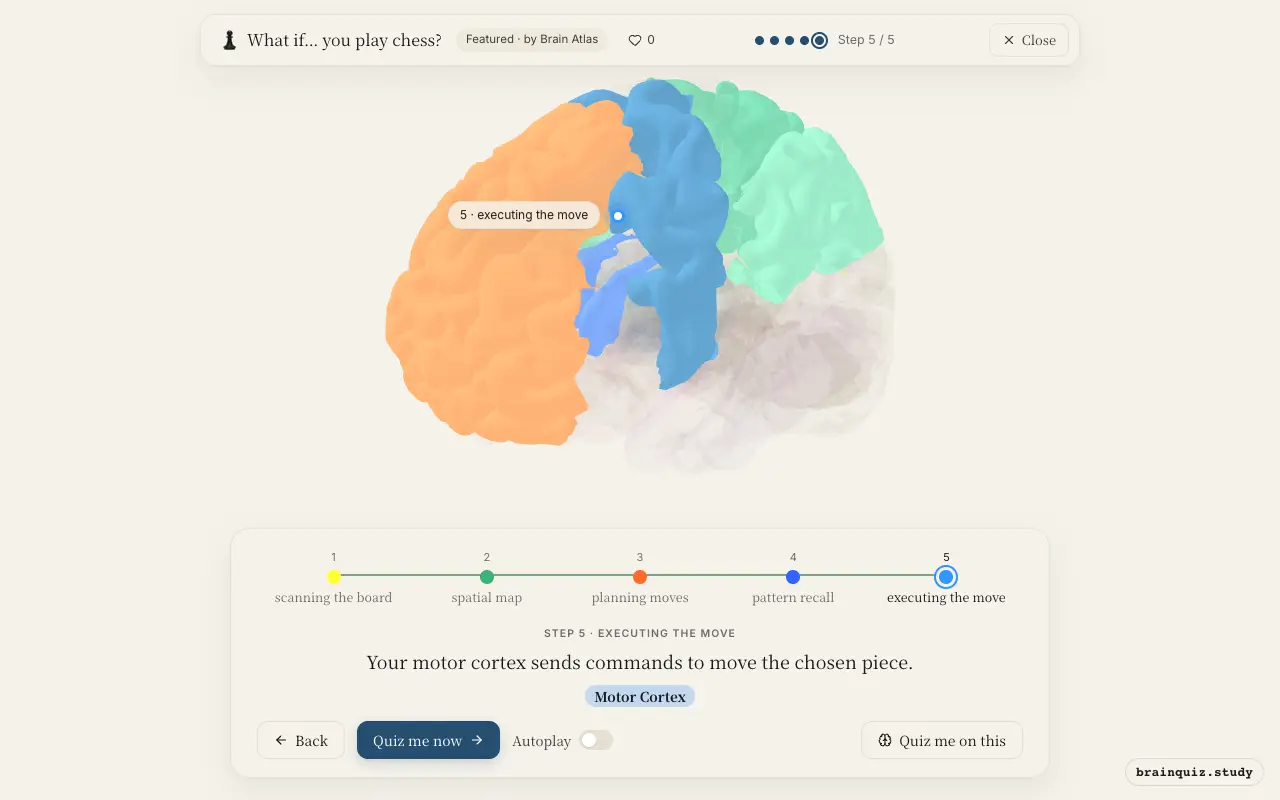
Watch it light up on the 3D brain
Brain regions that light up
| Order | Region | What it does here |
|---|---|---|
| 1 | Visual Cortex | Your visual cortex decodes edges, shapes, and colors to recognize pieces and their positions. |
| 2 | Parietal Cortex | Your parietal cortex integrates the board layout and directs attention to key squares. |
| 3 | Prefrontal Cortex | Your prefrontal cortex holds positions in working memory and weighs candidate moves. |
| 4 | Caudate Nucleus | Your caudate nucleus taps into stored chess patterns and procedural memory. |
| 5 | Motor Cortex | Your motor cortex sends commands to move the chosen piece. |
1. Visual Cortex: scanning the board
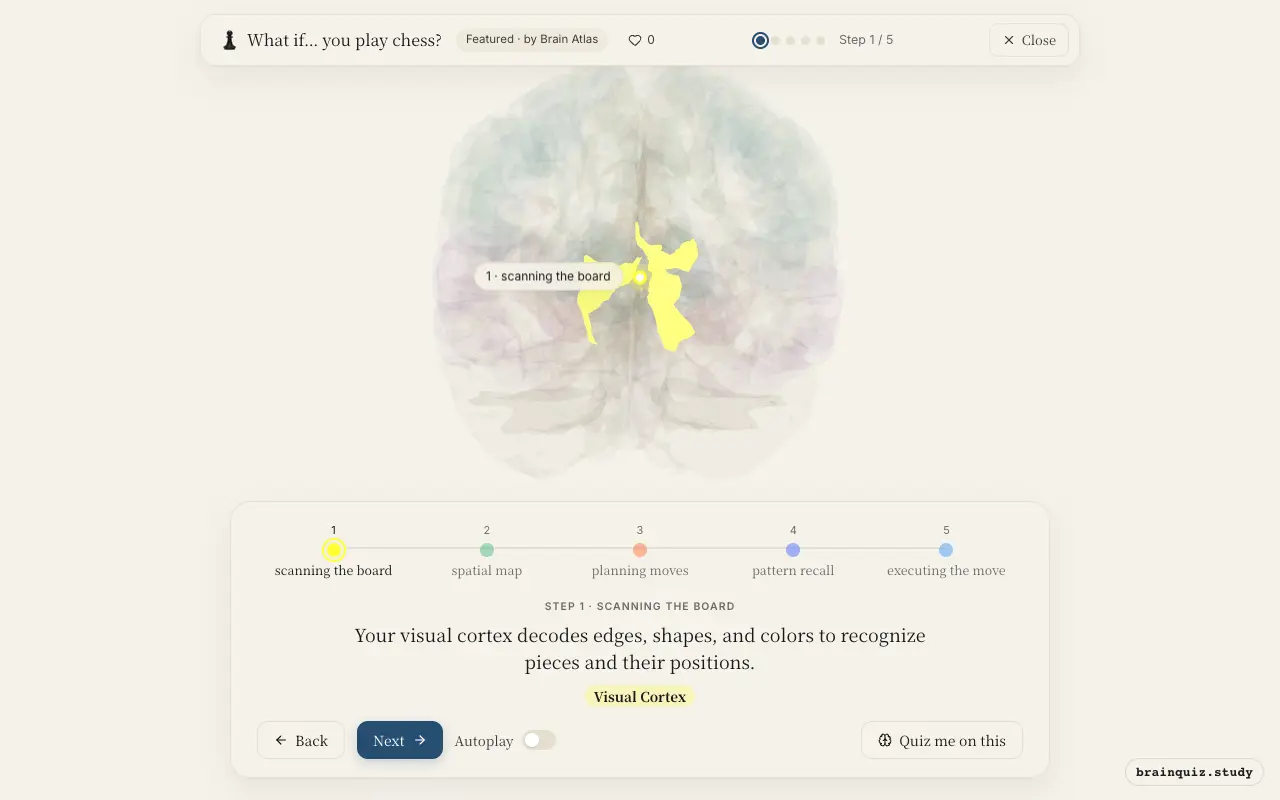
The primary visual cortex receives input from the eyes and processes basic features like lines and contrast. Higher visual areas then identify specific chess pieces and map their locations on the board, creating a coherent visual representation.
2. Parietal Cortex: spatial map
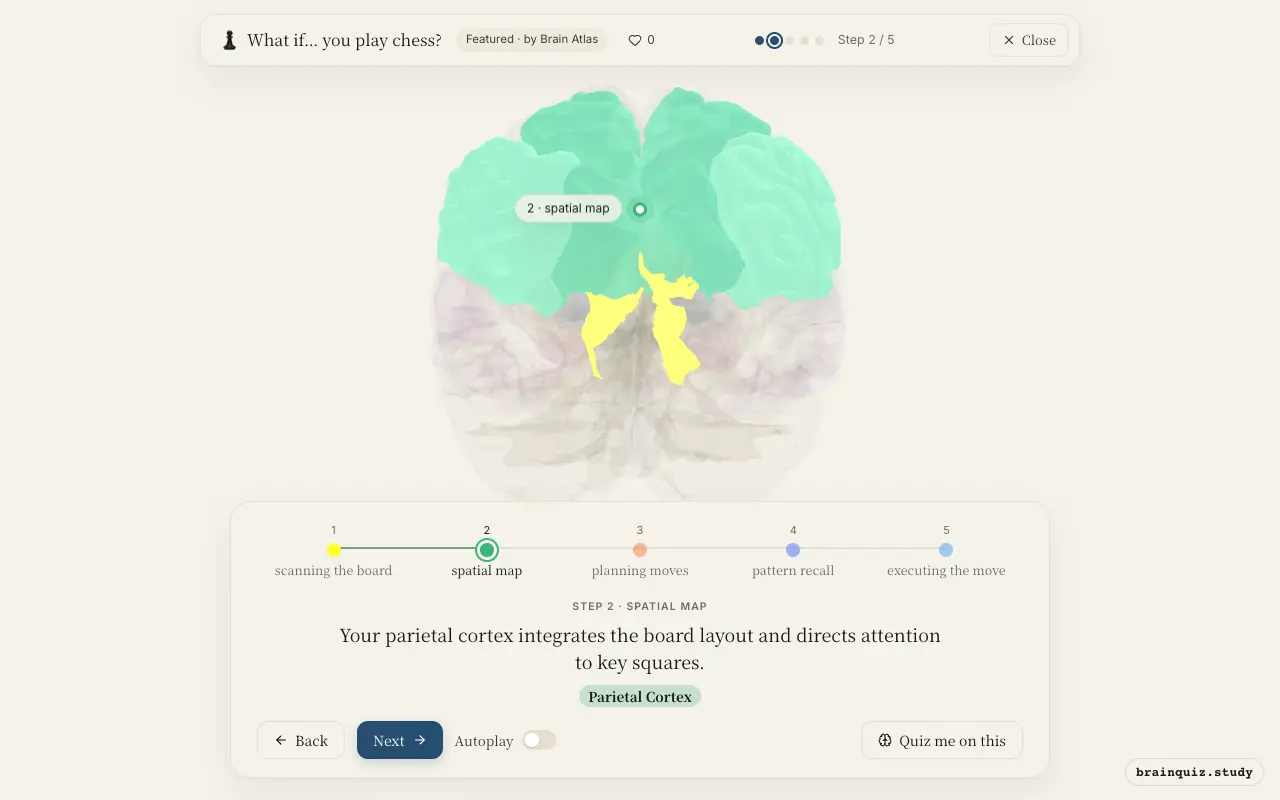
The parietal cortex, especially the posterior parietal area, combines visual information with spatial awareness. It helps you track multiple pieces simultaneously and shift attention between threats and opportunities, maintaining a mental map of the board.
3. Prefrontal Cortex: planning moves
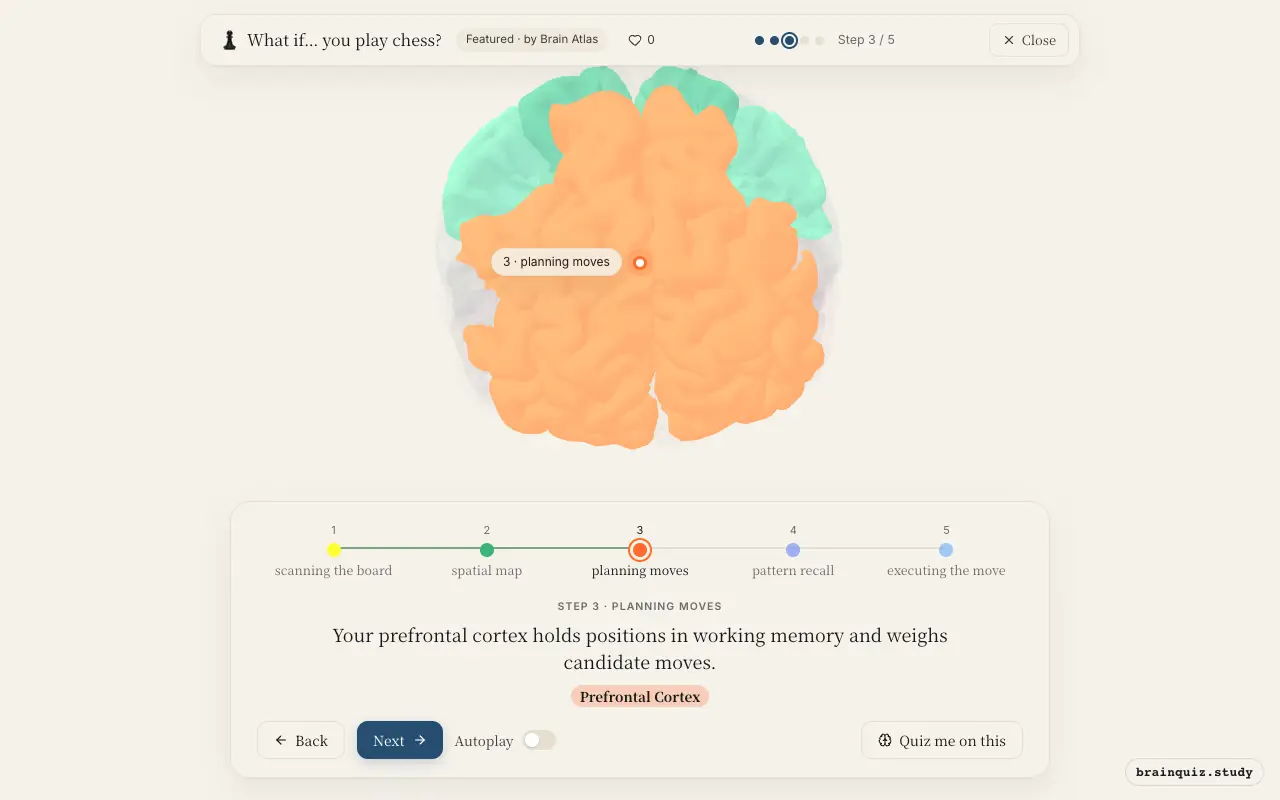
The dorsolateral prefrontal cortex is crucial for working memory, allowing you to keep the current position and possible variations in mind. It engages in executive functions like evaluating consequences, inhibiting impulsive moves, and selecting the best plan based on rules and goals.
4. Caudate Nucleus: pattern recall
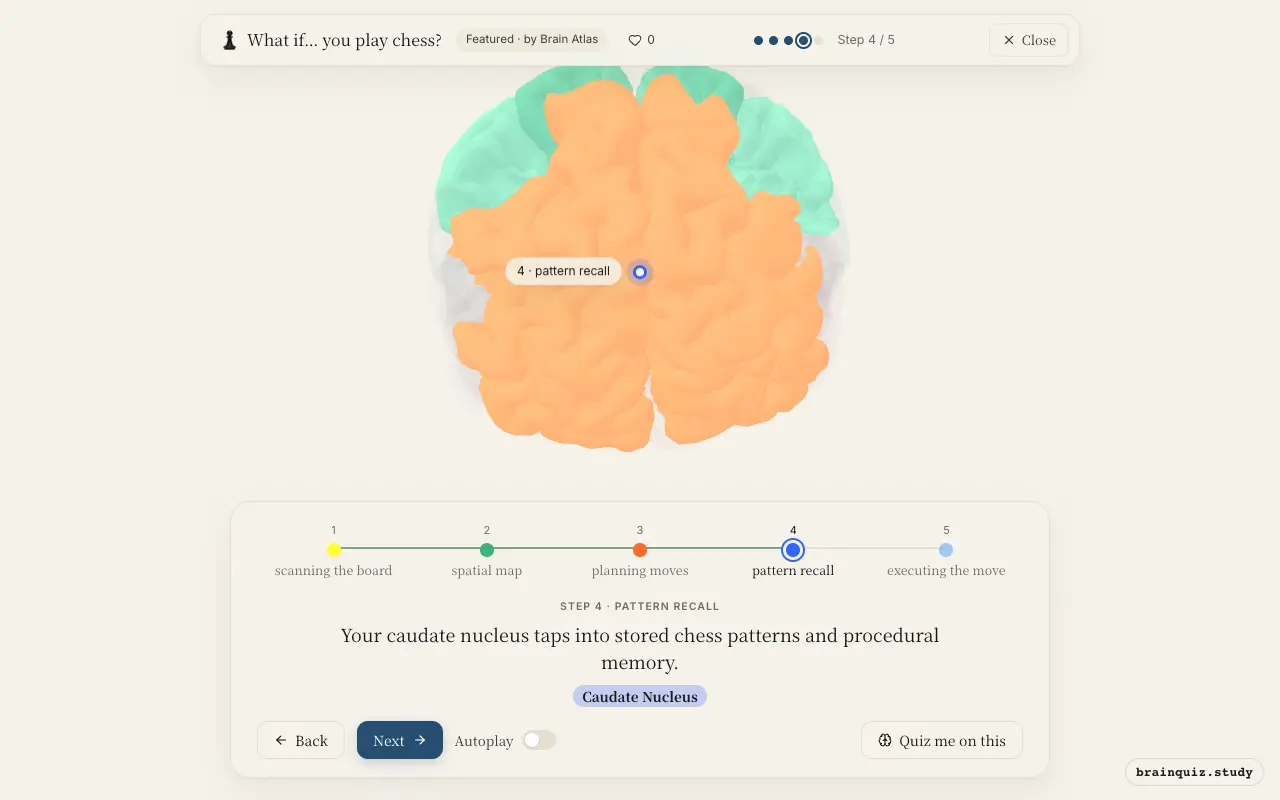
The caudate, part of the basal ganglia, is involved in learning and executing cognitive routines. In experienced players, it helps recognize familiar configurations and retrieve successful strategies automatically, reducing the load on deliberate planning.
5. Motor Cortex: executing the move
Once a move is selected, the primary motor cortex, along with premotor areas, generates the precise muscle activations needed to reach, grasp, and move the chess piece. This is a fine motor skill refined through practice.
Good to know
- Expert chess players show increased activation in the fusiform gyrus when viewing chess positions, similar to face recognition.
- Blindfold chess players rely more heavily on the prefrontal cortex and parietal cortex to maintain a mental board.
- Chess playing activates both hemispheres, but planning and decision-making involve bilateral prefrontal cortices, while spatial processing is often right-lateralized.
Chess vs Tennis
Chess heavily recruits prefrontal and parietal cortices for planning and spatial reasoning, with minimal motor demands. Tennis engages motor cortex, cerebellum, and basal ganglia for rapid coordinated movement, with less deliberative prefrontal activity. Both require attention and decision-making but differ in emphasis.
Test yourself
Which brain region is most responsible for holding the current board position in mind while calculating variations?
In expert chess players, which subcortical structure helps recognize familiar patterns automatically?
When you physically move a piece, which area executes the motor command?
0 of 3 answered · 0 correct
Simplified: many regions work together at once, and this shows the main players in the order they act.