What happens in your brain when you go for a run?
Updated
Your prefrontal cortex decides to run, basal ganglia initiates the movement, motor cortex sends commands to muscles, cerebellum fine-tunes coordination, and somatosensory cortex monitors limb position and ground contact.
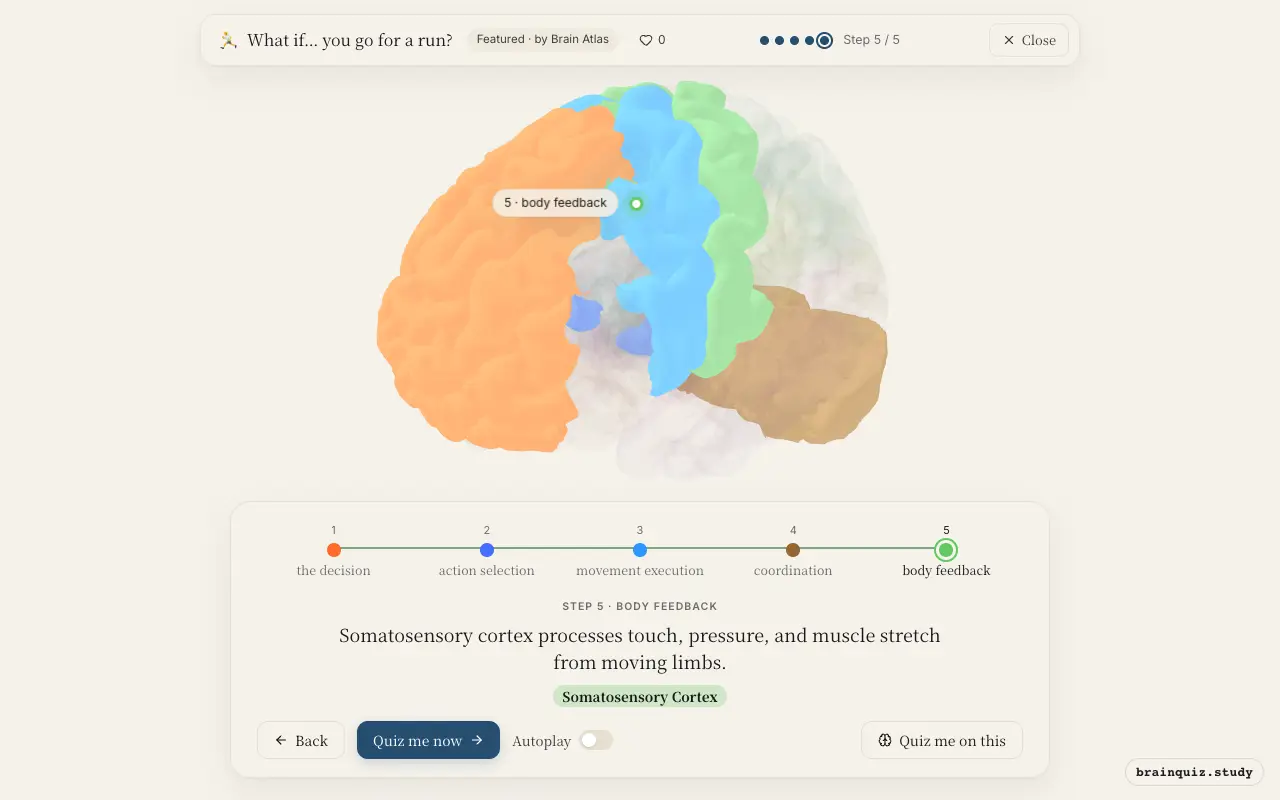
Watch it light up on the 3D brain
Brain regions that light up
| Order | Region | What it does here |
|---|---|---|
| 1 | Prefrontal Cortex | You decide to start running, setting the goal. |
| 2 | Basal Ganglia | Basal ganglia release the brake, allowing movement to proceed. |
| 3 | Motor Cortex | Motor cortex sends precise commands down the spinal cord to leg muscles. |
| 4 | Cerebellum | Cerebellum compares intended and actual movement, correcting errors in real time. |
| 5 | Somatosensory Cortex | Somatosensory cortex processes touch, pressure, and muscle stretch from moving limbs. |
1. Prefrontal Cortex: the decision
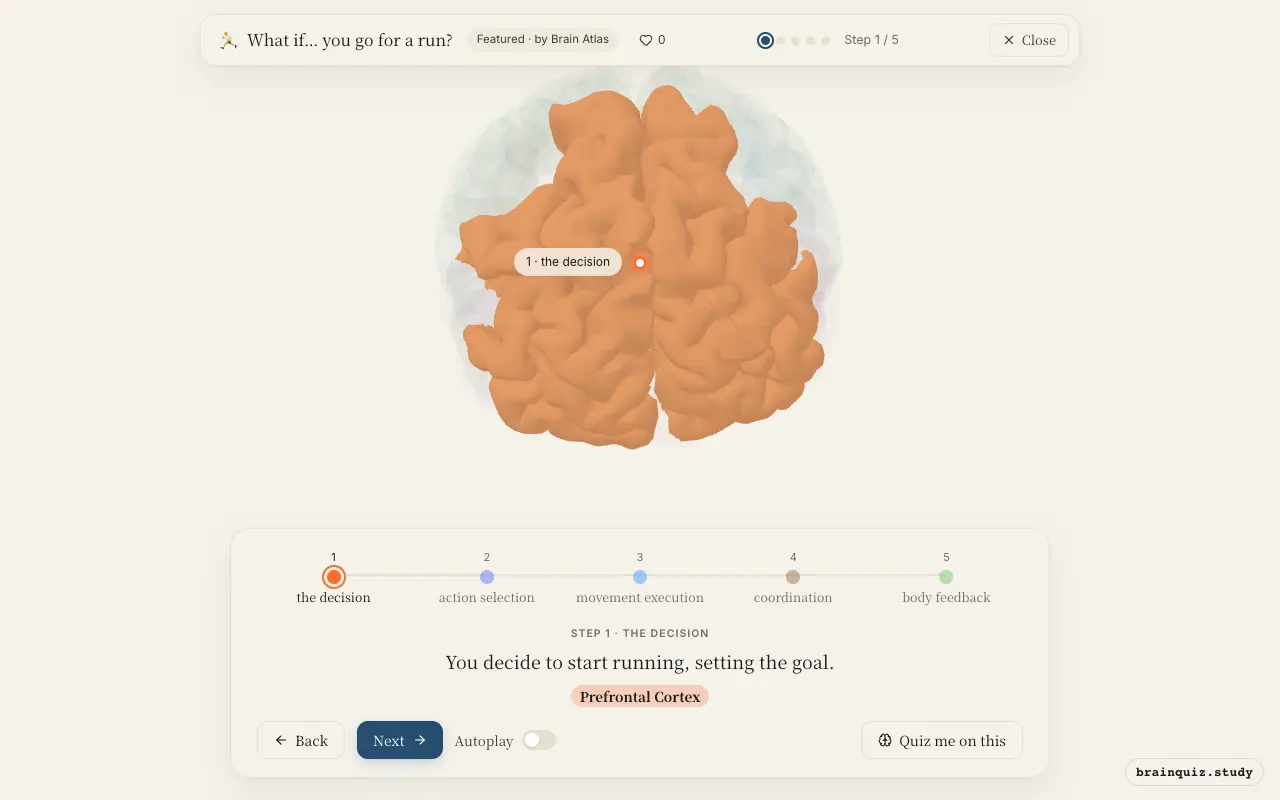
The prefrontal cortex, especially dorsolateral parts, evaluates context and motivation, committing to the run. It sends signals to premotor and motor areas to initiate the sequence. This executive input is crucial for initiating the run voluntarily.
2. Basal Ganglia: action selection
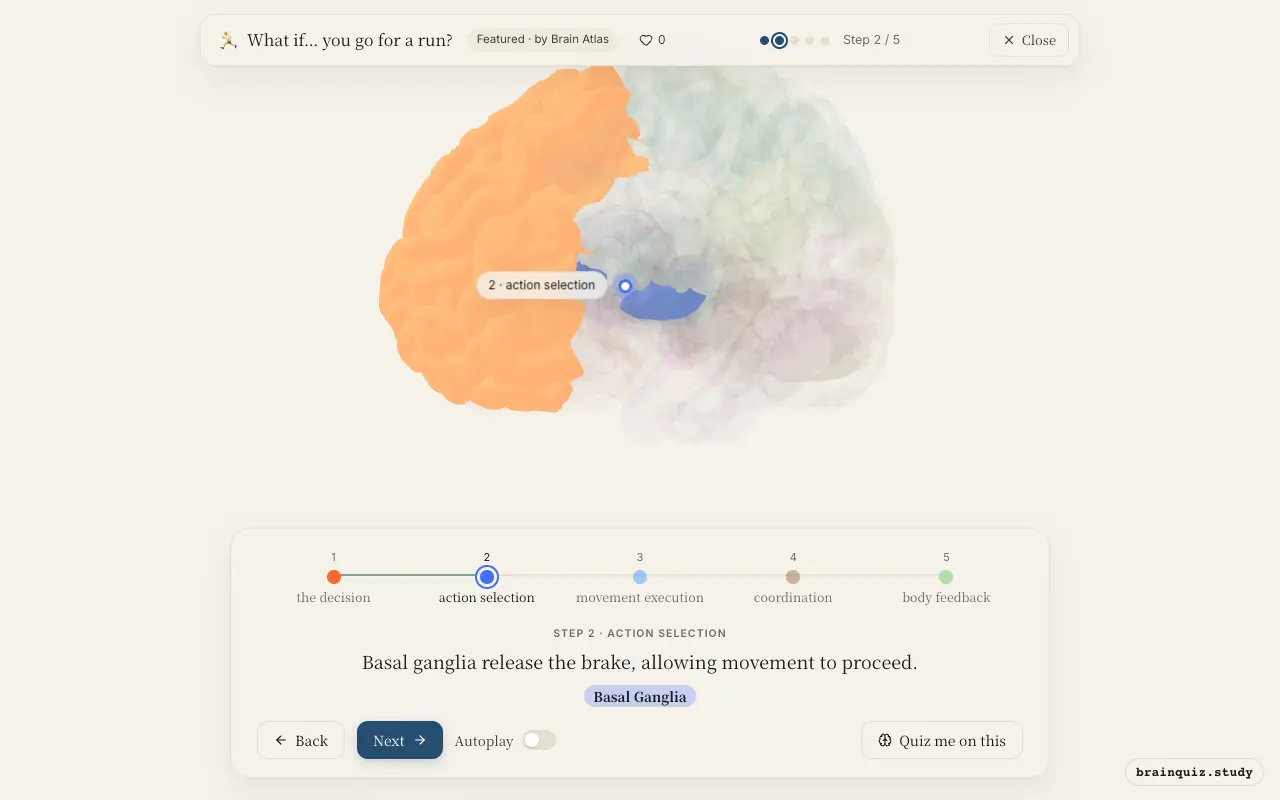
The basal ganglia, particularly the putamen and caudate, select the running motor program and disinhibit the thalamus and motor cortex. This gating ensures only the intended action is performed, suppressing competing movements like walking or standing still.
3. Motor Cortex: movement execution
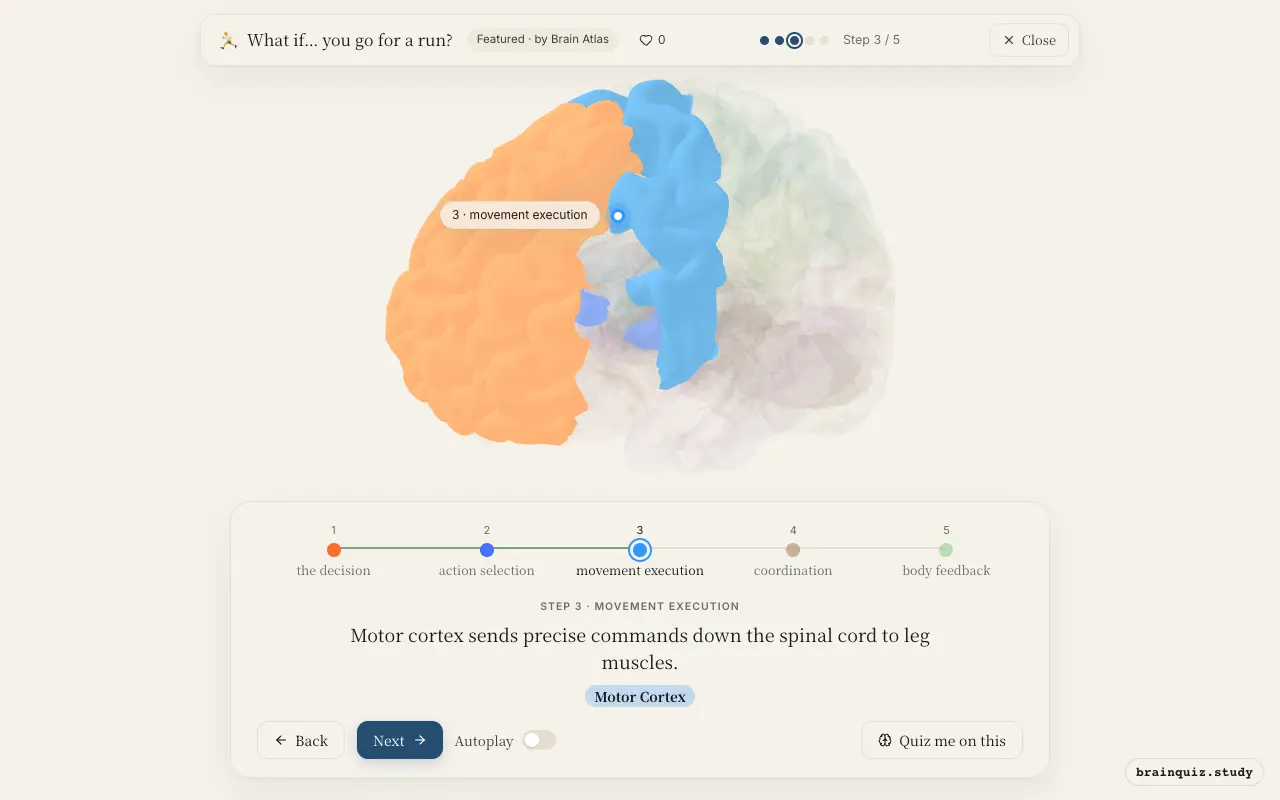
The primary motor cortex, located in the precentral gyrus, generates the patterned output that travels via the corticospinal tract to lower motor neurons. These neurons activate leg and core muscles in the rhythmic sequence of running. The intensity of activation correlates with speed and force.
4. Cerebellum: coordination
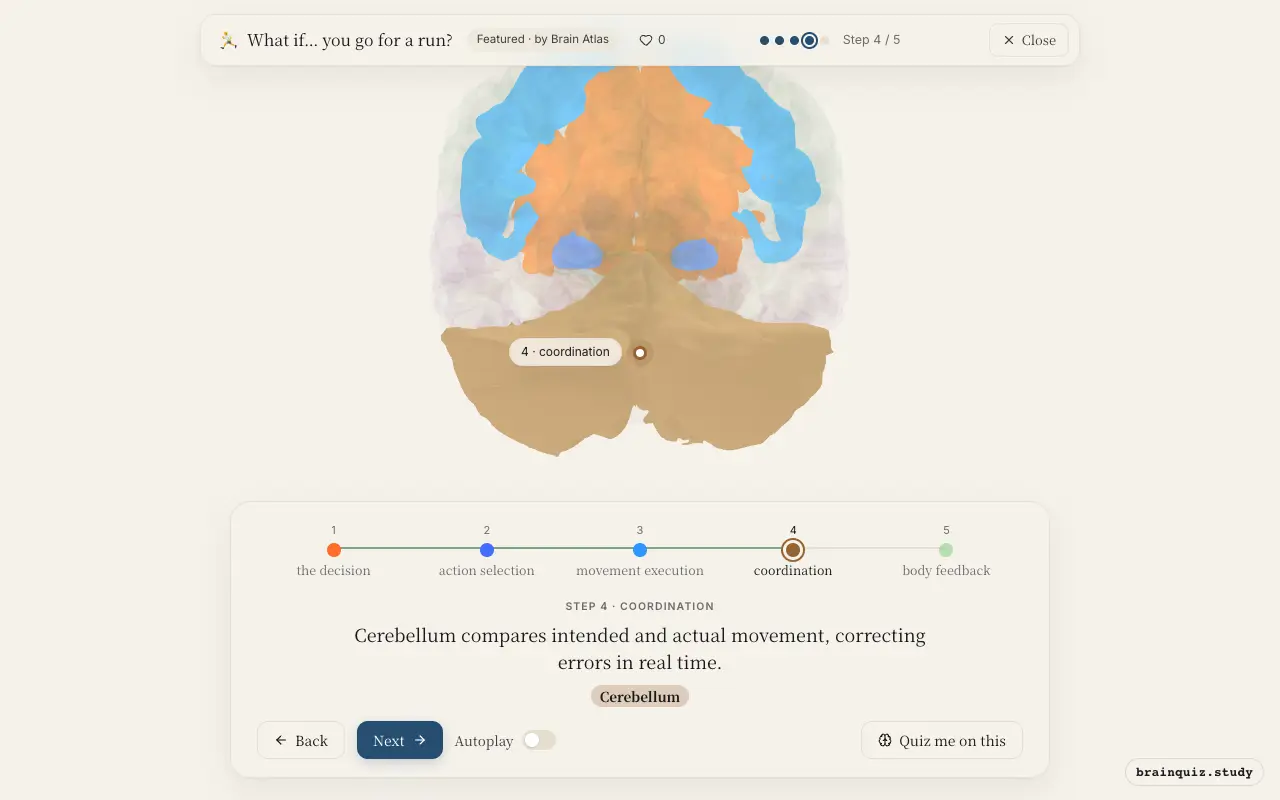
The cerebellum receives a copy of motor commands and sensory feedback about limb position and balance. It computes error signals and sends corrective output to the motor cortex and brainstem. This keeps your stride smooth, stable, and efficient, especially on uneven ground.
5. Somatosensory Cortex: body feedback
Sensory receptors in muscles, joints, and skin send signals via the thalamus to the somatosensory cortex. This region integrates proprioception to update your brain about where your limbs are and how they contact the ground. It helps adjust posture and prevents injury.
Good to know
- Running increases heart rate and breathing via brainstem autonomic centers, which operate without conscious control.
- The cerebellum contains more than half of all neurons in the brain, underscoring its role in motor coordination.
- Endorphins released during sustained running may produce a 'runner's high', though endocannabinoids are also implicated.
Running vs. Walking
Running demands faster, more forceful limb movements and higher precision than walking. The motor cortex and cerebellum show greater activation to manage increased speed and balance requirements. Walking relies more on spinal central pattern generators with less cortical oversight.
Test yourself
Which brain region is most responsible for the decision to go for a run rather than stay on the couch?
Damage to which region would most impair the smooth coordination of running, causing unsteady gait?
Which structure acts as a gate, selecting the running motor program and suppressing other movements?
0 of 3 answered · 0 correct
Simplified: many regions work together at once, and this shows the main players in the order they act.