What happens in your brain when you catch a ball?
Updated
The visual cortex detects the ball, the parietal cortex tracks its trajectory, the premotor and motor cortex plan and execute the hand movement, and the cerebellum fine-tunes timing and coordination for a successful catch.
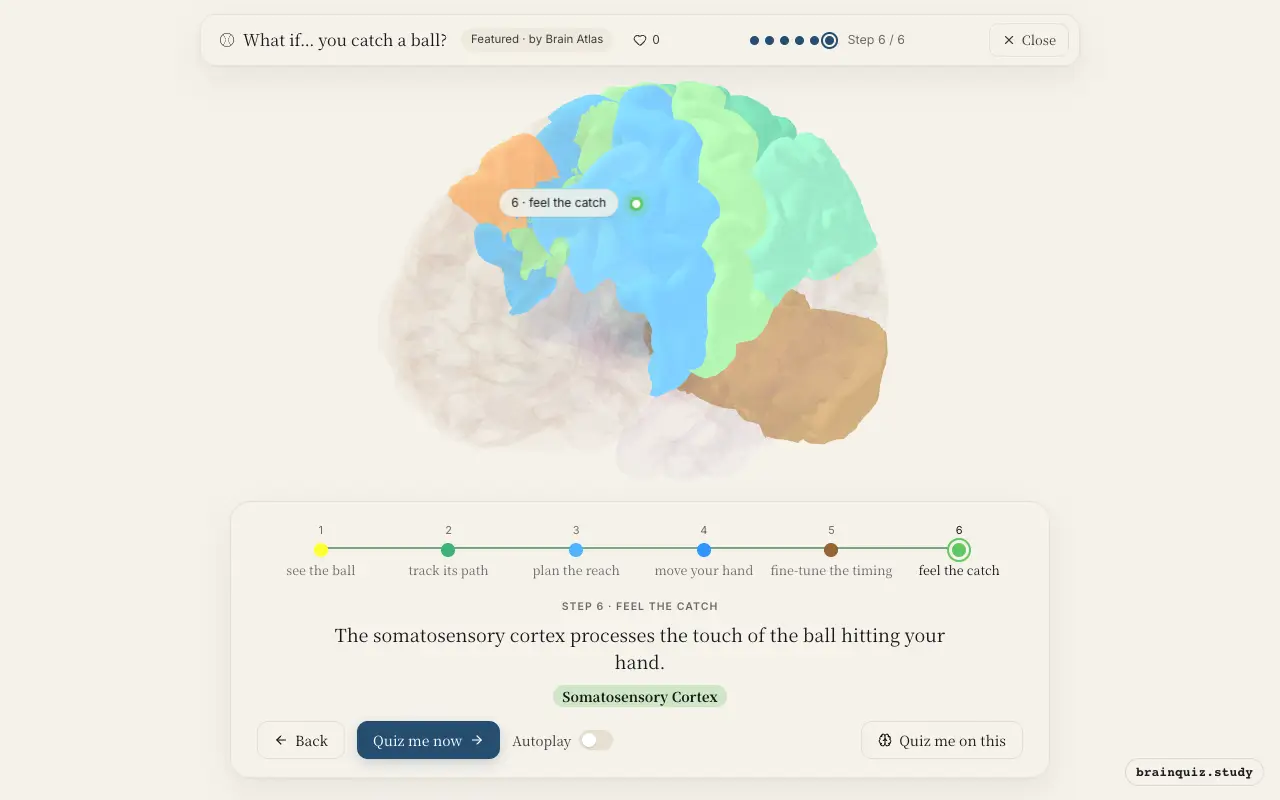
Watch it light up on the 3D brain
Brain regions that light up
| Order | Region | What it does here |
|---|---|---|
| 1 | Visual Cortex | The visual cortex processes the ball's shape, color, and motion. |
| 2 | Parietal Cortex | The parietal cortex computes the ball's trajectory and your hand's position. |
| 3 | Premotor Cortex | The premotor cortex plans the sequence of muscle activations needed to move your hand. |
| 4 | Motor Cortex | The motor cortex sends commands to your arm and hand muscles to execute the catch. |
| 5 | Cerebellum | The cerebellum compares intended and actual movement, making rapid corrections. |
| 6 | Somatosensory Cortex | The somatosensory cortex processes the touch of the ball hitting your hand. |
1. Visual Cortex: see the ball
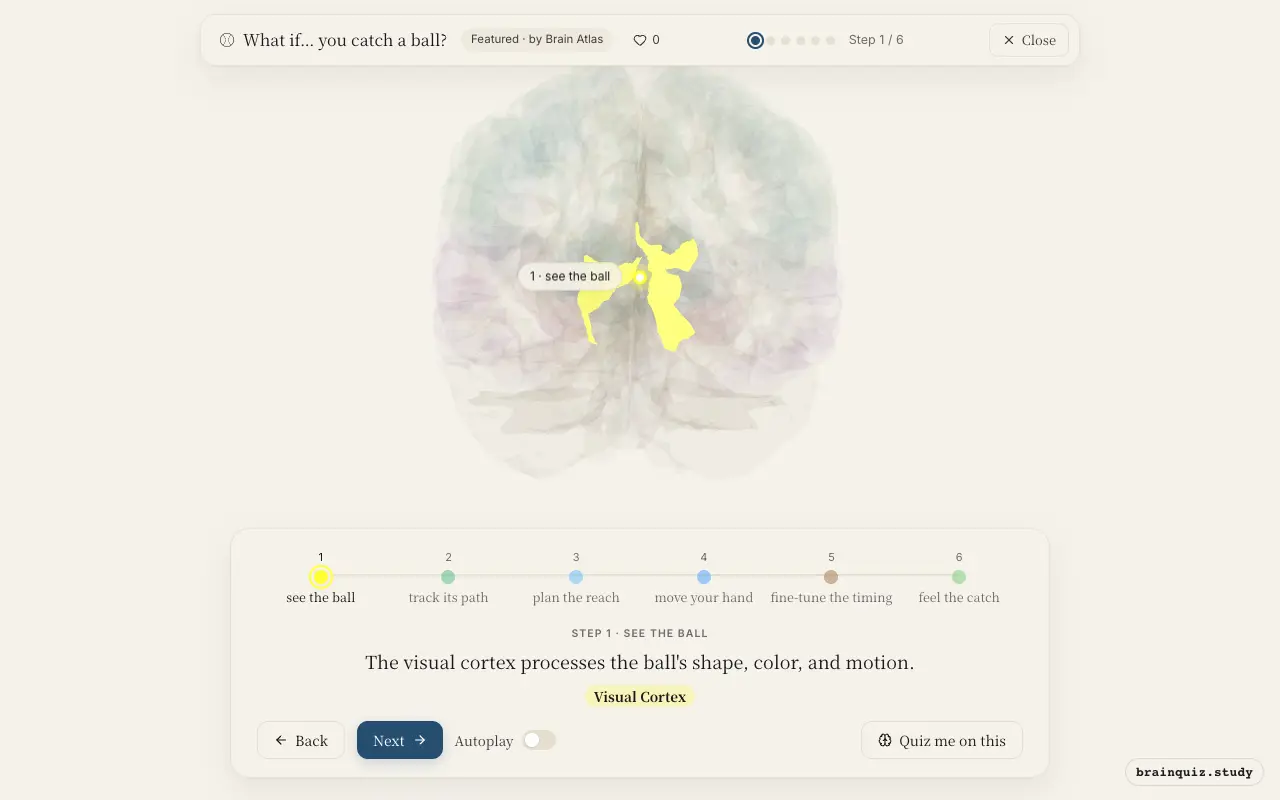
The primary visual cortex in the occipital lobe receives input from the eyes and extracts basic features like edges and direction of motion. This raw information is then passed to higher visual areas for further analysis.
2. Parietal Cortex: track its path
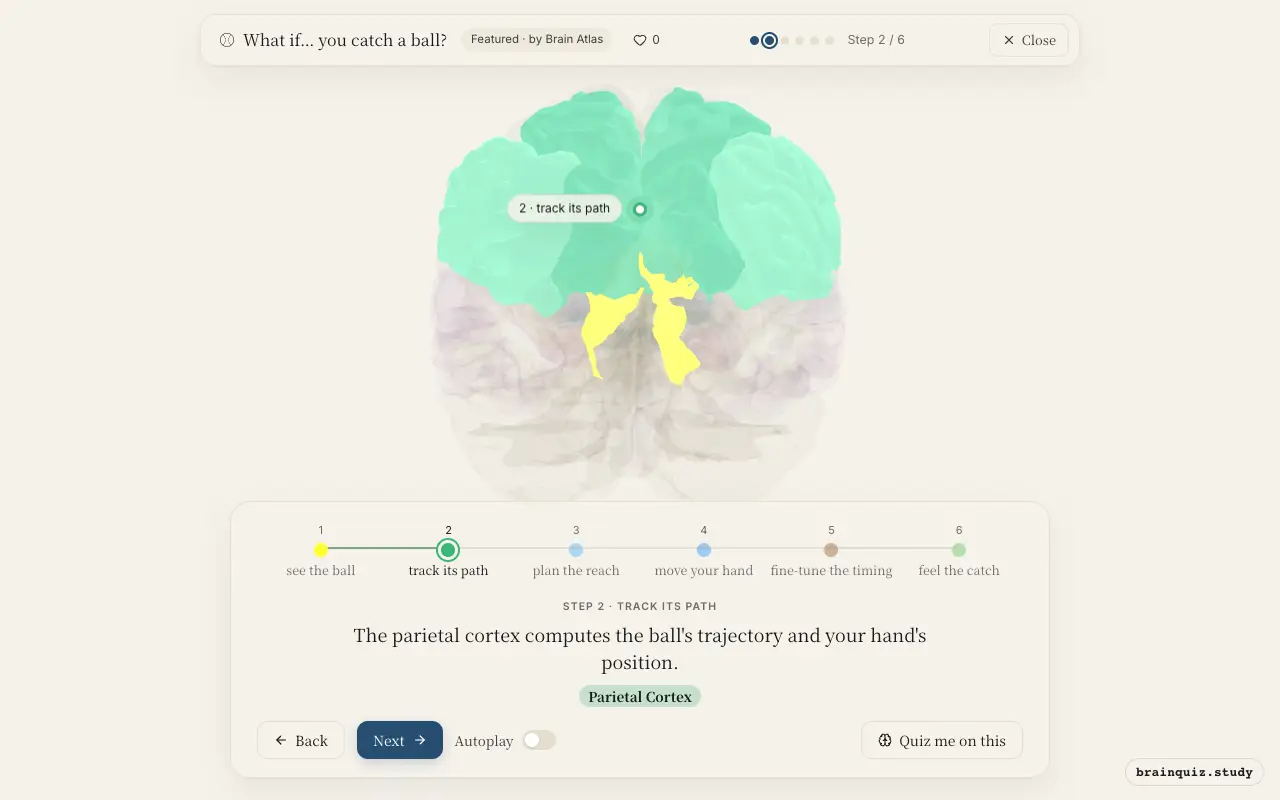
The posterior parietal cortex integrates visual information with proprioceptive signals from your body to create a spatial map. It estimates where the ball will be and guides your attention to the relevant location.
3. Premotor Cortex: plan the reach
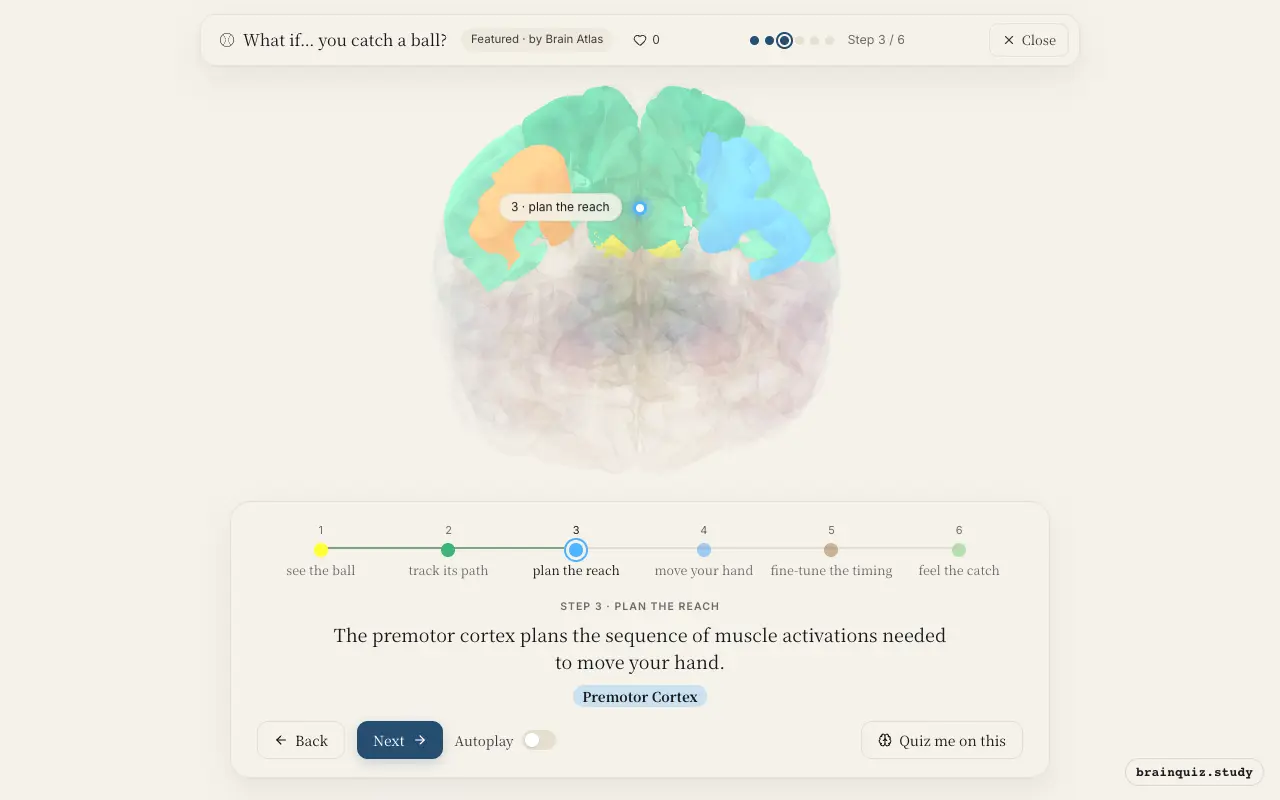
Based on the predicted trajectory, the premotor cortex selects an appropriate motor program. It sends signals to the primary motor cortex specifying the direction and extent of the reach.
4. Motor Cortex: move your hand
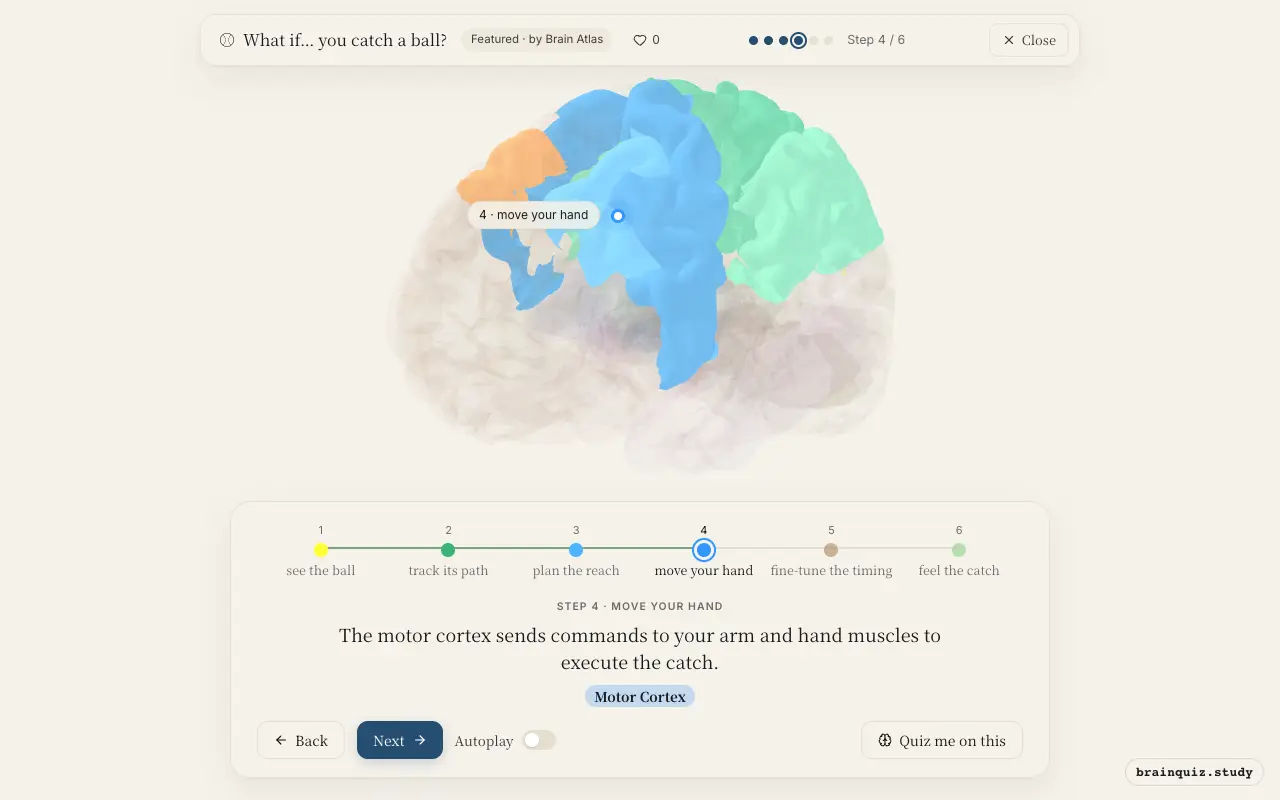
The primary motor cortex, located in the precentral gyrus, controls voluntary movements by activating specific motor neurons. It adjusts the force and timing of muscle contractions to position your hand correctly.
5. Cerebellum: fine-tune the timing
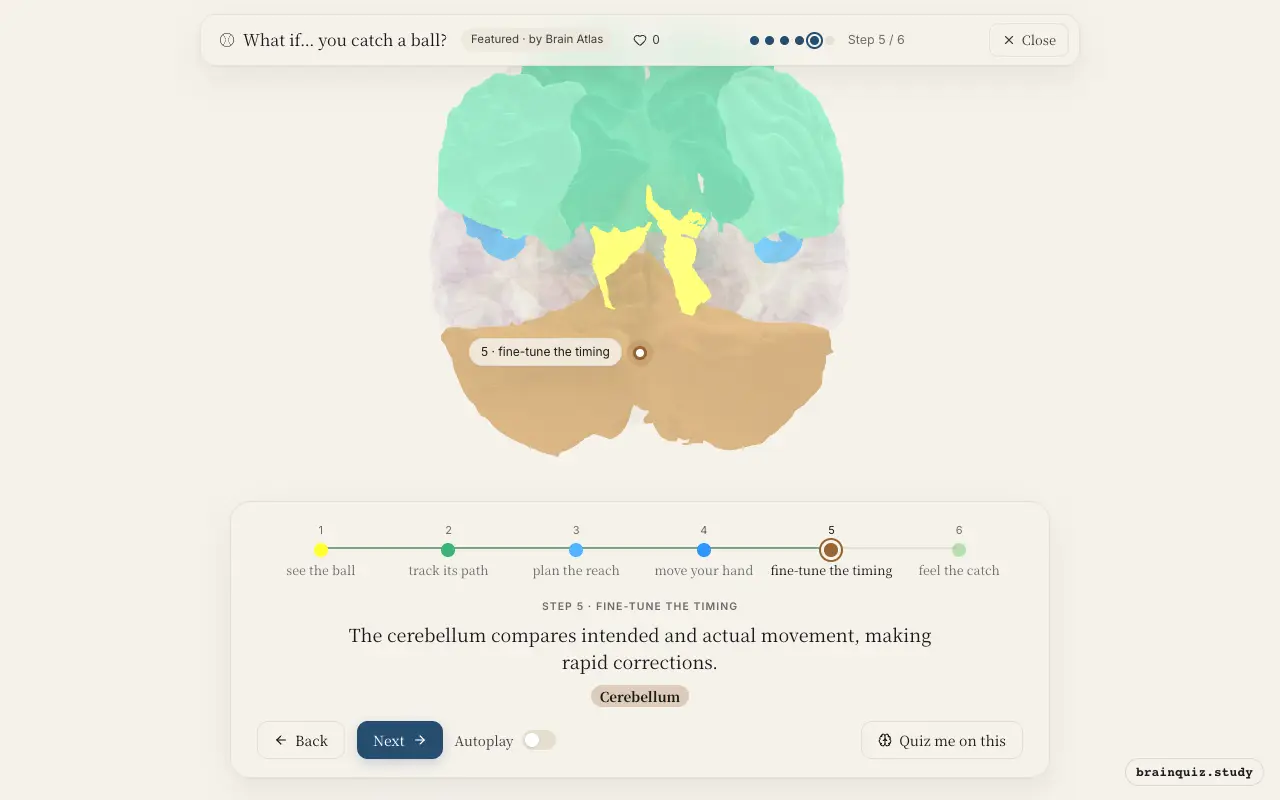
The cerebellum receives a copy of the motor command and sensory feedback about the actual movement. It detects errors and sends corrective signals to the motor cortex and brainstem, ensuring smooth and accurate hand closure around the ball.
6. Somatosensory Cortex: feel the catch
Once the ball contacts your palm and fingers, receptors send signals to the somatosensory cortex. This confirms the catch and allows you to adjust grip strength to secure the ball.
Good to know
- The cerebellum is essential for predicting the timing of moving objects, and damage can impair catching ability.
- Patients with damage to the posterior parietal cortex may show optic ataxia, the inability to accurately reach for seen objects.
- Premotor cortex activity increases before a voluntary movement, reflecting motor preparation even when no movement occurs.
Catching vs Throwing a Ball
Throwing relies more on the basal ganglia and motor cortex for initiating and executing a learned motor sequence, while catching depends heavily on visual tracking in the parietal cortex and rapid error correction by the cerebellum. Catching requires continuous updating of predictions, whereas throwing is a more ballistic action.
Test yourself
Which brain region first processes the visual information of the incoming ball?
What is the main role of the cerebellum in catching a ball?
Damage to which area would most impair your ability to accurately reach for the ball?
0 of 3 answered · 0 correct
Simplified: many regions work together at once, and this shows the main players in the order they act.