Somatosensory Cortex — Function, Location & Quiz
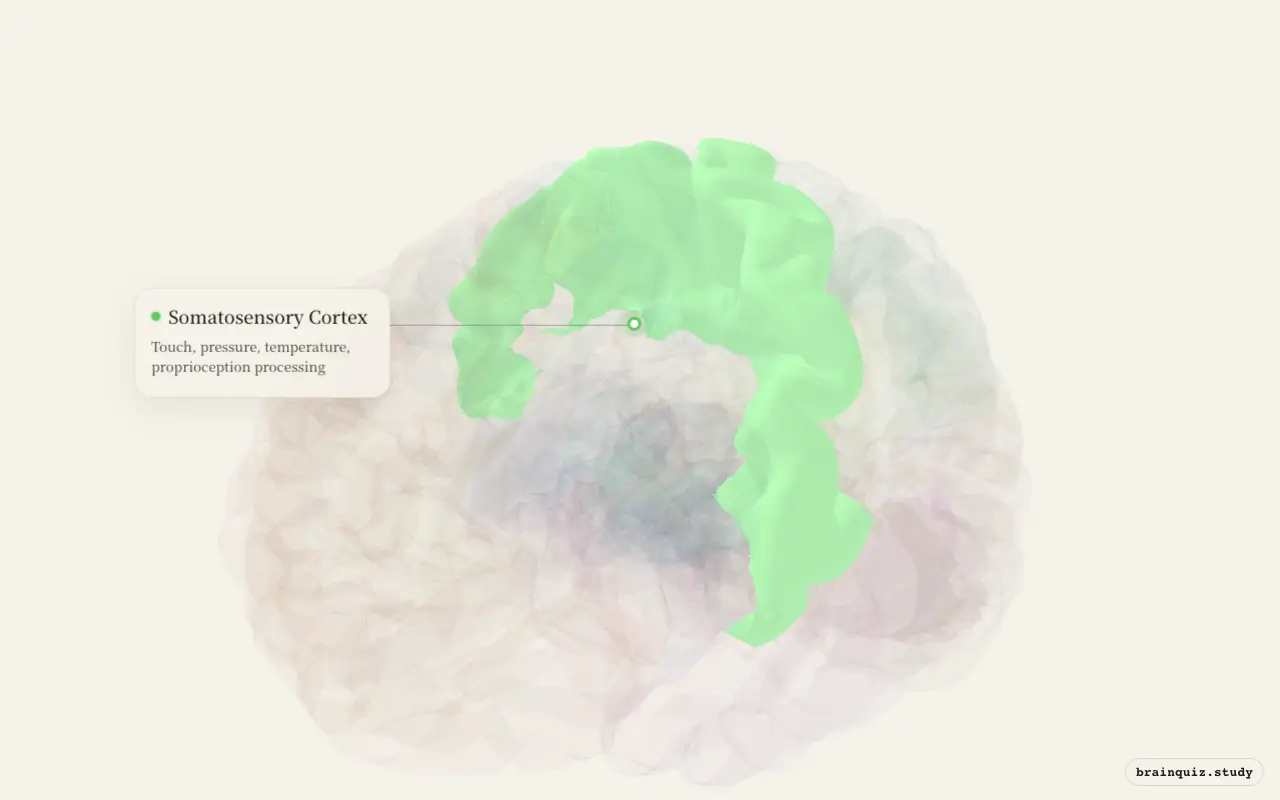
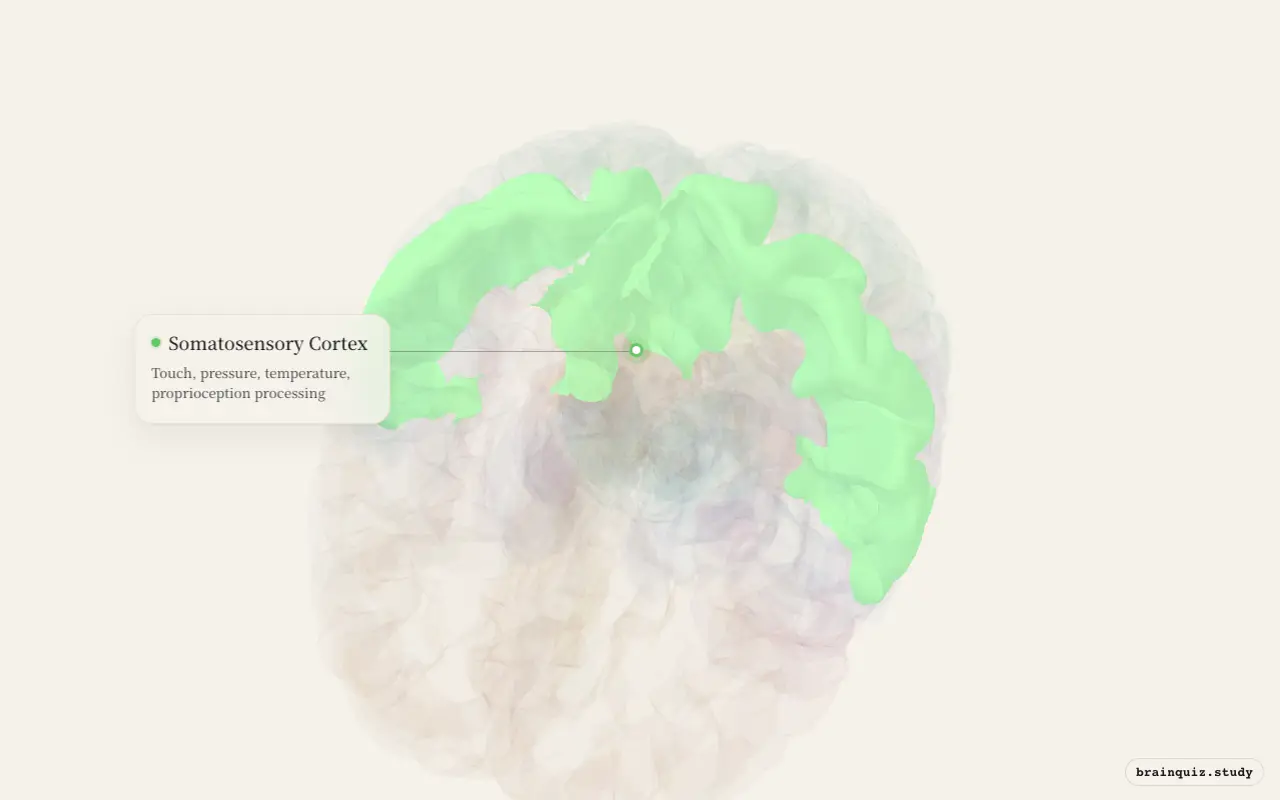
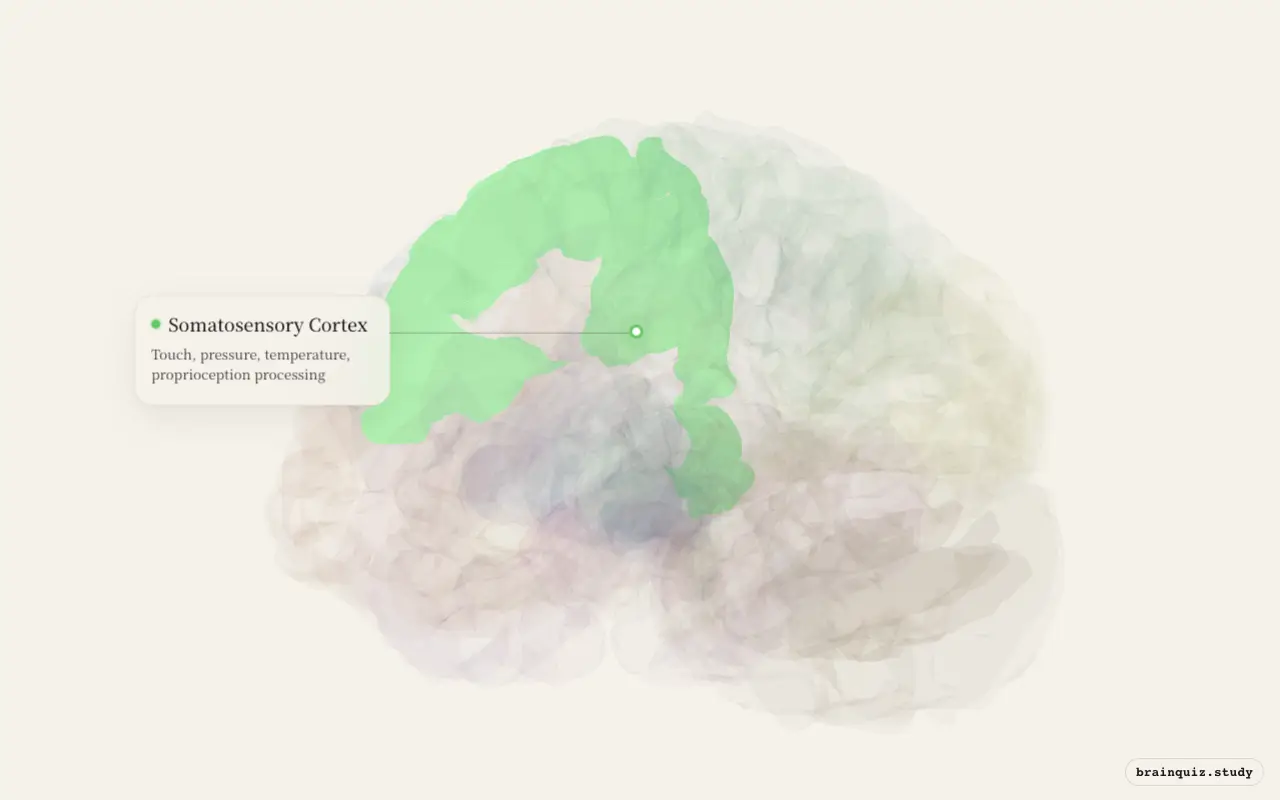
Primary somatosensory cortex occupies the postcentral gyrus, one fold behind primary motor cortex. Remembering that anterior-to-posterior order—motor, central sulcus, sensory—prevents the most common surface-anatomy mix-up.
This cortex does more than register contact. It preserves a contralateral body map and extracts features such as texture, position and shape, so cortical damage can leave simple sensation partly present while recognition by touch fails.
Test this anatomy in the Lesion Localization Quiz: 15 Clinical Questions or explore it on the interactive 3D brain.
Where is the Somatosensory Cortex located?
Touch, pressure, temperature, proprioception processing.
What does the Somatosensory Cortex do?
- Processing touch, pressure, vibration, temperature
- Proprioception — body position sense
- Somatotopic organization — sensory homunculus
- Two-point discrimination and texture perception
Somatosensory Cortex pathways and connections
- Thalamus (VPL nucleus) → S1 (spinothalamic and dorsal column pathways)
- S1 → S2 (secondary somatosensory — bilateral processing)
- S1 → Posterior parietal cortex (sensorimotor integration)
What happens when the Somatosensory Cortex is damaged?
- Lesion → contralateral loss of fine touch, proprioception
- Cortical sensory loss: astereognosis (can't recognize objects by touch)
- Phantom limb pain — reorganization of sensory homunculus after amputation
- Ramachandran's mirror box therapy exploits S1 plasticity
Somatosensory Cortex key facts
Atlas category: cortical. Brodmann areas or landmark: BA 1, 2, 3 (S1 — primary somatosensory).
- Sensory homunculus: lips, tongue, and fingers have largest representation
- Merzenich: adult cortical maps are plastic — expand with use (violin players)
- BA 3b processes texture, BA 1 processes texture + motion, BA 2 integrates size/shape
Somatosensory Cortex exam tip
Postcentral gyrus = sensory. Precentral gyrus = motor. They're separated by the central sulcus. Never confuse them!
Common questions
Where is the somatosensory cortex located?
Primary somatosensory cortex lies in the postcentral gyrus of the parietal lobe, just posterior to the central sulcus, and includes Brodmann areas 1, 2 and 3.
What does the somatosensory cortex process?
It processes touch, pressure, vibration, temperature and proprioceptive information, organized as a somatotopic sensory homunculus.
What is a cortical sensory deficit?
A patient may detect basic sensation yet fail higher-order tasks such as recognizing an object by touch, called astereognosis. Fine touch and proprioception may also be reduced on the opposite side.
When does the Somatosensory Cortex light up?
- 🤧 When you sneeze: The somatosensory cortex processes the tactile sensation of nasal irritation.
- ❄️ When you shiver in the cold: You consciously feel the cold as the somatosensory cortex processes the temperature signal.
- 🦶 When you stub your toe: The somatosensory cortex maps the pain to a specific spot on your toe.
- 😂 When you get tickled: Light touch on ticklish skin activates the somatosensory cortex.
- ✋ When you get an itch: The somatosensory cortex pinpoints the itch location.
- 😳 When you blush: The somatosensory cortex processes the feeling of warmth from the skin.
- 🦵 When your leg falls asleep: The somatosensory cortex interprets the signals as tingling or numbness.
- 🌶️ When you eat spicy food: The somatosensory cortex maps where in the mouth the burning sensation occurs.