What happens in your brain when you eat spicy food?
Updated
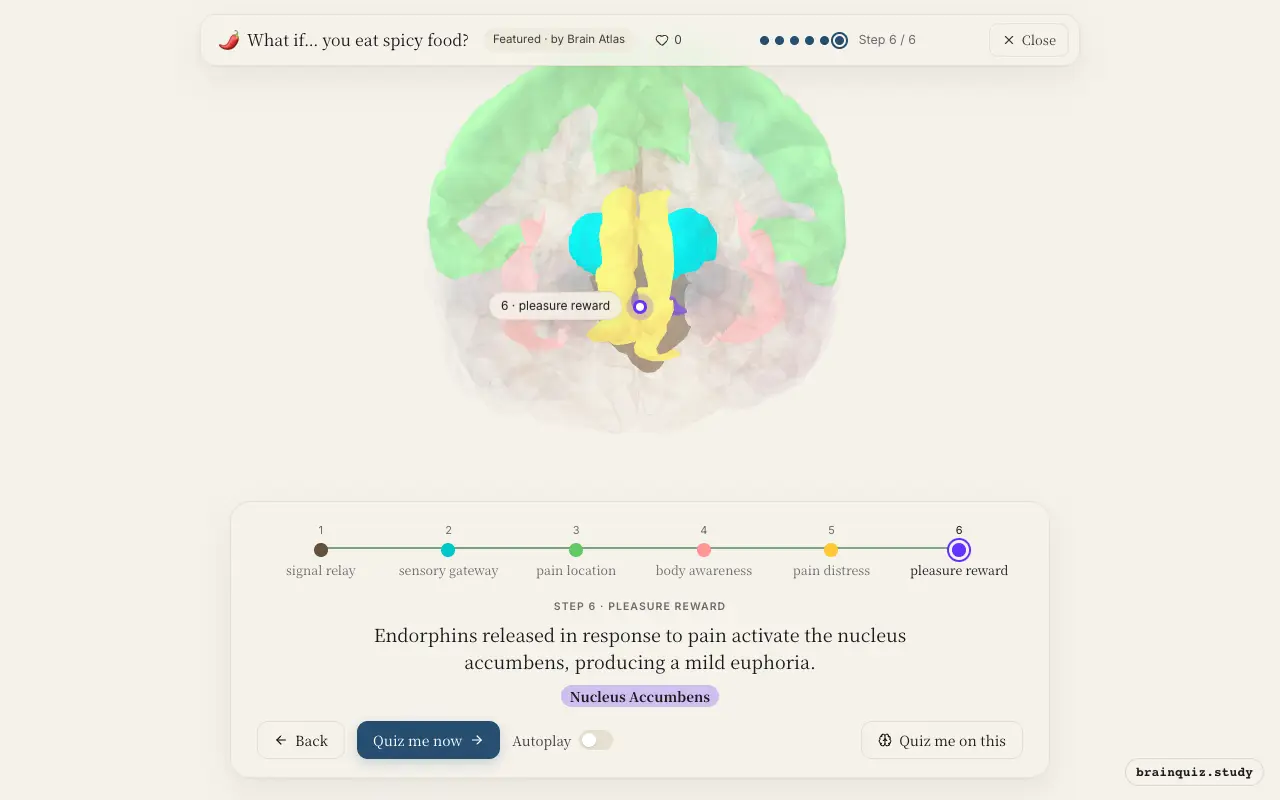
Capsaicin triggers pain and heat receptors. The brainstem relays the signal to the thalamus, then to the somatosensory cortex for localization, the insula for bodily awareness, the anterior cingulate for pain's unpleasantness, and the nucleus accumbens for endorphin-driven pleasure.
Watch it light up on the 3D brain
Brain regions that light up
| Order | Region | What it does here |
|---|---|---|
| 1 | Brainstem | Capsaicin activates pain and heat receptors, sending signals via the trigeminal nerve to the brainstem. |
| 2 | Thalamus | The thalamus routes the spicy pain signal to higher cortical areas. |
| 3 | Somatosensory Cortex | The somatosensory cortex maps where in the mouth the burning sensation occurs. |
| 4 | Insula | The insula generates the subjective feeling of intense heat and bodily discomfort. |
| 5 | Anterior Cingulate Cortex | The anterior cingulate cortex evaluates the unpleasantness of the spicy pain. |
| 6 | Nucleus Accumbens | Endorphins released in response to pain activate the nucleus accumbens, producing a mild euphoria. |
1. Brainstem: signal relay
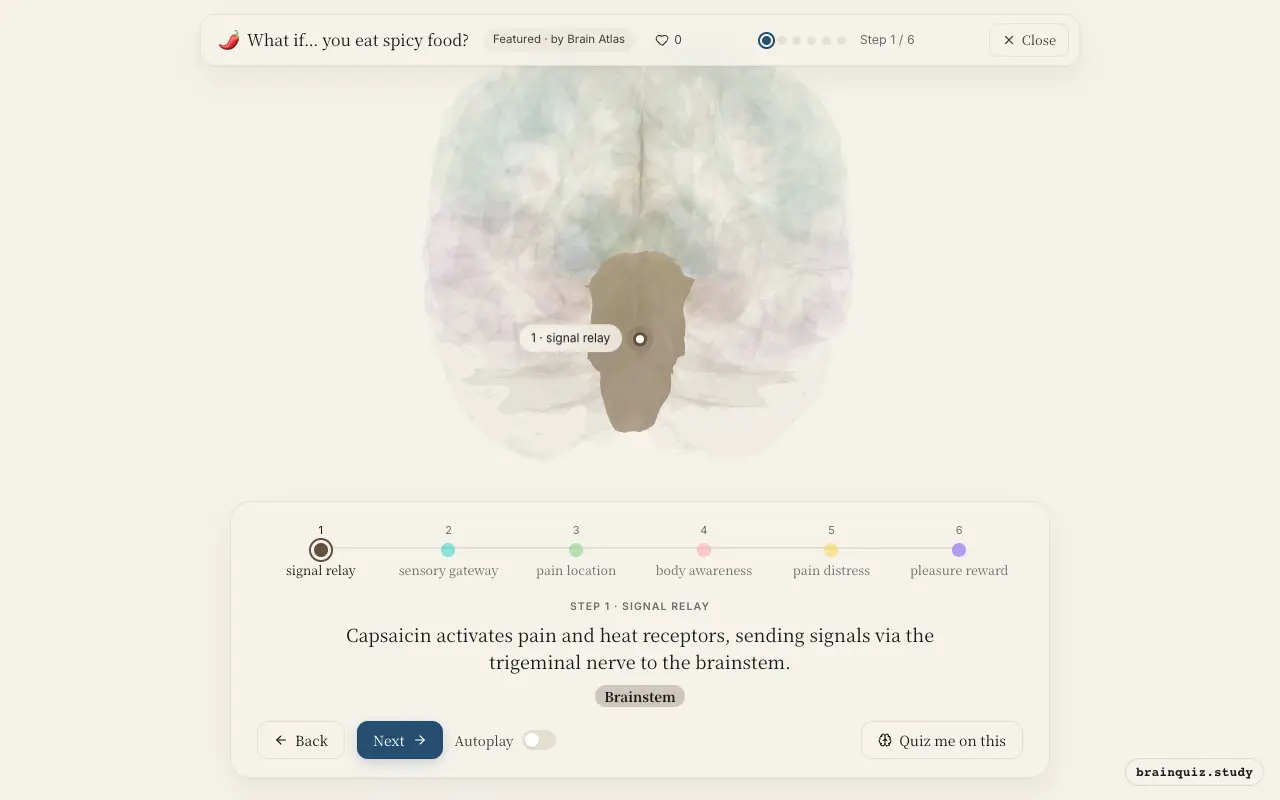
The brainstem's trigeminal nucleus receives the first central signal of spicy heat. It relays the information upward and triggers reflexes like tearing and salivation. This area also coordinates autonomic responses such as increased heart rate.
2. Thalamus: sensory gateway
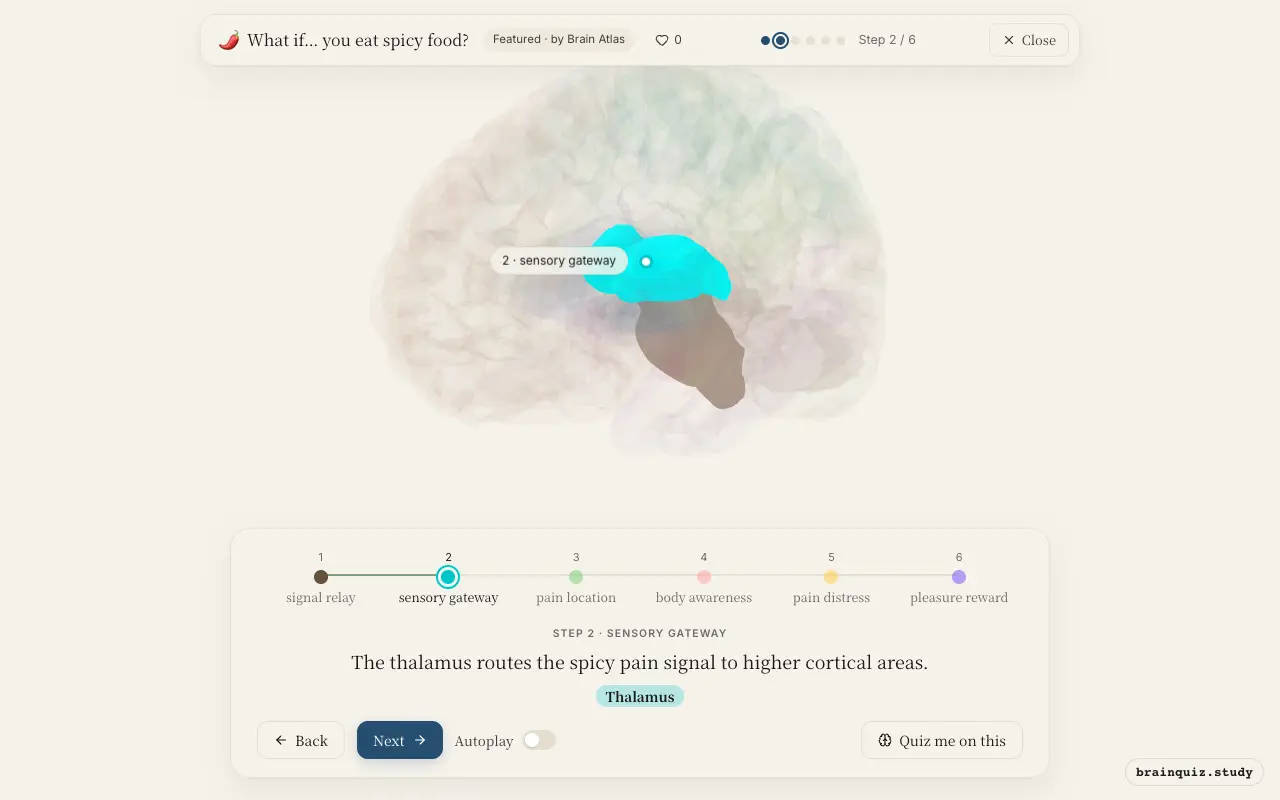
As the brain's main sensory relay, the thalamus filters and directs the incoming pain and temperature information. It sends projections to the somatosensory cortex for precise localization and to the insula and anterior cingulate for emotional and interoceptive processing.
3. Somatosensory Cortex: pain location
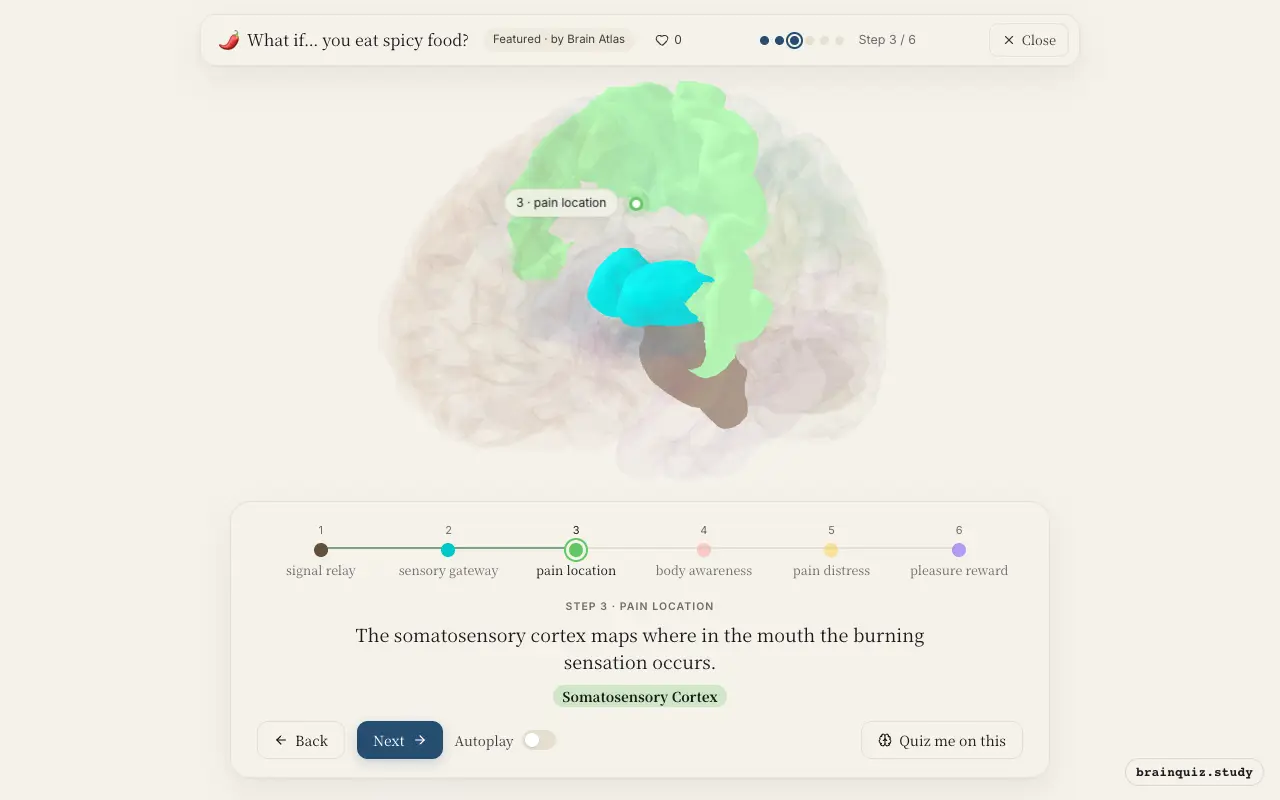
This region processes the discriminative aspect of pain—where exactly the heat is felt. It integrates touch and temperature signals from the tongue and oral cavity, allowing you to sense that the spiciness is on your lips, tongue, or throat.
4. Insula: body awareness
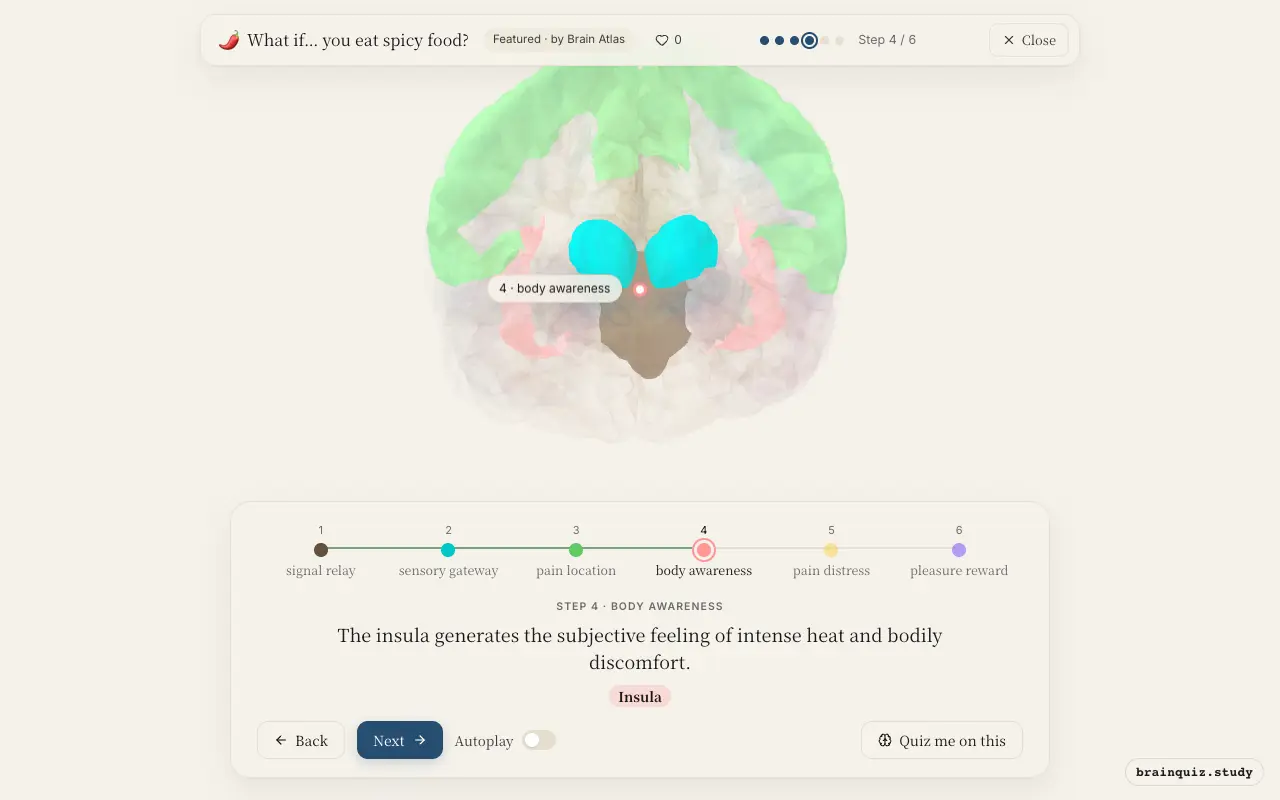
The insula processes interoception—the sense of the body's internal state. During spicy food consumption, it becomes highly active, contributing to the awareness of burning, sweating, and even nausea. It also plays a role in the emotional response to the pain.
5. Anterior Cingulate Cortex: pain distress
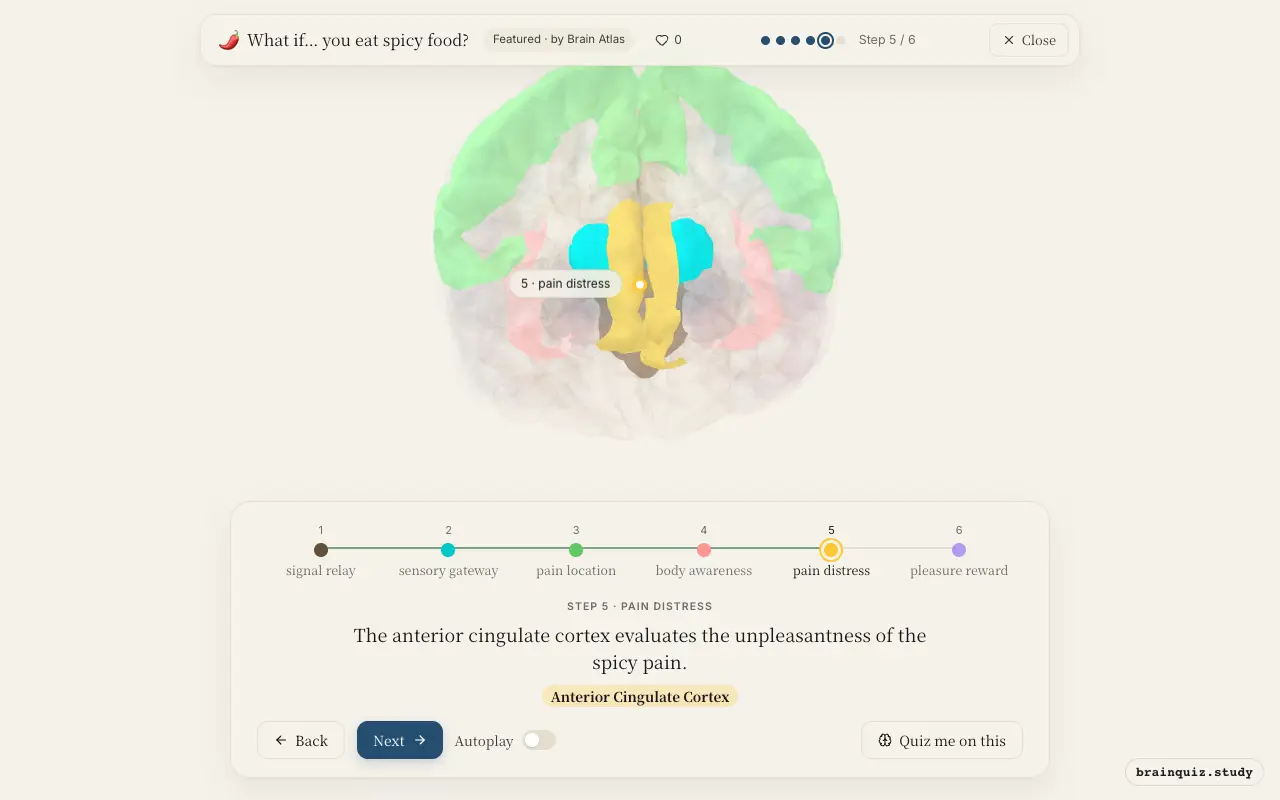
This region is crucial for the affective, motivational component of pain. It signals how much the burning bothers you and helps decide whether to keep eating or stop. Its activity correlates with the distress felt during intense spice.
6. Nucleus Accumbens: pleasure reward
Capsaicin-induced pain triggers the release of endogenous opioids. These endorphins bind to receptors in the brain's reward circuitry, including the nucleus accumbens, which is thought to explain why some people enjoy spicy food and even crave it.
Good to know
- Capsaicin binds to TRPV1 receptors, which normally respond to temperatures above 43°C (109°F).
- The heat from chili peppers is measured in Scoville Heat Units; pure capsaicin rates 16 million SHU.
- Regular consumption of spicy food can lead to desensitization of TRPV1 receptors, increasing tolerance.
Spicy vs. Sweet Taste
Sweet taste activates the gustatory pathway through the solitary tract and thalamus to the insula and orbitofrontal cortex, without pain signals. Spicy food bypasses taste receptors entirely, directly stimulating pain and temperature fibers, which then recruit the anterior cingulate and brainstem autonomic centers.
Test yourself
Which brain region is most directly responsible for the unpleasant emotional aspect of spicy pain?
What molecule in chili peppers activates heat and pain receptors?
Which neurotransmitter or neuromodulator is most associated with the pleasurable 'high' some people get from spicy food?
0 of 3 answered · 0 correct
Simplified: many regions work together at once, and this shows the main players in the order they act. For learning only, not medical advice.