What happens in your brain when you blush?
Updated
When you blush, the orbitofrontal cortex detects social threat, the amygdala triggers emotional arousal, the insula creates self-conscious awareness, and the hypothalamus dilates facial blood vessels via the sympathetic nervous system.
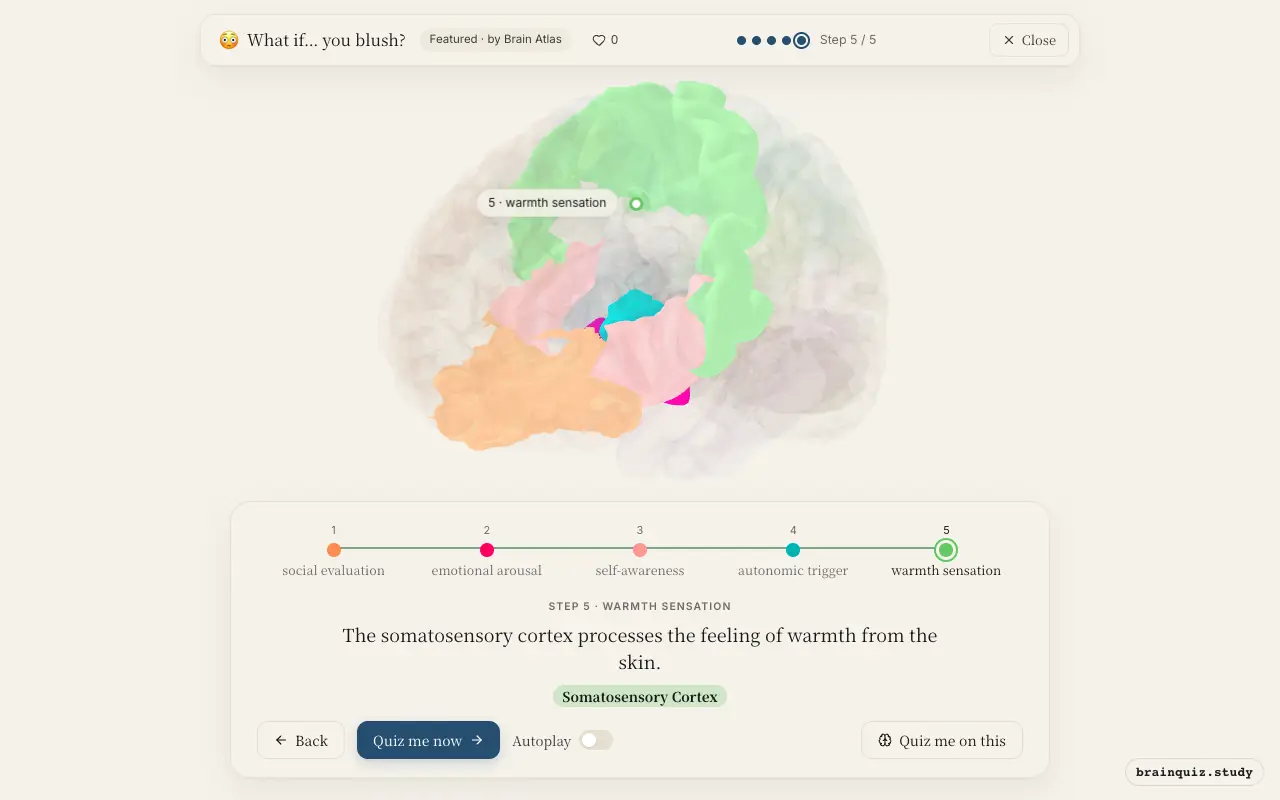
Watch it light up on the 3D brain
Brain regions that light up
| Order | Region | What it does here |
|---|---|---|
| 1 | Orbitofrontal Cortex | The orbitofrontal cortex detects social cues that might lead to negative judgment. |
| 2 | Amygdala | The amygdala generates a rapid emotional response, increasing arousal. |
| 3 | Insula | The insula creates conscious awareness of the emotional state and body sensations. |
| 4 | Hypothalamus | The hypothalamus activates the sympathetic nervous system, causing facial vasodilation. |
| 5 | Somatosensory Cortex | The somatosensory cortex processes the feeling of warmth from the skin. |
1. Orbitofrontal Cortex: social evaluation
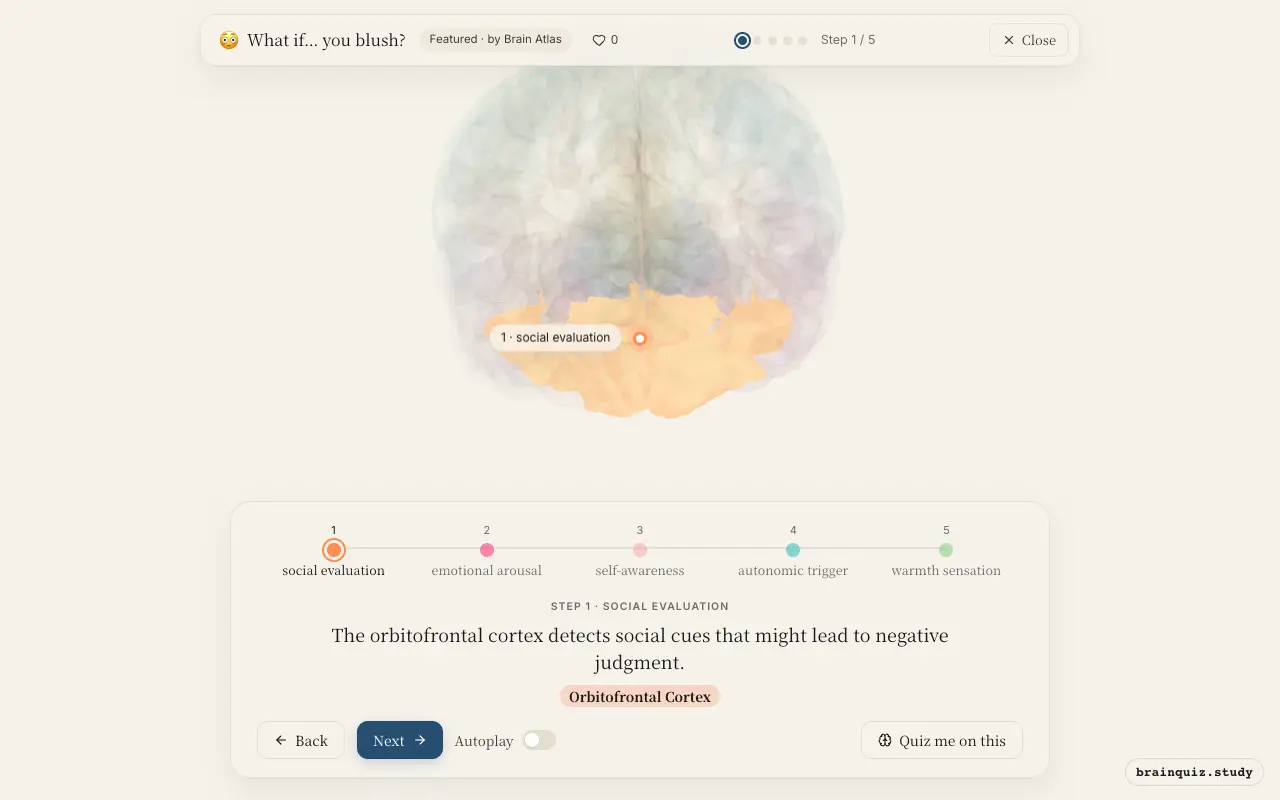
This region evaluates the social context and compares it with internal expectations. When it senses a potential faux pas or attention, it signals that the situation is socially threatening. This triggers the emotional response that leads to blushing.
2. Amygdala: emotional arousal
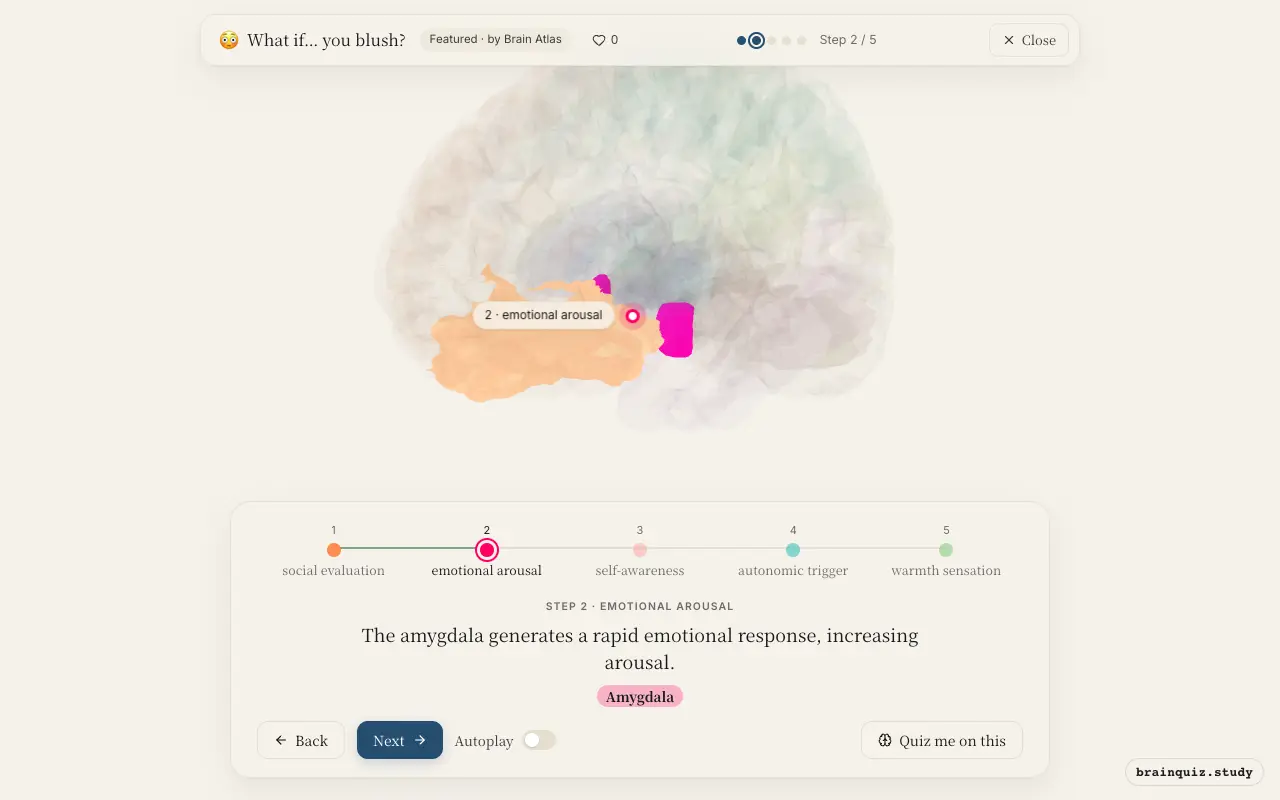
The amygdala processes the emotional significance of the social threat, producing feelings of embarrassment or self-consciousness. It communicates with the autonomic nervous system to prepare the body for a response. This arousal is a key driver of the blush.
3. Insula: self-awareness
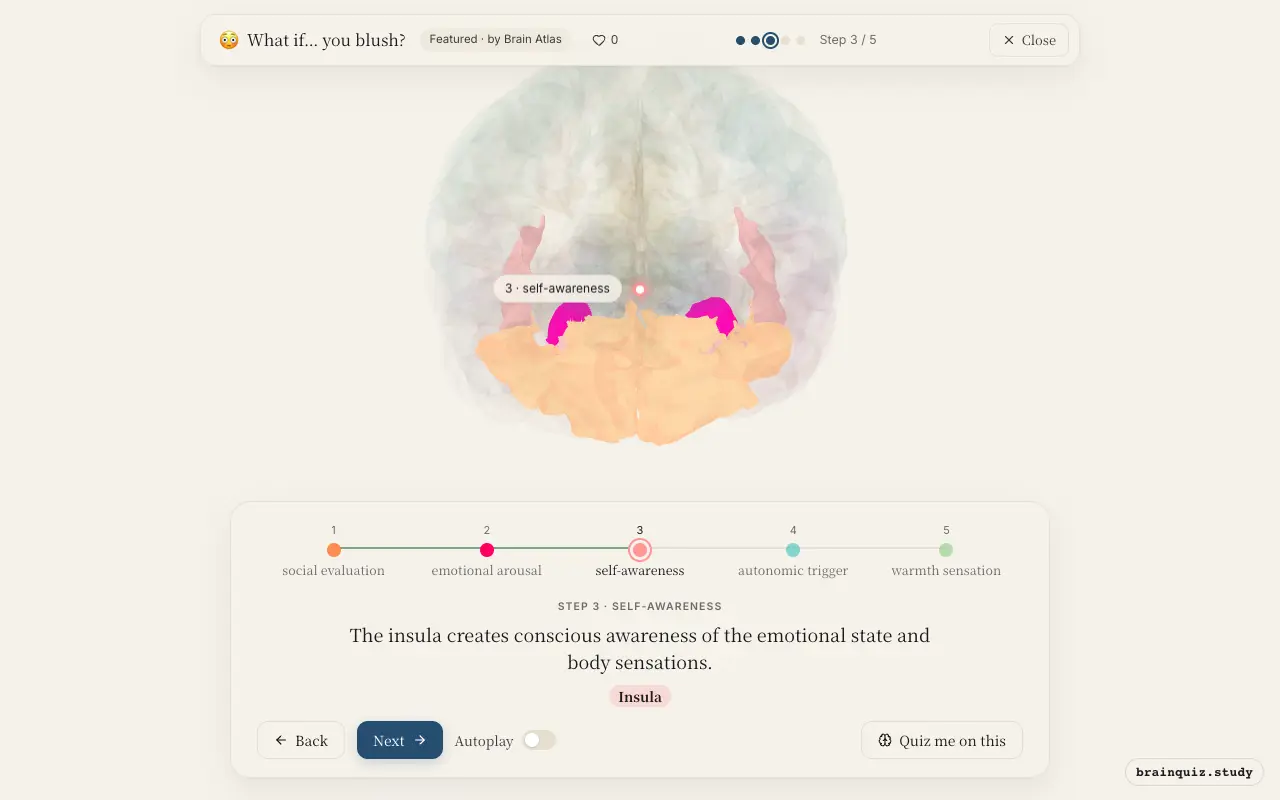
The insula integrates signals from the body and emotions, producing the subjective feeling of embarrassment. It also monitors the internal state, making you aware that you are blushing. This self-awareness can intensify the blush further.
4. Hypothalamus: autonomic trigger
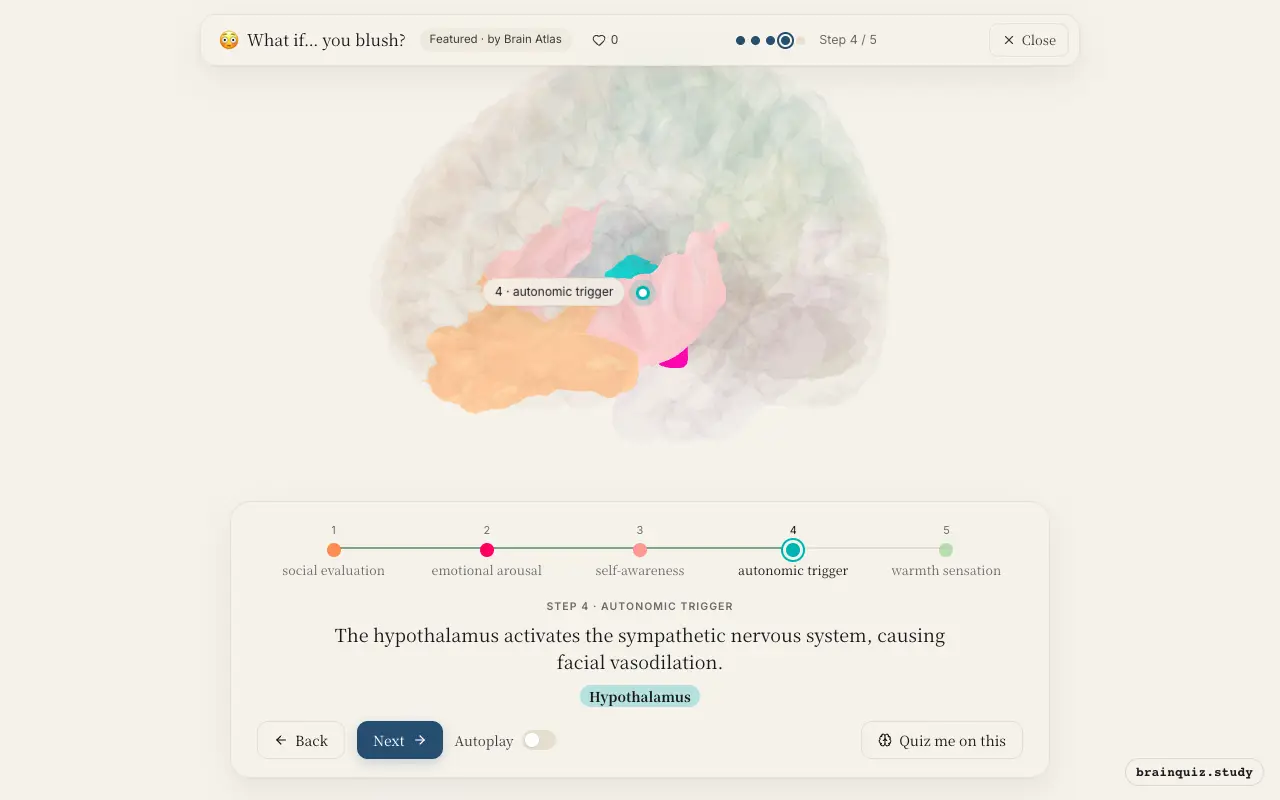
Through its control of the autonomic nervous system, the hypothalamus signals blood vessels in the face to dilate. This increases blood flow to the skin, producing the visible redness. The response is involuntary and difficult to suppress.
5. Somatosensory Cortex: warmth sensation
As blood rushes to the face, sensory receptors detect warmth and pressure. The somatosensory cortex receives this information, making you consciously feel the heat. This feedback can reinforce the emotional experience.
Good to know
- Blushing is unique to humans and is thought to have evolved as a social signal of appeasement.
- The blush response is mediated by beta-adrenergic receptors in facial blood vessels, unlike typical sympathetic vasoconstriction which is alpha-adrenergic.
- Blushing is often accompanied by increased heart rate and sweating, indicating general sympathetic activation.
Blushing vs Exercise Flush
While both involve facial redness, exercise flush results from thermoregulatory vasodilation driven by the hypothalamus in response to heat. Blushing is triggered by social-emotional processing in the orbitofrontal cortex and amygdala, leading to a distinct pattern of sympathetic activation. The insula is more involved in blushing due to its role in self-awareness.
Test yourself
Which brain region is primarily responsible for initiating the blush response by activating the sympathetic nervous system?
The feeling of embarrassment associated with blushing is most closely linked to activity in which region?
Blushing is unique among sympathetic responses because it involves:
0 of 3 answered · 0 correct
Simplified: many regions work together at once, and this shows the main players in the order they act.