What happens in your brain when you poop?
Updated
The sacral spinal cord triggers the defecation reflex, the insula creates the urge, the prefrontal cortex decides if it's appropriate, and the motor cortex relaxes the external sphincter.
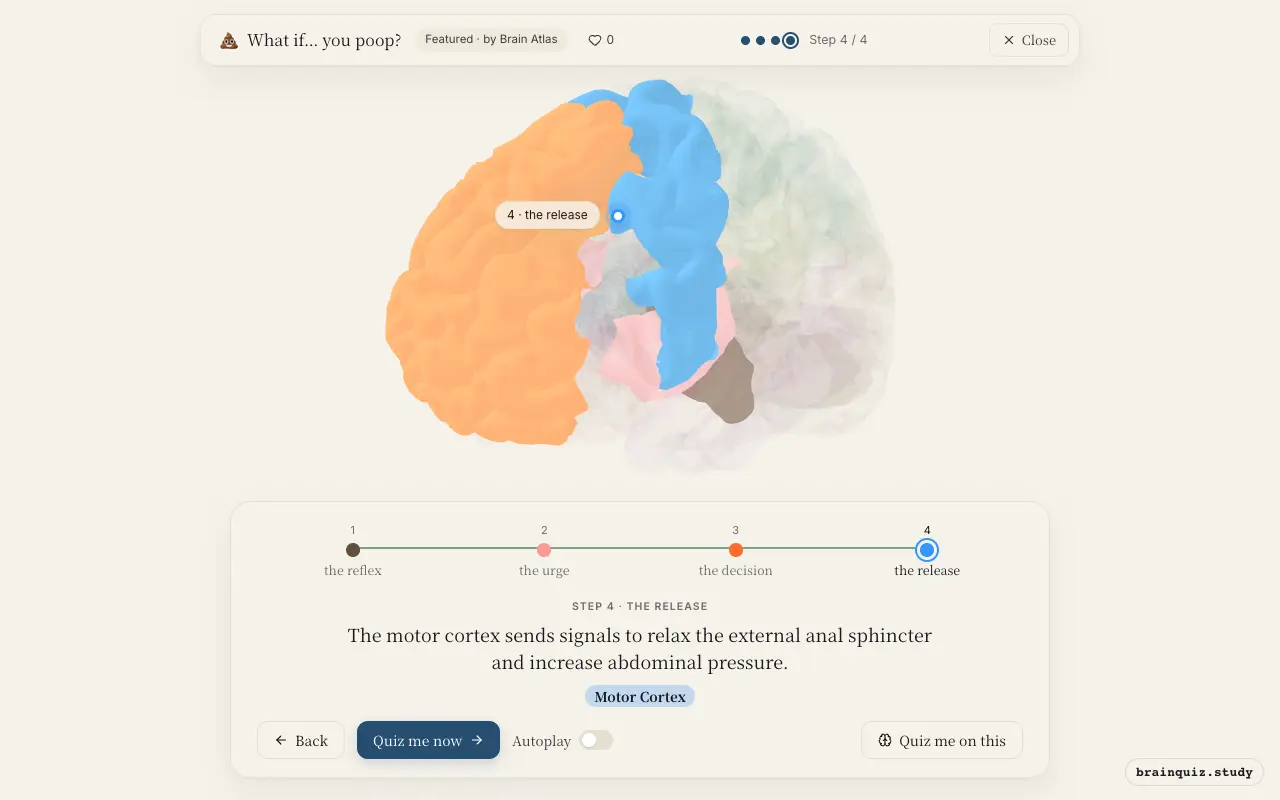
Watch it light up on the 3D brain
Brain regions that light up
| Order | Region | What it does here |
|---|---|---|
| 1 | Brainstem | Rectal fullness triggers the sacral spinal cord's defecation reflex, which relaxes the internal anal sphincter. |
| 2 | Insula | The insula registers the sensation of rectal pressure, creating the conscious urge to defecate. |
| 3 | Prefrontal Cortex | The prefrontal cortex evaluates the social context and decides to permit or suppress the urge. |
| 4 | Motor Cortex | The motor cortex sends signals to relax the external anal sphincter and increase abdominal pressure. |
1. Brainstem: the reflex
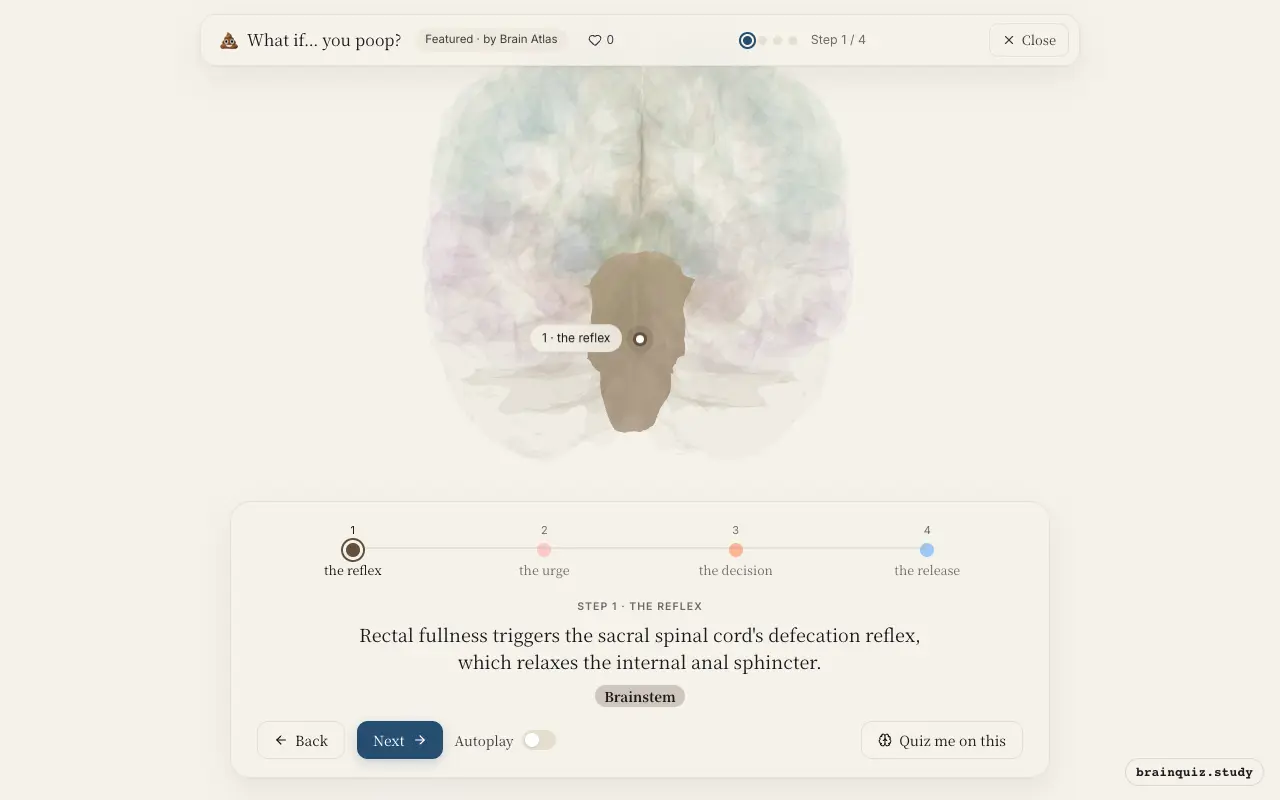
The brainstem integrates sensory signals from the rectum and sends parasympathetic signals to the colon and rectum. This causes peristaltic waves and relaxation of the internal anal sphincter, an involuntary smooth muscle. This reflex can occur without conscious input, but higher brain centers normally modulate it.
2. Insula: the urge
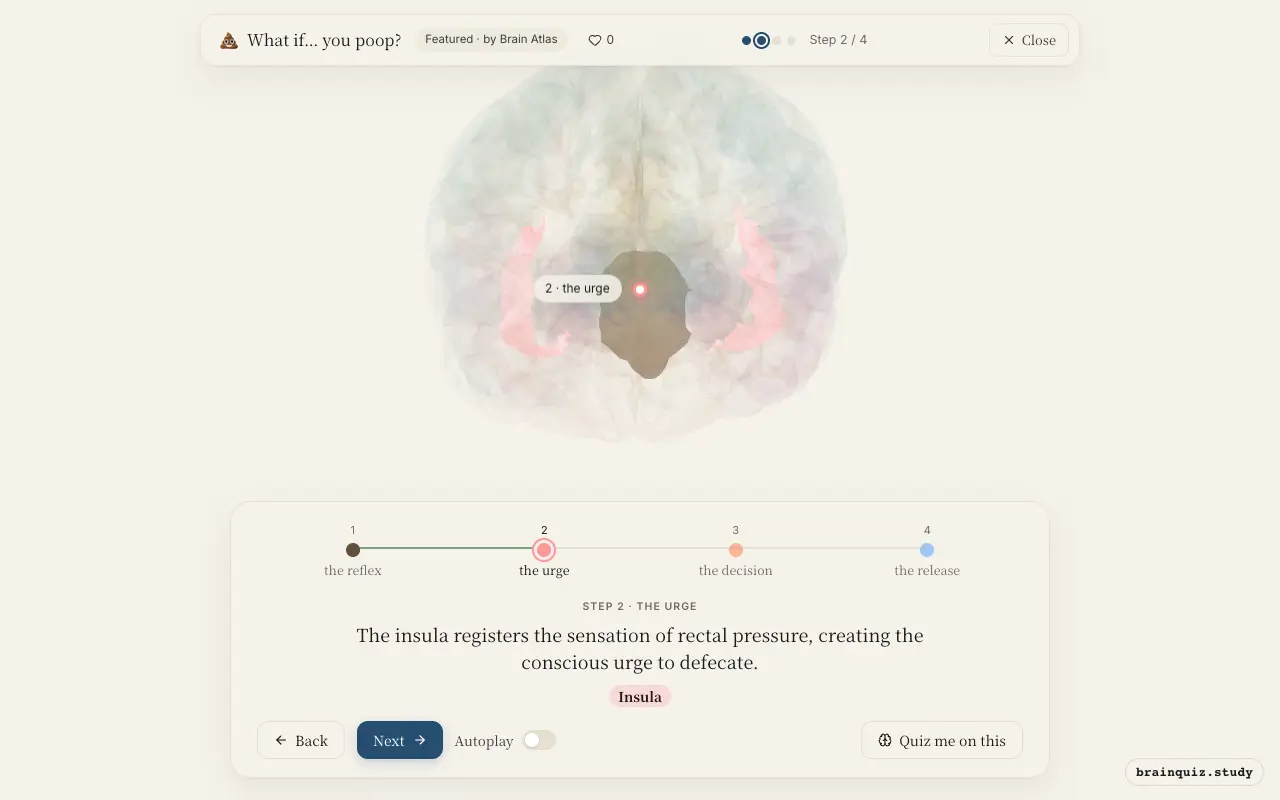
The insula is the primary cortical area for interoception, the sense of the body's internal state. It receives signals from the rectum via the thalamus and generates the subjective feeling of needing to go. This awareness is essential for deciding when and where to defecate.
3. Prefrontal Cortex: the decision
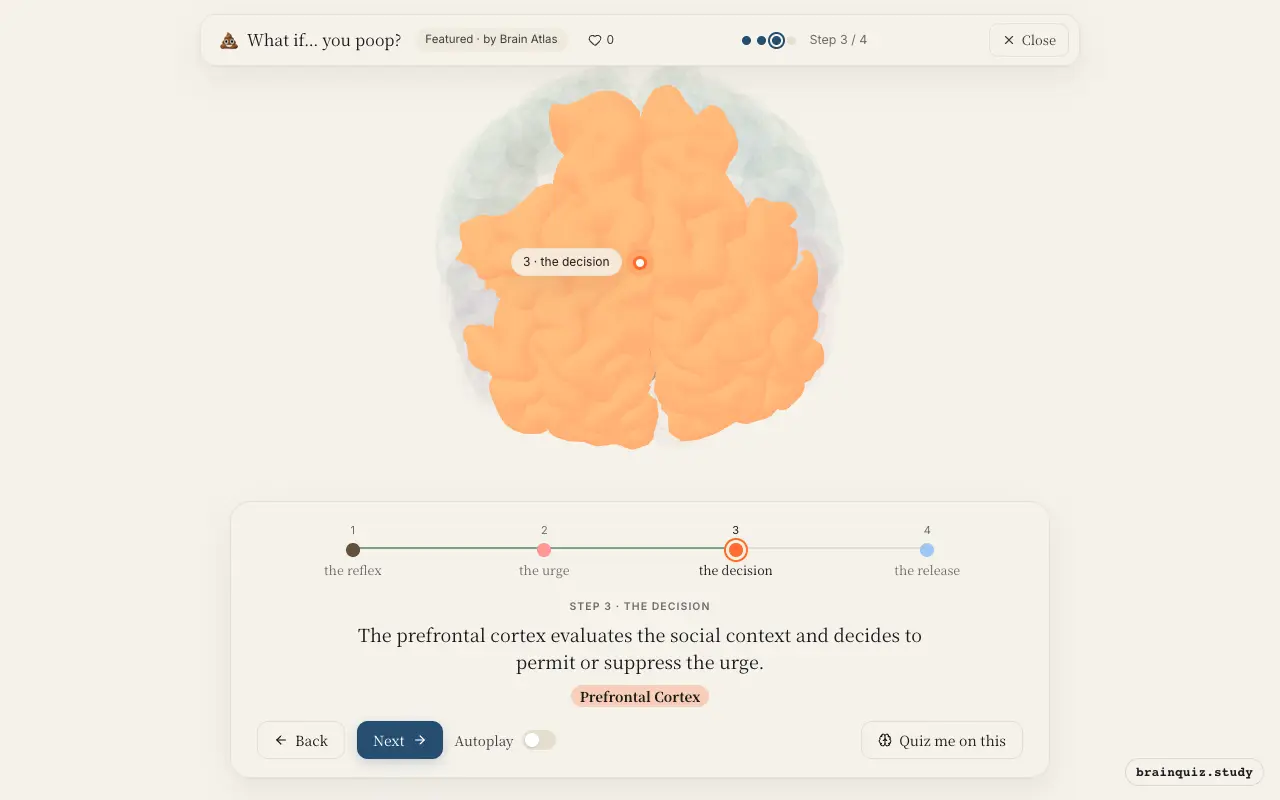
The prefrontal cortex is involved in executive functions including decision-making and impulse control. It weighs social appropriateness, availability of a toilet, and other factors. If conditions are favorable, it sends signals to allow the reflex to proceed; if not, it inhibits the brainstem and signals the motor cortex to contract the external sphincter to maintain continence.
4. Motor Cortex: the release
The motor cortex controls voluntary skeletal muscles via the corticospinal tract. It projects to the pudendal nerve to relax the external anal sphincter, and to abdominal muscles to contract, raising intra-abdominal pressure. This, combined with the brainstem reflex, allows stool to pass.
Good to know
- The internal anal sphincter is smooth muscle under autonomic control, while the external anal sphincter is skeletal muscle under voluntary control.
- The defecation reflex can be voluntarily overridden by higher brain centers, allowing continence.
- The Valsalva maneuver increases intra-abdominal pressure to aid defecation.
Pooping vs Holding It In
When holding it in, the prefrontal cortex actively inhibits the brainstem reflex and the motor cortex contracts the external sphincter. When pooping, that inhibition is released, the sphincter relaxes, and abdominal muscles contract.
Test yourself
Which brain region is primarily responsible for the conscious urge to defecate?
The internal anal sphincter is controlled by which part of the nervous system?
If you decide to delay defecation, which region is most active in suppressing the urge?
0 of 3 answered · 0 correct
Simplified: many regions work together at once, and this shows the main players in the order they act.