What happens in your brain when you get hiccups?
Updated
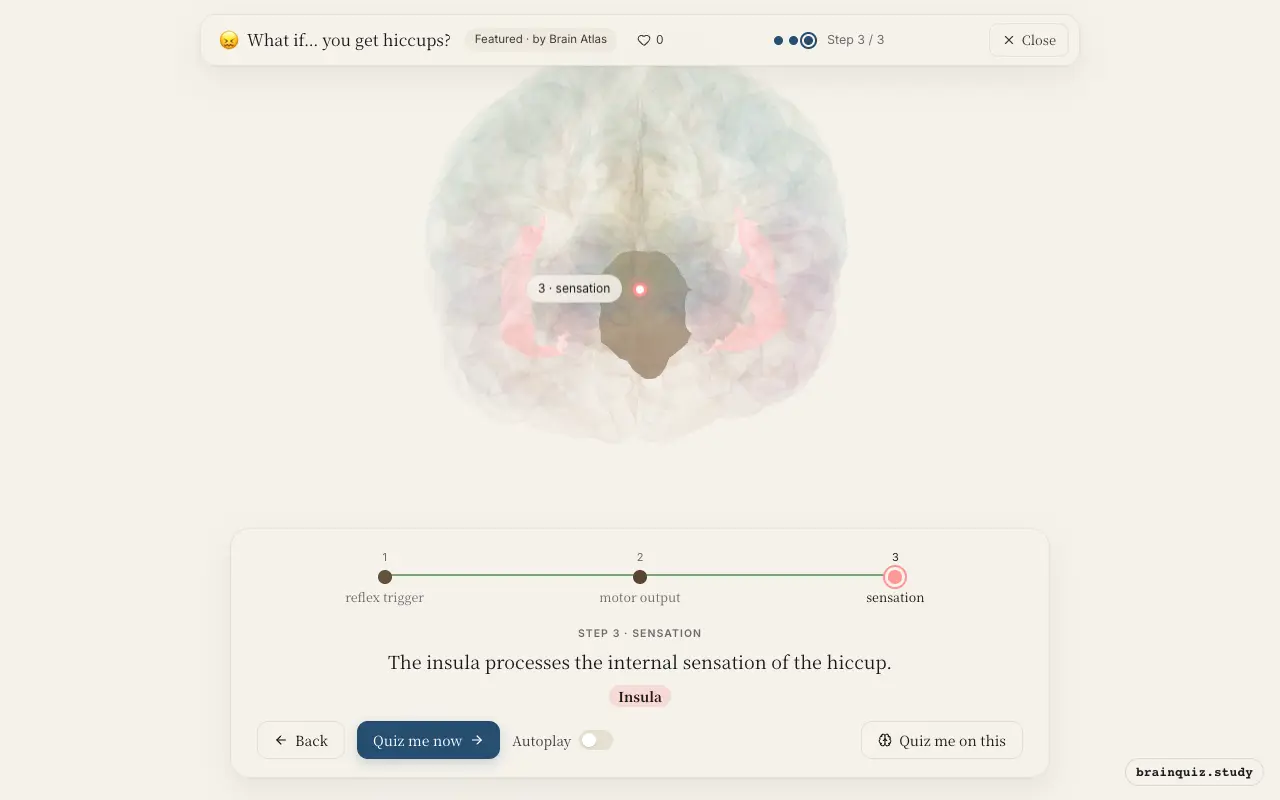
The brainstem integrates the hiccup reflex, the spinal cord relays the motor command to the diaphragm via the phrenic nerve, and the insula processes the resulting sensation. Together they produce the involuntary 'hic'.
Watch it light up on the 3D brain
Brain regions that light up
| Order | Region | What it does here |
|---|---|---|
| 1 | Brainstem | The brainstem receives sensory input from the diaphragm and phrenic nerve. |
| 2 | Spinal Cord | The spinal cord sends motor signals via the phrenic nerve to the diaphragm. |
| 3 | Insula | The insula processes the internal sensation of the hiccup. |
1. Brainstem: reflex trigger
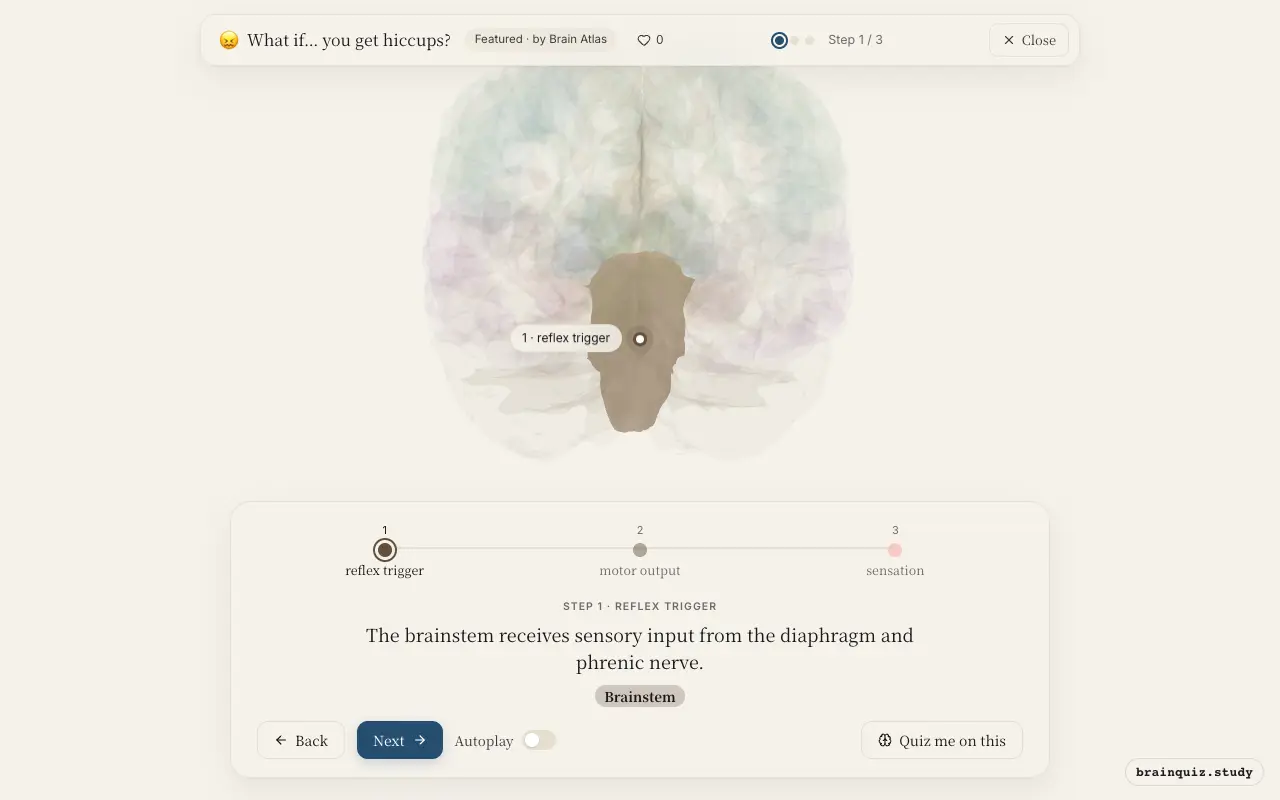
The brainstem, particularly the medulla, contains the hiccup center that integrates afferent signals from the vagus and phrenic nerves. It detects the irritation or stretch that triggers the reflex.
2. Spinal Cord: motor output
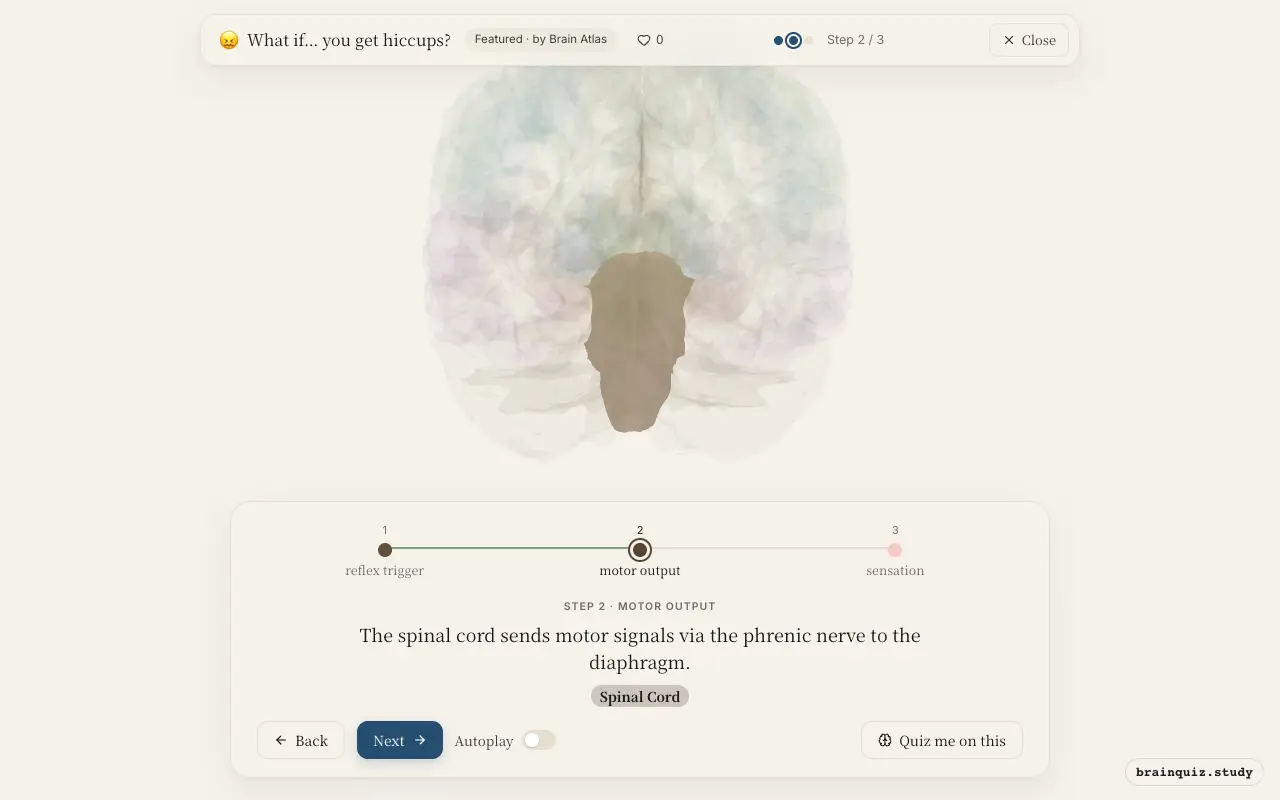
Motor neurons in the cervical spinal cord (C3-C5) receive the command from the brainstem and fire, causing the diaphragm to contract suddenly. This produces the 'hic' sound.
3. Insula: sensation
The insula receives interoceptive information about the diaphragm contraction and glottis closure, making you aware of the hiccup. It may also contribute to the unpleasant feeling.
Good to know
- Hiccups are caused by sudden, involuntary contractions of the diaphragm followed by rapid closure of the glottis, producing the characteristic 'hic' sound.
- The hiccup reflex arc involves the phrenic nerve, vagus nerve, and the brainstem, particularly the medulla.
- Persistent hiccups can result from brainstem lesions, phrenic or vagus nerve irritation, or metabolic disturbances.
Hiccups vs Breath Holding
Hiccups are an involuntary brainstem reflex that bypasses higher centers, while breath holding requires prefrontal cortex to inhibit the brainstem's respiratory drive. In hiccups, the brainstem acts alone; in breath holding, cortical control overrides brainstem automaticity.
Test yourself
Which brain region is primarily responsible for generating the hiccup reflex?
Through which nerve does the motor command for diaphragm contraction travel?
Which brain region is likely involved in the conscious sensation of a hiccup?
0 of 3 answered · 0 correct
Simplified: many regions work together at once, and this shows the main players in the order they act.