Spinal Cord — Function, Location & Quiz
The spinal cord is not a passive cable from brain to muscle. It contains reflex circuits, lower motor neurons and central pattern generators capable of organizing rhythmic movement while descending systems set goals and adapt behaviour to the environment.
Its clinical map depends on keeping pathway level clear. Corticospinal injury produces upper-motor-neuron signs below the lesion, while damage to the final motor neurons or roots produces flaccidity, atrophy, fasciculations and lost reflexes in the affected segment.
Test this anatomy in the Lesion Localization Quiz: 15 Clinical Questions or explore it on the interactive 3D brain.
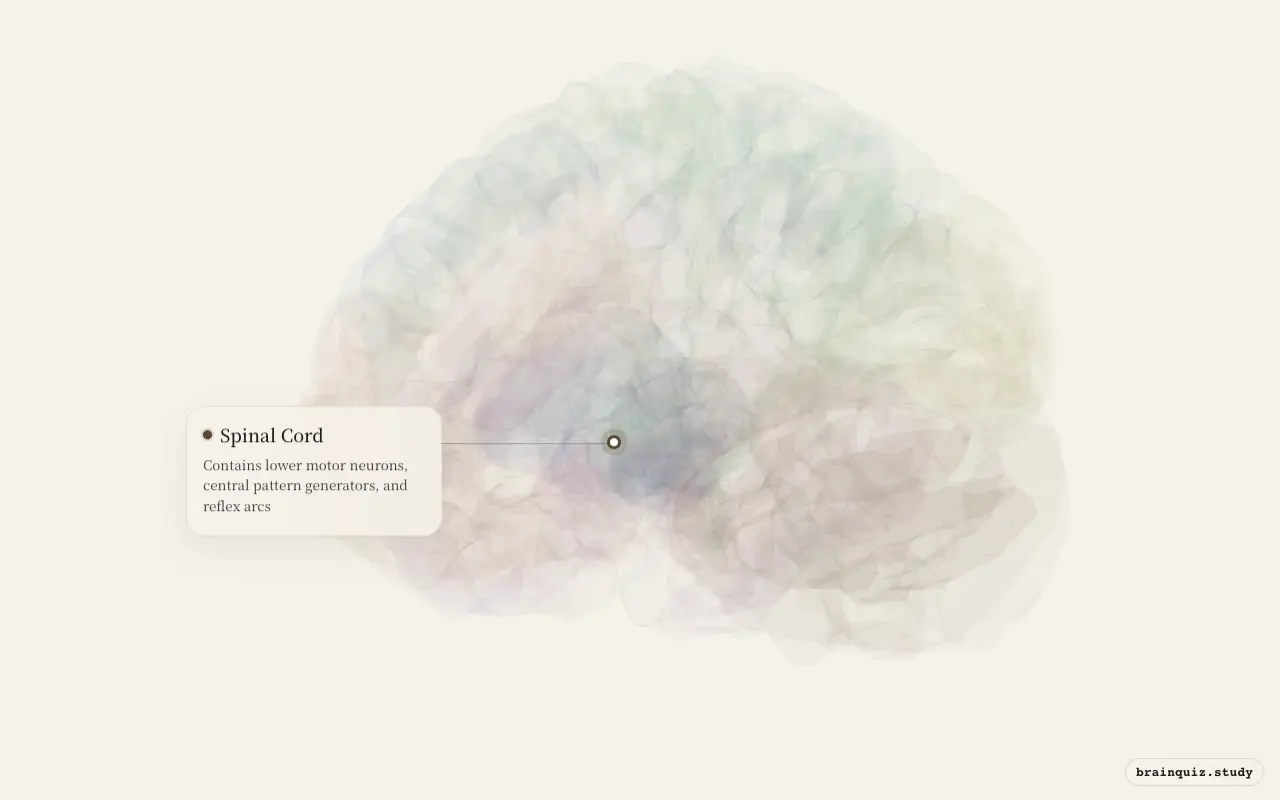
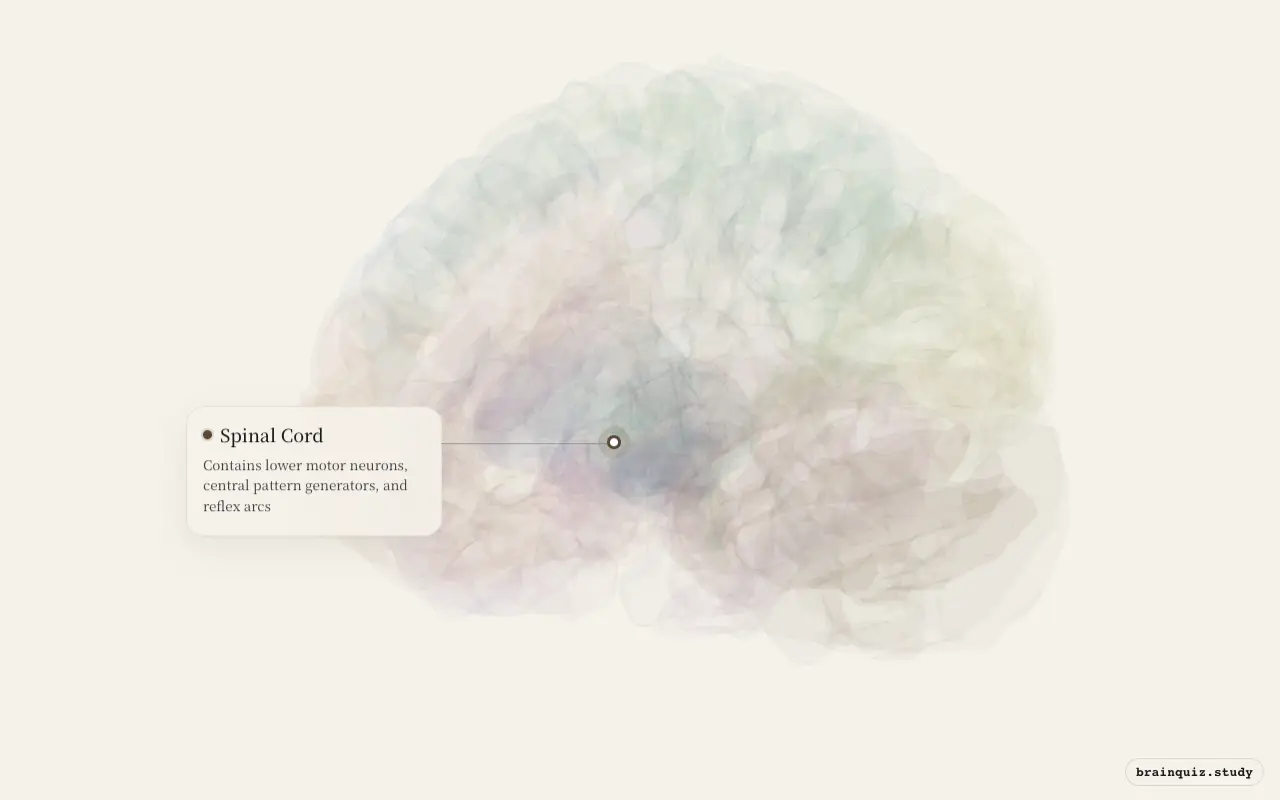
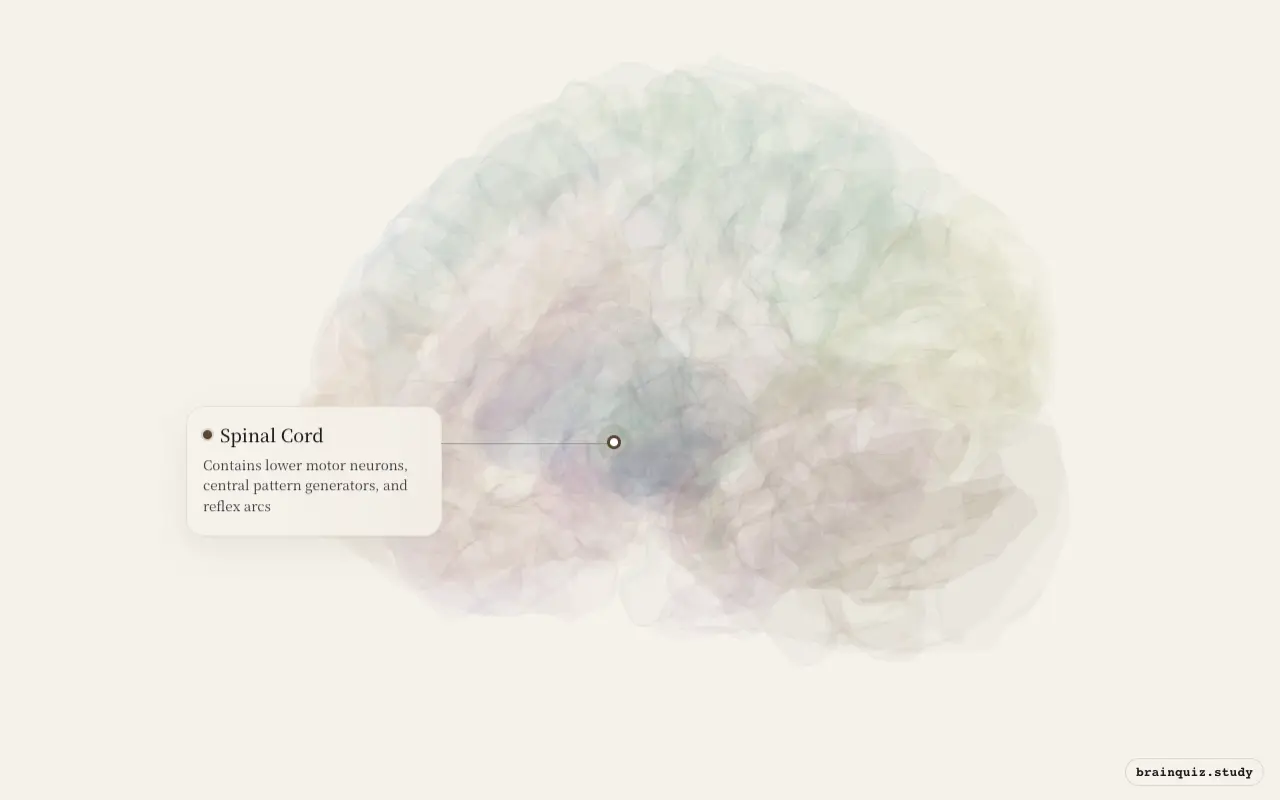
Where is the Spinal Cord located?
Contains lower motor neurons, central pattern generators, and reflex arcs.
What does the Spinal Cord do?
- Lower motor neuron circuits — final common pathway to muscles
- Central pattern generators (CPGs) — produce rhythmic movement without brain input
- Reflex arcs — monosynaptic (stretch reflex) and polysynaptic (withdrawal)
Spinal Cord pathways and connections
- Lateral corticospinal tract → distal muscles (fine motor, crossed)
- Medial corticospinal tract → proximal muscles (posture, uncrossed)
- CPGs for locomotion — generate walking rhythm autonomously
What happens when the Spinal Cord is damaged?
- Transection = paralysis below the level of injury, but CPGs still function
- Cat treadmill experiment: spinalized cats can walk on treadmill (CPGs intact without brain)
- Lower motor neuron signs: flaccid paralysis, areflexia, atrophy, fasciculations
Spinal Cord key facts
Atlas category: brainstem.
- CPGs = cruise control for walking — cortex needed only for obstacle avoidance and initiation
- Headless chicken runs because spinal CPGs generate locomotion without brain input
- Alpha motor neurons = lower motor neurons = final common pathway
Spinal Cord exam tip
CPGs generate rhythmic movement WITHOUT brain input (headless chicken, spinalized cat). Cortex = start/stop and obstacles only.
Common questions
What motor functions can the spinal cord perform?
It contains reflex arcs, lower-motor-neuron output and central pattern generators that can organize rhythmic locomotor activity without moment-to-moment cortical commands.
What is a central pattern generator?
It is a spinal neural circuit that produces a repeating motor rhythm, such as the alternating pattern of locomotion, even without a separate command for every muscle contraction.
How do upper and lower motor neuron signs differ?
Upper-motor-neuron injury causes spasticity, hyperreflexia and Babinski responses; lower-motor-neuron injury causes flaccidity, areflexia, atrophy and fasciculations.
When does the Spinal Cord light up?
- 😖 When you get hiccups: The spinal cord sends motor signals via the phrenic nerve to the diaphragm.
- ❄️ When you shiver in the cold: Motor neurons in the spinal cord fire rapidly, causing muscles to contract and relax quickly.
- 🥵 When you sweat in the heat: Sympathetic preganglionic neurons in the spinal cord send signals that lead to cholinergic activation of sweat glands.
- 🦶 When you stub your toe: A sudden pain signal triggers a spinal reflex, pulling your foot back before the brain is conscious.
- 😳 When you jerk awake as you fall asleep: The command reaches lower motor neurons in the spinal cord, causing your limbs to twitch suddenly.
- 🔥 When you touch something hot: Spinal cord triggers immediate muscle contraction to pull hand away.
- ⚡ When you get a spinal cord injury: The spinal cord is damaged, severing long axon tracts that carry sensory and motor signals.