Medullary Pyramids — Function, Location & Quiz
The medullary pyramids are visible bundles of corticospinal fibres on the ventral medulla, not a separate movement centre. Their key event is the pyramidal decussation, where most fibres cross before descending in the lateral corticospinal tract.
The crossing creates a powerful localization rule, but it must be stated from the lesion’s perspective. Injury rostral to the decussation affects the opposite side of the body; injury to the descending tract after it has crossed affects the same side below that level.
Test this anatomy in the Lesion Localization Quiz: 15 Clinical Questions or explore it on the interactive 3D brain.
Where is the Medullary Pyramids located?
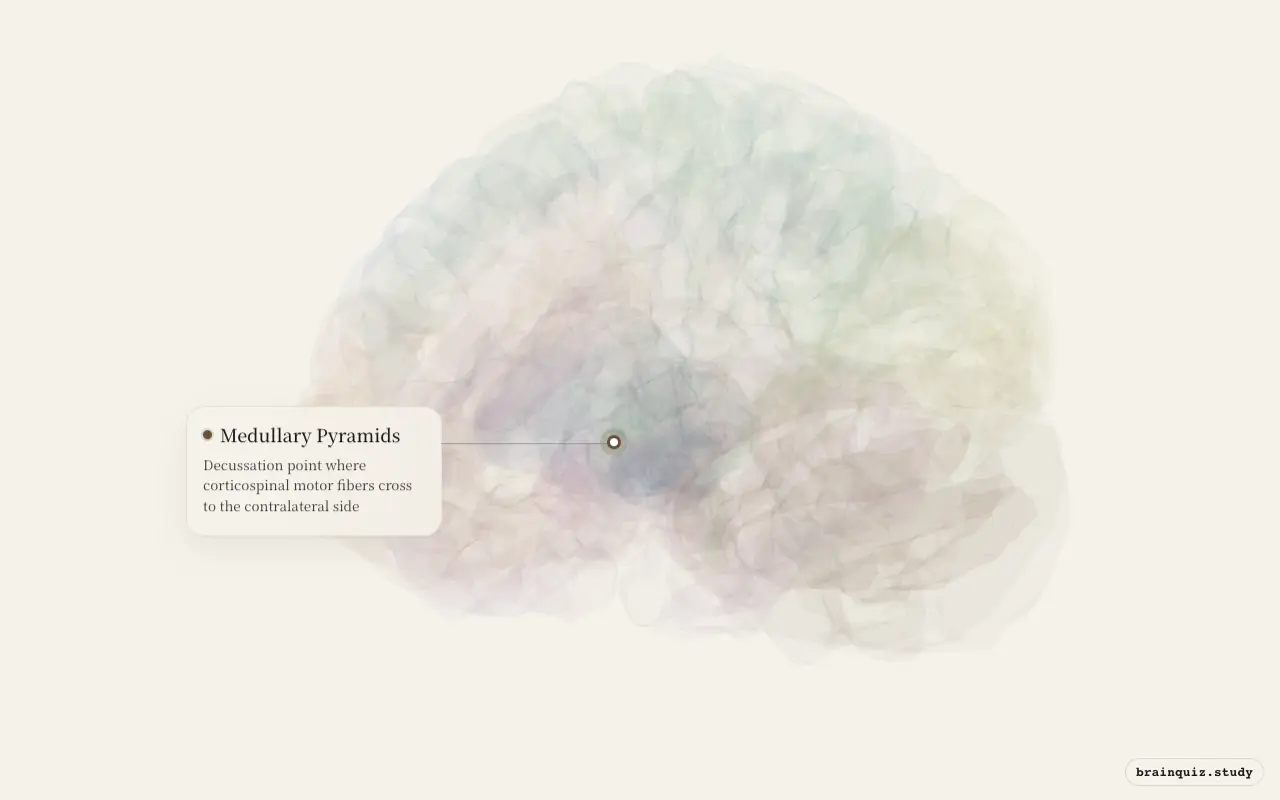
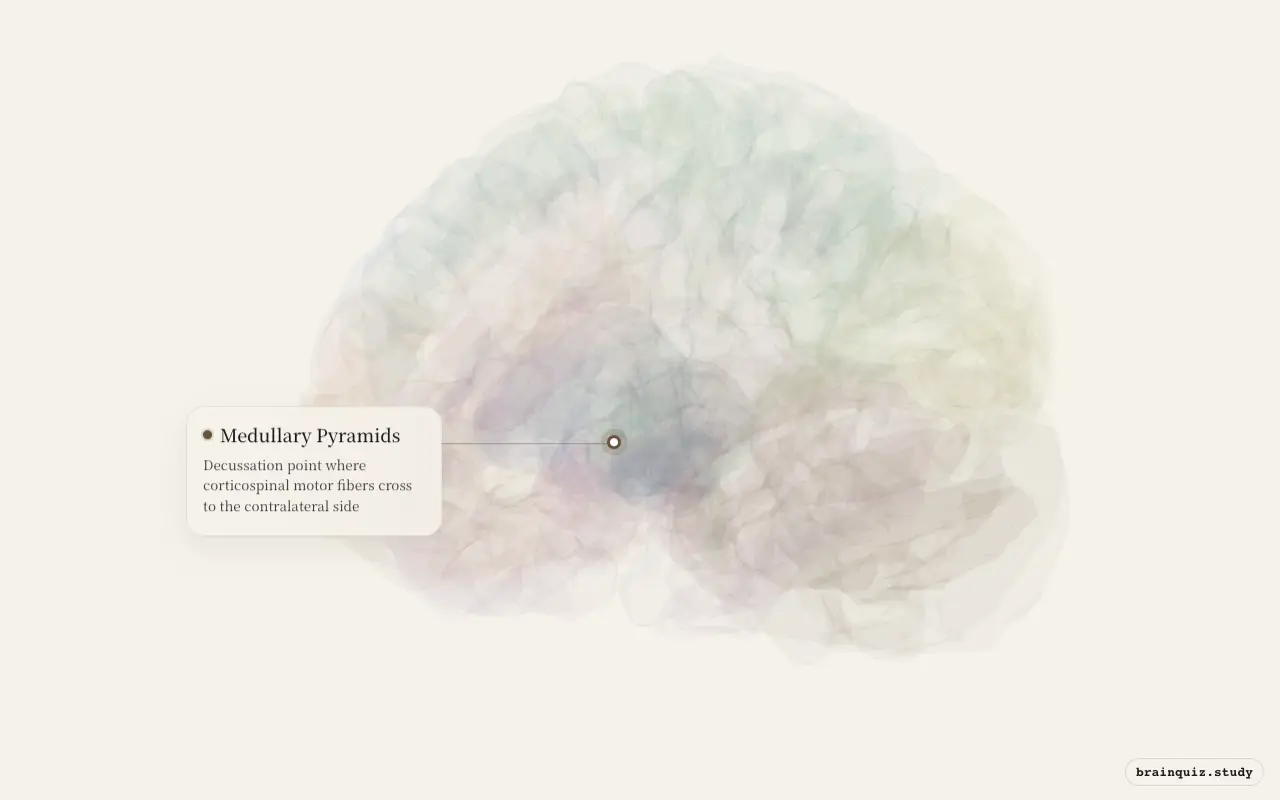
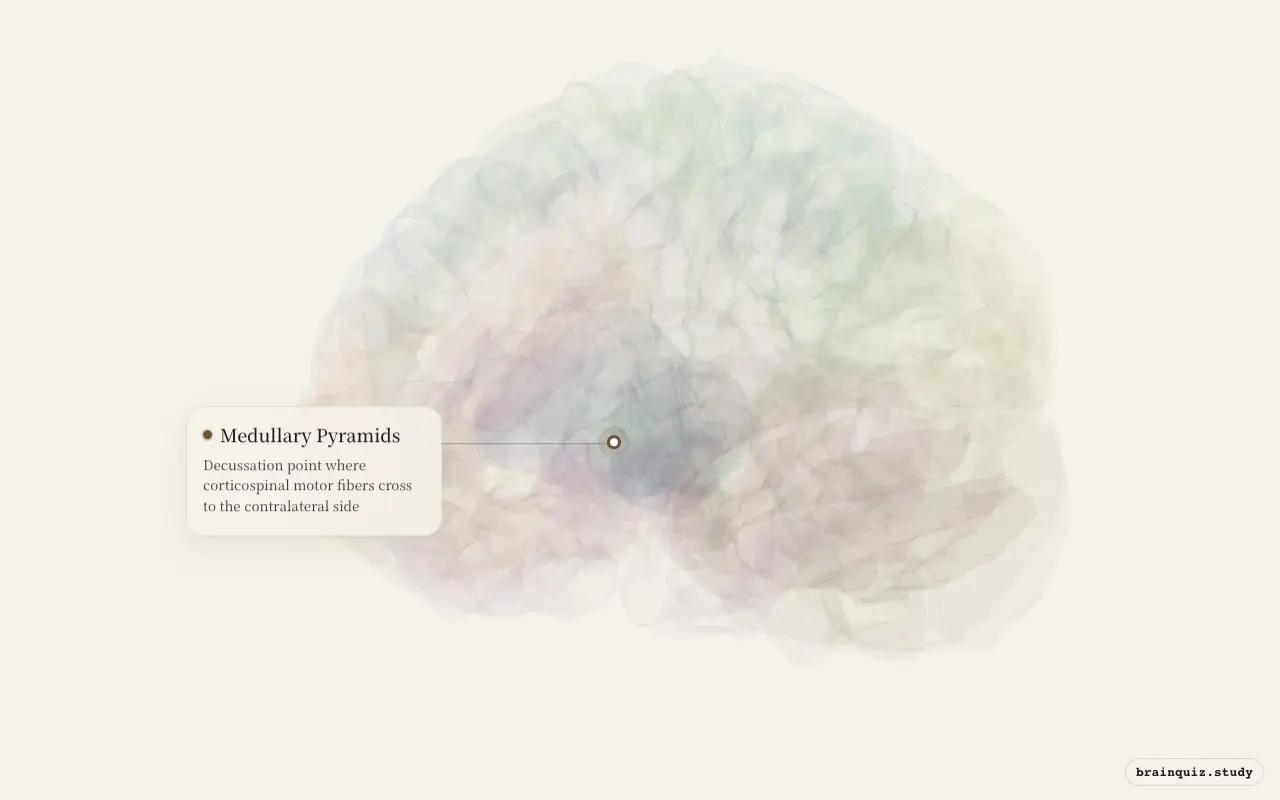
Decussation point where corticospinal motor fibers cross to the contralateral side.
What does the Medullary Pyramids do?
- Pathway for corticospinal tract through the medulla
- Site of pyramidal decussation — where ~90% of fibers cross to the opposite side
- Separates lateral (crossed) and medial (uncrossed) corticospinal tracts
Medullary Pyramids pathways and connections
- Lateral corticospinal tract (crossed at pyramids) → contralateral distal muscles (fine motor)
- Medial corticospinal tract (uncrossed) → ipsilateral proximal muscles (posture, trunk)
What happens when the Medullary Pyramids is damaged?
- Lesion ABOVE decussation = ipsilateral extremity weakness (fibers haven't crossed yet)
- Lesion BELOW decussation = contralateral extremity weakness (fibers already crossed)
- Medullary pyramid lesion → contralateral hemiparesis (fibers cross here)
Medullary Pyramids key facts
Atlas category: brainstem.
- ~90% of corticospinal fibers cross at the pyramidal decussation
- Lateral tract = distal muscles (hands, fingers). Medial tract = proximal muscles (shoulders, trunk)
- This is WHY the brain controls the opposite side of the body
Medullary Pyramids exam tip
Above decussation = ipsilateral effects (fibers haven't crossed yet). Below decussation = contralateral effects.
Common questions
What are the medullary pyramids?
They are paired corticospinal fibre bundles on the ventral medulla carrying voluntary motor commands from cerebral cortex toward the spinal cord.
What happens at the pyramidal decussation?
About 90 percent of corticospinal fibres cross to the opposite side and form the lateral corticospinal tract, which is especially important for distal fine movement.
How does the decussation change weakness localization?
A lesion above the crossing produces contralateral body weakness; a spinal corticospinal lesion below the crossing produces ipsilateral weakness below the lesion.