What happens in your brain when you touch something hot?
Updated
When you touch something hot, the spinal cord triggers a fast withdrawal reflex, the thalamus relays the pain signal to the somatosensory cortex, which localizes it, and the insula and anterior cingulate generate the unpleasant feeling.
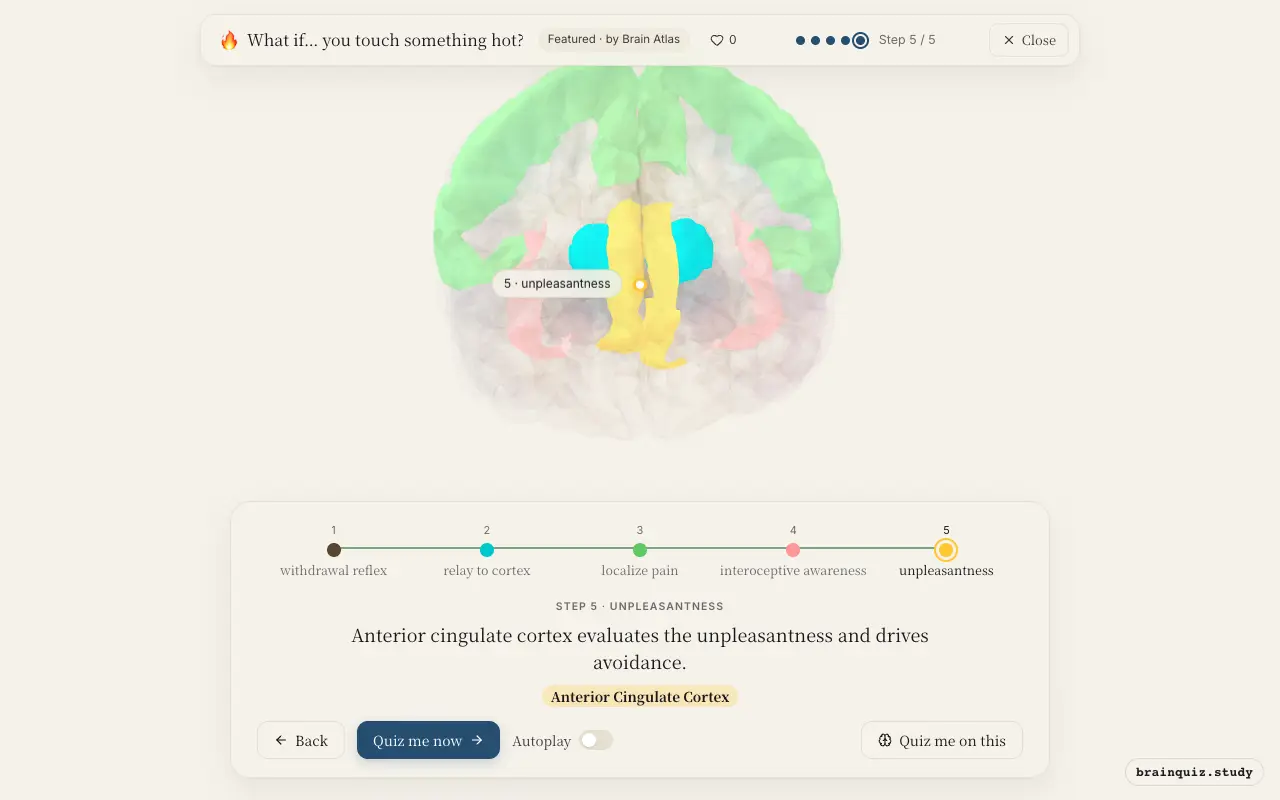
Watch it light up on the 3D brain
Brain regions that light up
| Order | Region | What it does here |
|---|---|---|
| 1 | Spinal Cord | Spinal cord triggers immediate muscle contraction to pull hand away. |
| 2 | Thalamus | Thalamus routes the pain signal to the somatosensory cortex. |
| 3 | Somatosensory Cortex | Somatosensory cortex identifies where and how intense the pain is. |
| 4 | Insula | Insula integrates bodily signals, contributing to the feeling of pain. |
| 5 | Anterior Cingulate Cortex | Anterior cingulate cortex evaluates the unpleasantness and drives avoidance. |
1. Spinal Cord: withdrawal reflex
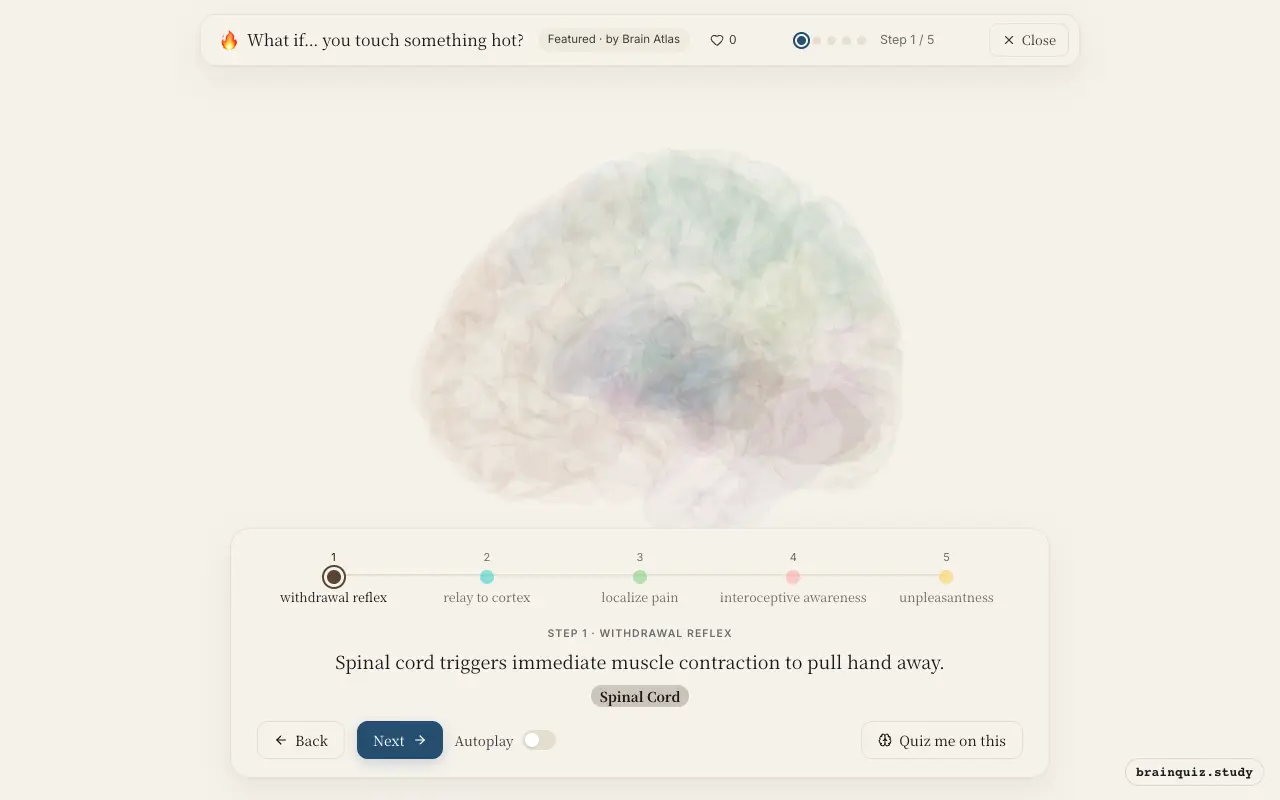
The hot stimulus activates nociceptors; signals travel to the spinal cord, which integrates a fast withdrawal reflex without waiting for the brain. This protects the body from further damage.
2. Thalamus: relay to cortex
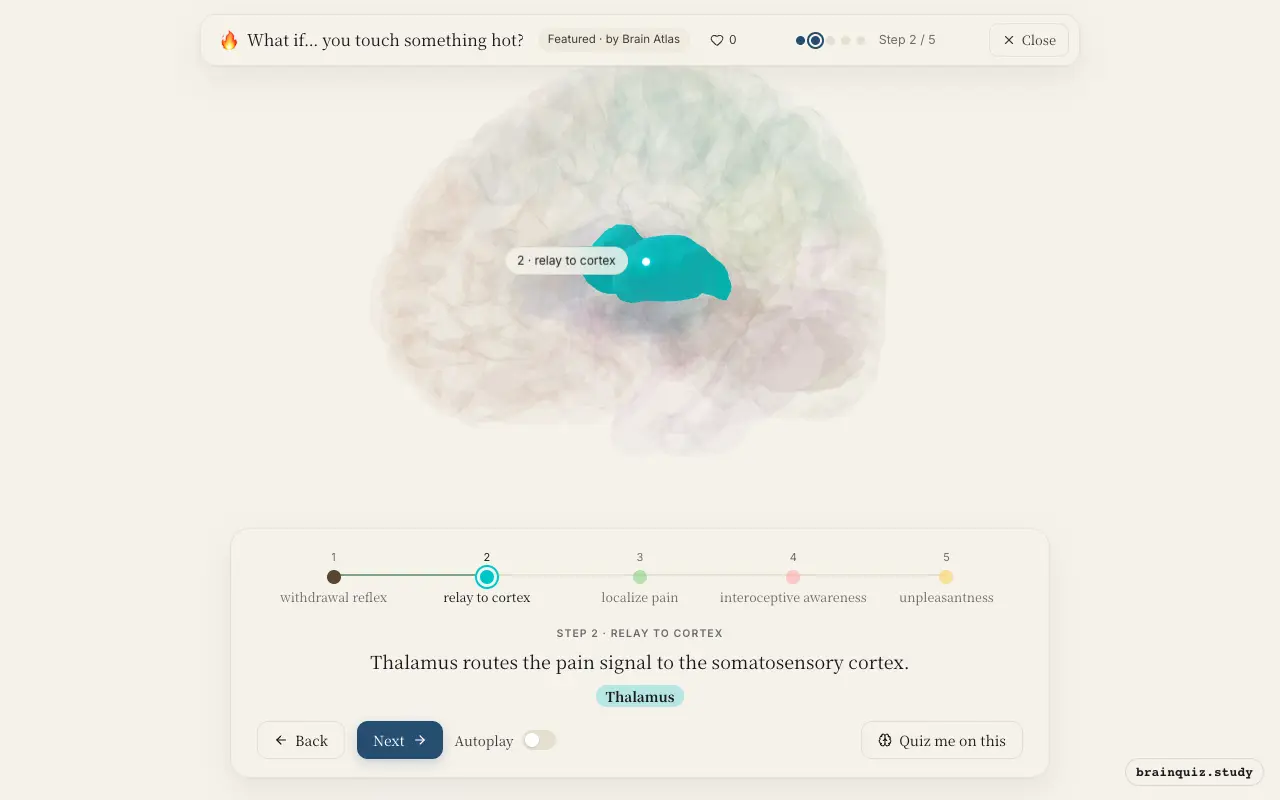
The spinothalamic tract carries pain and temperature information to the thalamus, which acts as a sensory relay station. The thalamus then forwards the signal to appropriate cortical areas for conscious perception.
3. Somatosensory Cortex: localize pain
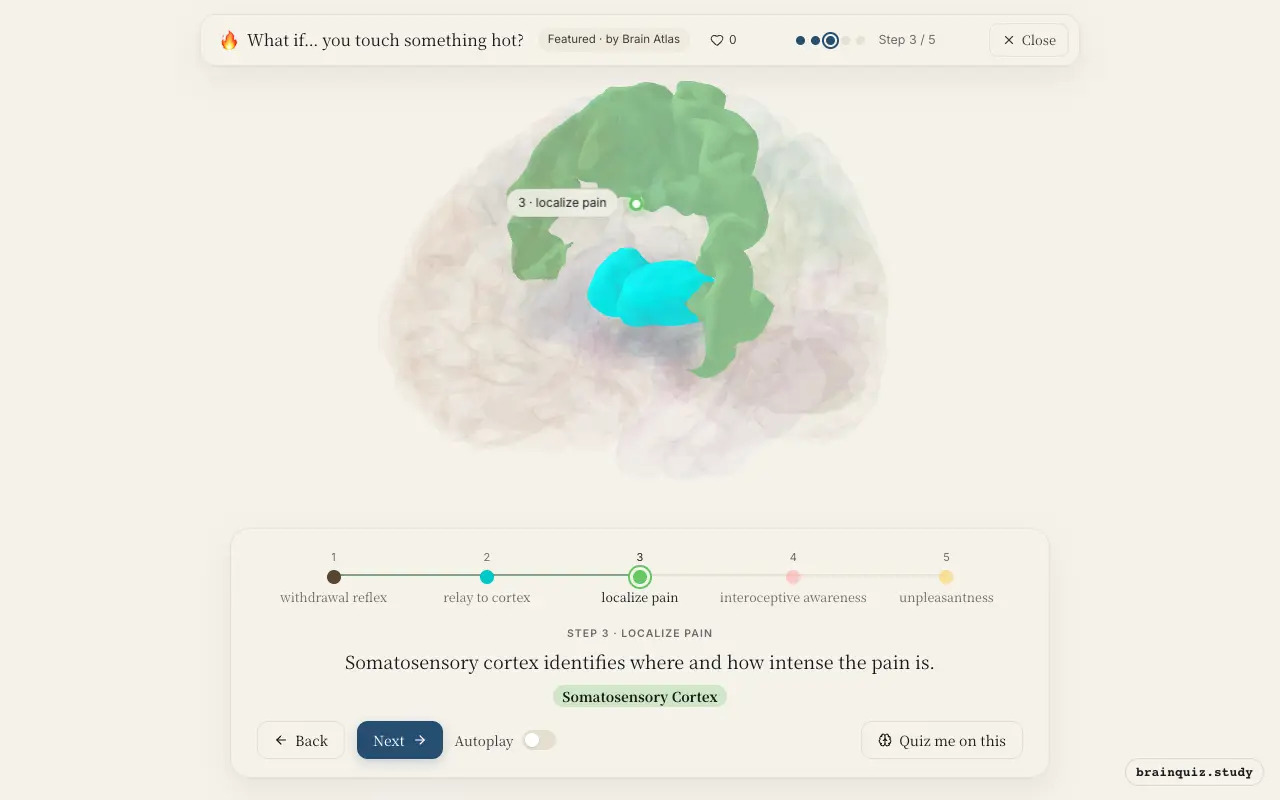
The primary somatosensory cortex receives the topographic map of the body, allowing precise localization of the burned area. It processes the sensory discriminative aspects of pain, such as location and intensity.
4. Insula: interoceptive awareness
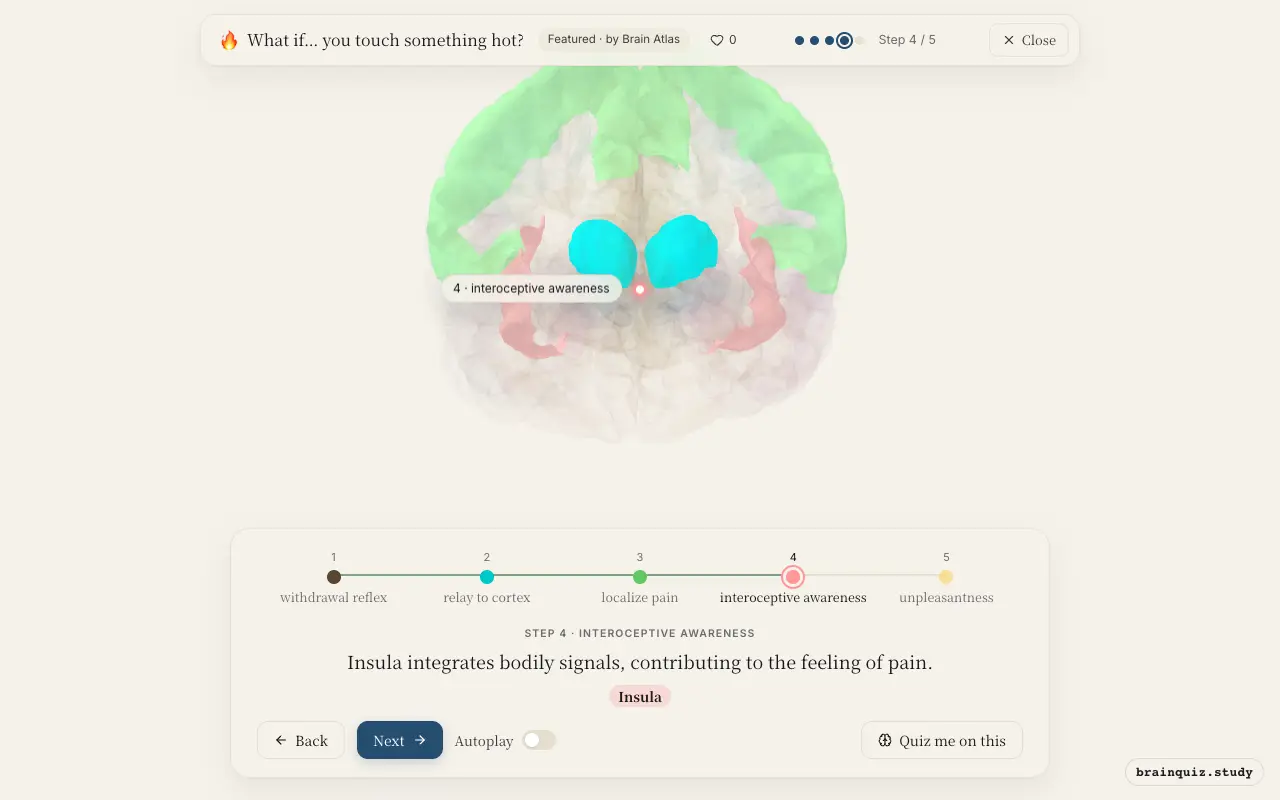
The insula processes interoceptive information, giving rise to the subjective awareness of the painful state. It is thought to be important for the emotional and motivational aspects of pain.
5. Anterior Cingulate Cortex: unpleasantness
The ACC is involved in the affective component of pain, encoding how bad it feels. It also helps direct attention and motor responses to escape the harmful stimulus.
Good to know
- Pain signals travel via two fiber types: fast A-delta fibers for sharp, immediate pain and slow C fibers for dull, burning pain.
- The spinothalamic tract crosses to the opposite side of the spinal cord soon after entry.
- The withdrawal reflex can occur in a fraction of a second, faster than conscious perception.
Physical vs Emotional Pain
Physical pain from a hot object and emotional pain from social rejection both activate the insula and anterior cingulate cortex. However, physical pain also strongly engages the somatosensory cortex for localization, while emotional pain more heavily involves the prefrontal cortex and amygdala.
Test yourself
Which brain region is responsible for the immediate withdrawal reflex?
What is the role of the thalamus in pain processing?
Which region is most associated with the emotional aspect of pain?
0 of 3 answered · 0 correct
Simplified: many regions work together at once, and this shows the main players in the order they act.