What happens in your brain when you hear a loud bang?
Updated
A loud bang triggers rapid auditory processing: the brainstem initiates a startle reflex, the thalamus relays the sound to the auditory cortex for perception, and the amygdala quickly flags it as a potential threat, prompting fear and arousal.
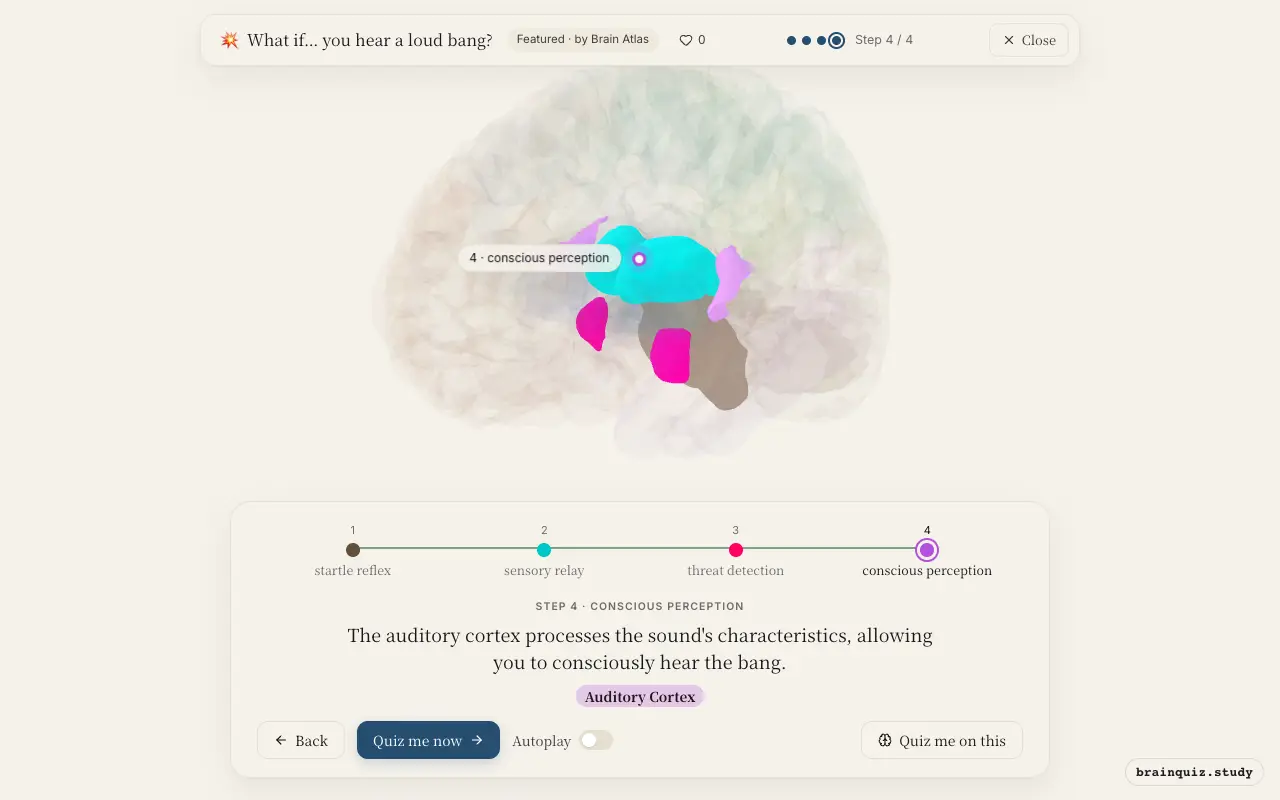
Watch it light up on the 3D brain
Brain regions that light up
| Order | Region | What it does here |
|---|---|---|
| 1 | Brainstem | The auditory nerve sends signals to the brainstem, triggering a rapid startle response. |
| 2 | Thalamus | The thalamus routes the sound information to both the amygdala and auditory cortex. |
| 3 | Amygdala | The amygdala rapidly evaluates the sound and triggers fear and arousal responses. |
| 4 | Auditory Cortex | The auditory cortex processes the sound's characteristics, allowing you to consciously hear the bang. |
1. Brainstem: startle reflex
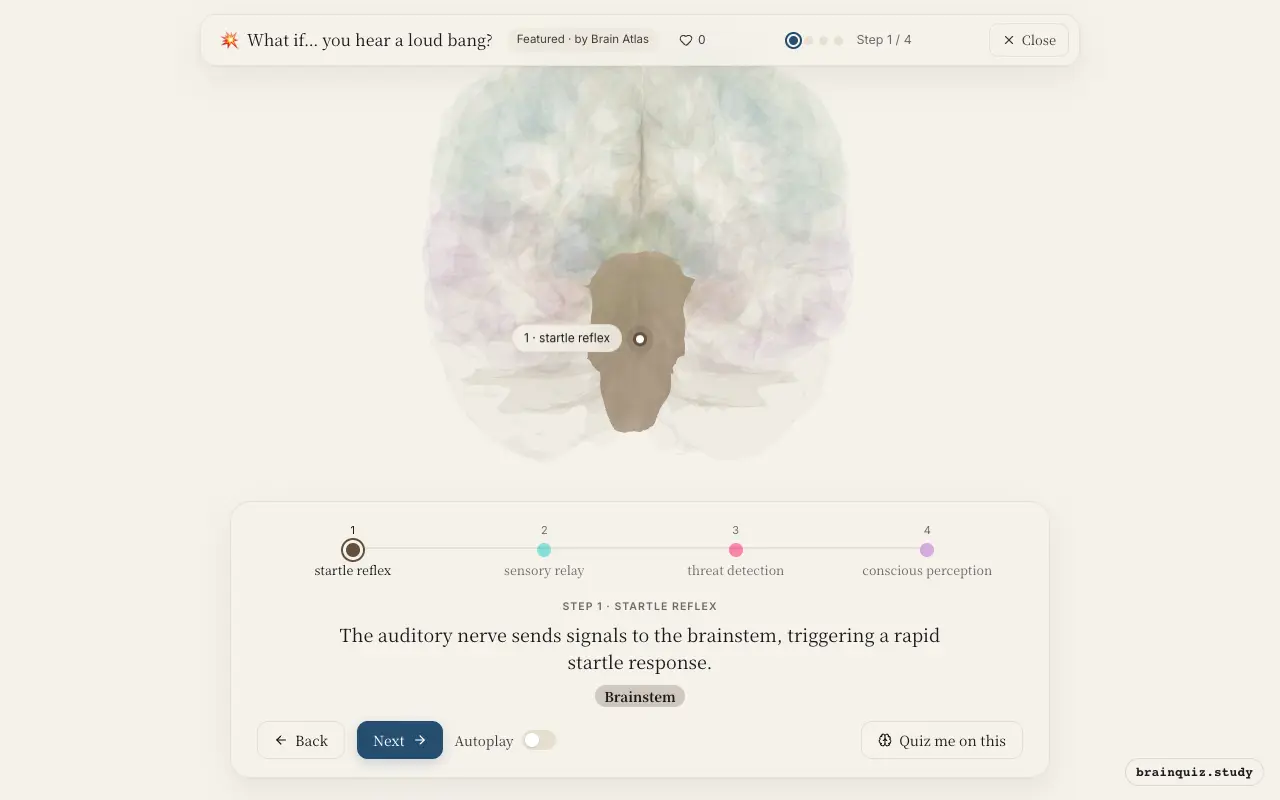
The brainstem's cochlear nuclei receive the auditory signal from the inner ear and send it to higher centers. Simultaneously, the reticular formation triggers a startle reflex—muscle tensing, eye blink, and a jump—that happens before you consciously perceive the sound. This reflexive response is highly conserved across mammals.
2. Thalamus: sensory relay
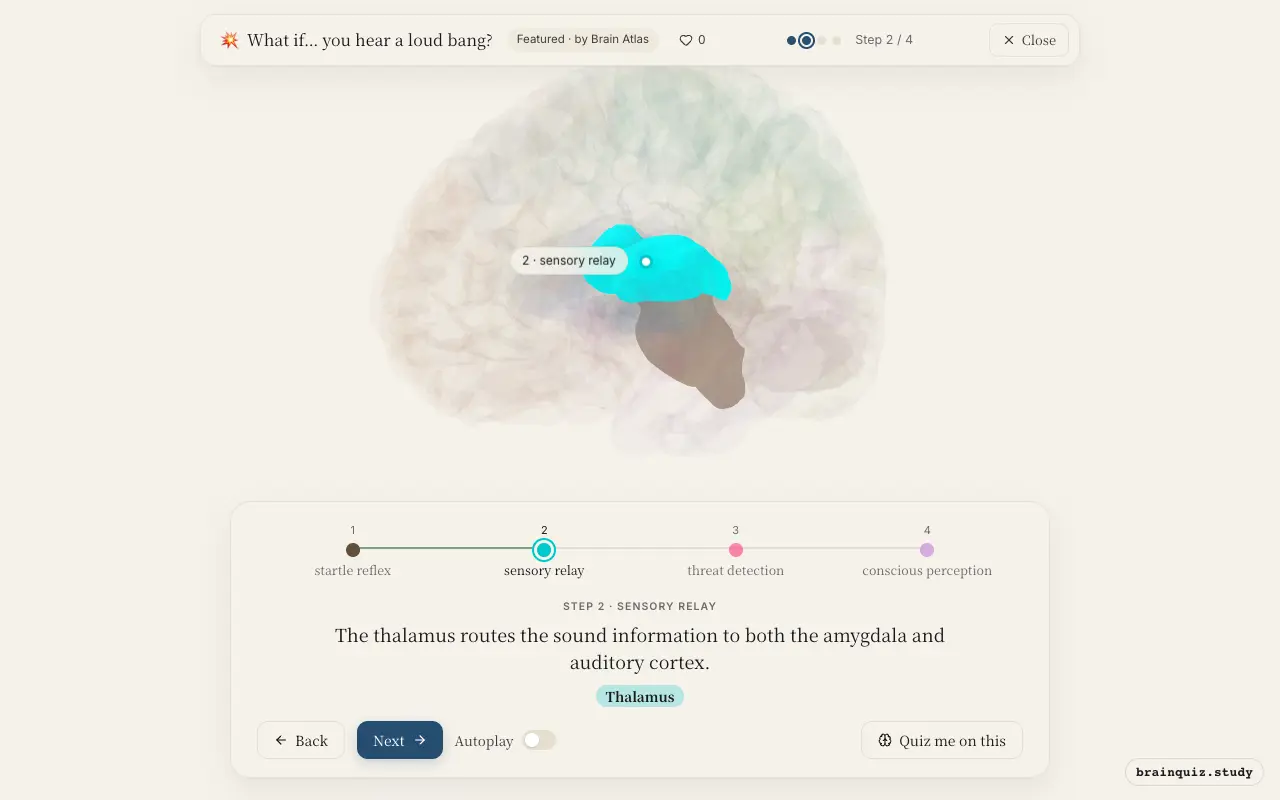
The medial geniculate nucleus of the thalamus relays the auditory signal to the amygdala for rapid threat detection and to the auditory cortex for detailed processing. This dual pathway allows quick reactions to potential danger before conscious recognition occurs. This parallel processing is critical for survival.
3. Amygdala: threat detection
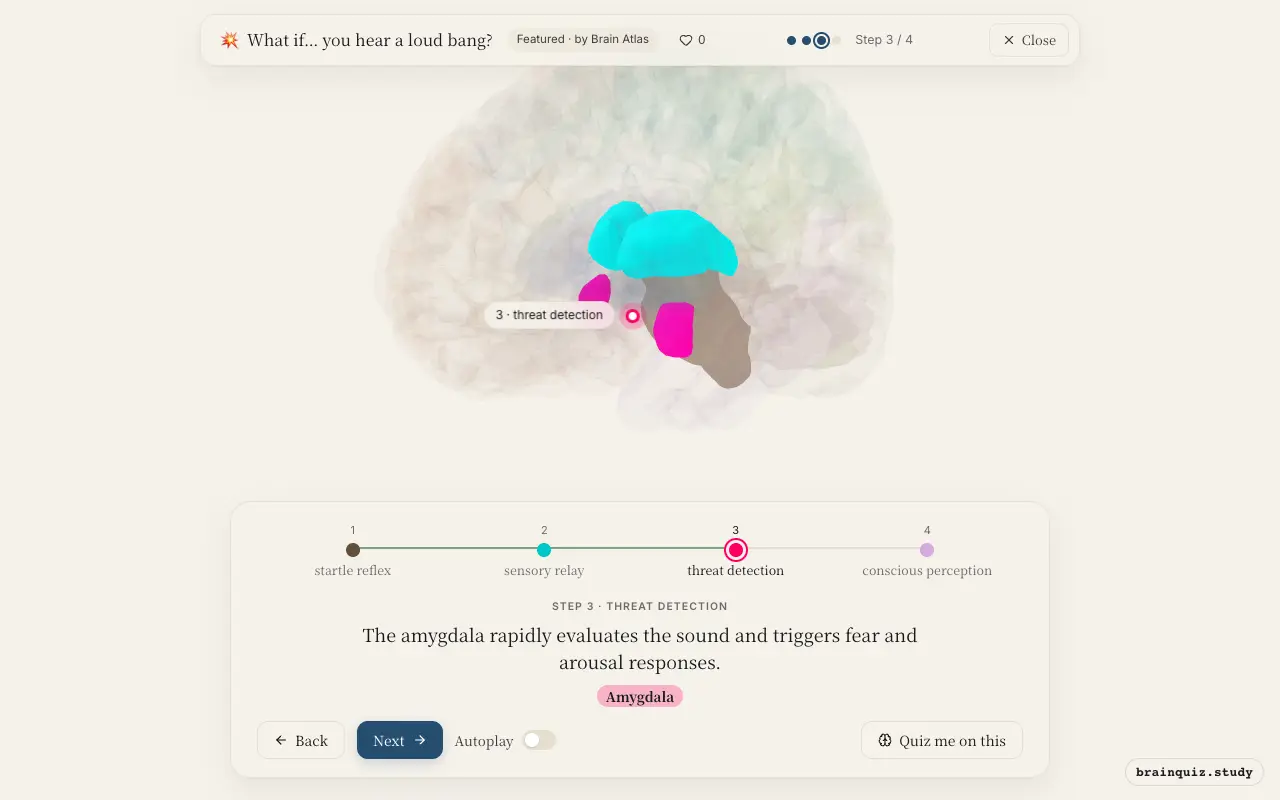
The amygdala compares the sound to stored emotional memories; if it's unexpected or loud, it activates the sympathetic nervous system—heart rate increases, adrenaline surges. This happens within tens of milliseconds, preparing the body for fight or flight. The response is quick and automatic.
4. Auditory Cortex: conscious perception
The primary and secondary auditory cortices analyze pitch, loudness, and location, integrating the sound into your ongoing experience. You become aware of the bang and can identify it as a gunshot, car backfire, or other source. This detailed analysis happens slightly later than the emotional response, giving you a conscious understanding of the event.
Good to know
- The startle reflex has a latency of about 30-50 milliseconds, making it one of the fastest motor responses in humans.
- The amygdala may respond to threatening sounds even when they are not consciously perceived, as suggested by some masked-stimulus experiments.
- Loud sounds activate the sympathetic nervous system via the brainstem, increasing heart rate and blood pressure within seconds.
Unexpected Bang vs. Expected Loud Sound
An unexpected loud bang triggers a stronger amygdala response and startle reflex because the brain has no prediction. In contrast, an expected loud sound, like at a concert, involves prefrontal cortex modulation that dampens the amygdala and brainstem response, reducing the startle.
Test yourself
Which brain region initiates the startle reflex to a loud bang?
The amygdala receives auditory information directly from which structure for rapid threat detection?
What is the primary role of the auditory cortex in this scenario?
0 of 3 answered · 0 correct
Simplified: many regions work together at once, and this shows the main players in the order they act.