What happens in your brain when you get a song stuck in your head?
Updated
The temporal cortex retrieves the song, the auditory cortex replays it as if heard, and the prefrontal cortex tries to stop the loop.
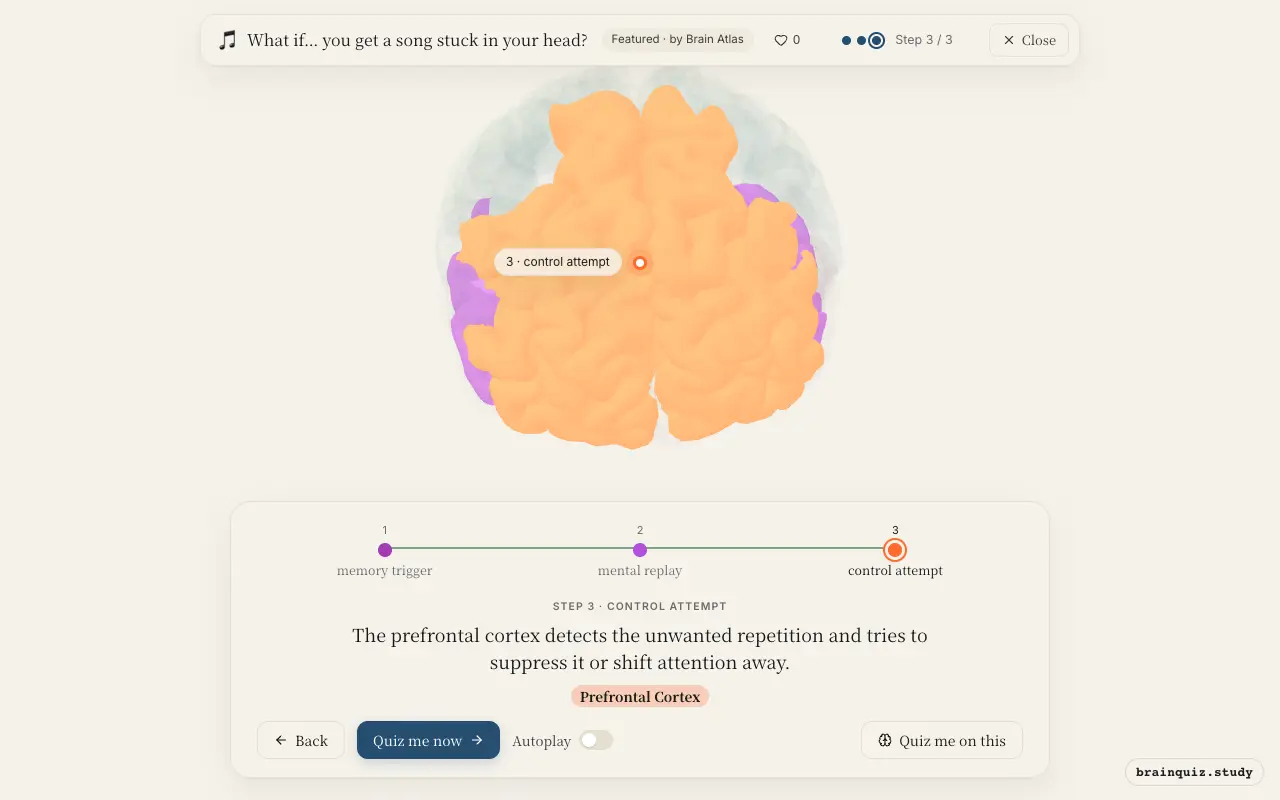
Watch it light up on the 3D brain
Brain regions that light up
| Order | Region | What it does here |
|---|---|---|
| 1 | Temporal Cortex | The temporal cortex retrieves the familiar song from semantic memory, often triggered by an external cue or thought. |
| 2 | Auditory Cortex | The auditory cortex becomes active as if hearing the song, generating the experience of the tune in your head. |
| 3 | Prefrontal Cortex | The prefrontal cortex detects the unwanted repetition and tries to suppress it or shift attention away. |
1. Temporal Cortex: memory trigger
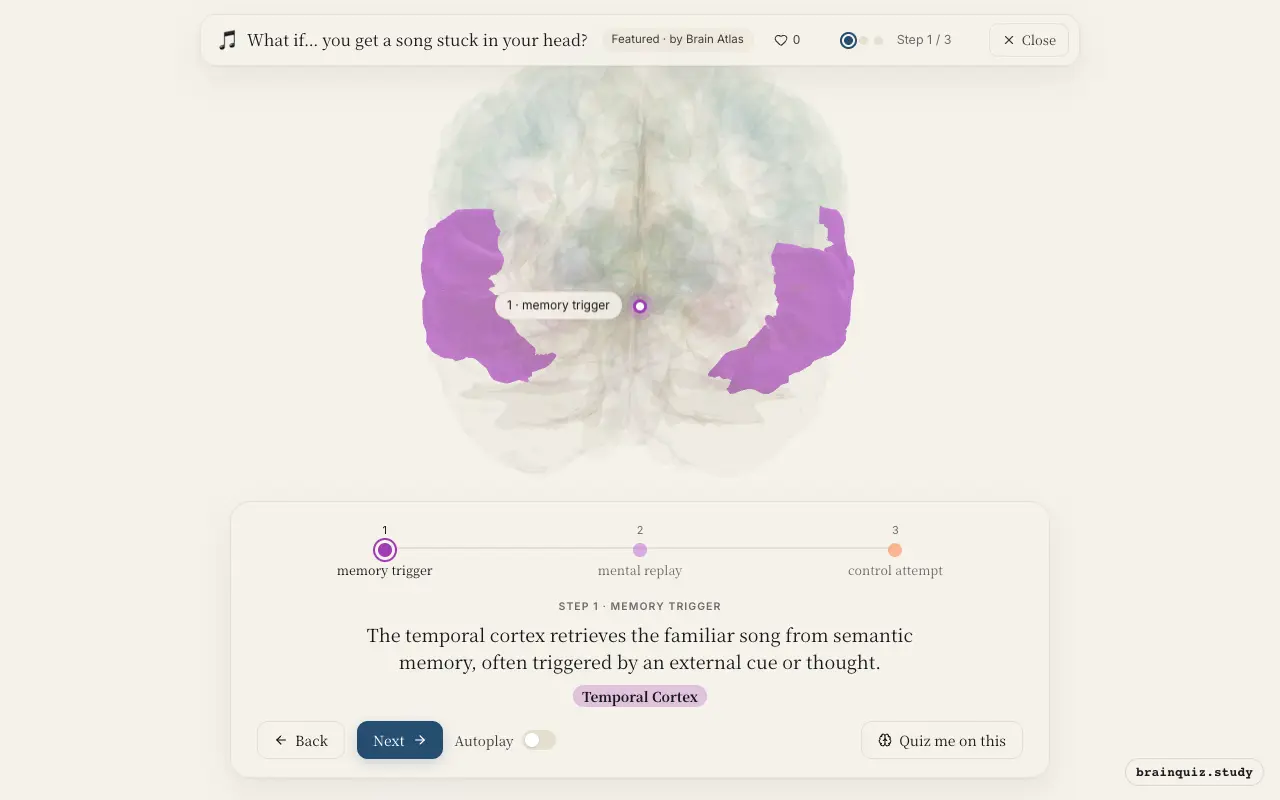
The temporal cortex stores semantic knowledge including melodies and lyrics. When a cue, such as a word or situation, activates this network, the song is retrieved automatically. This region provides the content that will be replayed.
2. Auditory Cortex: mental replay
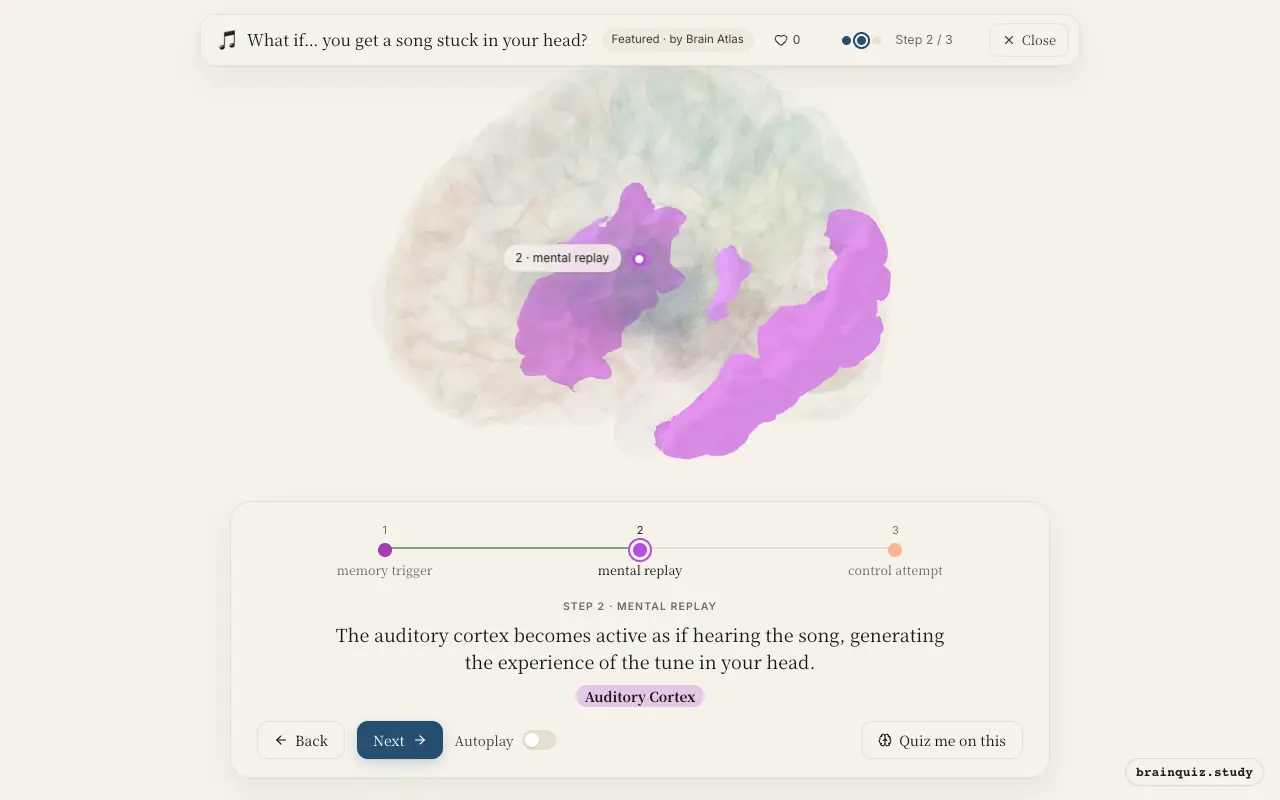
Even without external sound, the auditory cortex processes imagined music. This top-down activation produces the vivid perception of the melody, similar to actual listening but weaker. The loop occurs because this activation persists and repeats.
3. Prefrontal Cortex: control attempt
As the executive center, the prefrontal cortex monitors ongoing mental activity and attempts to stop the earworm. However, its efforts can sometimes backfire because monitoring for the song keeps it active, a phenomenon known as ironic process.
Good to know
- Earworms are most often triggered by recent exposure to a song, especially if it has a simple, repetitive melody.
- The auditory cortex shows similar activation patterns during imagined music and actual listening, though typically weaker.
- Attempts to suppress an earworm can increase its persistence due to ironic monitoring by the prefrontal cortex.
Earworm vs. Voluntary Musical Imagery
When you intentionally imagine a song, the prefrontal cortex initiates and guides the imagery, giving you control. In an earworm, the process is involuntary, and the prefrontal cortex is recruited after the fact to try to stop it, often with limited success.
Test yourself
Which region is primarily responsible for the perception of the stuck song even without external sound?
Why does trying to suppress an earworm sometimes make it worse?
Which region stores the melody and lyrics of a familiar song?
0 of 3 answered · 0 correct
Simplified: many regions work together at once, and this shows the main players in the order they act.