Temporal Cortex — Function, Location & Quiz
Inferior and middle temporal cortex sit near the end of the ventral visual stream, where edges and colours have been assembled into recognizable objects. That role is distinct from primary auditory cortex above and medial temporal memory structures deeper inside the lobe.
The clinical errors are therefore errors of identity and meaning, not simply blindness. Bilateral inferior temporal damage can leave vision present while objects become unrecognizable, whereas anterior temporal degeneration progressively erodes conceptual knowledge.
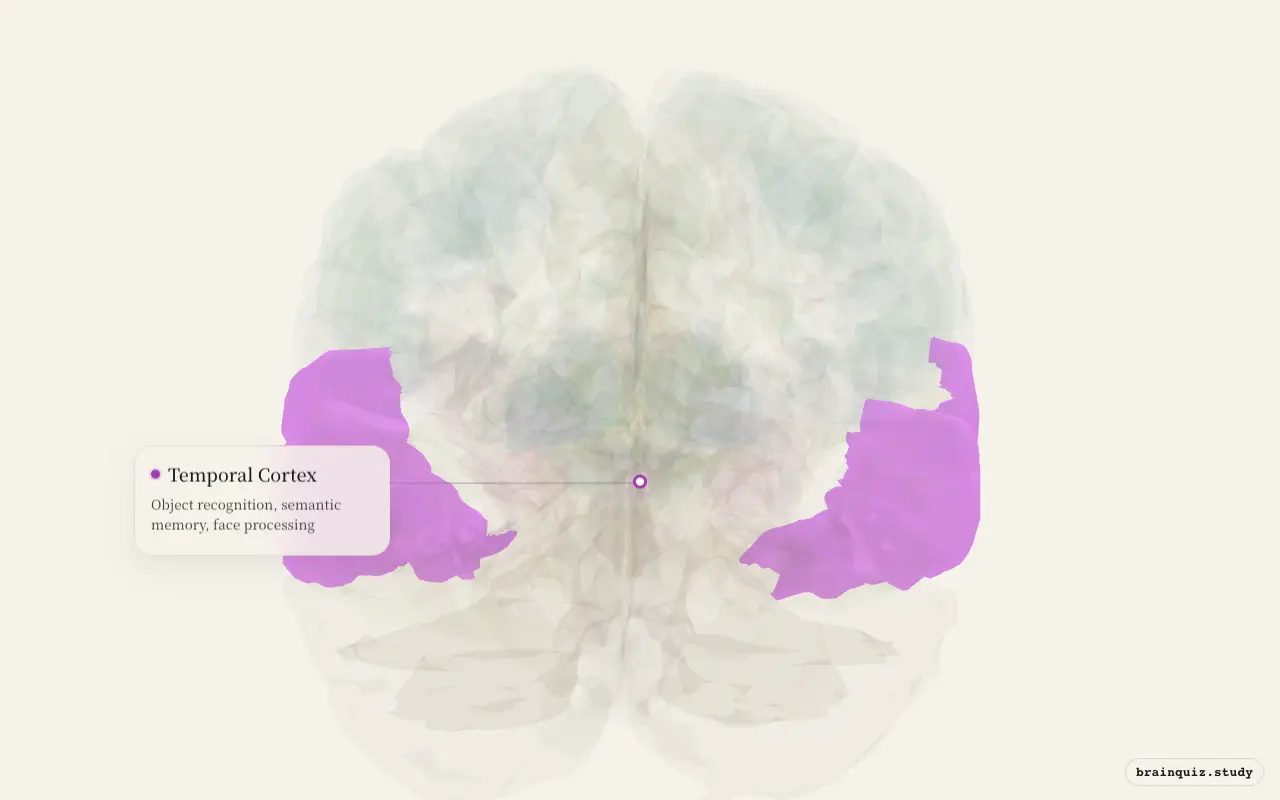
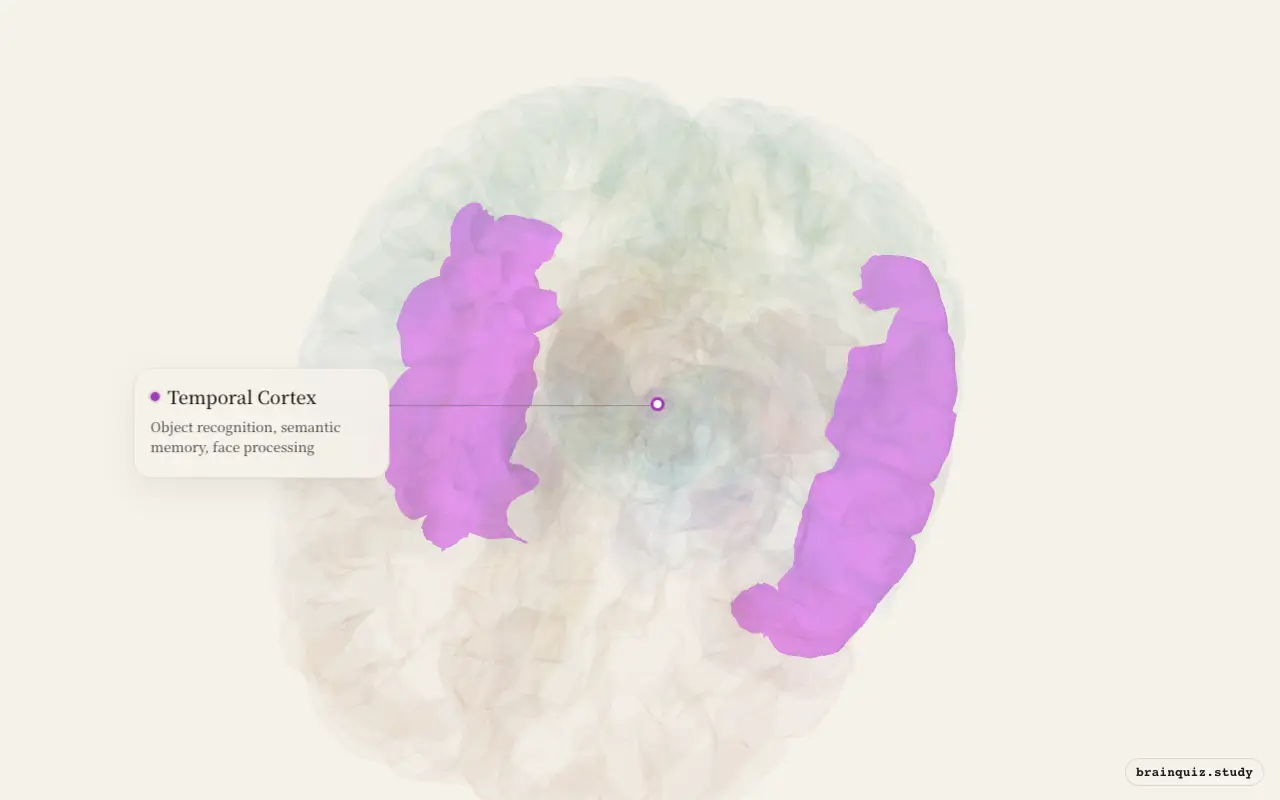
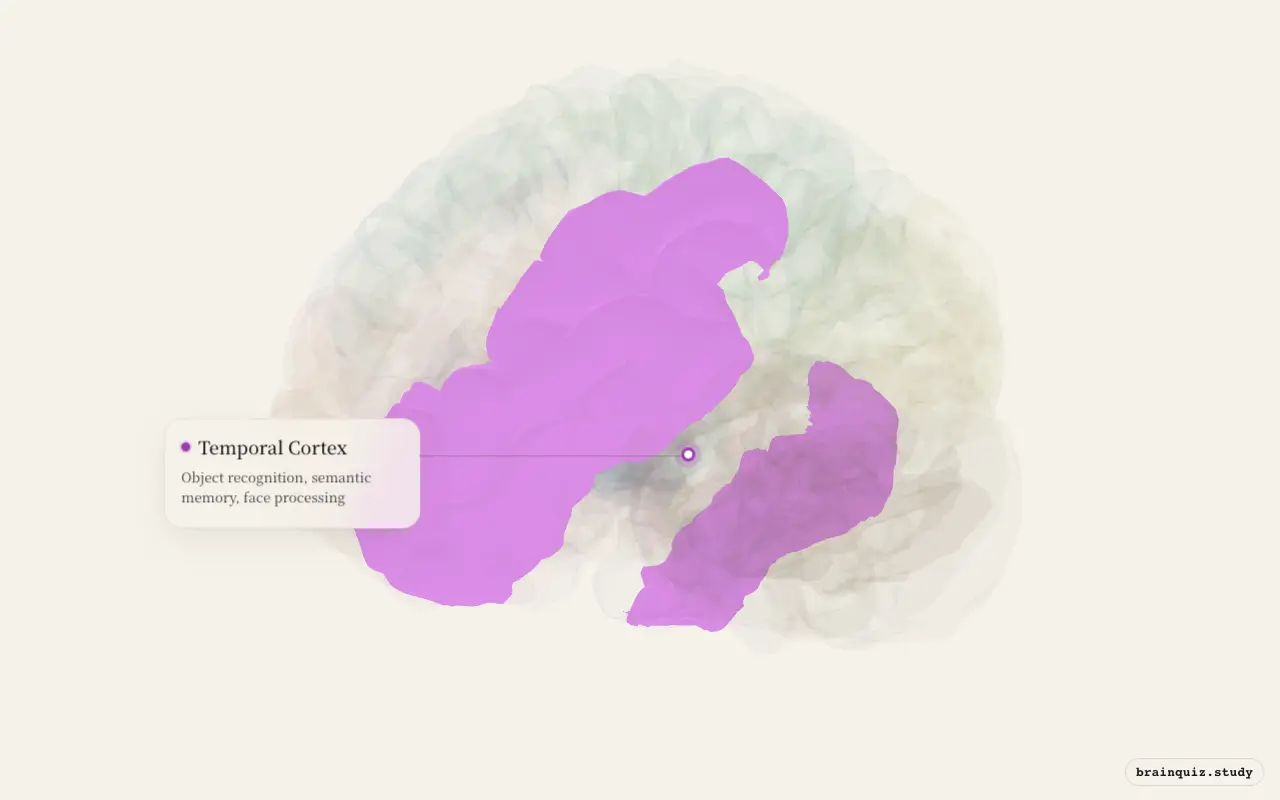
Test this anatomy in the Brain Regions Quiz: 15 Questions With Answers or explore it on the interactive 3D brain.
Where is the Temporal Cortex located?
Object recognition, semantic memory, face processing.
What does the Temporal Cortex do?
- Object recognition and visual categorization
- Semantic memory — knowledge about the world
- Face processing pipeline (fusiform face area)
- Reading — visual word form area (VWFA)
Temporal Cortex pathways and connections
- Ventral stream terminus ('what' pathway from V1 → V2 → V4 → IT)
- IT ↔ Hippocampus (encoding visual memories)
- IT ↔ PFC (object-guided behavior)
What happens when the Temporal Cortex is damaged?
- Bilateral IT lesion → visual agnosia (can see but can't recognize objects)
- Left anterior temporal → semantic dementia (loss of word/concept knowledge)
- Temporal lobe epilepsy — déjà vu, olfactory hallucinations, automatisms
Temporal Cortex key facts
Atlas category: cortical. Brodmann areas or landmark: BA 20, 21, 37 (inferior and middle temporal gyri).
- IT neurons respond to increasingly complex features along the hierarchy
- Tanaka: some IT neurons are selective for specific object views
- Temporal pole = 'semantic hub' — integrates meaning across modalities
Temporal Cortex exam tip
Ventral stream = V1→V2→V4→IT. Each step = more complex features. IT = the end of the 'what' pathway.
Common questions
What does the temporal cortex do?
Inferior and middle temporal regions support object recognition, visual categorization, semantic knowledge, face-processing pathways and visual word recognition.
Which visual pathway reaches temporal cortex?
The ventral “what” stream travels from primary visual cortex through areas including V2 and V4 toward inferior temporal cortex for object identity.
What happens after bilateral inferior temporal damage?
It can cause visual agnosia: the person can see features but cannot identify the object. Anterior temporal degeneration can instead cause semantic dementia.
When does the Temporal Cortex light up?
- 😴 When you sleep after learning something new: Temporal cortex stores the replayed memory traces.
- 🎵 When you get a song stuck in your head: The temporal cortex retrieves the familiar song from semantic memory, often triggered by an external cue or thought.
- 📞 When you recognise a voice on the phone: Your temporal cortex compares the sound to stored voice templates, identifying it as familiar.
- 👄 When you read lips in a noisy room: Temporal cortex identifies the mouth and facial gestures as meaningful speech cues.
- 🌒 When you see in the dark: The temporal cortex matches the processed visual input to stored object representations.
- 😬 When you feel peer pressure: Your temporal cortex processes faces and voices to register the group's opinion.
- 🧠 When you get Alzheimer's disease: Spread to the temporal cortex disrupts semantic memory and language.