Left Anterior Temporal Lobe — Function, Location & Quiz
The left anterior temporal lobe helps bind knowledge from different senses into coherent concepts. A dog is not stored only as a picture, sound or word; this hub account explains how distributed features can converge on the same meaning.
Semantic dementia makes the distinction from hippocampal amnesia vivid. Anterior temporal atrophy progressively removes facts and word meanings while personal episodes may initially survive, whereas early hippocampal disease more strongly disrupts new episodic memories.
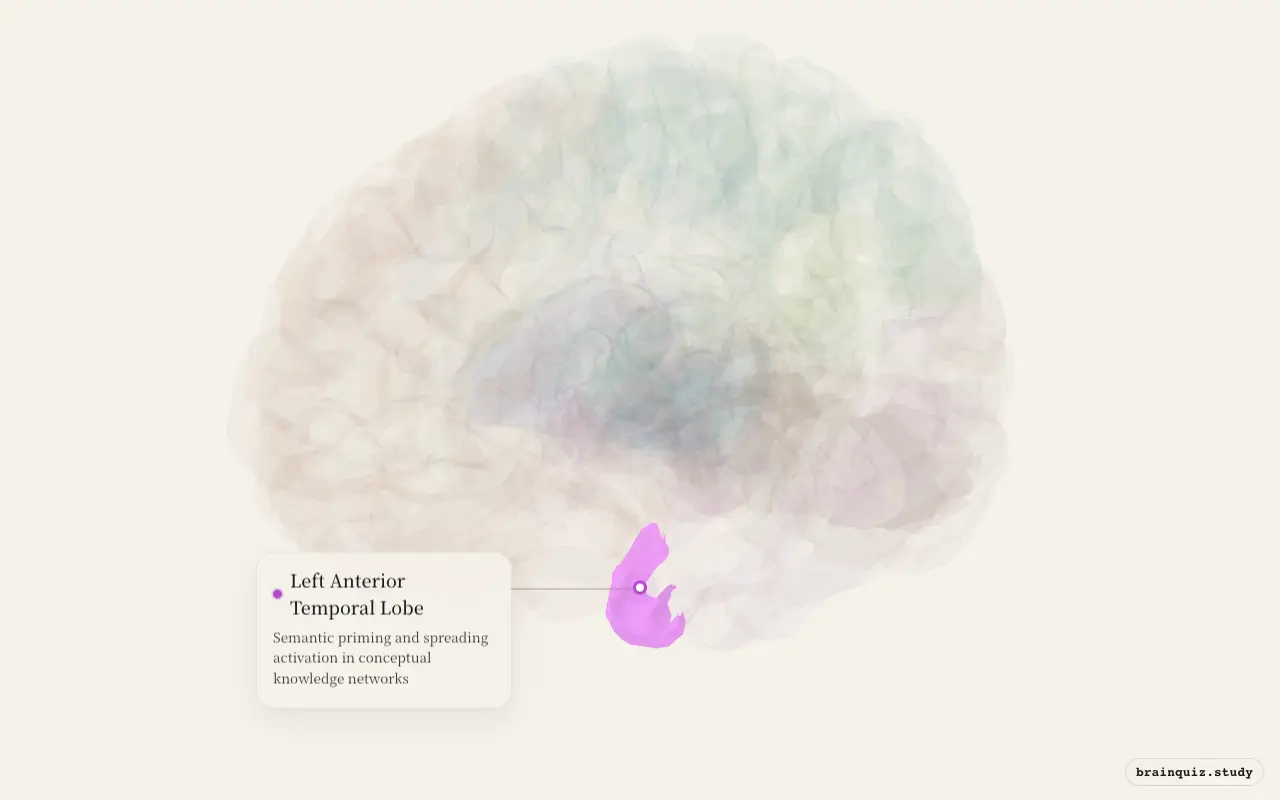
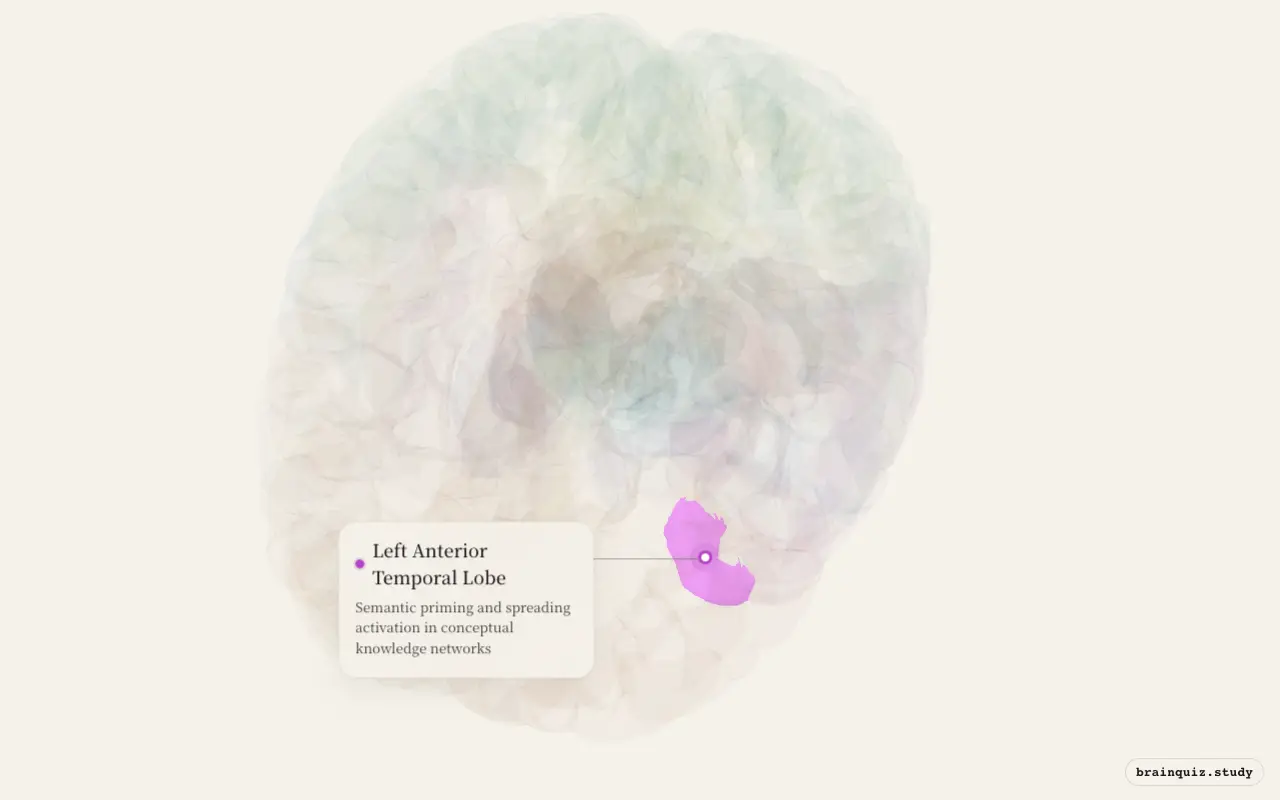
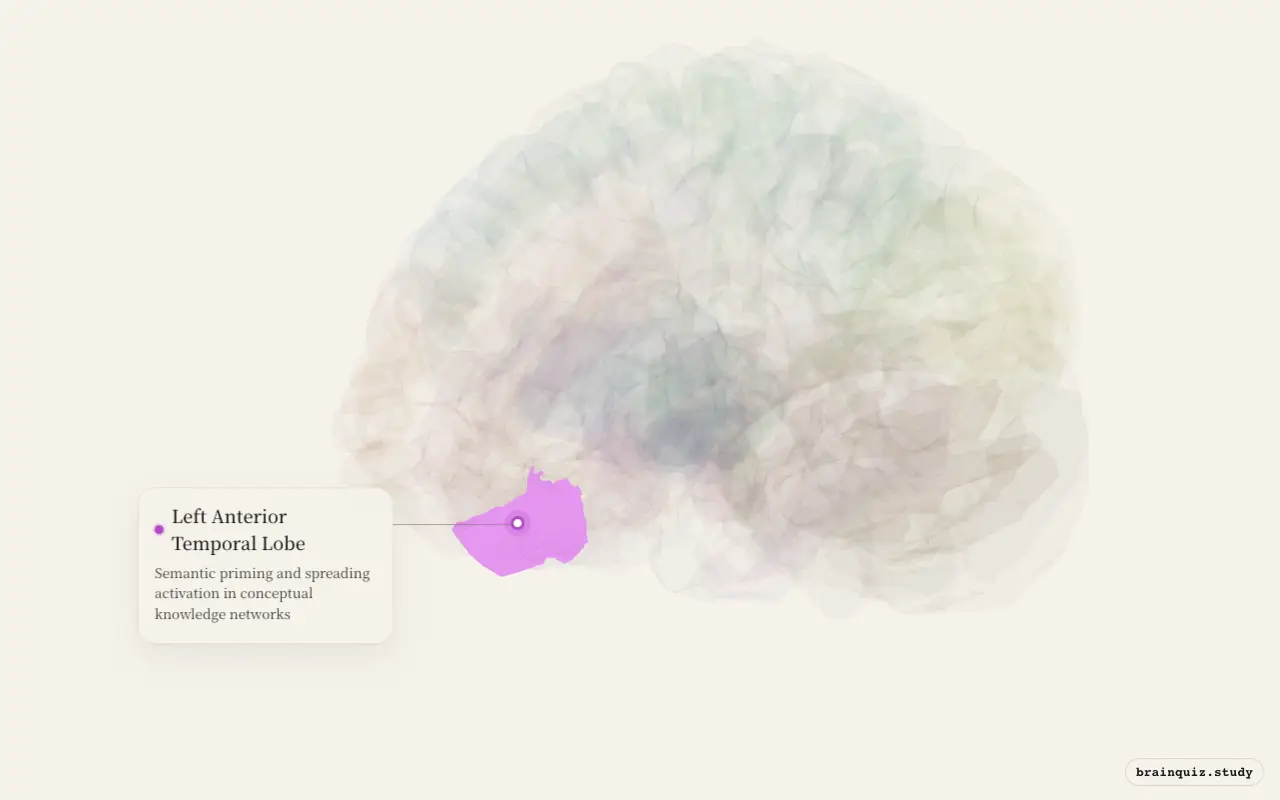
Test this anatomy in the Brain Regions Quiz: 15 Questions With Answers or explore it on the interactive 3D brain.
Where is the Left Anterior Temporal Lobe located?
Semantic priming and spreading activation in conceptual knowledge networks.
What does the Left Anterior Temporal Lobe do?
- Amodal semantic hub — integrates meaning across all modalities (visual, auditory, tactile, etc.)
- Semantic priming and spreading activation
- Distributed-plus-hub model: ATL is the convergence zone for conceptual knowledge
Left Anterior Temporal Lobe pathways and connections
- Left ATL ↔ All sensory cortices (hub that integrates meaning from every modality)
- Left ATL ↔ Hippocampus (semantic support for episodic memory)
What happens when the Left Anterior Temporal Lobe is damaged?
- Atrophy causes semantic dementia — progressive loss of conceptual knowledge
- Semantic dementia: patients lose facts but keep episodic memories initially
- Can't name objects, don't know what they're for, but remember personal experiences
Left Anterior Temporal Lobe key facts
Atlas category: cortical. Brodmann areas or landmark: BA 38 (temporal pole), BA 20, 21 (anterior ITG/MTG).
- Distributed-plus-hub model (Patterson, Lambon Ralph): meaning is stored in sensory cortices but ATL binds it all together
- Semantic dementia = anterior temporal atrophy — lose facts but keep episodes
- Distinguishes from Alzheimer's (hippocampal — lose episodes but keep facts initially)
Left Anterior Temporal Lobe exam tip
Semantic dementia = anterior temporal atrophy, lose facts but keep episodes. Alzheimer's = hippocampal, lose episodes but keep facts. Know the contrast!
Common questions
What does the left anterior temporal lobe do?
It acts as an amodal semantic hub, integrating visual, auditory, verbal and other features into conceptual knowledge and supporting semantic priming.
What is semantic dementia?
It is a progressive loss of conceptual and word knowledge associated with anterior temporal atrophy. Patients may recognize that an object is visible yet no longer know its name or use.
How does semantic dementia differ from hippocampal amnesia?
Semantic dementia initially erodes facts and concepts while episodic experiences can be relatively preserved; hippocampal damage chiefly impairs formation and recollection of episodes.
When does the Left Anterior Temporal Lobe light up?
- 🤔 When you have a word on the tip of your tongue: You try to retrieve the concept, activating related words and meanings.