What happens in your brain when you sleep after learning something new?
Updated
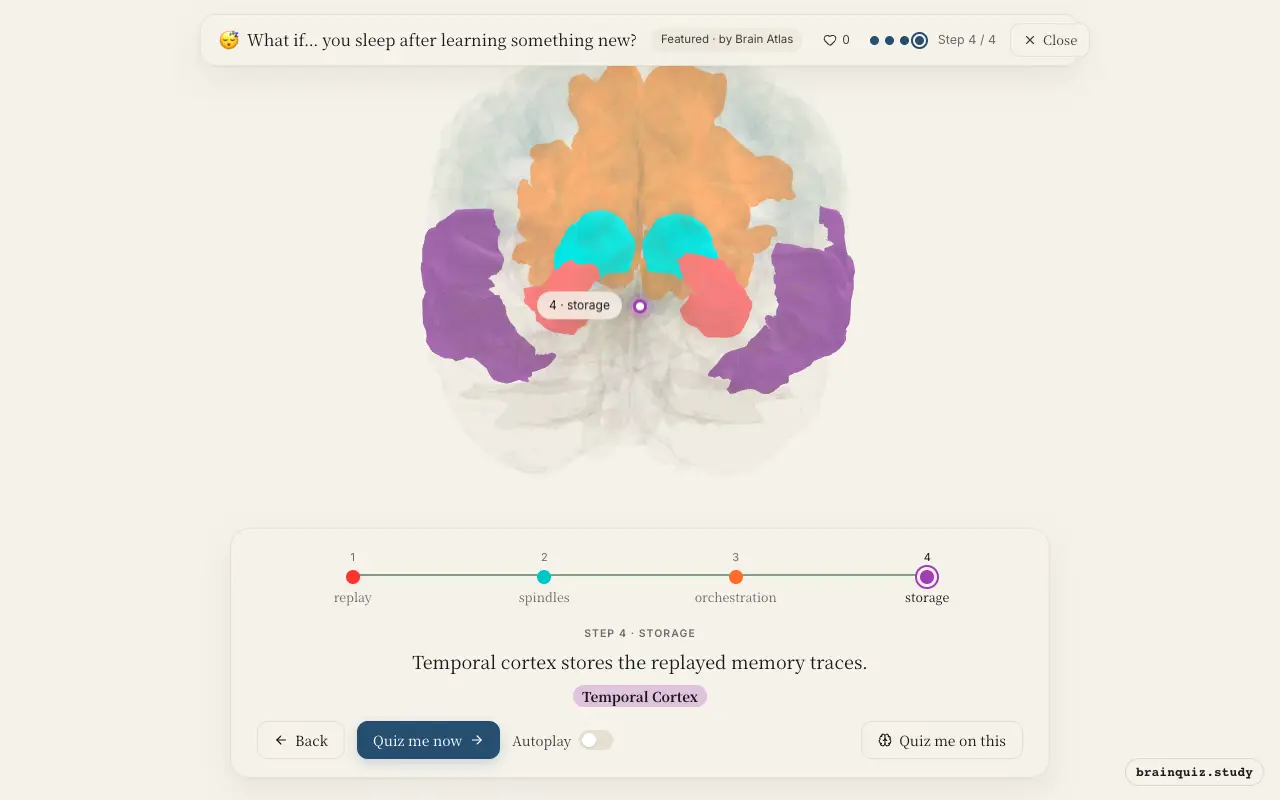
During sleep, the hippocampus replays newly encoded patterns, the thalamus generates spindles that couple with ripples, and the prefrontal cortex orchestrates slow oscillations that guide temporal cortex to store memories long-term.
Watch it light up on the 3D brain
Brain regions that light up
| Order | Region | What it does here |
|---|---|---|
| 1 | Hippocampus | Hippocampus replays the day's learning patterns during sharp-wave ripples. |
| 2 | Thalamus | Thalamus generates sleep spindles that pace the replay dialogue. |
| 3 | Prefrontal Cortex | Prefrontal cortex initiates slow oscillations that synchronize the network. |
| 4 | Temporal Cortex | Temporal cortex stores the replayed memory traces. |
1. Hippocampus: replay
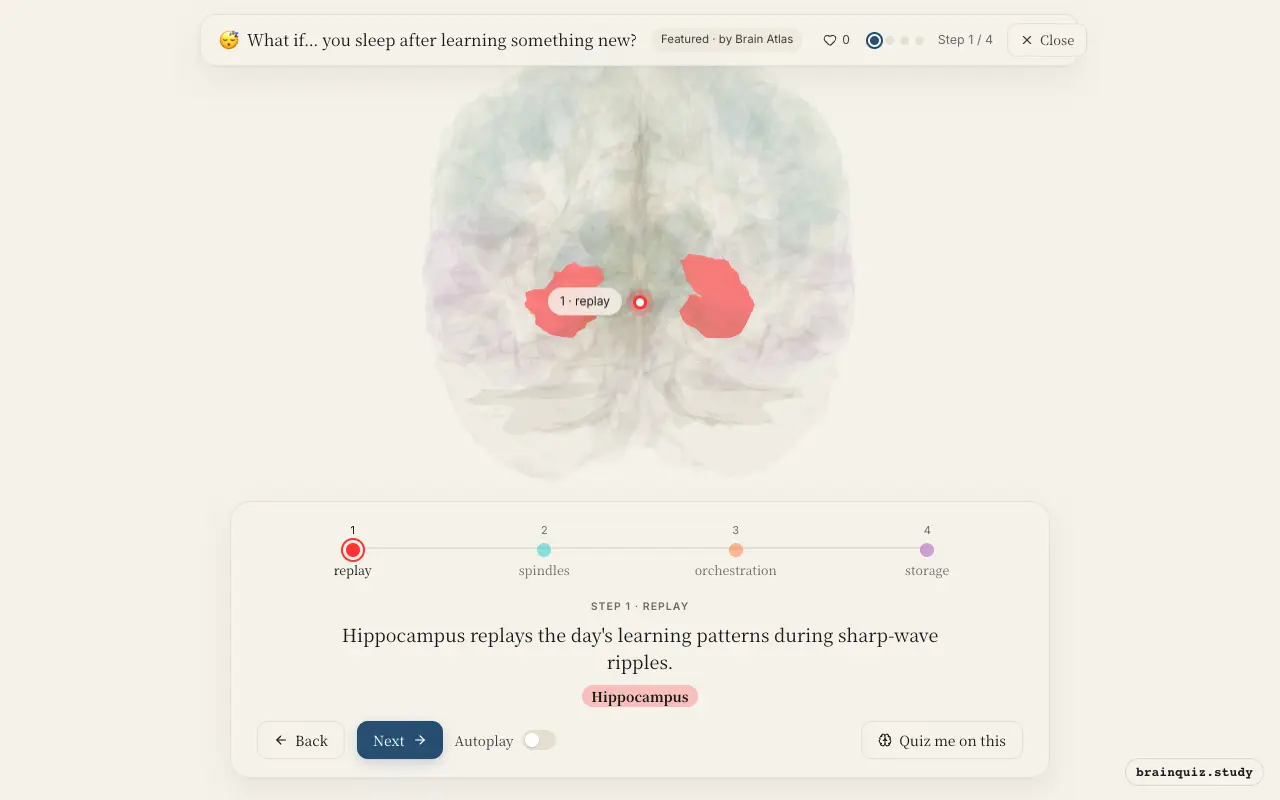
During non-REM sleep, the hippocampus generates sharp-wave ripple events that reactivate recently learned neural ensembles. This process is thought to compress and replay spatial or episodic sequences, providing a teaching signal to the neocortex. The replay is not a verbatim copy but a selective, temporally ordered reactivation that prioritizes salient or rewarded information.
2. Thalamus: spindles
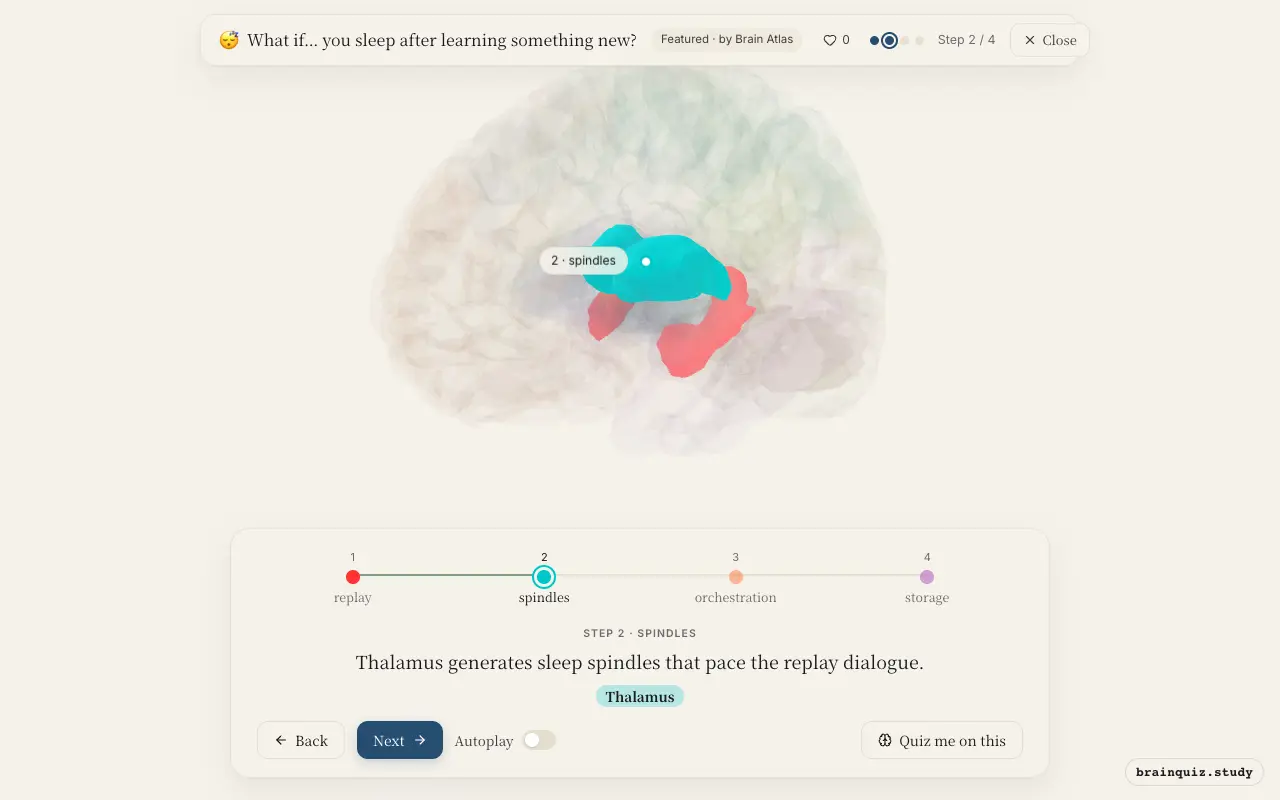
Thalamic reticular neurons burst to produce sleep spindles, 10-16 Hz oscillations lasting 0.5-2 seconds. Spindles coordinate with hippocampal ripples and cortical slow oscillations, creating windows of plasticity. This thalamocortical coupling is essential for gating which reactivated memories are consolidated, possibly tagging them for long-term storage.
3. Prefrontal Cortex: orchestration
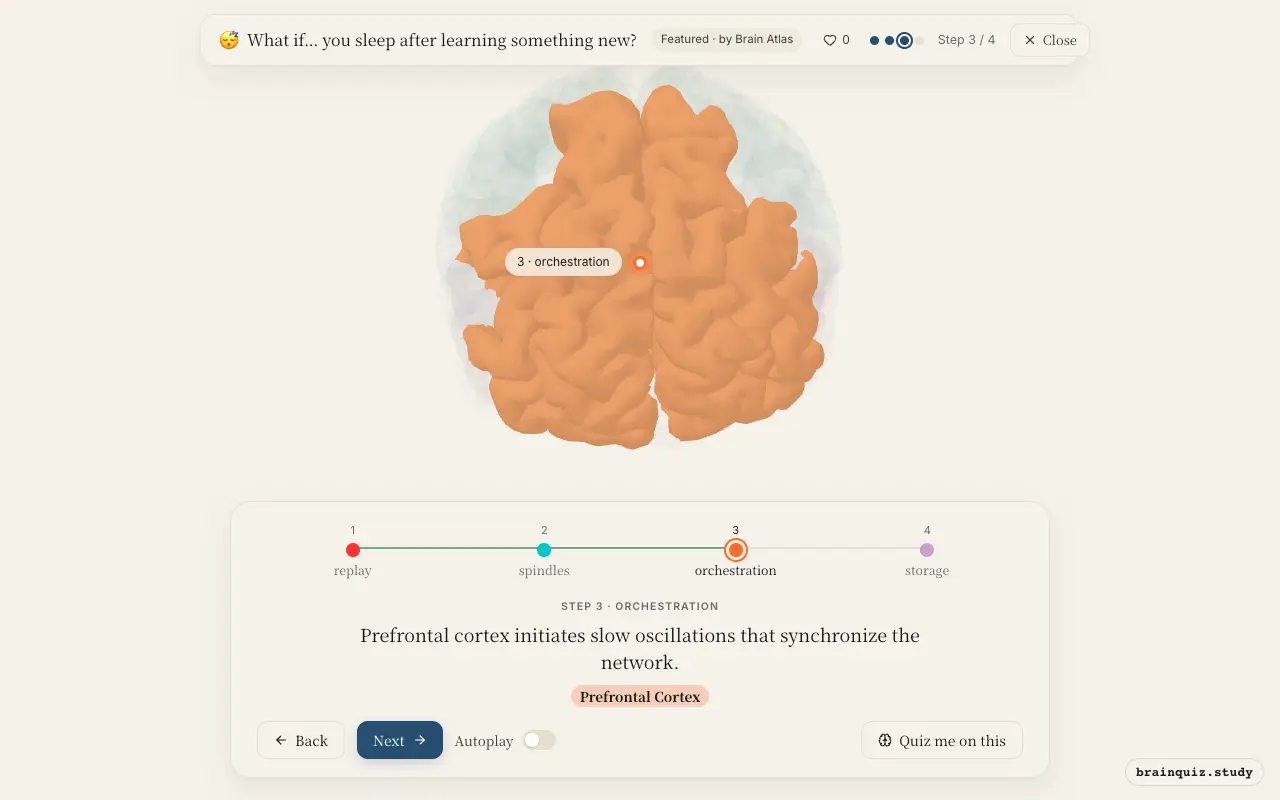
Slow oscillations (<1 Hz) are thought to originate in prefrontal cortex and propagate as traveling waves across the cortex. They act as a global clock, grouping spindles and ripples into discrete up-states. This orchestration ensures that hippocampal replay occurs during periods of increased cortical excitability, allowing the neocortex to integrate the replayed information into existing knowledge networks.
4. Temporal Cortex: storage
During the coordinated up-states, synaptic plasticity in temporal cortical areas is enhanced, enabling the transfer of hippocampal-dependent memories to more distributed neocortical representations. Over successive sleep cycles, these traces become less dependent on the hippocampus, a process known as systems consolidation. This storage frees the hippocampus for new learning while establishing long-lasting semantic or episodic memory.
Good to know
- Sharp-wave ripples in the hippocampus occur predominantly during slow-wave sleep and are thought to reflect memory replay.
- Sleep spindles are associated with improved retention of declarative memories, with higher spindle density correlating with better recall.
- The prefrontal cortex is a major source of slow oscillations during non-REM sleep, coordinating hippocampal-cortical dialogue.
Sleep after learning vs staying awake
During sleep, hippocampal replay and spindles actively consolidate memories, while staying awake lacks these coordinated oscillations. Awake rest may allow some replay, but without the neuromodulatory environment of sleep, consolidation is less effective. Thus, sleep provides unique conditions for memory transfer that wakefulness cannot replicate.
Test yourself
Which brain region replays newly learned information during sleep?
Sleep spindles are generated by which structure?
What role does the prefrontal cortex play during sleep consolidation?
0 of 3 answered · 0 correct
Simplified: many regions work together at once, and this shows the main players in the order they act.