What happens in your brain when you pull an all-nighter?
Updated
The hypothalamus signals wakefulness despite mounting sleep pressure. The brainstem keeps you aroused. The prefrontal cortex then loses its executive edge, the amygdala becomes hyperreactive, and the hippocampus cannot consolidate new memories.
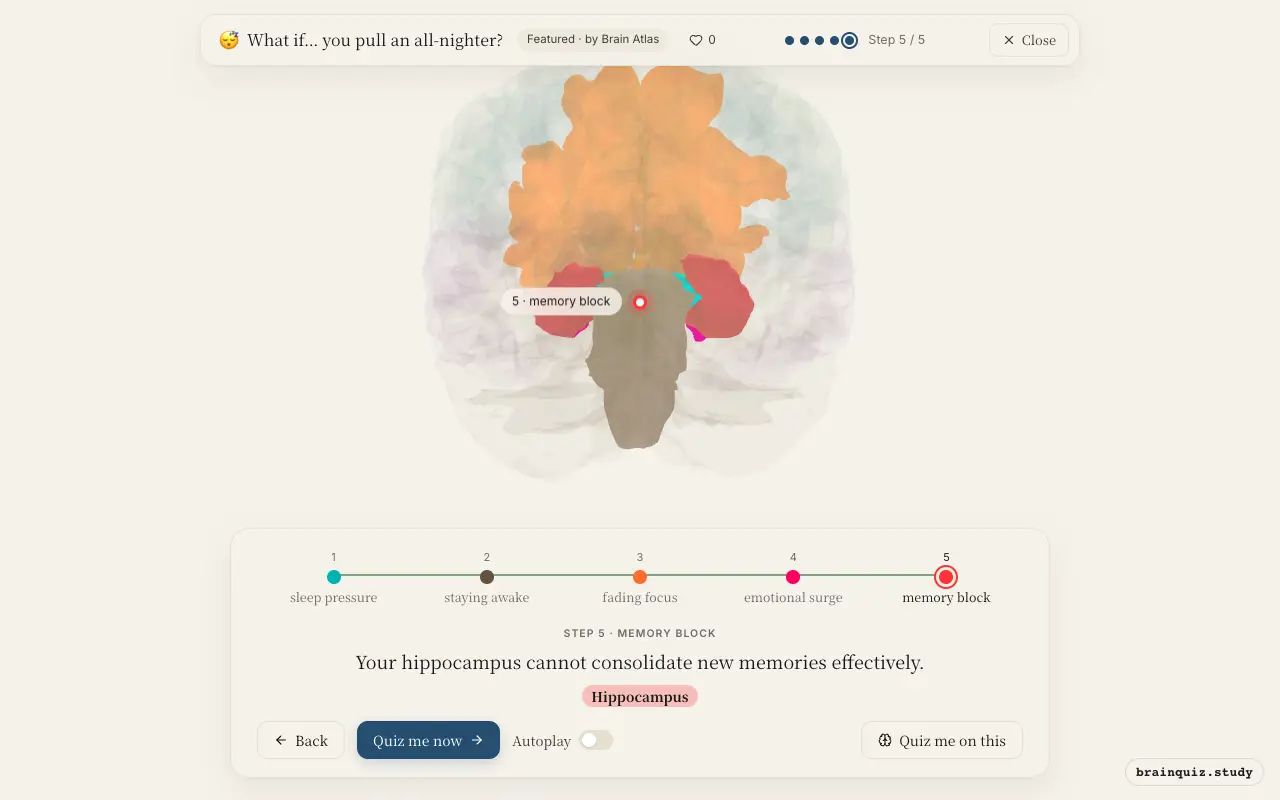
Watch it light up on the 3D brain
Brain regions that light up
| Order | Region | What it does here |
|---|---|---|
| 1 | Hypothalamus | Some hypothalamic signals promote sleep, but you override them. |
| 2 | Brainstem | Your brainstem arousal systems keep you awake against the sleep drive. |
| 3 | Prefrontal Cortex | Your prefrontal cortex struggles, impairing decisions and working memory. |
| 4 | Amygdala | Your amygdala becomes hyperactive, heightening emotional reactions. |
| 5 | Hippocampus | Your hippocampus cannot consolidate new memories effectively. |
1. Hypothalamus: sleep pressure
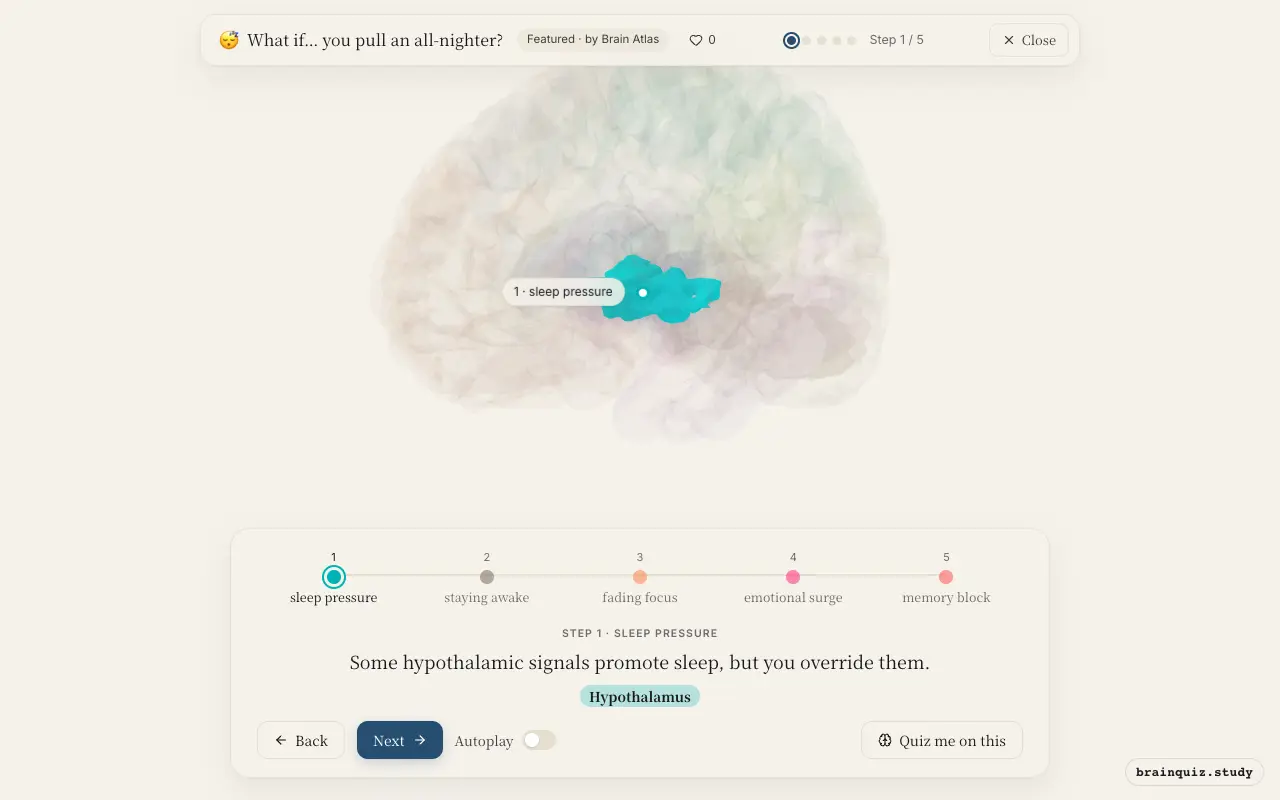
The suprachiasmatic nucleus in the hypothalamus drives your circadian rhythm, promoting alertness during the day. As the night wears on, sleep pressure from adenosine builds, but you consciously resist. The hypothalamus also regulates homeostatic sleep drive. This creates a conflict between the circadian alerting signal and the increasing need for sleep.
2. Brainstem: staying awake
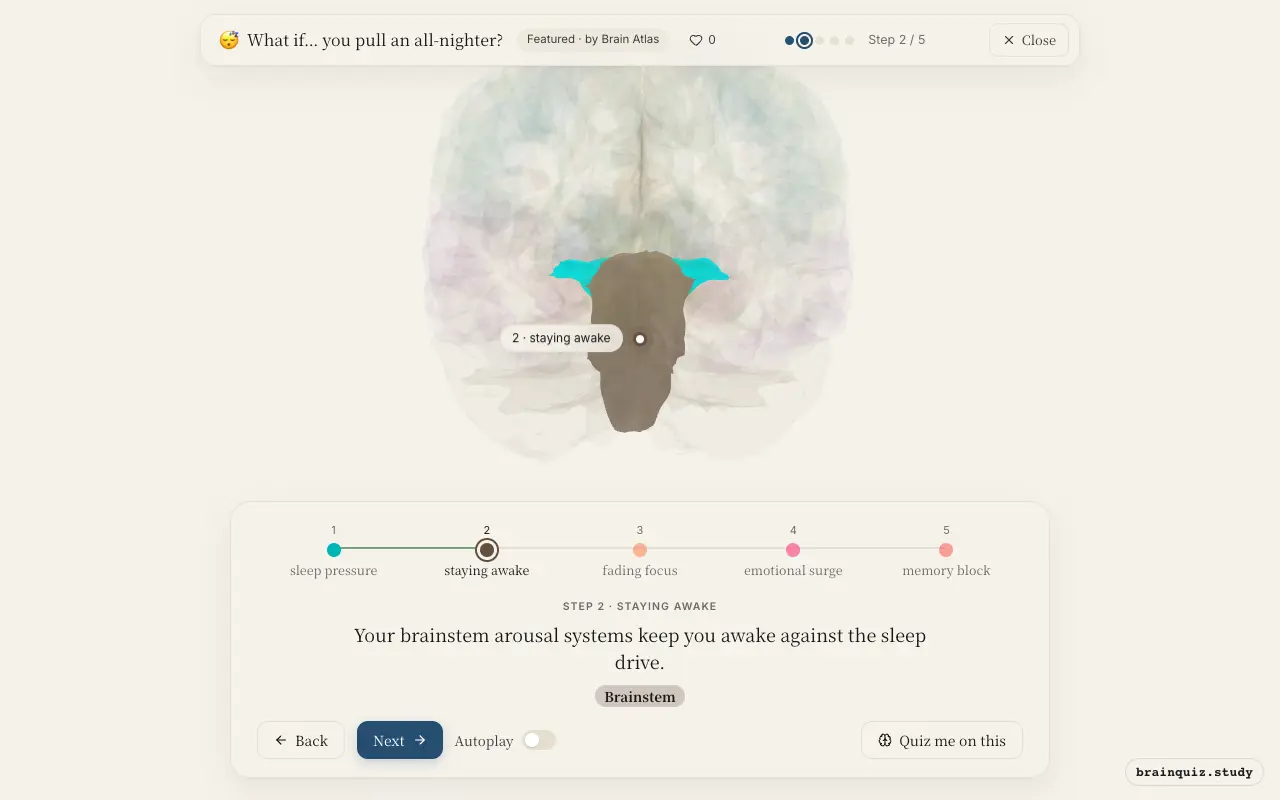
The reticular activating system in the brainstem sends excitatory signals to the cortex, maintaining wakefulness. Neurons in the locus coeruleus release norepinephrine, increasing vigilance. This is why you can push through the night, though the effort becomes harder. Over time, this system fatigues.
3. Prefrontal Cortex: fading focus
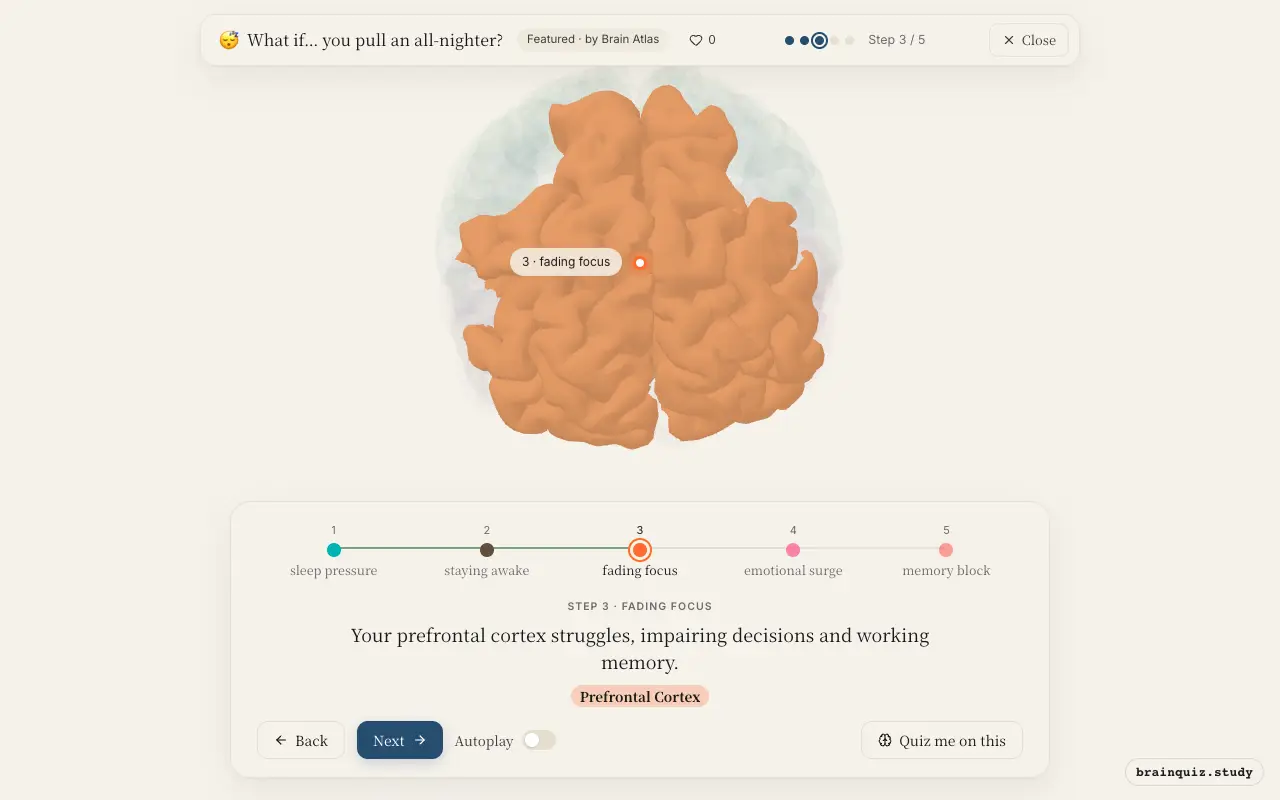
Sleep deprivation reduces metabolic activity in the prefrontal cortex, the seat of executive functions. You have trouble concentrating, making sound judgments, and inhibiting impulses. This explains why late-night decisions are often poor and reaction times slow. Even simple tasks feel mentally taxing.
4. Amygdala: emotional surge
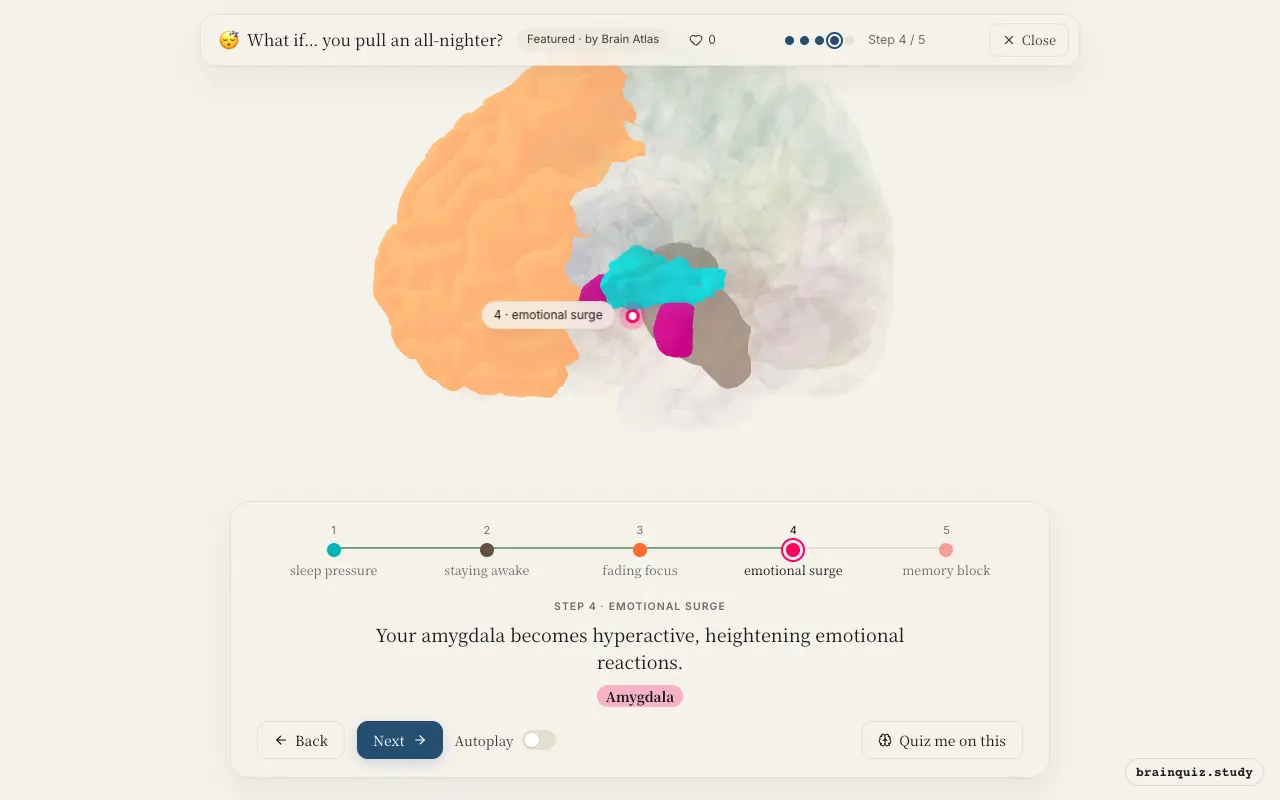
Without sleep, the amygdala shows increased reactivity to negative stimuli, and its connection to the prefrontal cortex weakens. This loss of top-down control makes you more irritable, anxious, or prone to mood swings. Minor frustrations can feel overwhelming. Emotional regulation falters.
5. Hippocampus: memory block
Sleep is essential for the hippocampus to transfer short-term memories to long-term storage. Pulling an all-nighter disrupts this process, so you may forget what you studied or experienced. The next day, recall and learning are significantly impaired. Even existing memories may be harder to retrieve.
Good to know
- Adenosine, a byproduct of energy use, accumulates in the brain during wakefulness and promotes sleep pressure.
- Sleep deprivation impairs attention and working memory to a degree comparable to alcohol intoxication.
- The glymphatic system is thought to clear metabolic waste from the brain during sleep, and an all-nighter may reduce this clearance.
All-nighter vs. Normal Sleep
In normal sleep, the brain cycles through non-REM and REM stages, with the hippocampus consolidating memories and the prefrontal cortex restoring its resources. During an all-nighter, these restorative processes never occur; the brainstem maintains arousal, but the prefrontal cortex and hippocampus remain impaired, and the amygdala stays hyperreactive.
Test yourself
Which brain region drives your circadian rhythm and signals sleep pressure during an all-nighter?
What happens to the amygdala when you stay awake all night?
Why does pulling an all-nighter impair memory?
0 of 3 answered · 0 correct
Simplified: many regions work together at once, and this shows the main players in the order they act.