What happens in your brain when you wake up to an alarm?
Updated
Your auditory cortex registers the alarm; the brainstem's arousal network and thalamus wake the cortex; the prefrontal cortex interprets the sound; the motor cortex moves your hand to silence it.
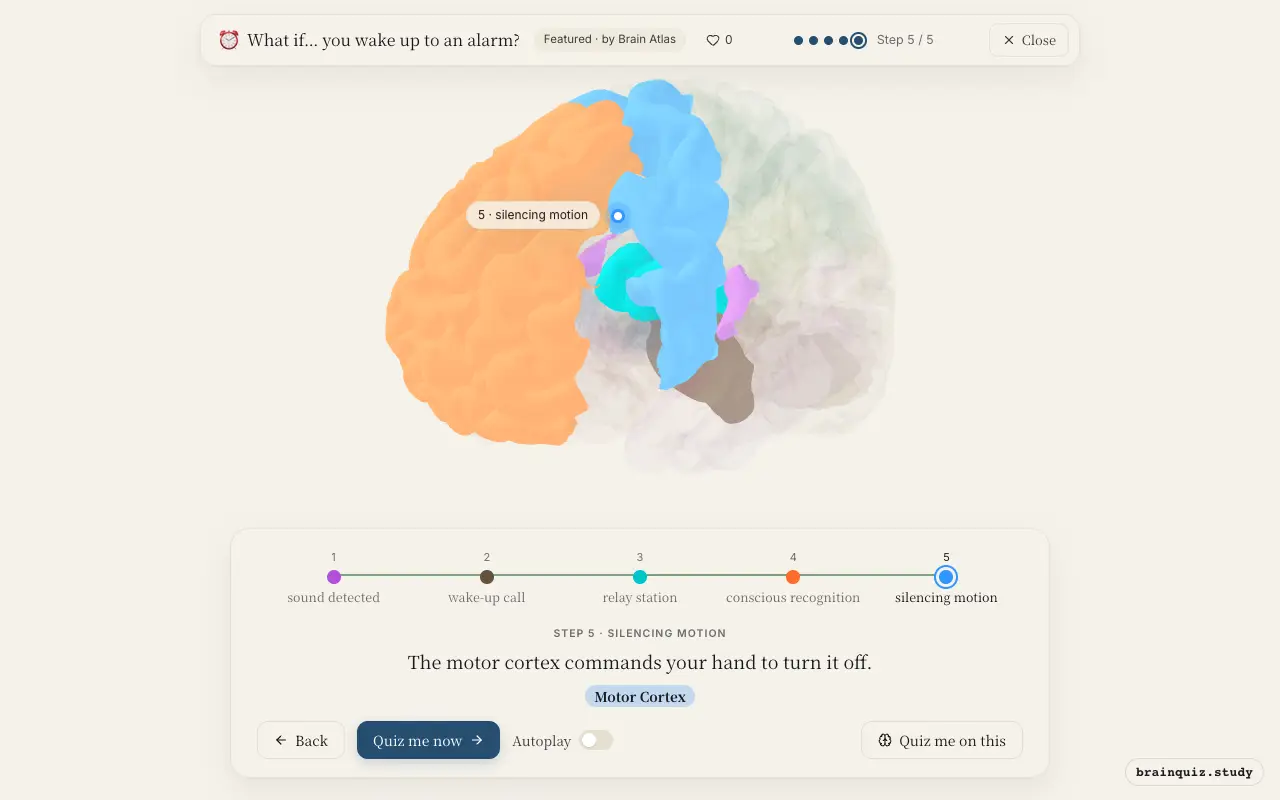
Watch it light up on the 3D brain
Brain regions that light up
| Order | Region | What it does here |
|---|---|---|
| 1 | Auditory Cortex | The auditory cortex picks up the alarm's sharp tones. |
| 2 | Brainstem | The brainstem's reticular formation triggers arousal. |
| 3 | Thalamus | The thalamus gates and relays the sound to the cortex. |
| 4 | Prefrontal Cortex | The prefrontal cortex interprets the sound as your alarm. |
| 5 | Motor Cortex | The motor cortex commands your hand to turn it off. |
1. Auditory Cortex: sound detected
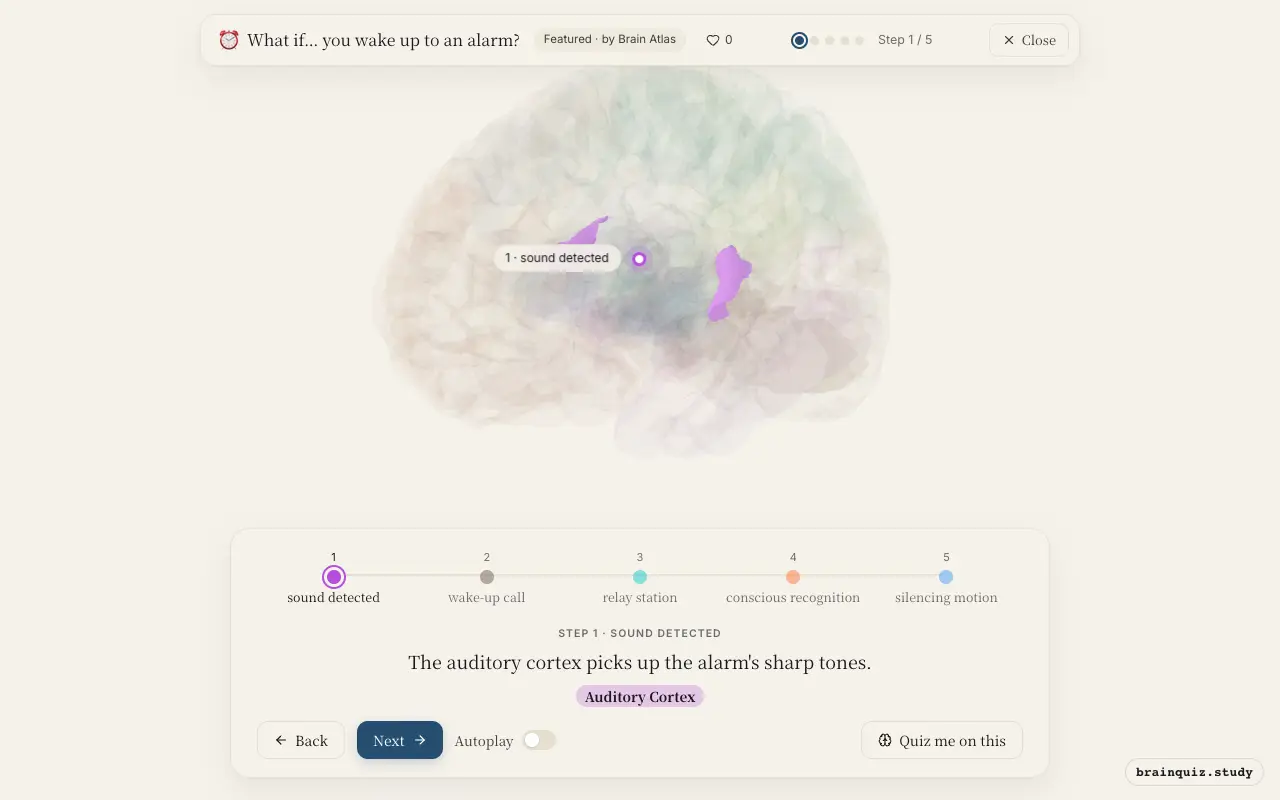
The auditory cortex processes the acoustic features of the alarm, such as pitch and volume. It relays this information to higher-order areas and brainstem arousal systems, signalling that a salient sound has occurred.
2. Brainstem: wake-up call
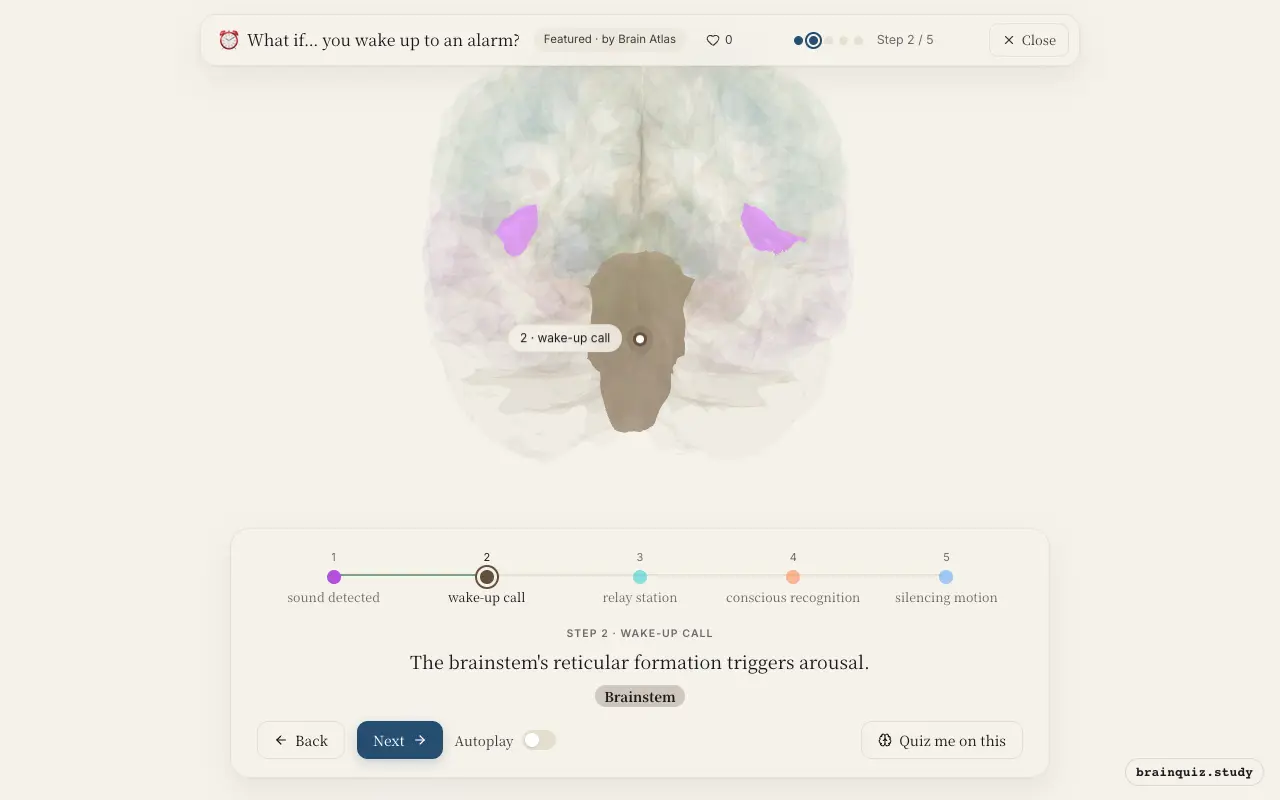
The reticular formation sends widespread projections to the thalamus and cortex, promoting wakefulness. This ascending reticular activating system is crucial for transitioning from sleep to alert consciousness.
3. Thalamus: relay station
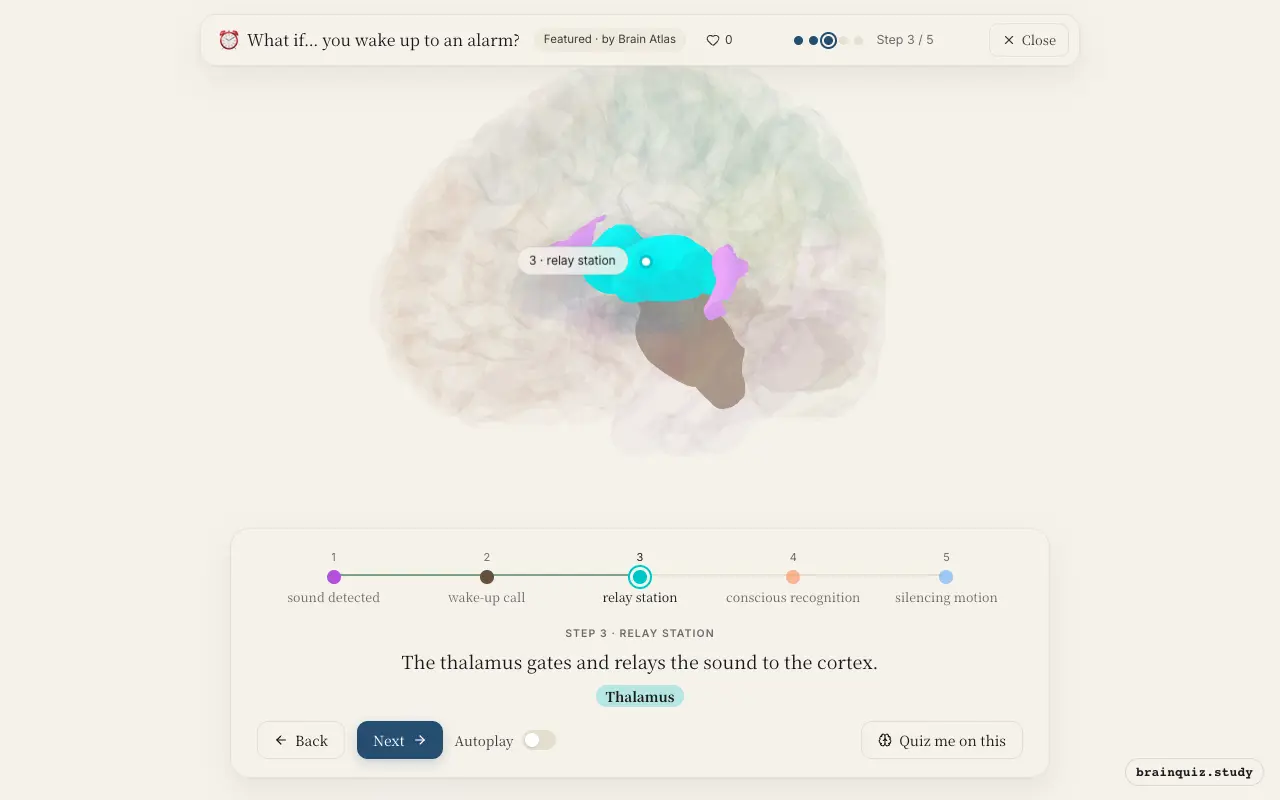
The thalamus acts as a gateway, filtering the alarm signal and sending it to the auditory cortex for conscious processing. Its intralaminar nuclei also help maintain cortical arousal.
4. Prefrontal Cortex: conscious recognition
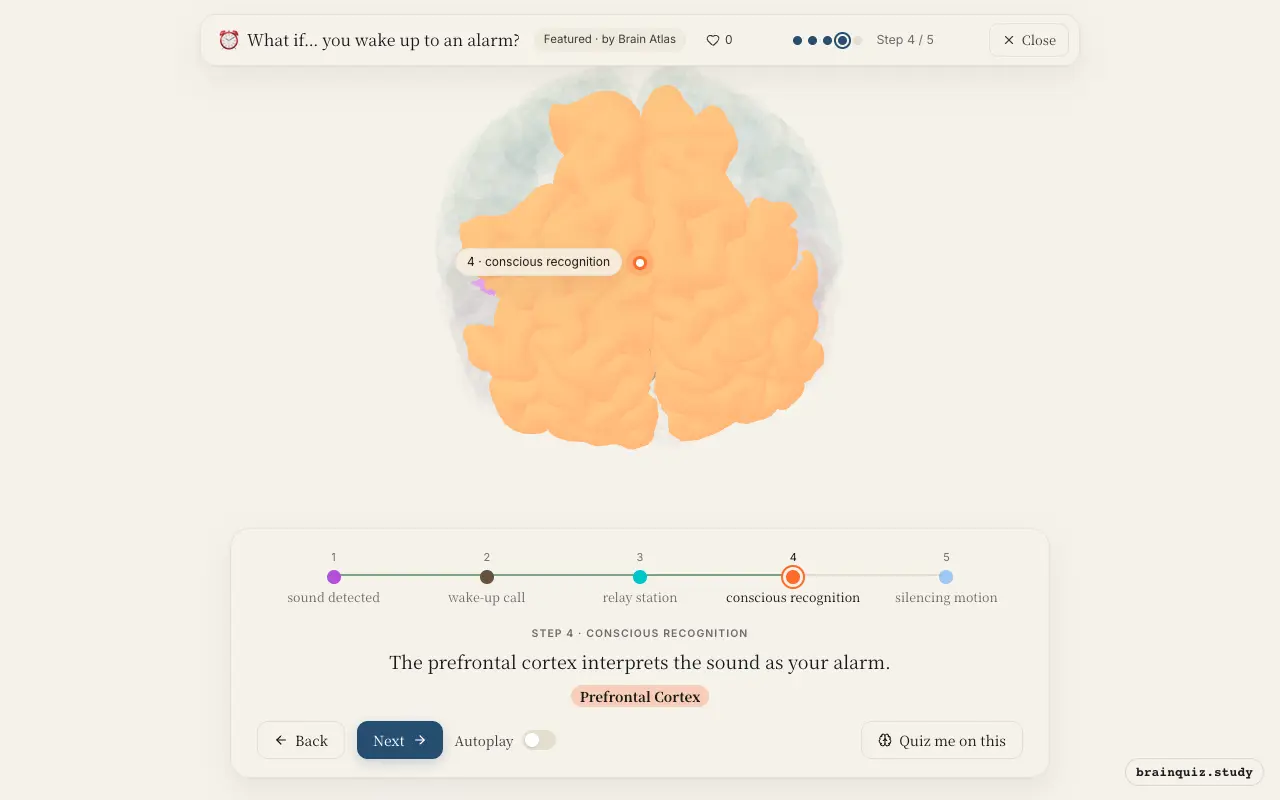
The prefrontal cortex integrates the auditory information with memory and context, recognizing the sound as a signal to wake up. It then plans the motor response.
5. Motor Cortex: silencing motion
The motor cortex sends signals via the corticospinal tract to your arm and hand muscles, executing the movement to press the alarm. This completes the wake-up sequence.
Good to know
- The ascending reticular activating system in the brainstem is necessary for maintaining wakefulness; damage can cause coma.
- The auditory system can process sounds during sleep, but salient or meaningful sounds are more likely to wake you.
- The prefrontal cortex is one of the last brain regions to fully activate upon waking, which can cause temporary grogginess called sleep inertia.
Alarm vs natural waking
Natural waking is gradual, driven by circadian signals from the hypothalamus and increasing light, with lower stress responses. An alarm abruptly activates the auditory cortex and brainstem arousal, often triggering a startle response and higher cortisol. The prefrontal cortex may be slower to engage after an alarm, leading to brief confusion.
Test yourself
Which brain region first processes the sound of the alarm?
What role does the brainstem play in waking to an alarm?
Sleep inertia (grogginess after waking) is thought to be linked to delayed activation of which region?
0 of 3 answered · 0 correct
Simplified: many regions work together at once, and this shows the main players in the order they act.