What happens in your brain when you have a lucid dream?
Updated
Prefrontal cortex activates to trigger awareness that you're dreaming; posterior cingulate may maintain self-awareness; parietal cortex integrates sensory and spatial information to make the dream feel real; motor cortex enables voluntary dream actions if you choose to move.
Watch it light up on the 3D brain
Brain regions that light up
| Order | Region | What it does here |
|---|---|---|
| 1 | Prefrontal Cortex | Your prefrontal cortex lights up, letting you recognize that you are dreaming. |
| 2 | Posterior Cingulate Cortex | The posterior cingulate may help maintain your sense of self as a dream character. |
| 3 | Parietal Cortex | Parietal regions integrate sensory and spatial information, making the dream world feel real. |
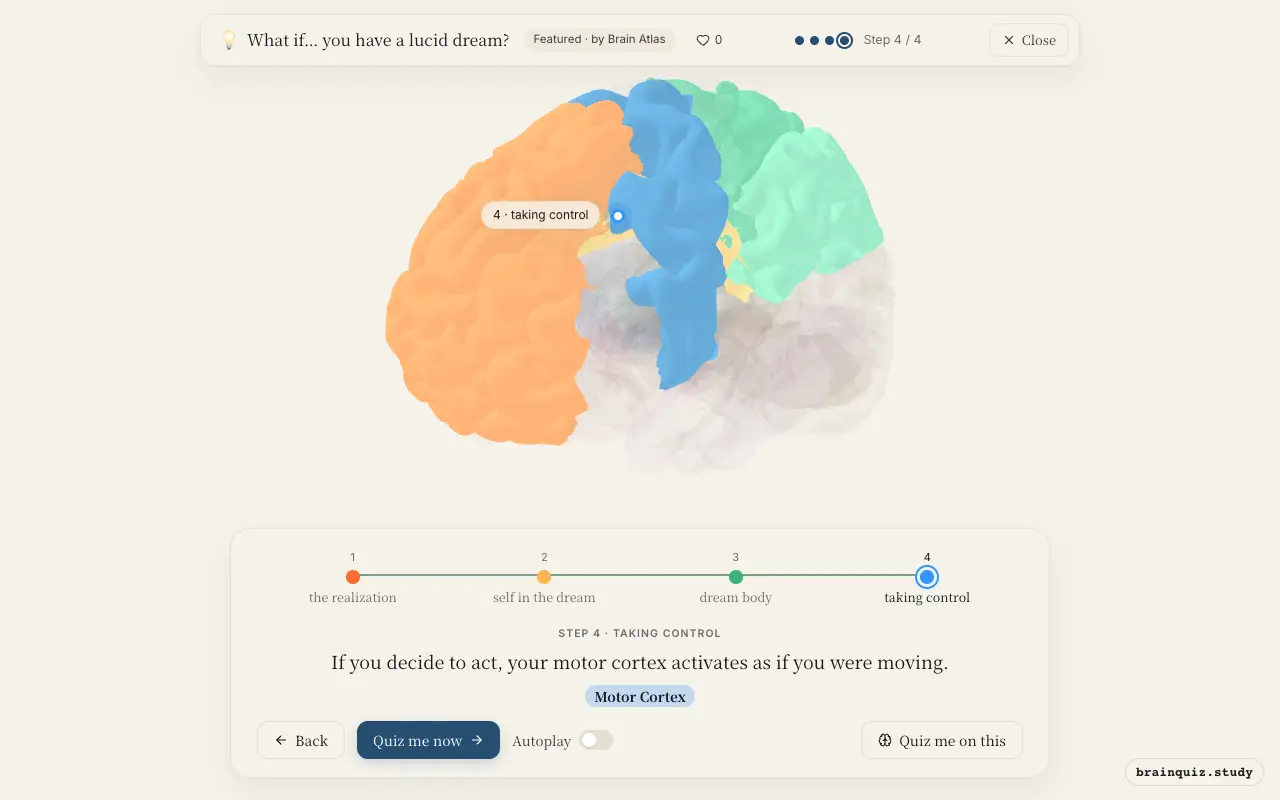
| 4 | Motor Cortex | If you decide to act, your motor cortex activates as if you were moving. |
1. Prefrontal Cortex: the realization
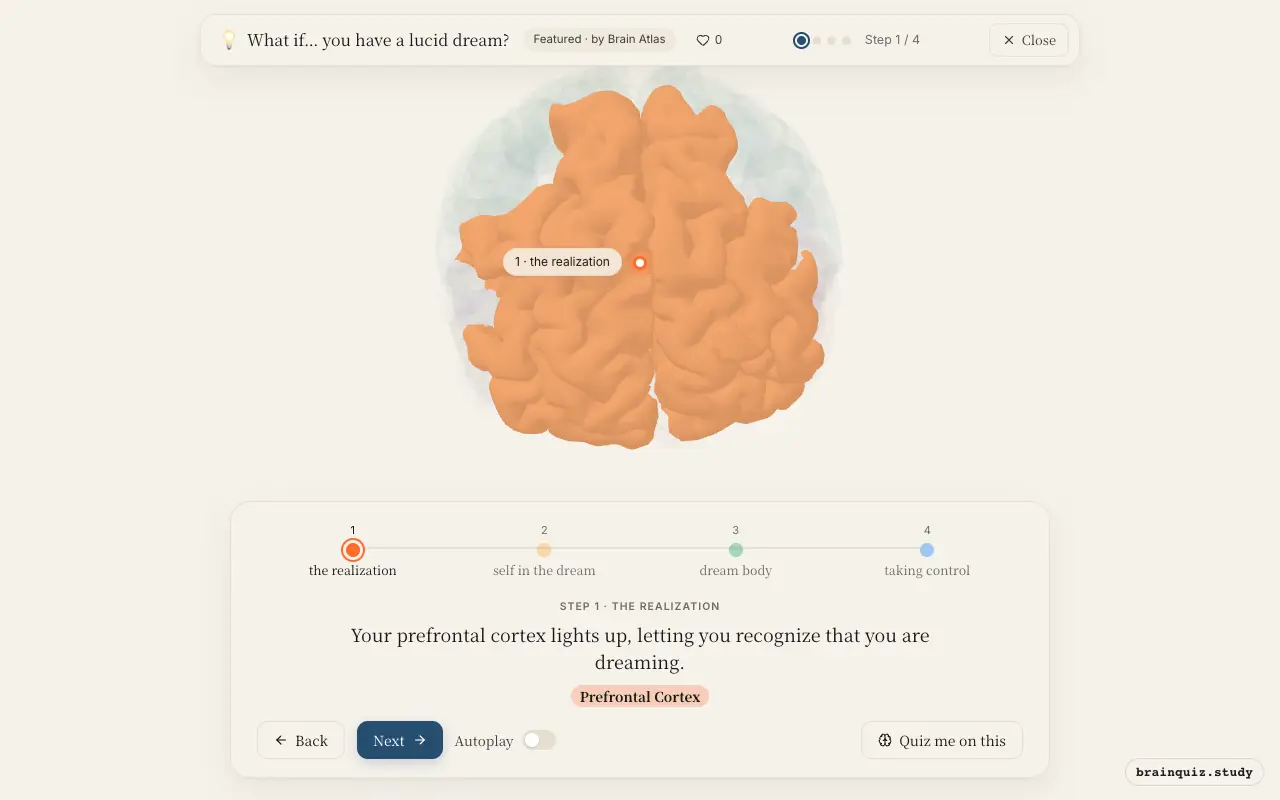
Normally less active during REM sleep, the prefrontal cortex becomes engaged in lucid dreams. This region supports metacognition—thinking about your own thoughts—so its activation allows you to notice the dream's unreality and gain conscious awareness within the dream state.
2. Posterior Cingulate Cortex: self in the dream
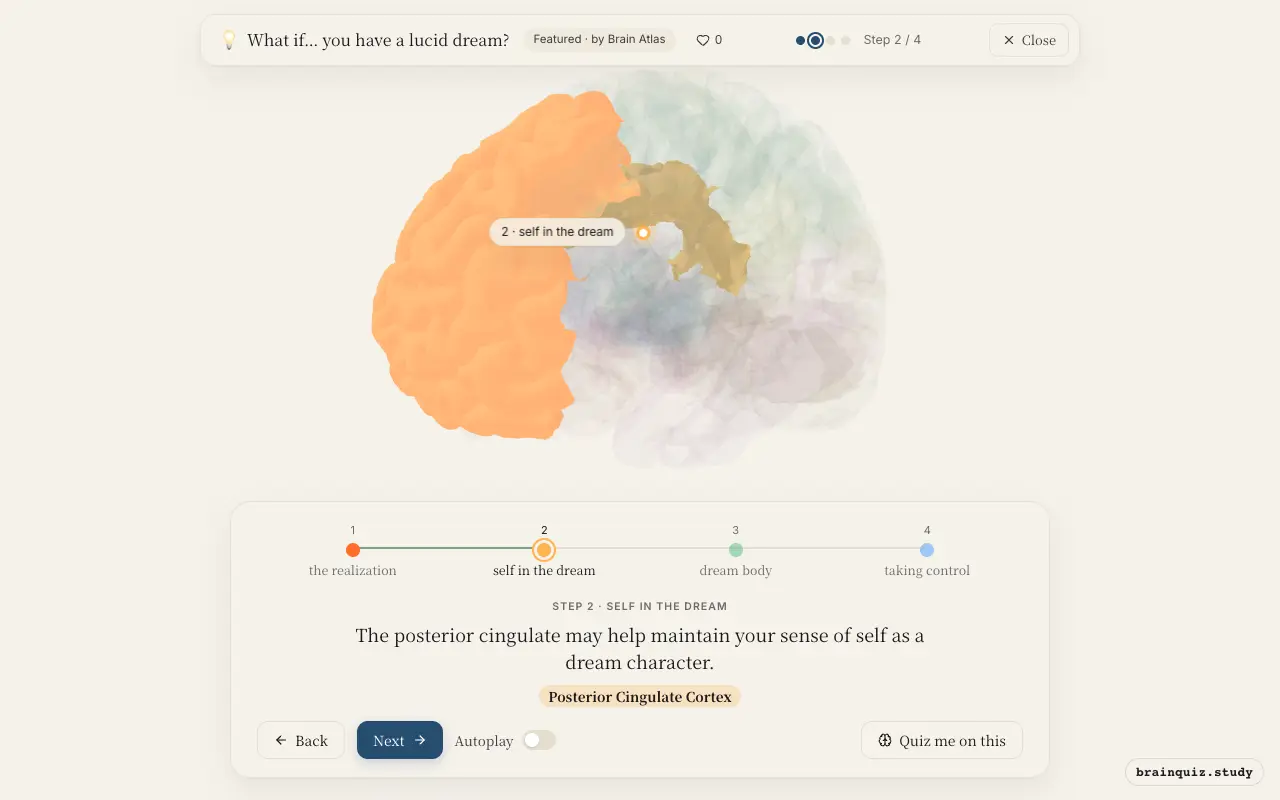
Part of the default mode network, the posterior cingulate is involved in self-referential processing and autobiographical memory. During lucid dreaming, its activity may reinforce the continuity of your identity, anchoring the 'you' that is aware of dreaming.
3. Parietal Cortex: dream body
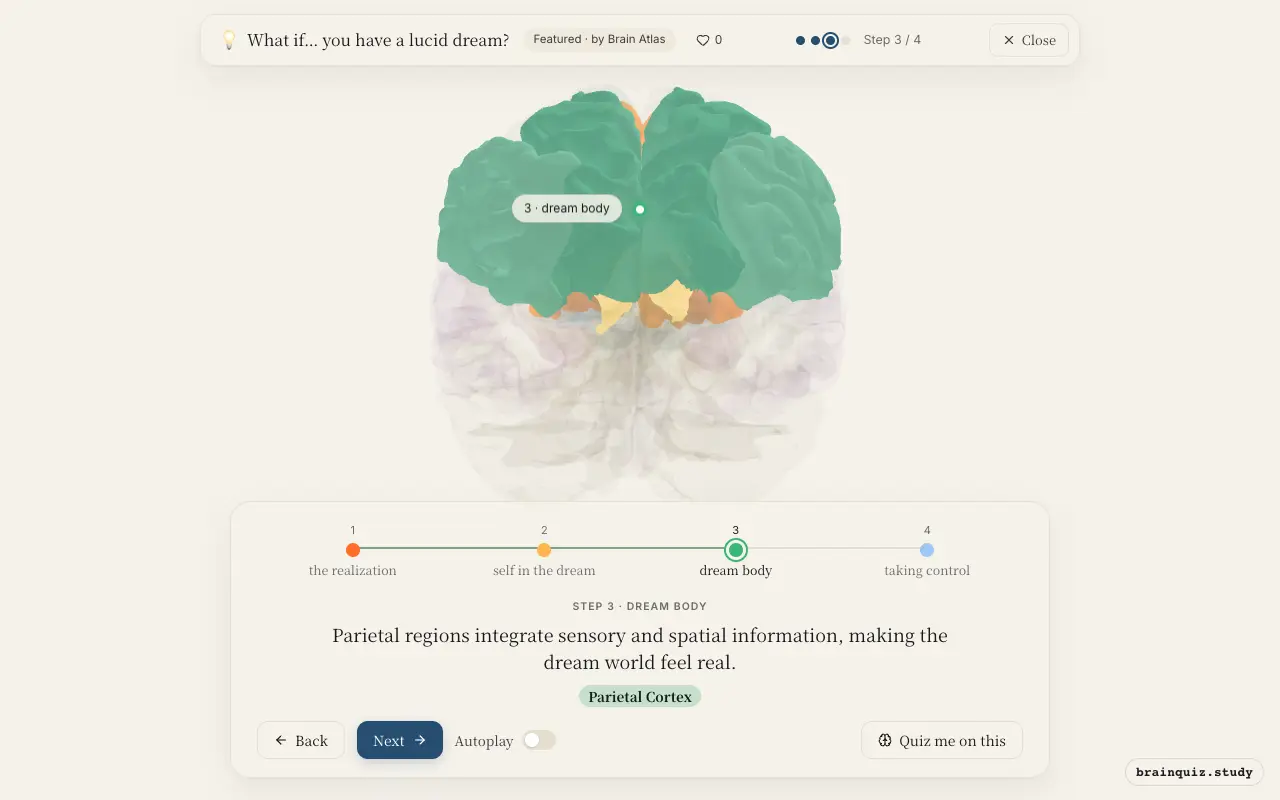
The parietal cortex combines touch, vision, and body position signals to create a coherent spatial map. In a lucid dream, this integration allows you to perceive and navigate the dream environment, and may contribute to the sensation of having a dream body that you can control.
4. Motor Cortex: taking control
The motor cortex plans and simulates voluntary movements, even when actual muscles are paralyzed during REM sleep. In lucid dreams, when you consciously decide to fly or run, this region becomes active in patterns similar to waking motor imagery, enabling dream actions.
Good to know
- Lucid dreaming occurs during REM sleep, when the brain is highly active and dreaming is most vivid.
- People can train themselves to have lucid dreams using techniques such as reality testing and mnemonic induction.
- Studies suggest that lucid dreams are associated with increased gamma-band oscillations, linked to conscious awareness.
Lucid vs. Non-Lucid Dreams
In non-lucid REM dreams, the prefrontal cortex is relatively deactivated, so you accept the dream as real. Lucid dreaming reactivates this region, enabling critical self-awareness and the ability to question the dream state, often leading to voluntary control over the narrative.
Test yourself
Which brain region is most essential for realizing you are dreaming?
What role does the parietal cortex play in lucid dreaming?
Lucid dreaming primarily occurs during which sleep stage?
0 of 3 answered · 0 correct
Simplified: many regions work together at once, and this shows the main players in the order they act.