What happens in your brain when you fall asleep?
Updated
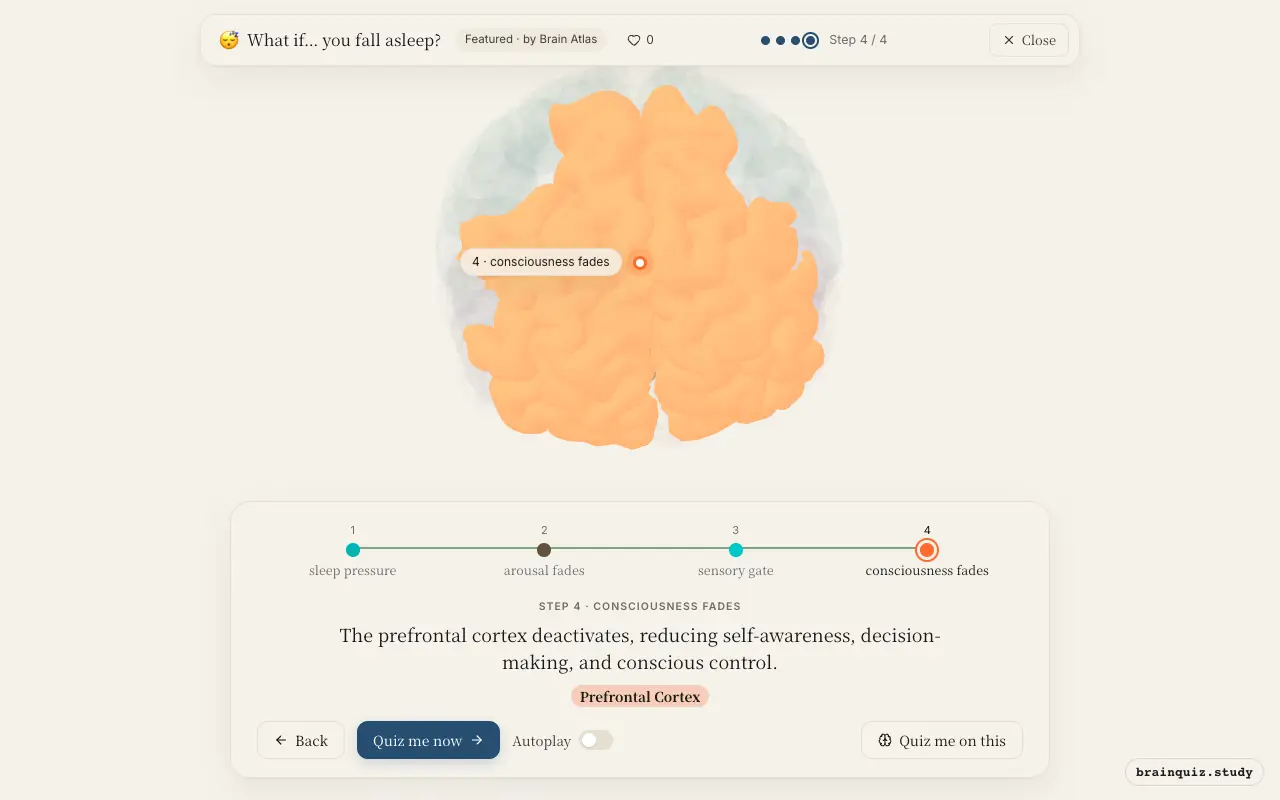
The hypothalamus initiates sleep, quieting the brainstem's arousal system. The thalamus then reduces sensory input to the cortex, and the prefrontal cortex powers down, reducing consciousness and inhibition.
Watch it light up on the 3D brain
Brain regions that light up
| Order | Region | What it does here |
|---|---|---|
| 1 | Hypothalamus | The hypothalamus integrates sleep pressure and triggers sleep onset by inhibiting arousal centers. |
| 2 | Brainstem | The brainstem's reticular activating system reduces its activity, decreasing cortical arousal. |
| 3 | Thalamus | The thalamus shifts to a sleep mode, reducing sensory information reaching the cortex. |
| 4 | Prefrontal Cortex | The prefrontal cortex deactivates, reducing self-awareness, decision-making, and conscious control. |
1. Hypothalamus: sleep pressure
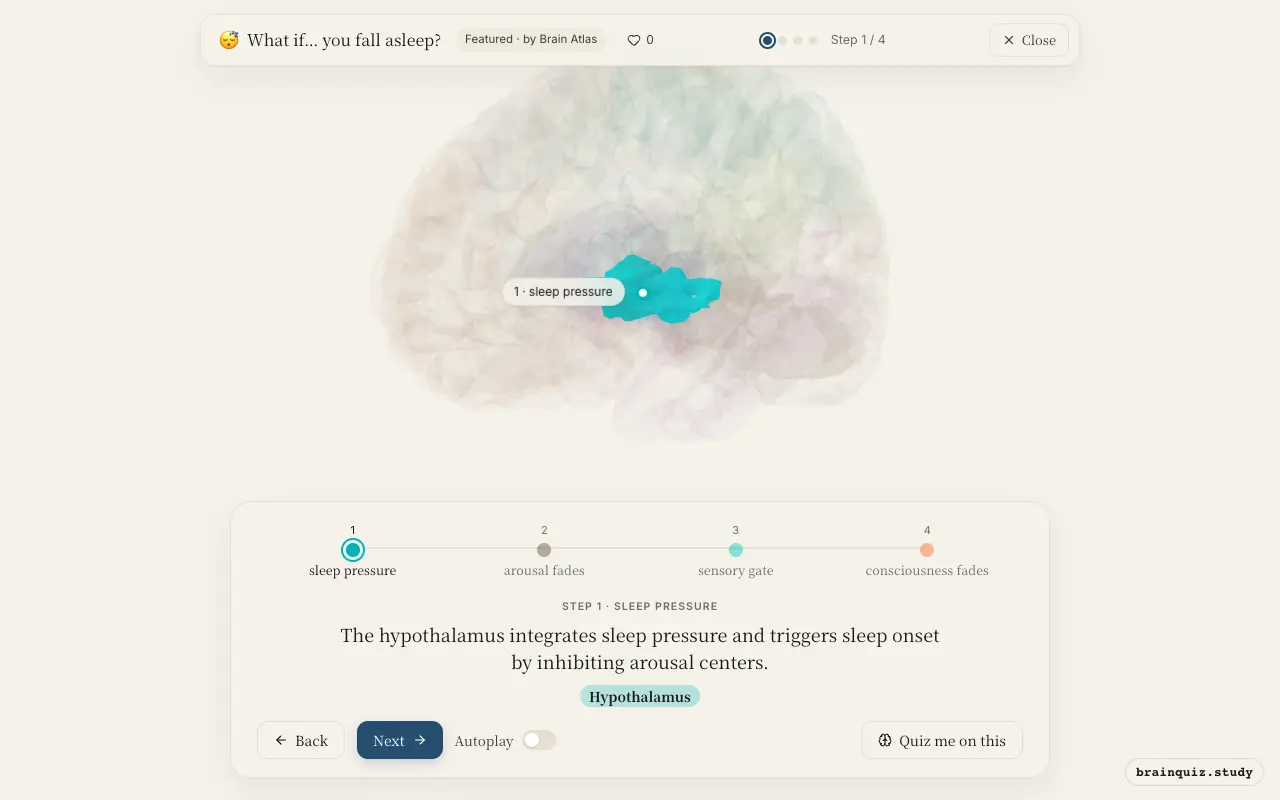
The hypothalamus integrates circadian and homeostatic sleep signals. When sleep drive is high, its sleep-active neurons release inhibitory neurotransmitters like GABA, suppressing wake-promoting regions in the brainstem and hypothalamus itself. This shifts the brain from wakefulness to sleep.
2. Brainstem: arousal fades
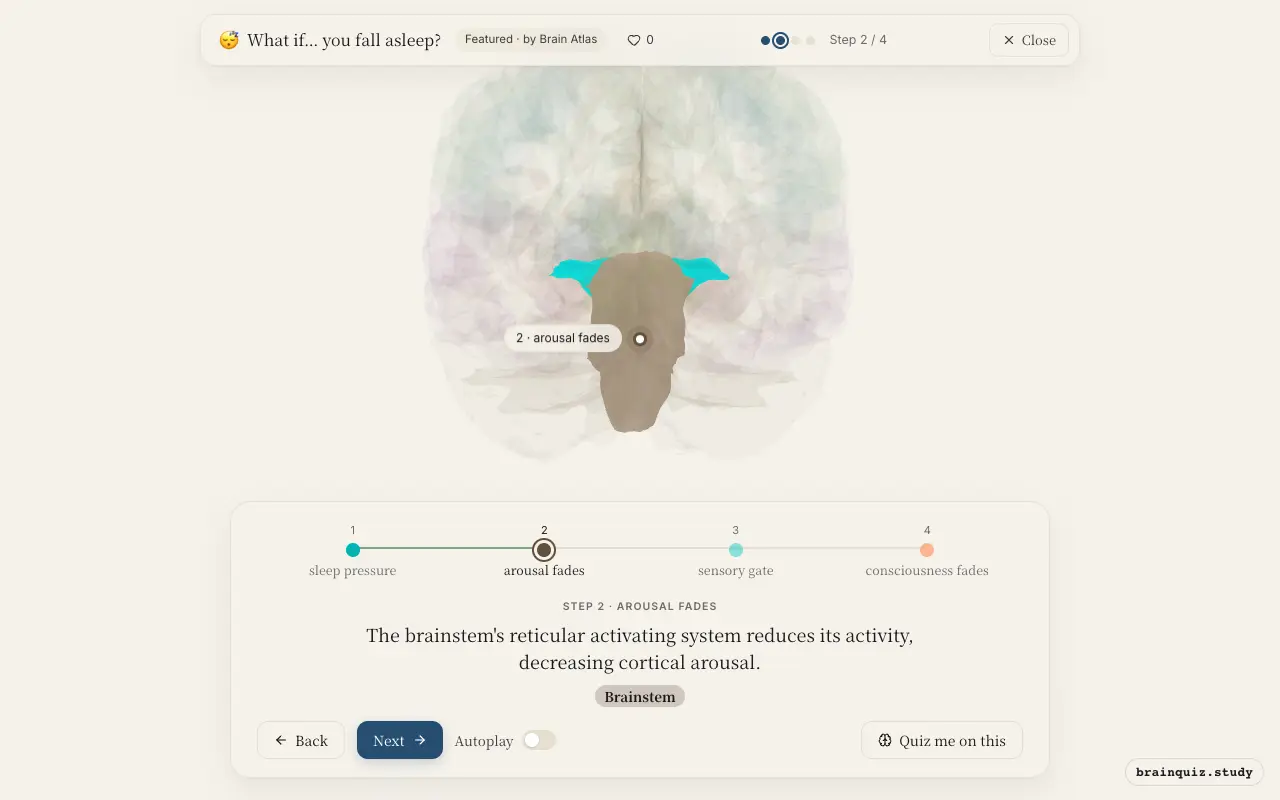
The reticular activating system in the brainstem normally maintains wakefulness by sending arousal signals to the cortex. As the hypothalamus inhibits this system, its firing rate drops, reducing the release of wake-promoting neurotransmitters like acetylcholine and norepinephrine. This allows the cortex to disengage.
3. Thalamus: sensory gate
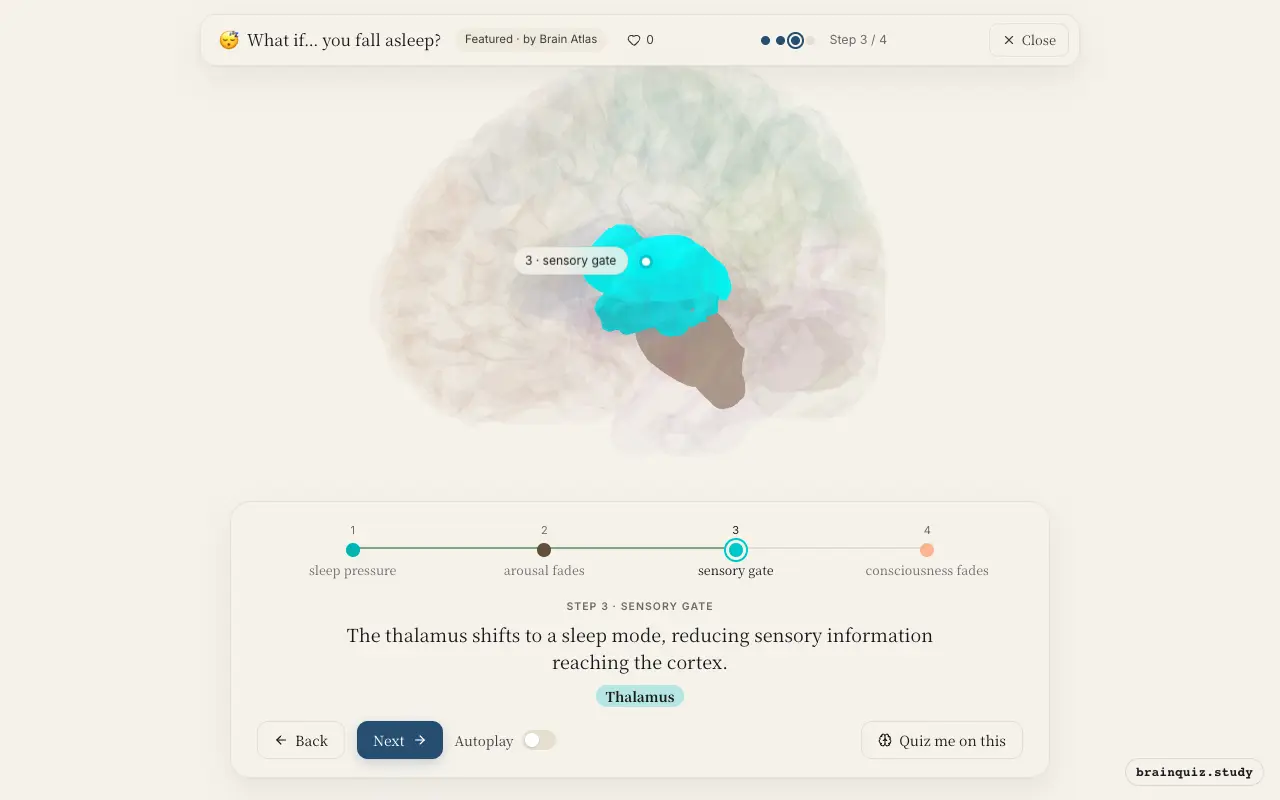
Normally, the thalamus relays sensory inputs to the cortex, keeping us aware of the environment. During sleep onset, its neurons switch from tonic to burst firing, acting as a gate that reduces transmission of external stimuli. This isolates the cortex from the outside world.
4. Prefrontal Cortex: consciousness fades
The prefrontal cortex is the seat of executive functions and self-monitoring. As sleep takes hold, its metabolic activity drops significantly, leading to loss of voluntary thought, judgment, and the sense of a continuous self. This marks the transition into unconsciousness.
Good to know
- During non-REM sleep, brain waves slow down, showing high-amplitude delta waves in deep stages.
- Sleep is regulated by two processes: the circadian drive (body clock) and the homeostatic sleep drive (accumulating adenosine).
Falling asleep vs waking up
Falling asleep involves inhibition of arousal systems by the hypothalamus, reducing thalamic relay and cortical activity. Waking up reverses this: the brainstem's reticular activating system becomes active, the thalamus reopens sensory gates, and the prefrontal cortex reactivates.
Test yourself
Which brain region initiates the transition to sleep?
What happens to the thalamus as you fall asleep?
How does the prefrontal cortex change during sleep onset?
0 of 3 answered · 0 correct
Simplified: many regions work together at once, and this shows the main players in the order they act.