Fusiform Gyrus — Function, Location & Quiz
The fusiform gyrus is best known for face-selective responses, but it is better understood as high-resolution visual expertise territory along the ventral surface. Right-sided regions are emphasized in face identity, while left fusiform cortex includes the visual word-form system used in fluent reading.
This lateralization prevents two neighbouring syndromes from being confused. Fusiform damage can produce prosopagnosia when face identity fails, or pure alexia after left-sided injury when reading fails despite preserved writing.
Test this anatomy in the Brodmann Areas Quiz: 15 Questions With Answers or explore it on the interactive 3D brain.
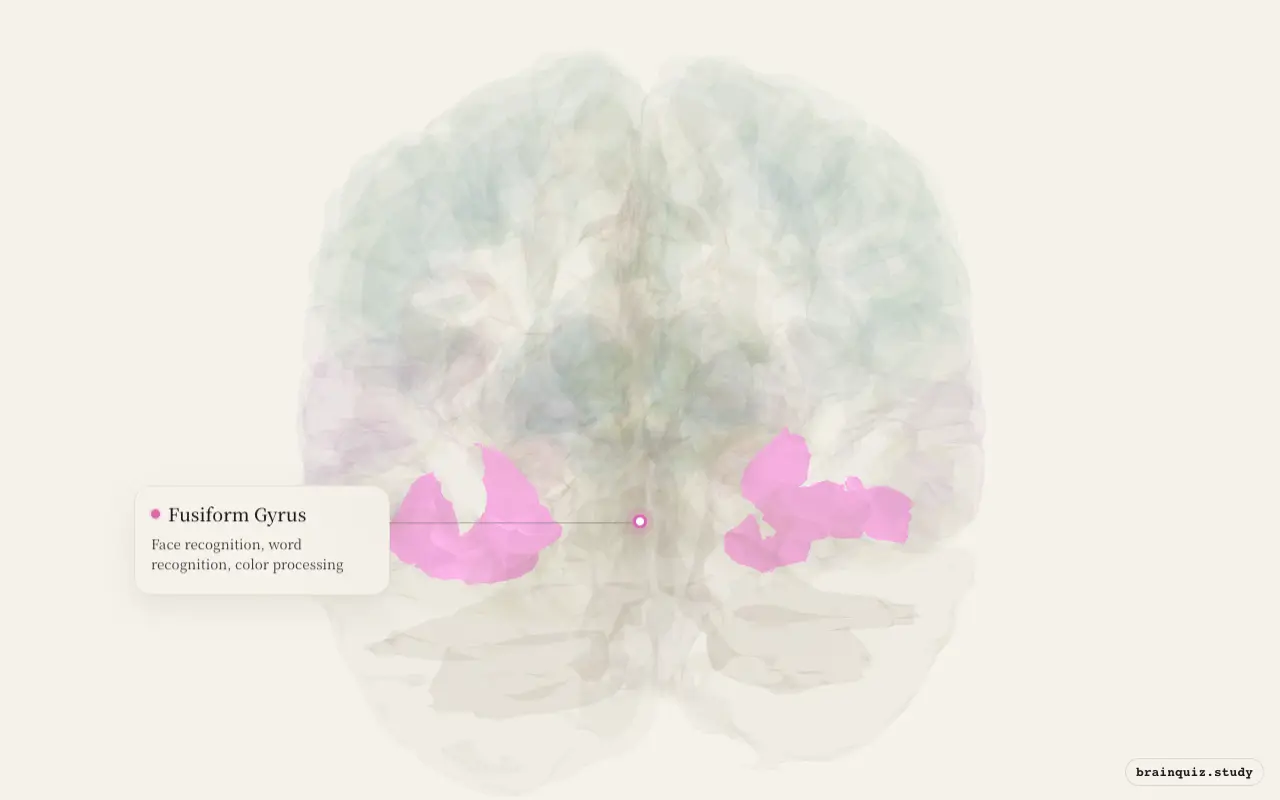
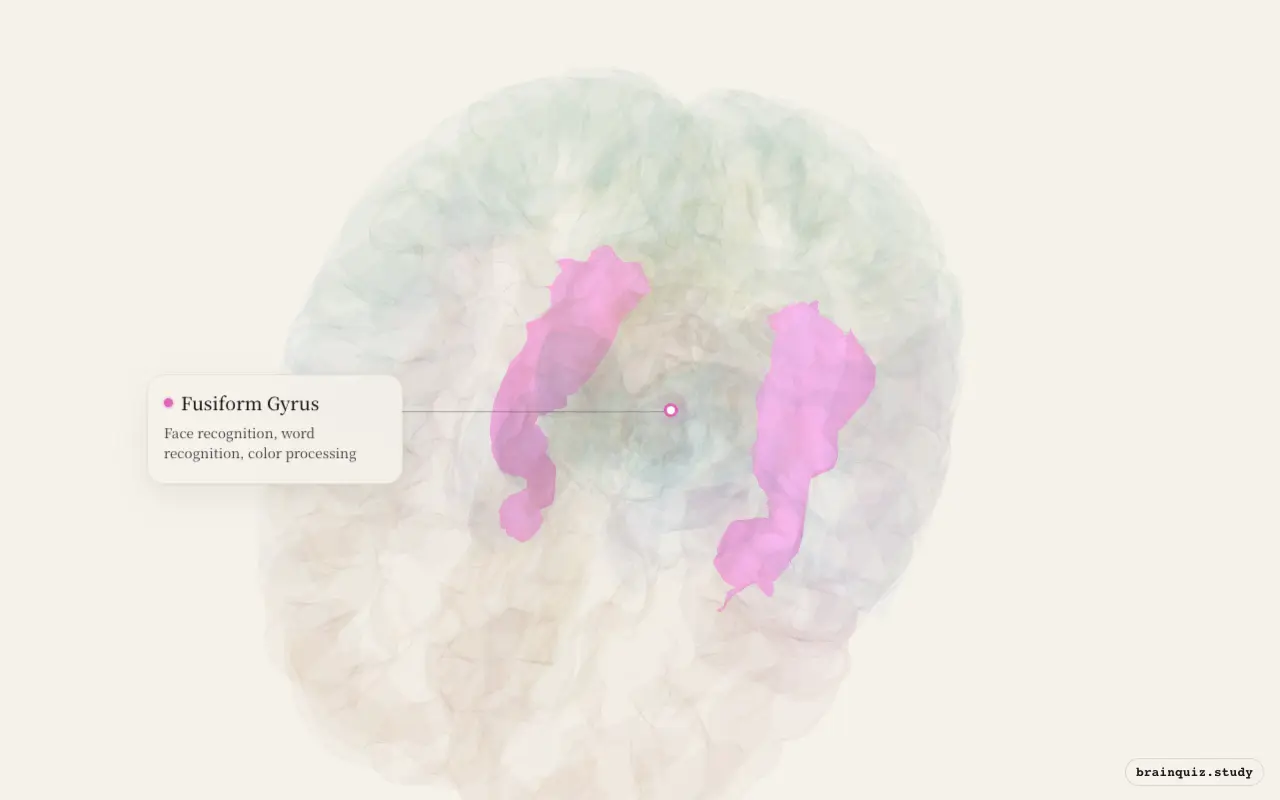
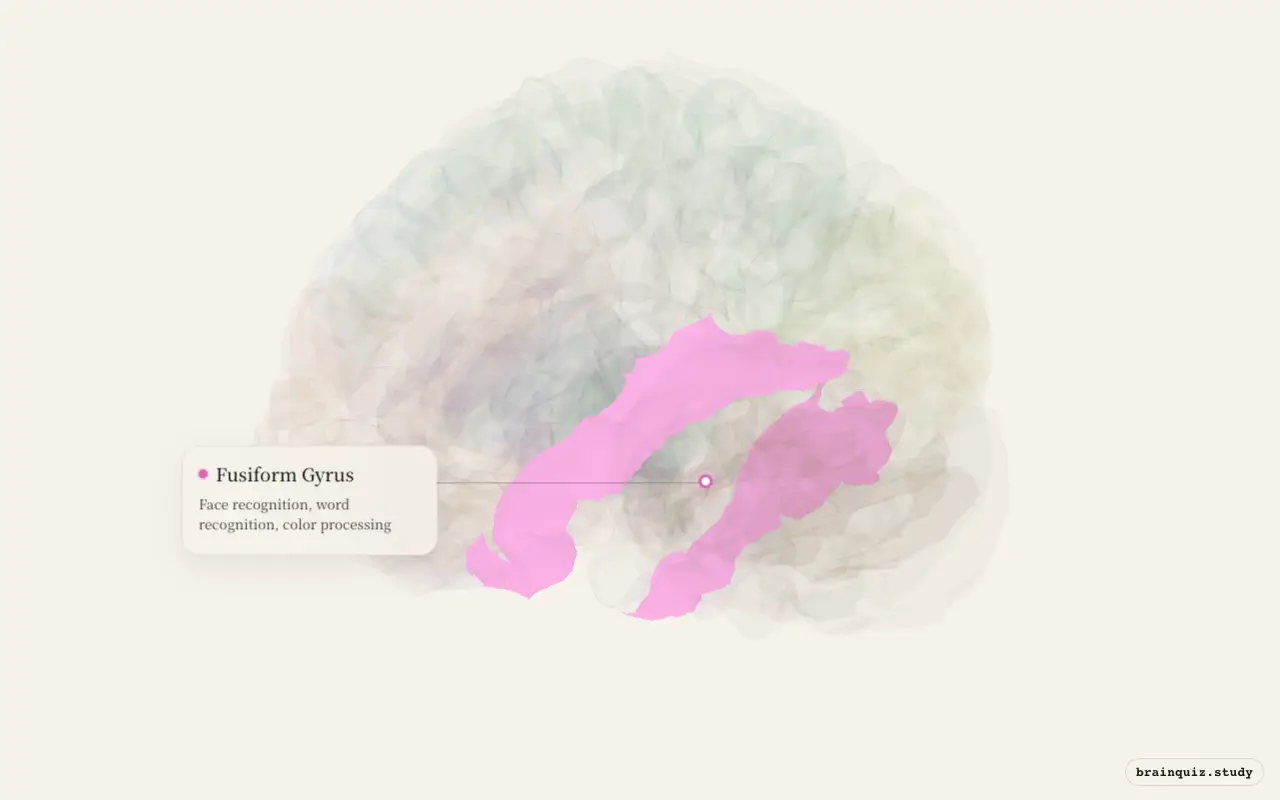
Where is the Fusiform Gyrus located?
Face recognition, word recognition, color processing.
What does the Fusiform Gyrus do?
- Face perception and identity recognition
- Expert-level visual categorization (cars for experts, birds for birders)
- Visual word form processing (left fusiform — VWFA)
- Fine-grained within-category discrimination
Fusiform Gyrus pathways and connections
- V1 → V2 → V4 → Fusiform (ventral stream)
- Fusiform → Amygdala (emotional face processing)
- Fusiform → Superior temporal sulcus (dynamic face features — gaze, expression)
What happens when the Fusiform Gyrus is damaged?
- Prosopagnosia — inability to recognize faces (can be acquired or congenital)
- Patient DF (Goodale & Milner) — ventral stream damage but preserved dorsal stream
- Left fusiform damage → pure alexia (can't read but can write)
Fusiform Gyrus key facts
Atlas category: cortical. Brodmann areas or landmark: BA 37 (fusiform face area — FFA).
- Kanwisher et al. (1997): FFA responds more to faces than any other category
- Debate: face-specific module vs. expertise hypothesis (Gauthier: Greebles)
- FFA shows N170 ERP component — peaks ~170ms after face onset
- Autistic individuals show reduced FFA activation for faces
Fusiform Gyrus exam tip
FFA = faces. PPA (parahippocampal place area) = scenes. VWFA = words. These are the 'big three' category-selective areas.
Common questions
What does the fusiform gyrus do?
It supports fine visual discrimination, especially face identity and expert-level category recognition. Left fusiform cortex also contributes to rapid visual word-form processing.
What is the fusiform face area?
It is a region in fusiform cortex, commonly associated with Brodmann area 37, that responds more strongly to faces than to many other visual categories.
What is prosopagnosia?
Prosopagnosia is impaired recognition of familiar faces despite adequate basic vision. It can follow ventral occipitotemporal injury or occur developmentally.
When does the Fusiform Gyrus light up?
- 📱 When you scroll social media: The fusiform gyrus identifies familiar faces, words, and meaningful objects in the feed.
- 📖 When you read a book: The fusiform gyrus recognizes entire words as visual patterns.
- 🧠 When you study with flashcards: The fusiform gyrus recognizes the written word as a familiar visual form.
- 💭 When you try to remember a face: The fusiform gyrus rebuilds the facial features into a coherent image.
- 👀 When you look at a face: The fusiform gyrus matches the pattern to stored face templates.
- 👁️ When you see colours: The fusiform gyrus integrates colour with object and face recognition.
- 🤝 When you meet someone new: The fusiform gyrus specializes in recognizing faces, turning visual input into a known or novel face.
- 👀 When you make eye contact: The fusiform gyrus integrates features to recognize the face and locate the eyes.