What happens in your brain when you meet someone new?
Updated
Seeing a new face activates your visual cortex and fusiform gyrus for recognition. Your amygdala makes a snap judgment, the prefrontal cortex evaluates social cues, and the nucleus accumbens signals reward if you like them.
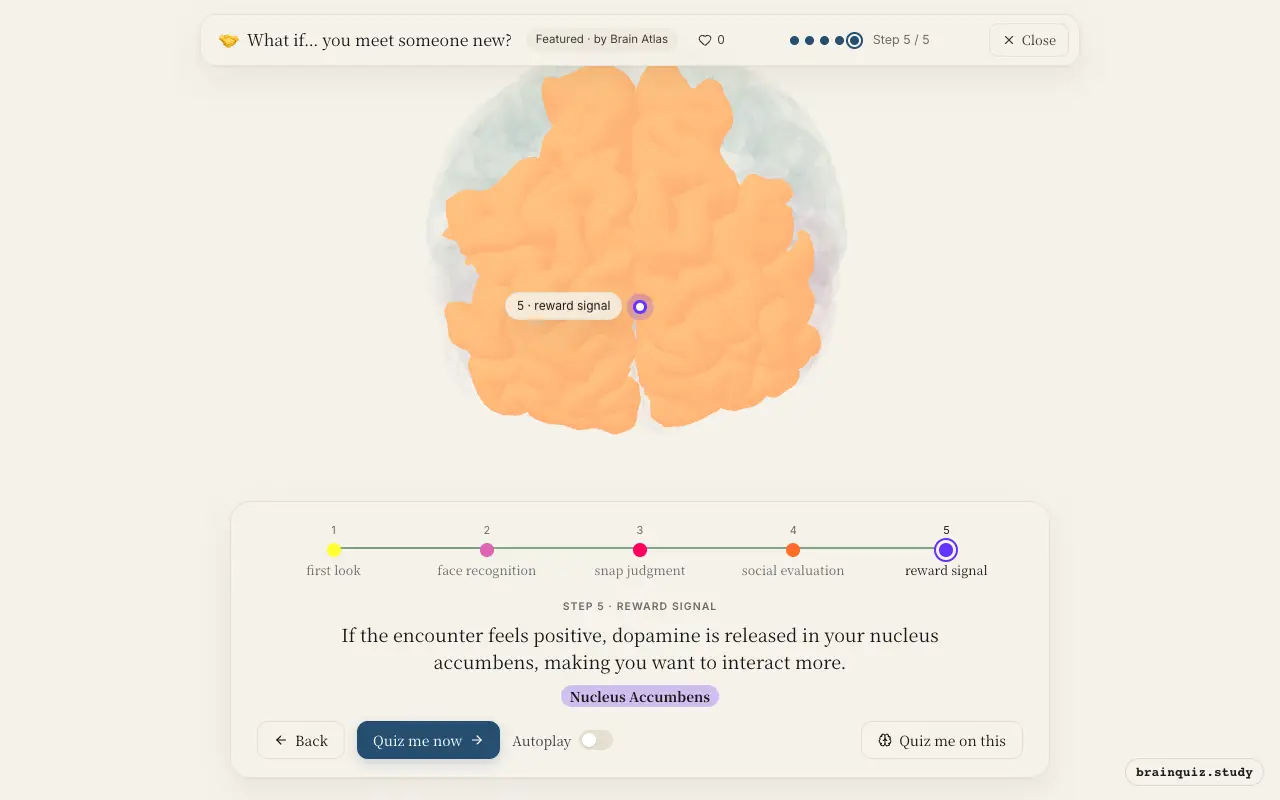
Watch it light up on the 3D brain
Brain regions that light up
| Order | Region | What it does here |
|---|---|---|
| 1 | Visual Cortex | Your visual cortex processes the basic features of the new person's face and body. |
| 2 | Fusiform Gyrus | The fusiform gyrus specializes in recognizing faces, turning visual input into a known or novel face. |
| 3 | Amygdala | Your amygdala rapidly assesses the person for threat or trustworthiness, before conscious thought. |
| 4 | Prefrontal Cortex | The prefrontal cortex deliberates: it draws on memory and social norms to form a considered impression. |
| 5 | Nucleus Accumbens | If the encounter feels positive, dopamine is released in your nucleus accumbens, making you want to interact more. |
1. Visual Cortex: first look
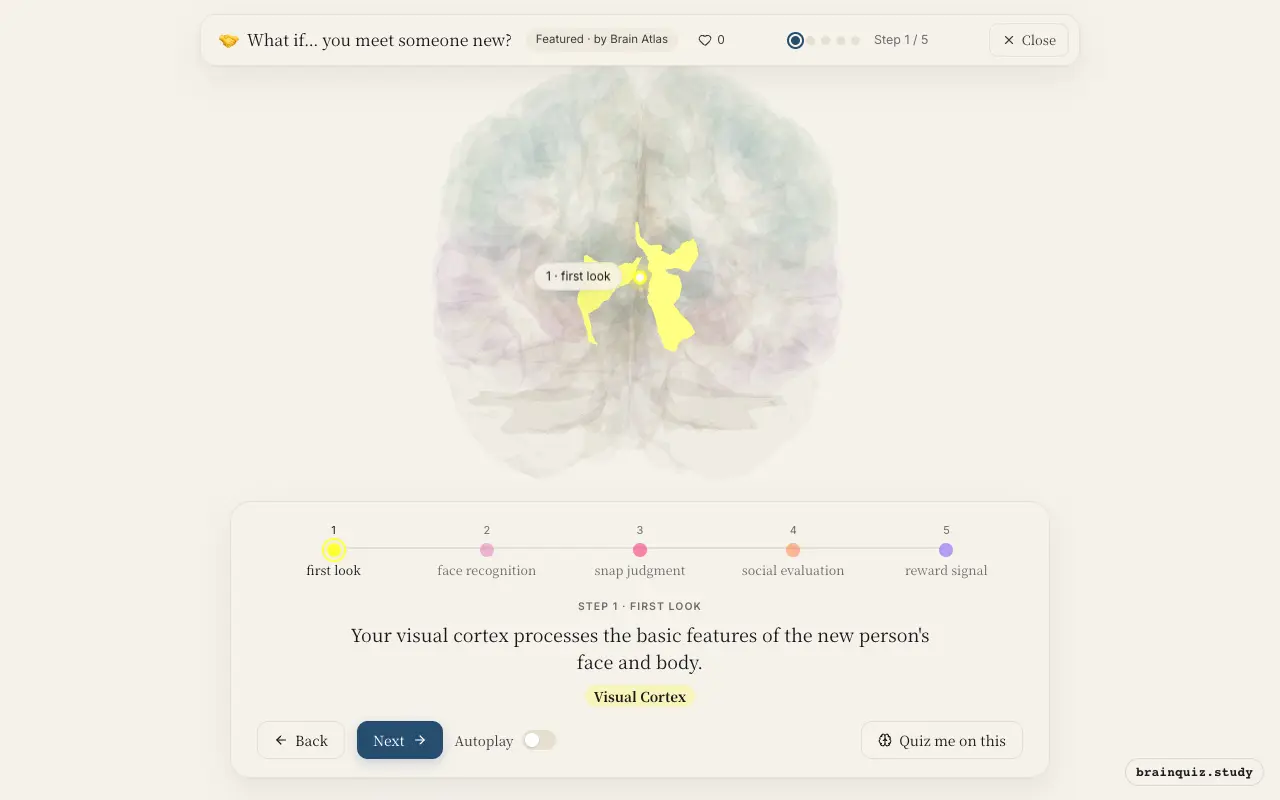
The visual cortex, at the back of the brain, extracts edges, shapes, and motion from the incoming light. It builds a representation of the face as a pattern of visual features, which is then passed forward to higher visual areas for more specific processing.
2. Fusiform Gyrus: face recognition
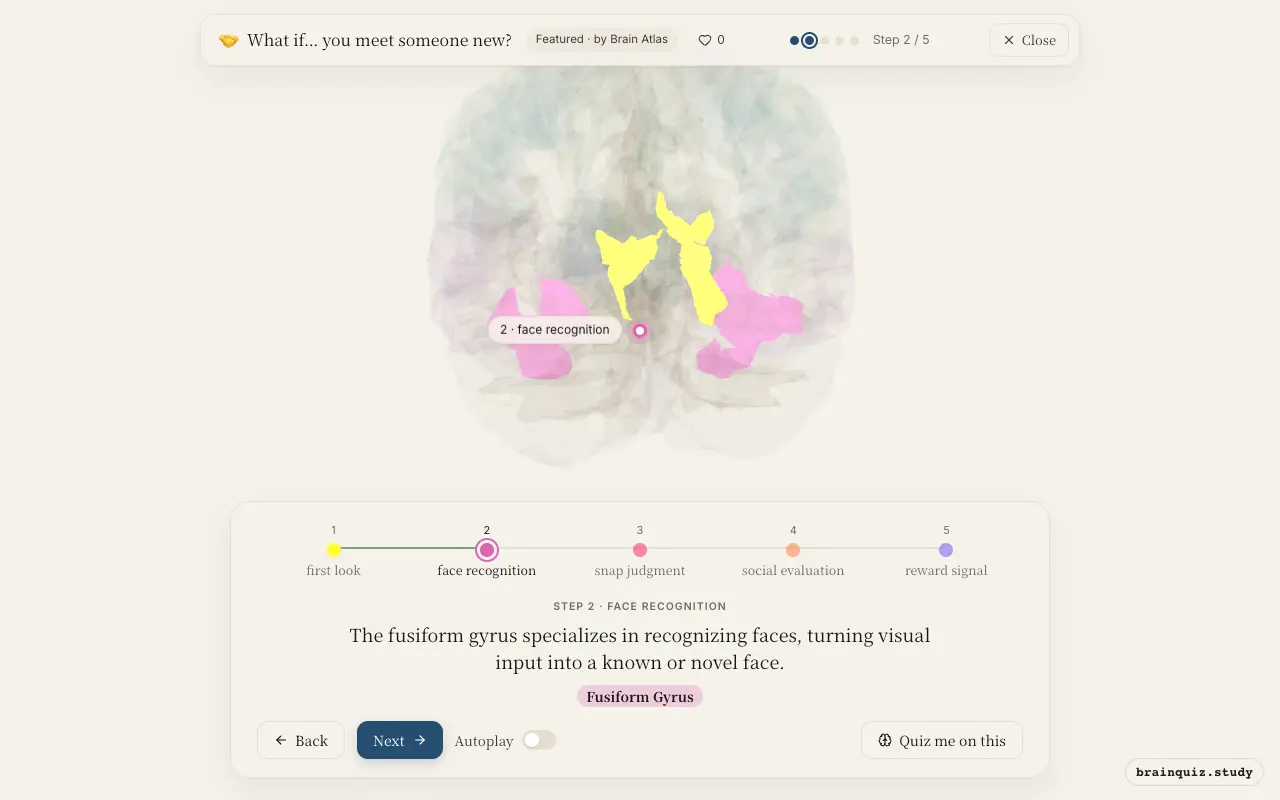
Located on the underside of the temporal lobe, the fusiform face area is crucial for perceiving facial identity. It integrates features like eyes, nose, and mouth into a unique face, and damage to this region can cause prosopagnosia, the inability to recognize faces.
3. Amygdala: snap judgment
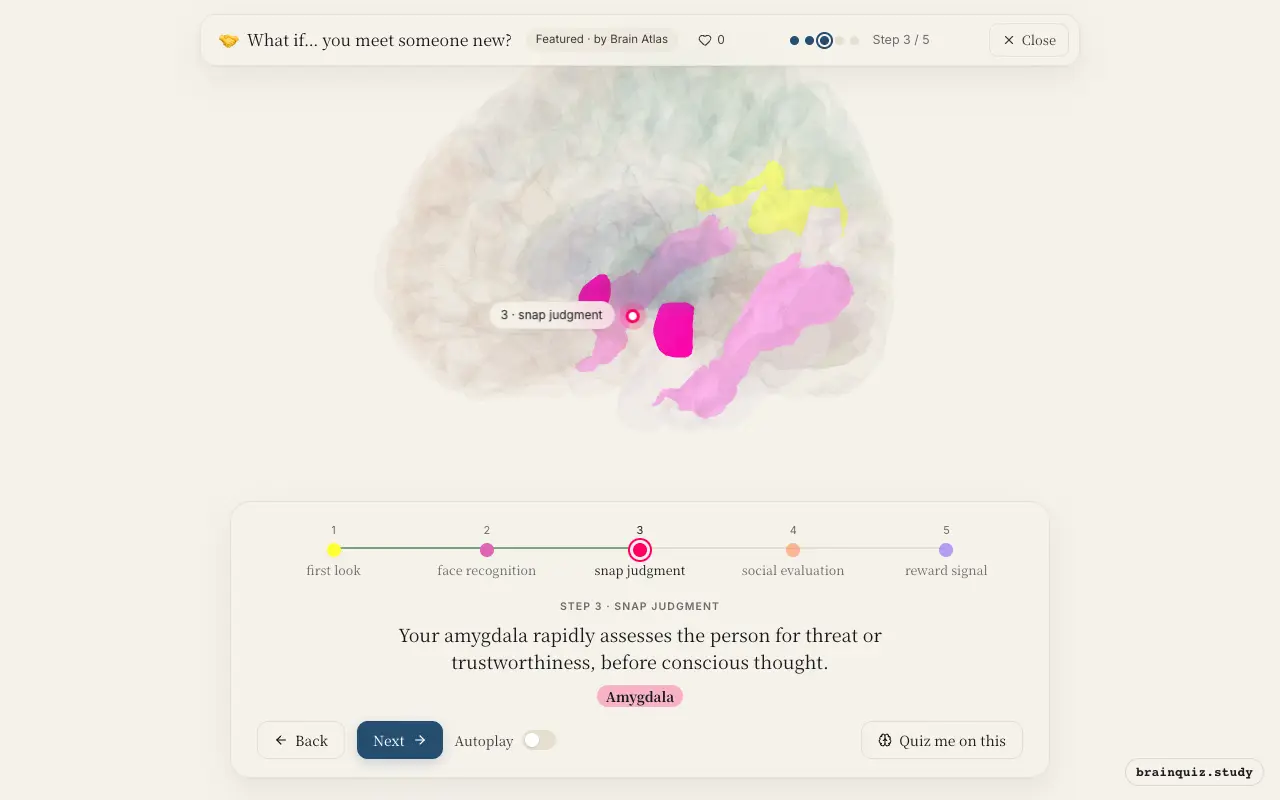
The amygdala, deep in the temporal lobe, evaluates emotional significance and social cues such as facial expression, eye gaze, and body posture. It can trigger a fast, unconscious response that prepares the body to approach or avoid the new person.
4. Prefrontal Cortex: social evaluation
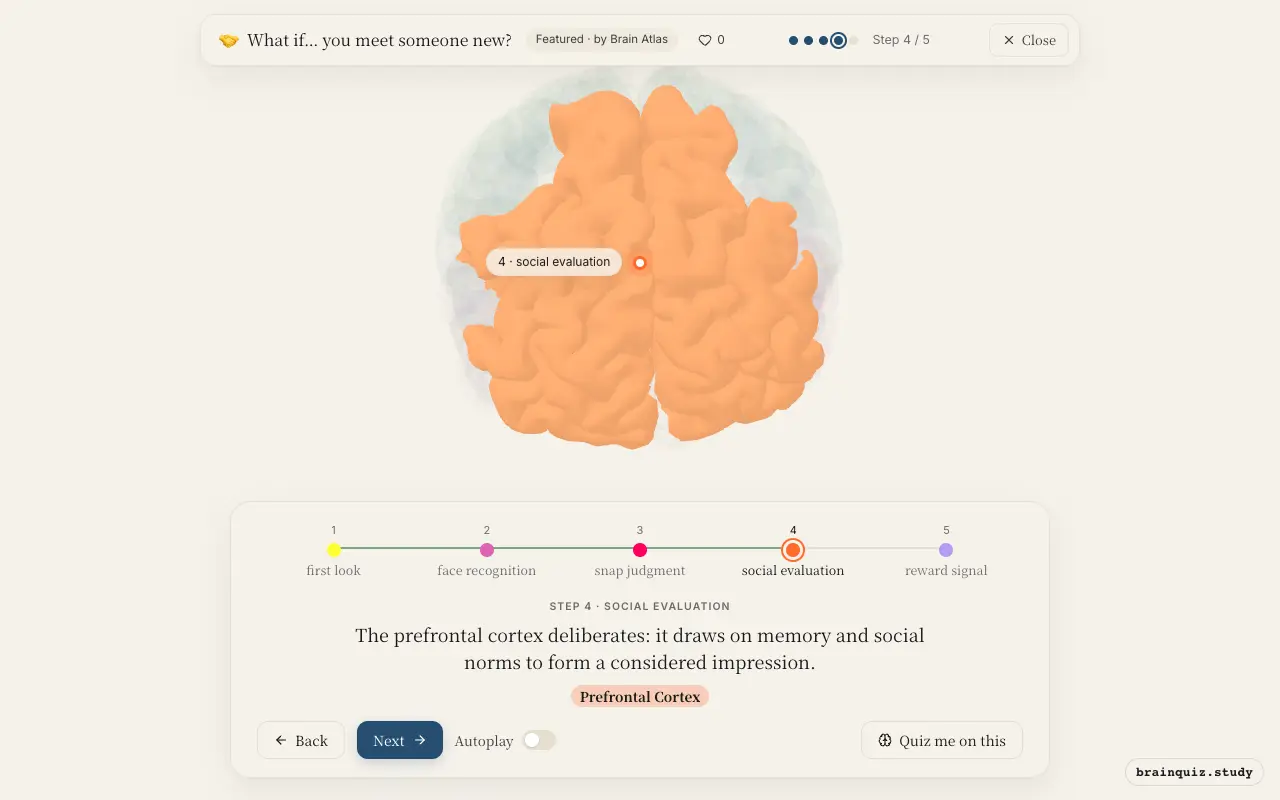
The prefrontal cortex, especially its medial and dorsolateral parts, supports theory of mind—understanding the other person's thoughts and intentions. It integrates information from memory and emotion to judge personality, trustworthiness, and suitability for social interaction. This region is also involved in decision making about how to respond socially.
5. Nucleus Accumbens: reward signal
The nucleus accumbens is a key part of the brain's reward circuit, receiving dopamine from the ventral tegmental area. Activation here signals pleasure and motivation, promoting social approach and the desire to continue the interaction. If the meeting is unpleasant, this area is less active.
Good to know
- First impressions are formed almost instantly, driven by rapid amygdala responses to facial features.
- The fusiform gyrus also responds to non-face objects, but faces elicit the strongest activation.
- Meeting someone new activates the hippocampus, helping encode a memory of the person for future recognition.
Meeting someone new vs seeing a familiar friend
Meeting a new person triggers more amygdala and prefrontal cortex activity as you assess unknown threat and form an impression. Seeing a familiar friend activates memory regions like the hippocampus and often stronger reward responses from past positive interactions.
Test yourself
Which brain region is most specialized for recognizing faces?
What role does the amygdala play when you first meet someone?
Which neurotransmitter is associated with reward when you like the new person?
0 of 3 answered · 0 correct
Simplified: many regions work together at once, and this shows the main players in the order they act.